Fuel Injection
ROGER HUNTINGTON, who lives in Lansing, Michigan, has written extensively for motoring publications in this country and England.
by ROGER HUNTINGTON
IT’S very frustrating for an engineer to have to live for years with a functionally inferior device just because the right way to do the job costs too much money.
A perfect example is the carburetor on the family car. Here is a component with an extremely exacting assignment to fill — a marvel in practical, bread-and-butter engineering, but a technical blind alley as far as the designer is concerned. Look at the basis of the problem. The liquid gasoline used for power in an internalcombustion engine must be mixed with a certain proportion of air in order to burn in the cylinders. Is it logical to mix the gasoline and air in a separate device outside the cylinders and feed it to them through a tortuous network of tubes? This is the situation with a carburetor.
There are a number of inherent disadvantages in this layout that cannot be resolved. For one thing, it is impossible to get equal proportions of fuel and air to every cylinder of an engine. Air turbulence in the manifold tubes, gravity and centrifugal forces in the high-velocity air flow, tend to separate the heavier droplets of gas from the air, feeding some cylinders overrichly and starving others.
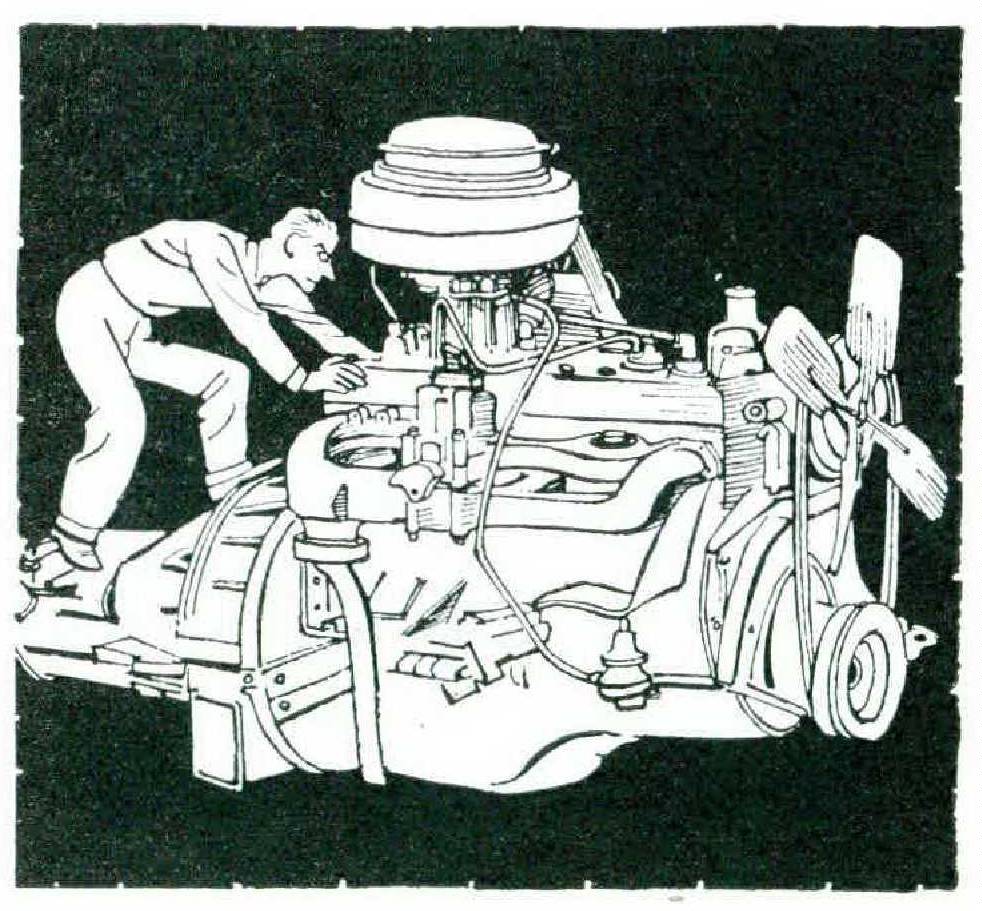
The point is, too “lean” a fuel-air mixture in any one cylinder will cause it to knock (detonate or preignite), burn valves, and misfire — in that order. So the carburetor designer must adjust his instrument to meter a sufficiently rich over-all mixture to keep the leanest cylinder out of trouble.
There are other difficulties. When the designer puts heat on the manifold to vaporize the liquid gasoline droplets and improve the mixture distribution, the power drops off and the engine may start knocking badly. One final indignity: in order to assure decent throttle response when the gasoline and air are mixed away from the cylinders, the carburetor must incorporate some device that literally floods the manifold with raw gas when the driver punches the accelerator pedal hard.
What is the ideal method for feeding fuel to an automobile engine? The faults of the carburetor can answer that: inject the gasoline directly into each cylinder (or into the port passage leading to the cylinder just above the inlet valve) and draw only pure air on the suction stroke. This, in a nutshell, is the principle of “fuel injcrtion.” The mothod is actually |being used on several small German economy ears, and fuel injection is the real reason behind the performance of the new 160 m.p.h. Mercedes-Benz 300 SL sports car. With the aid of direct fuel feed to the six cylinders, 240 horsepower is developed on fillmgstation gas from an engine about the size of a Nash Rambler’s. Other Mercedes-Benz models are scheduled to use fuel inject ion in the near future; in fact, I he idea is catching on in engineering departments all over Europe.
Providing a separate fuel feed for each cylinder wipes out the disadvantages of conventional carburotion in one stroke. The fuel-air mixture proportions can be precisely cont rolled and perfectly distributed. This alone is worth two or three miles per gallon over present mileages with overrich carburetor settings. The engine gets more work out of every drop of gas. Furthermore, if engineers take full advantage of the close fuel feed control offered by fuel injection, new combustion chamber designs are possible that will allow higher compression (for more efficiency) without need for expensive super-octane gasolines. Even with present engines and fuels the “breathing" restriction caused by manifold heaters and carburetor passages would be eliminated — which would add some 10 per cent to the power without other changes.
There’s certainly nothing new about the method. Dr. Rudolf Diesel injected fuel directly on his “compression-ignition" engine before the turn of the century; fuel ignition is the very basis of the diesel theory. There were crude attempts to adapt it on spark-ignition gasoline engines as long ago as 1907, and many successful applications of it have been developed since. Hitler’s Luft waffe standardized fuel injection on all combat planes in the mid-thirties, and it is widely used in commercial aviation today.
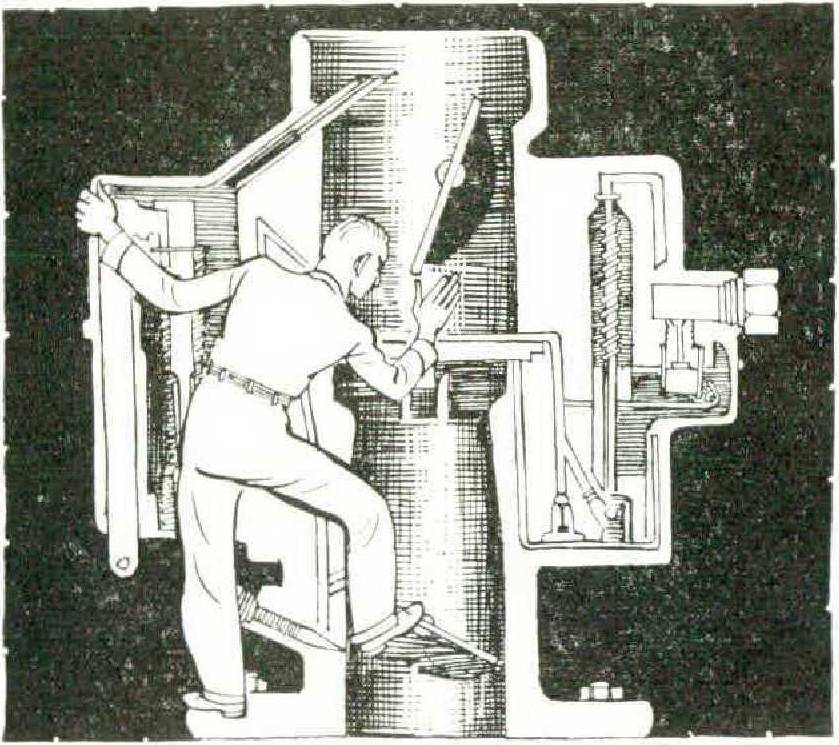
But as is so often the case with a technical improvement the drawback that keeps it from more ordinary use is cost. The little pump needed to inject the liny shots of fuel into each cylinder on each intake stroke tends to be complicated and expensive. One injection may be only one onethousandth of a cubic inch, and there may be over 200 of them required per second. An added problem is the control unit for the pump, which is necessary to give just the right amount of fuel feed in aceordanee with the amount of pure air going to the cylinders. This means more cost and complication. There are many parts, ultraclose-tolerance machining is required, and assembly is complicated. Injection pumps on diesel truck engines today cost around $400 at retail. Mass production could bring this down, hut not enough, and the automobile industry men estimate a really practical find injection pump should not cost much more than a big fourbarrel carburetor, perhaps under $100.
Detroil’s current “ horsepower race” is stirring a new interest in fuel injection, and engineers are searching for every means of getting more power and torque without cutting into economy too seriously. Fuel injection is a logical step. But the obstacle has been the development of a practical, economical pump design. The pumps on most diesel truck engines for the last twenty years, using a separate plunger unit for each cylinder to inject the fuel, are out of the question in point of cost. But after several years of diligent research, the pump manufacturers have achieved a basic design that can make fuel injection practical for ordinary passenger cars.
The new pumps use only one plunger unit — making six or eight times as many strokes per minute — with a rotating “distributor head” to route each measured shot of fuel to the proper cylinder through a metal tube. The principle is much like an ignition distributor, with the injection nozzles replacing the spark plugs, and with tubes instead of wires. The unit is simple, rugged, has fewer parts, and can be mass-produced at a cost competitive wdth a four-barrel carburetor. Simplified mixlure control units have also been developed, and are even now undergoing extensive road tests in all sections of the country.
Fuel injection is coming on the American family car as surely as the sixty-year-old piston engine itself will someday give way to the simple gas turbine.