Our Peruvian Turkey
FLORENCE P. HODGSON is the wife of a doctor on the staff of the Mayo Clinic. This is her first appearance in the Atlantic.
by FLORENCE P. HODGSON
WE ONCE knew, briefly but all too well, a Peruvian turkey called ElPavote. This means Super Turkey. And he was. He ruled our large household — men, boys, mistress, and servants— for more than two weeks. This is the story of that rule and how we finally overpowered him and ate him for Christmas dinner.
It happened our first year in Peru. We wanted a traditional Christmas turkey, and Delfina, our cook, was alerted early in November. A huge zamba of sixty years and a hundred sagging kilos, Delfina was untidy, autocratic, and an accomplished liar. But she cooked like an angel — most of the time. Even when she didn’t we remembered her chupe de camerones and were content. In the matter of the Christmas turkey she seemed both evasive and pessimistic. Ay! How much of time and experience was needed to find such a bird, she said. But with paciencia and buena suerte we would see.
So we practiced patience for a week ■— to no avail. Then I thought one fine morning that good luck had taken over. For what should come strolling down the Malecón Figueredo but an enchanting man with organ-grinder mustachios, driving five magnificent white turkeys before him. He was vending them in a rolling yodel and collecting children in a Pied Piper’s queue.
Immense turkeys! Handsome turkeys!
Super turkeys!
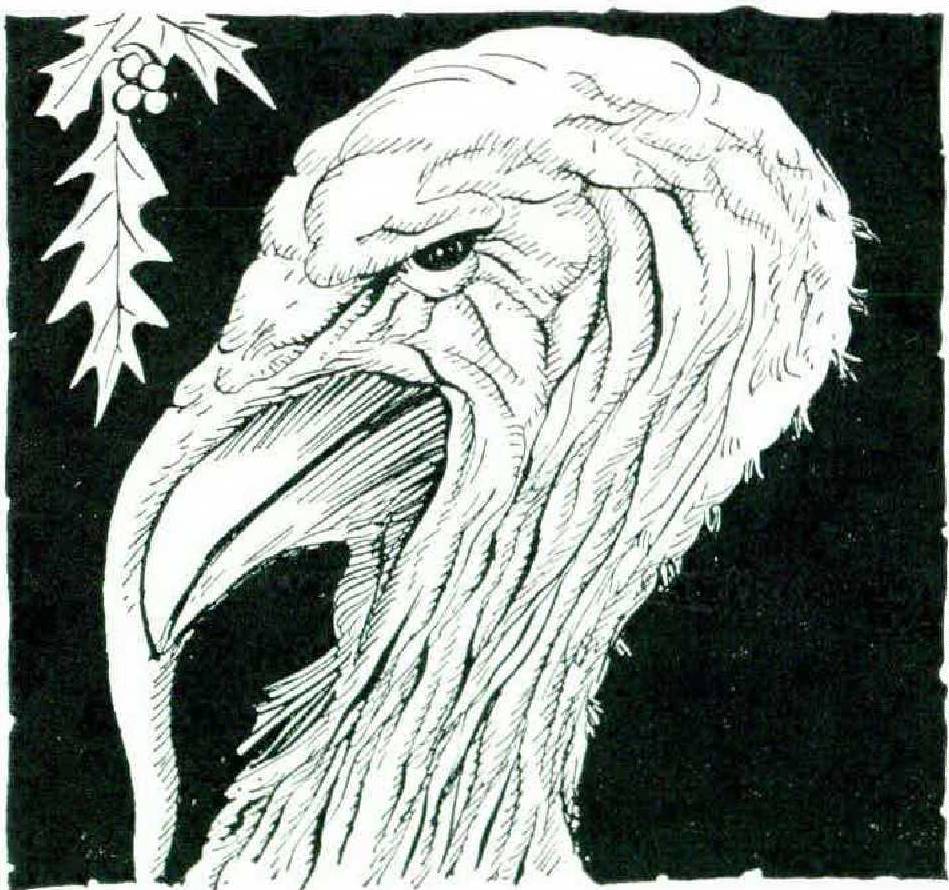
Beautiful señoritas!
Lean — look — and buy!”
And lean we all did, all of us beautiful, too — at least for that magic moment — while the children danced to the yodeler’s tune and the great birds paced in the summer sun. The man was so dashing, so straight out of Italian opera, that I longed to bargain with him myself. But I knew my gringo limitations and sent for Delfina, She eyed my open purse as though she had caught me with a tinderbox in a haystack, closed it firmly, and adjusted the masses of her bulk against the window sill. It appeared that she and Mustachio were old friends.
“And is business good, then, Humberto?” she asked after considerable chat.
“But excellent!” he assured her. “Imagine! This morning alone I have promised turkeys to a dozen of my best customers, and only God knows where I can buy them — unless you know, Señora Delfina ?”
“Try Pancho Roca,” Delfina suggested indifferently. “He has a few poor things that might be fattened.” Her eyes admired the turkeys. “Tell me again what you call your beautiful samples.”
Fondly Humberto pointed to each bird in turn. “Rosita, Christina, Josefina, Catalina, and Betty Grable,” he said. “But growing old, alas! For five years now we have walked the streets of Lima together, selling turkeys to all the most distinguished señoras. Now, pobrecitas, they grow stiff of leg. Where shall I find another troupe so docile, so well matched? Ay-ay! the pity of old age, not?”
As he moved away, Delfina struggled to her feet and sighed. “Poor Humberto! Our samples wear out and then how can we sell our goods? As for our turkey, Señorita, you can see it is still a matter of paciencia and buena suerte.” She went out with the air of a general not yet ready to reveal a major strategy.
Delfina let my impatience ripen two more days, then sought me out. Her speech had been prepared beforehand, as indeed had her smile, donned at the last moment and involving everything but her eyes. These remained as canny and watchful as an old turtle’s.
“I bring you good news of the turkey, Señorita,” she began. “I have a pet — El Pavote I call him — a turkey of magnificence. Big, young, tender, raised by my own hand. He sleeps in my room, feeds from my plate, and is just now ready to eat. I had thought to have a feast on my Saint’s Day— but no matter! He is yours, Señorita! A gift!”
Green though I was, I did know about this gift business. Delfina simply meant that a turkey — probably bought in the market that morning — was mine for a price. Just how high that figure could be pushed she still had to determine. While her sharp old turtle’s eyes worked my face over for a price mark, we exchanged the compliments and pretty insincerities by which these people do business. The figure she gave me at the end of this routine was delicately balanced between exorbitance and the going rate. the kitchen with all the temperament of a true Latin, leaving behind me admiration and silence.
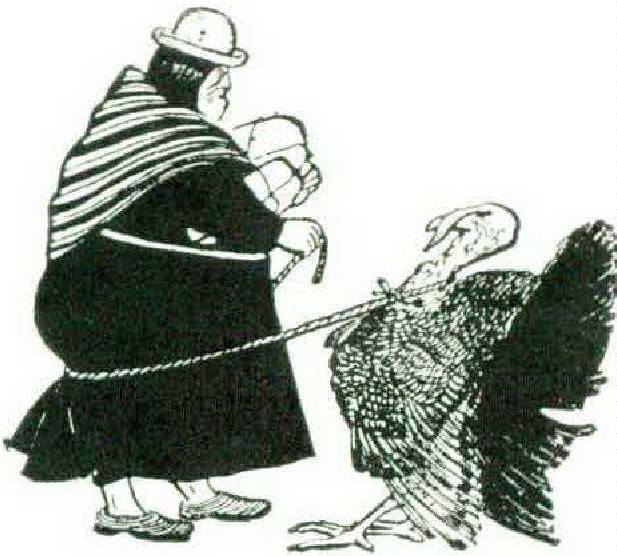
The trolley ran past the back of our property and Delfina had long ago bullied the motorman into making a special stop for her each morning. One day in December I saw her arrive. She descended from the back platform loaded with market bags, but in a hunched-over position, buttocks first. The other passengers were laughing and shouting advice as she tried to coax a great brown turkey down the steps on a length of cord. A magnificent creature, but balky. First he refused to budge; then, as the motorman swore loudly on his bell, he took off with a great flapping of wings straight into Delfina’s face. The doughty old girl stood her ground, clutching her packages and the cord. El Pavote flopped to the end of his leash, reversed himself, and wound his tether tightly about Delfina and her bags. The trolley clanged off, leaving the furious old woman all trussed up with her bags and her crazy bird there in the midst of traffic.
She at once began to bellow lustily for Felix, our young mayordomo, and there was an answering clamor all through the house as he, laundress, nurse, and children all slammed out of various doors to the rescue.
For the next fortnight the voice of the turkey was loud in our lives. Delfina insisted that El Pavote be given his freedom a part of each day, and he strutted in and out of the other servants’ rooms surrounding the patio at will. He mounted the outside staircase, perched on the sill of my husband’s bathroom window, and unnerved him as he shaved. lie even followed Delfina into the kitchen one day, and everywhere he went he left tremendous droppings and a feather or two.
The cook regarded his health and welfare as her first duty, was deaf to the increasing complaints from all sides. Every day she took him squawking into her arms, wrestled him to submission, and forced exactly twenty-six walnut meats into his beak. Then she massaged his long neck to get them down. Wonderful for the white meat, she said. Sometimes in the late afternoon the old woman and the handsome bird both sought the shade of the scraggly palm, Delfina cooling her feet and El Pavote looking sulky and pecking testily at all passers-by.
At last only two days remained before Christmas. The kitchen smelled wonderfully of the mincemeat I had come down to taste and stir. Felix polished silver. Jesus, the laundress, ironed the best napkins (looking, in the last month of her pregnancy, like a smooth brown Madonna). Delfina shelled peas and guessed the weight of El Pavote, while he, full of arrogance and walnut meats, watched from the outside sill of a high window.
Delfina arose and rattled the peas into a pot on the drainboard. Startled or greedy, the turkey beat his wings, pushed in the screen, and — barely missing my terrified head — swooped down over the mincemeat, made a squawking turnover Jesus, and flapped to a bad landing in the sink. The air was full of feathers and dust. Jesus was hysterical, crying that her unborn child would surely be marked. Felix forgot my presence and swore loudly at Delfina. She swore back — twice as loudly and in Quechua. The turkey skidded about in the sink and ate peas from the pot. There was only one thing to do and I did it. I threw a handy egg splatt! onto the kitchen floor. (Nothing quells a kitchen riot like a well-thrown egg, the old-time gringos had assured me. And they were right.) I stalked from
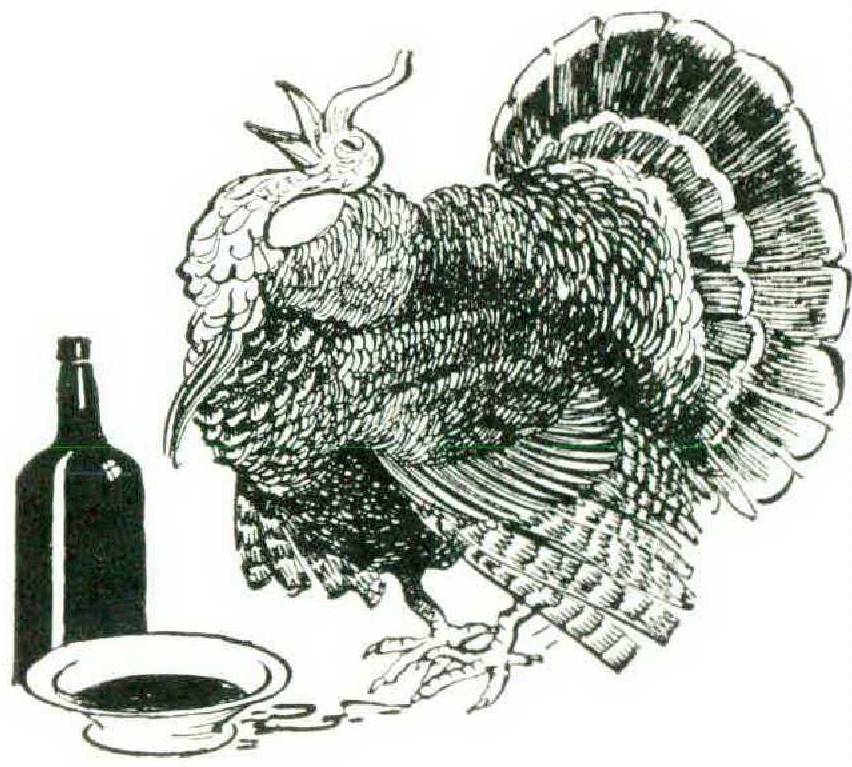
Late that afternoon I was respectfully summoned to the dispensa to unlock the wine cupboard and issue a portion of pisco for El Pavote. Not only was this a nice gesture toward the condemned, they explained, but also intoxication would draw all the blood from the white meat to the head. I had never seen a drunken turkey, so I stayed awhile. The last I saw of El Pavote he had the real blind staggers, and Delfina was calmly preparing to do her duty.
I felt that the cook should be complimented upon her Christmas dinner. The turkey had come to the table brown and delicious — looking remarkably chic, too. Lace paper frills adorned the legs, and the head (considered a great delicacy in these latitudes) was tucked neatly beneath one wing. I went to look for Delfina full of well-practiced Spanish superlatives.
She sat beneath her palm, her feet freed from her Sunday shoes, a plate of well-picked bones about mid-slope of her lap. The children squatted beside her, listening intently.
“... deep in a cave below the ground is where the mother rabbit has her babies,” she was saying. Her face wore an expression that I recognized with alarm. She patted the hard earth beside her. “For example, in this patio a rabbit would dig her cave beneath this tree. Then we would see them come forth one day, like a little holyday procession — tiny, perfect, white as little angels.” The children shivered with delight, and Delfina paused dramatically. “If your mama would permit — I have a pet. El Conejote, he is called. Sooper Rahbeet, no? He and his little wife live in my room in Callao, eat from my plate, and have pink eyes. But you may have them, Señoritos! A gift!”
I turned to tiptoe away. Tomorrow, yes, tomorrow, I would think of some way to stop this gift racket. But now, in the light from the children’s faces —and knowing our Delfina — my mind’s eye could see very plainly an endless procession of baby rabbits, perfect, white as little angels, issuing from the roots of the old palm tree.