New Books for Children
MARGARET FORD KIERAN was Children’a Page Editor of the Ponton Herald for twentythree gears. She is the author of a juvenile entitled David and the Magic Powder.

by MARGARET FORD KIERAN
WHEN I was editing the Children’s Page for the Boston Herald I was constantly surprised to find that many of two million or more young readers I’d accumulated over the years had to be coaxed to read fiction. This was a shock to me because my youth had been spent in a daydreamy way, going over The Green Fairy Book, The Yellow Fairy Book, the “Oz” books, and even what I thought was that rather silly grownups’ story called Alice in Wonderland.
At the Library the lady who sat on a platform and stamped my worn card was most understanding. “You’ll like this,” she would say, “there’s not a bit of truth in it. It’s all makebelieve.”
The years go by and today small boys with eyeglasses can scarcely be lured away from books on A-bombs, books on mineral collections, and books on the breeding of hamsters. Small girls are equally engrossed in books that tell what Girl Scout, founder Juliette Low was really like, how Florence Nightingale started her career of nursing, and what subjects they might have to take in order to become dietitians.
To say that a book is for a tenyear-old or a twelve-year-old or a sixteen-year-old is a tricky business and something that I do reluctantly. You see, by a curious sociological phenomenon every parent has a child who is just a bit brighter than the average. Every parent, mind you.
So, when I point out that such and such would be suitable for a twelveyear-old, I realize fully that the twelve-year-old for whom yon are buying it is way above the average. My only suggestion is, then, that you will remember this and will get a book your child will have to strive to understand rather than one he dismisses haughtily as “kid stuff.”
In the harvest of fall books over a hundred of which the postman, now round-shouldered from their weight, has delivered to my door, there is one that handles the fact-versus-fiction element charmingly. It was done by Lois Lenski and she calls it Prairie School (Lippiucott, $2.75) because that is what it is about.
The school in South Dakota she writes of is now deserted, and cold winds will whistle through its walls this winter. As fate as 1950. though, it was used, and it was then that Miss Lenski visited it by jeep through blinding snow. The year before that she had received a letter from the teacher which convinced her this story should be told. “Since the severe blizzard the first week in January,” the letter said, “the children have had to walk as much as two or three miles because no horse, car, or truck can get through the drifts. Today it is twenty-five below.”
For people who live in cities or even in country towns where the school bus promptly picks up mitlened youngsters by t heir mailboxes, it is hard to imagine the almost Abe Lincoln primitiveness in this saga of contemporary education. The book gave me a thrill and I am inclined to think it might be a good thing to have around the house for those under-twelves who have to he bribed with television to do their homework and threatened with its withdrawal if they don’t get a hustle on, school mornings. When they ask, “Did those kids really get frostbitten trying to make a geography class on time?" you can look them steadily in the eye and answer, “Yes. And it happened in the United States last year. And it’s just as true as an A-bomb.”
FOR THE TEEN-AGE BOY
The blizzard reminds me of another new book I liked, Everyday Weather and How It Works by Herman Schneider (Whiltlesey House, $2.75). This will hold a position analogous to that of the toy locomotive at Christmas, I imagine. The boy for whom it is purchased will be lucky to get a peek over the shoulder once Father becomes enamored of the experiments showingwhy land heats faster than water or why a dip in the ocean is warmer by night than by day. And as for the chapter on “building Your Own Weather Station,” the makers of newspaper maps on this subject had better look to their laurels.
I have only one slight misgiving that tempers my enthusiasm for this book. I cower at the thought of Mother’s expression when Junior assembles the materials needed for the homemade weather station. Ready? They are (and of course the kitchen table at meal preparation time is the only logical assembling place) an empty milk carton, a sewing needle, a broom straw, Scotch tape, a bit of nail polish or glue, a human hair at least nine inches long, four pins or thumbtacks, a sharp razor blade, a blank card, a paper clip, and a penny. Maybe, from now on, cook’s day out will be known as National Weather Station Assembly Day. But the book is realty top-notch and a great help to anyone who is planning a picnic, say.
So is another I will tell you about, once I explain how I solved the task of selecting certain books which seemed more compelling than others. Since, as I said, I looked at well over a hundred, it became apparent early in the postman’s visits that the job was too much for one person. So I engaged as helper a young man pushing thirteen who was living near me in Nantucket. It was understood that mine was to be the final word — that his talents would be pressed into service for only first, flash reactions. He nodded his understanding and, with great delicacy I thought, avoided any mention of remuneration, confining his remarks along this line, instead, to a simple “Boy, is this a honey of a book! Boy, if I had $2.50 I’d sure buy this one.”
I required no more prodding than that to make a straightforward arrangement with him which resulted in an extremely pleasant labormanagement relationship. Indeed my respect for his judgment grew so rapidly that 1 found myself quite set up when we agreed on the merits of a book.
Animal Tools by George F. Mason (Morrow, $2.00), for instance, drew a long whistle from Ronnie, my apprentice, and I liked it, too. “It’s the nuts,” he said. “Look, it shows the way frogs’ goggles start from the lower part of their eyes and it shows how the light comes from a firefly’s stomach.” It did indeed. It also had some pretty graphic descriptions and illustrations of how birds’ bills determine their eating habits, what mechanism is responsible for a mosquito’s maddening hum, and just how important a tail is to a monkey or a gopher or an opossum.
FOR TEN AND UNDER
Ronnie liked that book much better than A Ranch for Danny by Clyde Robert Bulla (Crowell, $2.50), and I could understand why, because the ranch story was rather youngish. But it is a good tale of two little boys who visited their Uncle Mack’s ranch wa-a-a-y out West. It lias everything idolaters of Hopalong Cassidy hold sacred: a pony that does tricks, a calf-roping sequence, and (but naturally) the news at the end of the book that Danny doesn’t have to go back to that old city after all. Daddy just buys the whole durned ranch.
Perhaps I was attracted to A Child’s Book of Sewing by Jane Chapman (Greenberg, $2.50) because I am constantly running into young women fresh out of college who are frantically enrolling in courses given by the Singer Sewing Machine people. With life so short it does seem that some of these skills could have been acquired in earlier years, and certainly this book is a pointer that marks the way. Large, clear diagrams and explicit text will show any little girl how to make a bookmark‚ a sewing kit, a beanbag, or a belt — and most important of all, perhaps, how to sew on buttons properly.
But Ronnie tossed this book aside contemptuously and he showed only little more respect for Steamboat South by Madye Lee Chastain (Harcourt, Brace, $2.50), which I enjoyed very much. The steamboat that is going South carries little Amy Travis who, way back when there was increasing talk of war between the states, went all by herself from Ohio to Texas. Ordinarily you would not think a simple steamboat trip could pack in so much flavorsome action, but perhaps books like Showboat have prepared us to expect entertaining reading when the setting is the Mississippi of long ago.
The story moves along with better characterizations than have most juveniles and with a thread of quiet humor that Amy, a rather sweetly precocious youngster, distills. There is an air of unhurried elegance in the tale, and I think little girls will enjoy Steamboat South and feel greatly relieved when Amy finds a home at last.
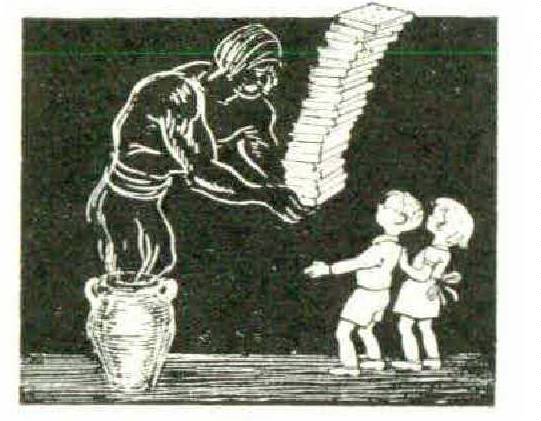
ANIMAL STORIES FOR TEEN-AGERS
What my apprentice liked about Luck of the Irish by Ruth Adams Knight (Doubleday, $2.50) I liked, too. First of all, it’s a good dog story with authentic details pertaining to dog training, obedience tests, show grooming, and so on. But beyond this there’s some pretty exciting stuff when the owner of the Irish setter Lady learns that his father’s plane in search of oil has been missing three days over Venezuela. Where you or I might phone or cable for further information, our hero, Steve Sullivan, is satisfied with no such shilly-shallying. He’s Johnny-on-thespot by plane himself, and his experiences in the Venezuelan jungle make his rescued father sum things up this way: “Take one part foolhardiness, one part fortitude, and one part faith and mix well. That’s the luck of the Irish.”
An incredibly beautiful book is Gypsy byKate Seredy (Viking, $3.00), who did the illustrations, too. Languorous tigerlike kittens and cats gaze from large black and white drawings. Especially memorable is the one which shows in a law of the jungle arrangement a stealthy cat watching an owl descend on a trembling mouse.
So I give you one dog and one cat book.
There were several horse stories too, but it was more difficult to single out one of these because so many were fine. Most of them, however, had the old familiar setting — the great open spaces — and that may be why Smoking Hoof by Gertrude Robinson (Oxford University Press, $2.50) stands out in my mind. She chose as a background the American Revolution instead of the plains, and the result is certainly sugar-coated history in the best sense.
Ronnie liked it. I could tell because, in the course of our reading, I devised a ruse that served as a gauge of a book’s spellbinding quality. A Hershey bar given to him would be devoured if the story had only moderate appeal. At the end of Smoking Hoof there was just a nibble gone from the milk chocolate on the table beside him. Yes, it’s a fine tale of Timothy Tucker who at Fort Ticonderoga helped guide a group of soldiers through the woods of Vermont and New Hampshire. From page I which describes the odor of sugar bread for General Gage’s supper, to page 220 where Timmy is assured that Captain Carr will shoot his I “Smoking Hoof” rather than have him suffer in battle, the book is 1 packed with action. I wouldn’t have dreamed of finishing the Hershey bar myself.
FOR TWELVE AND OVER
History is tapped again as a setting for another book that stands out in this fall’s crop. Mr. Brady’s Camera Boy by Frances Rogers (Lippincott, $2.75) does a wonderful job of re-creating Washington in the underground slave traffic days; and as for Mr. Brady, well I think every school child knows him as the forerunner of today’s camera fiend and as the man who made a lifework of his pictorial record of the Civil War. But this is essentially the story of his young apprentice, of the boy’s technique with head-clamp immobilizers, and of his adventures with runaway slaves. Fact and fiction again, and extremely well done.
Every year there’s bound to be one outrageously ridiculous book that some children look at with raised eyebrows and others clutch to their hearts like well-worn Teddy bears. This time it is McWhinney’s Jaunt by Robert Lawson (Little, Brown, $2.50). Maybe there’s a dash of Mary Poppins in McWhinney, but what of that? In all probability they are first, cousins once removed. Removed from the ground, that is, since the ground is something Professor McWhinney has spurned ever since he invented a Z-gas with which he fills his bicycle tires. Actually the invention was bred of his desire to embark on a trip in order to get away from Mrs. McWhinney, who, since she had taken up needlepoint, had become, in his opinion, a very great bore. Surely his was an understandable yearning, and the only impediment to his proposed trip was lack of money, a condition (he reports with Micawberlike placidity) not infrequent in his household. Some people might not believe all the things he says he did — things like soaring right over policemen’s heads at the base of the George Washington Bridge. But there is a drawing of him doing just that, so he must have.
FOR TWELVE AND UNDER
I remember reading Tree in the Trail by Holling Clancy Holling a few years back and being tremendously impressed by the device he used for presenting a panoramic view of the early Santa Fe trail and the country thereabouts. His new book, Minn of the Mississippi (Houghton Mifflin, $3.00), is a stunning addition to this unusual and distinguished series with Minn, the snapping turtle, moving slowly down the great river past ancient weapons and forgotten treasures. A turtle-eye view of the Mississippi may seem a little odd, but it is surprising how, through this method (with well-documented text and diagrams), you really get the feeling of centuries of growth in Midwestern America.
FOR TEN TO SIXTY
A quick change of pace from life in the slimy water came when I picked up The Kid Who Hatted 1.000 by Bob Allison and Frank Ernest Hill (Doubleday, $2.50). If there is any boy between, say, ten and — oh — sixty who doesn’t put his official O.K. on this baseball story, I think he must be a little strange, and frankly I prefer to have no part of him. Some of the dialogue is slightly reminiscent of Elmer the Great, and people who saw It Happens Every Spring may note a familiar ring, but the story itself has freshness and fast, authentic baseball jargon. My husband was chuckling through it when Bonnie, peeking over his shoulder, said, “Oooh, don’t turn over the pages so fast, Mister John. I want, to see if he calls the umpire a bum.”
And now I am aghast to find that the next book before me is Famous Paintings: An Introduction to Art for Young People by Alice Elizabeth Chase (Platt & Munk, $3.00). I am aghast because I don’t quite know how to make a transition from this baseball talk except by diving right in and saying that the book is delightful. It has been put together with a thoughtful consideration for child-appeal.
Instead of museum type of grouping by artists, by schools, or by century, for example, the plates are classified by subject matter: Horses, Storms at Sea, Children and Pets, Saints at Home, Man and Beast, Trains and Stations, Playing Games, and so on. Botticelli, Hogarth, Monet, Renoir, Turner, and Vermeer are among the fifty artists included, and the color reproductions of their paintings are excellent.
FOR GIRLS UNDER TWELVE
When I read Lisa and Lottie by Erich Kastner (Little, Brown, $2.50) I couldn’t understand why no one had thought of this novel twist for a twins book before. For these two little girls, separated because their parents are separated, meet unknown to each other at school. Then, unknown to their parents, they exchange places, one returning to the mother, the other to the father. If you can picture the possibilities for a complicated plot development, it will save me trying to unravel it for you here. I can easily understand why the book has already been translated into six languages. It has originality of idea and piquancy of style. Gay, but without even a dash of anything saccharine, it made me feel very happy—something Pollyanna never did.
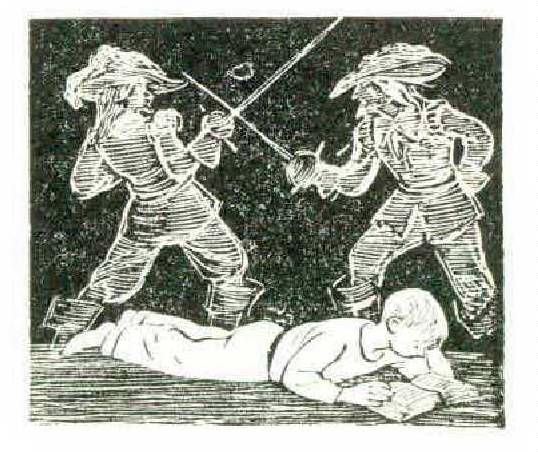
FOR OLDER BOYS AND GIRLS
In poignant contrast came Pong Choolie, You Rascal! by Lucy Herndon Crockett (Holt, $3.00). Pong Choolie is the name of a little Korean boy caught, bewildered, in the midst of the present mess there. First a fugitive from the South Koreans, who know that his father is a Communist, then callously used as a courier by the occupying Reds, he finally reaches sanct uary with a group of American soldiers who are touched by his confused plight. But this sanctuary is short-lived. The evacuating troops are just leaving the shore as he tries frantically and futilely to join them.
Serious-minded older boys and girls will be moved by this story. Ronnie started to read it but he said it had too many Chinese names and he was afraid it was going to be sad anyway.
It surely is. It surely is.
I turn to the books that remain with dismay, because I feel like a radio commentator who looks up at the clock and finds that the minutes will tick away before he has time to finish the notes he had made on other things he intended to mention.
Quickly then, I also enjoyed The Lest Kingdom by Chester Bryant (Messner, $2.50), a hair-raising account of two native boys’ experiences in crossing the Indian Green Jungle, and I found The Right Job for Judith by Enid Johnson (Messner, $2.50) a very pleasant account of how one teen-ager discovered what she wanted to do wilh her life. This years harvest has, too, a splendid array of books like La Salle and the Grand Enterprise by Jeannette Covert Nolan (Messner, $2.75), Lonely Crusader, a shortened biography of Florence Nightingale by Cecil Wooham-Smith (Whittlesey House, $2.75), and Mystery Mine by Kenneth L. Sinclair (Winston, $2.50).
A thoroughly satisfying series of books for ohler boys and girls is being published under the Random House Landmark imprint ($1.50 each). Of the most recent titles, I recommend Prehistoric Am erica by Anne Terry White, and The Explorations of Père Marquette by Jim Kjelgaard, a downright thrilling account of early Jesuit discoveries in the Midwest. The frightening shout of “Indians” hovers all through this tale, and it is truly inspiring, as is another in the series, The Vikings, by Elizabeth Janeway,
These, Ronnie explained to me, however, were not so much for kids. More like stuff my brother reads in high school,” he said, “but I guess they’re good books all right.”
I said I guessed ihey were, all right.