Eight-Day El Dorado
JOHN D. VOELKER was serving as prosecuting attorney of Marquette County, Michigan, until the election last fall. He is now practicing law in Ishpeming.
by JOHN D. VOELKER
ON the hot morning of June 1, 1949, Frank Russell, Rege Comer, and I were prospecting with Geiger counters near a trout stream southeast of Ishpeming, Michigan. The area lies near the heart of the Lake Superior iron range on the Upper Peninsula. We had gone there because I had recalled from previous fishing trips the unusually heavy dark red stain on the rock outcrops in that vicinity — a condition normally favorable to the presence of radioactive deposits.
Russell was a newspaperman, Comer a free-lance geologist, and I a mere middle-aged lawyer. About 11 A.M. we met at Comer’s jeep and sensibly had a cold beer. Russell moved and I seconded another of Comer’s cold beers. Motion carried — two to one.
Again we shouldered our Geiger counters and took off. Fighting deer flies and brush, I finally waded across the trout stream, ruefully observed a rising trout, and worked my way up a narrow, rocky valley which cut into a sheer rock cliff. There was plenty of dark red shun all about. My earphones were adjusted and my counter was turned on.
Gaining the top I stood panting, speculating on the ravages of time in general and the unfitness of lawyering as a prelude to prospecting in particular. I mopped the sweat off my face, batted a few more deer flies into oblivion, yearned for another beer, and leaned against a rocky ledge to rest. Wham went the needle on my counter, driving it off the dial. My earphones crackled so hard I had to whip them off. Just like popcorn.
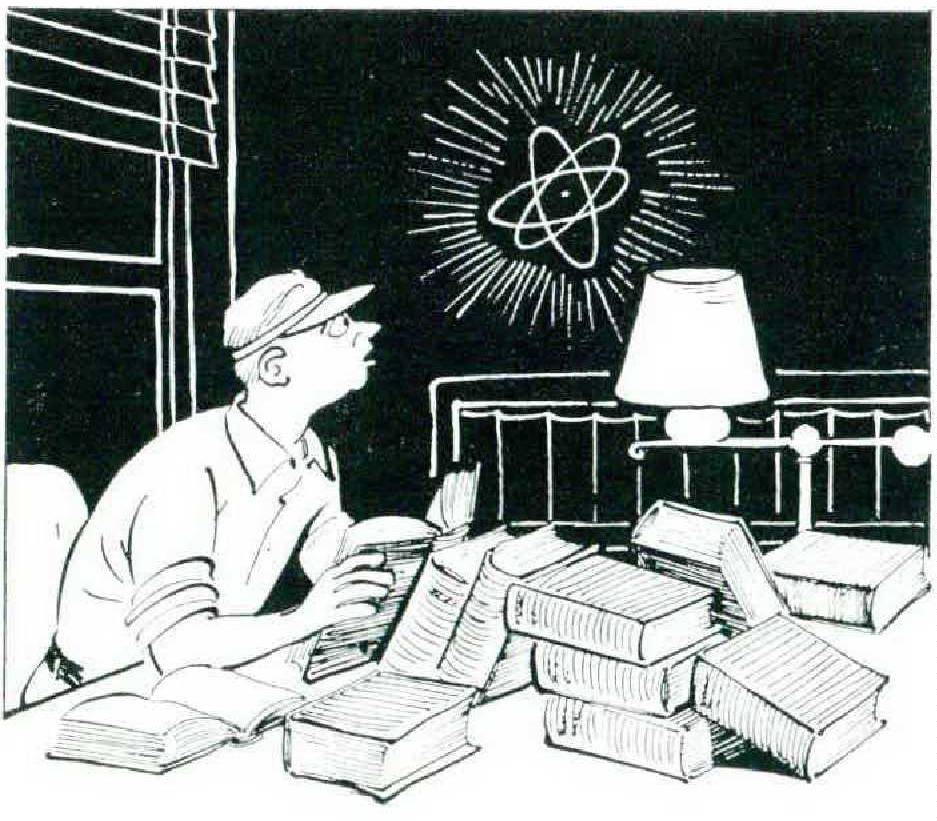
“Whoops!” I shouted, wildly clawing away at the moss-grown rocky ledge. Russell and Comer appeared from nowhere, leaping over the rocks like mountain goats. “Ah youth,” I thought. They pressed their counters against the ledge and their eyes grew wide with wonder. Wordlessly we reached out our hands in a three-way grip. At last we were in.
Prospecting is a madness as old as human curiosity and cupidity itself. Once caught in its feverish grip the victim has a grave tendency to forsake work, church, and community uplift; to forget wife, home, and children - even the payments on his car. This is the story of how one obscure country lawyer abandoned the drafting of ten-dollar wills and, staggering under the weight of a twelve-pound Geiger counter, wandered crazed throughout the countryside searching for radioactive minerals. How does one get that way?
My rock happiness was the result of a chain reaction that began in the autumn of 1948 when Bob Campbell of Toronto rediscovered Dr. LeConte’s hundred-year-old “lost” pitchblende strike at Theano Point, some seventy-odd miles northwest of the Canadian Soo on the north shore of Lake Superior. For years Canadians had been searching for it. All LeConte had left behind was a vague reference in an old scientific paper. Anyway, this was the first important uranium strike since the fabulous El Dorado on Great Bear Lake and also the first since Canada had taken the official wraps off prospecting for fissionable minerals. The story broke in November, 1948, after Campbell filed his claims, and all of Ontario went mad overnight. Papers in the U.S. gave it front page treatment - along with the latest sex slaying.
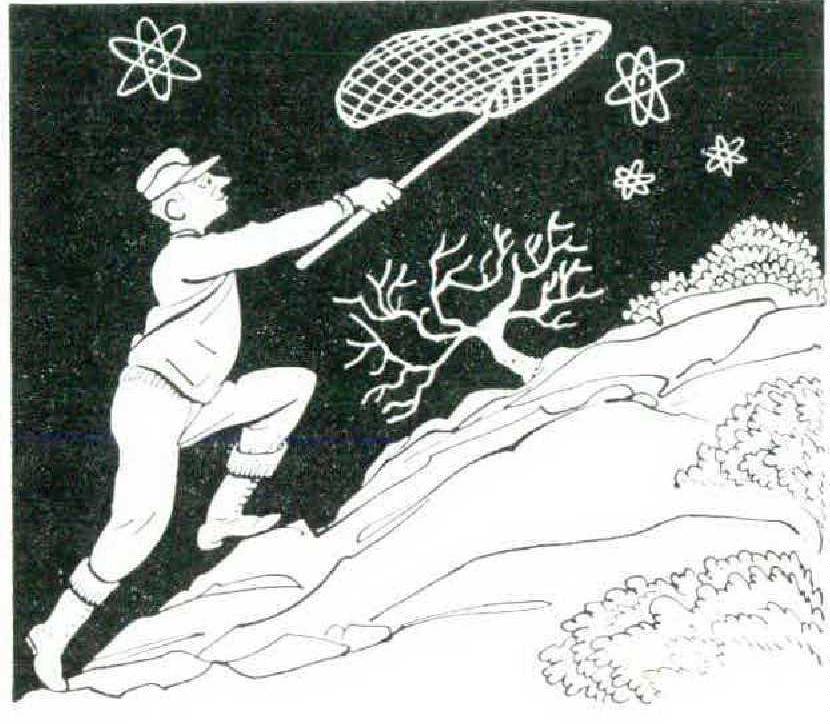
For days I sat brooding among my lawbooks over the dime store in Ishpeming, huddled over mounds of Canadian and American papers and mining gazettes, itching to grab my Model A fish car and dart across the Canadian border and join in the wild staking rush. The first symptoms of the madness were upon me. Instead I sighed and stolidly drew another will. “I bequeath to my dear Aunt Minnie . . .’
Then came the clincher. My good friend and fellow townsman, geologist John McKee “Long John “ to his friends — was way up in the Ontario bush on an iron-ore prospect when the news of Campbell’s strike broke. His nostrils immediately began to twitch, an occupational malady of your true prospector when a big rush is on. And, to make matters worse, he had two idle Geiger counters in camp. Finally he could stand it no longer. He broke camp and flagged the Algoma Central Railroad’s mixed daily and headed south for the Soo with the two counters and two sturdy young Canadian assistants, Matt Richards and Jack Drury. In three days Matt Richards had discovered uranium near the little town of Frater on the rock-bound rightof-way of the Algoma Central Railway.
When McKee and the others finished telling me the story of the Frater strike the following Saturday night during a celebration party in Ishpeming, my nostrils began to twitch uncontrollably.
“Look, Matt,” McKee said, pointing at me. “Voelker’s gone as radioactive as a two-dollar watch.”
“With a luminous dial,” Richards added, confirming the diagnosis.
The very next day I started stalking Geiger counters and, despite the early snow, finally ordered a sleek 230-dollar model. It arrived in the midst of a three-day blizzard, so I was obliged to spend the winter mystifying my friends by Geigering the luminous dials on their watches and clocks. Thorium-coated gasoline lamp mantles were also usually good for a laugh. My best bet, however, was a large work of commercial art which displayed a lady in a rather extensive state of dishabille. By concentrating dabs of invisible radioactive material at strategic points on her anatomy my trusty Geiger and I were the life of many a party that long winter. I also used up two sets of batteries at 23 bucks a throw.
But not all was gaiety and fun. All winter long I crammed on uranium and uranium prospecting, subscribed for Canadian mining gazettes, and waded through endless handbooks, pamphlets, and brochures on the subject.
March came, and I went to Toronto with McKee and Comer to attend the annual Prospectors’ Convention. I haunted every session and took bushels of notes. I also met and talked an arm off Bob Campbell, the hero of Theano Point, and kindly old Dr. Spence, one of the real pioneers of radioactive minerals in Canada. I was even made, of all things, an Honorary Prospector. A generous supply of Scotch providing bait, our hotel rooms were kept crammed day and night with uranium prospectors, the name of every other one of which, oddly enough, seemed to be Sandy. All the others were called Angus.
I came home so laden with radioactivity that I even brazenly wrote a popular science article on uranium — from which, I must report, shoals of magazines promptly recoiled in horror.
Spring finally came, and so advanced was my malady that on the opening day of trout season Frank Russell and I went Geigering instead! (For in the meantime I had inoculated poor Frank with the same virus.) Comer and his jeep arrived in June, and on our first day out we made our big strike. Now back to that.
Weak with excitement we lay huddled there against the strike, happily buzzing our counters and dreaming the dreamy dreams that come so seldom in any prospector’s life. First, there was the $10,000 reward offered by the Atomic Energy Commission.
“That’s 3333 bucks apiece,” Russell mused.
“And 3331/3 cents,” I added, conscious of my grave new legal responsibilities.
“Let’s get an assay first,” said Comer, our new chief geologist.
“I wonder who owns the land,” Russell pertinently remarked.
“Hm. . . . Trout fishing in the winter in the Mexican mountains,” I murmured.
What more could men ask out of life? Here we were, doing what we liked best to do, getting fabulously rich doing it, and being blazing patriots into the bargain.
The days that followed were crammed with excitement and hard work. First we had to run the lines to determine the precise boundaries of the land and the ownership. (Scarcely a day passed that one of us did not sneak away and snuggle up against our strike, earphones adjusted, and listen beatifically to the heavenly music of our bonanza.) Luck was running with us: the land belonged to the State of Michigan as reverted tax lands. But one could not stake claims in Michigan as in Canada. Then came a further stroke of luck. The state suddenly revised its land policy to permit long-term preferential royalty leases to persons finding fissionable ores on public lands. Voelker reluctantly visited his dusty law office long enough to prepare and dispatch an application for a lease with the state.
More luck came our way. Two state mineralogists and a professor of geology from Michigan State College happened to be in the vicinity. Under solemn vows of secrecy we rushed them out to the strike, and their visible excitement almost had me ordering a Cadillac roadster.
Luck, luck, luck — how it dogged us! The next day a field geologist of the raw materials division of the Atomic Energy Commission blew into town. All of us — including the assorted mineralogists of the day before — again made a flying-wedge trip down to our strike. As we waded across the trout stream, Voelker in the lead turned and sagely said, “ Please separate and walk in the brush, men. You know — don’t want to make an obvious path till we get our lease.”
The young AEC geologist quivered with excitement. The way he hacked away at our strike with his prospector’s pick and stashed the stuff away into little canvas bags made us yearn to restrain him before our mine disappeared under our very eyes. Comer and Russell glanced appealingly at their new chief counsel.
“Er — look,” I said. “What’re you figuring to do with all that stuff?”
“Why, fly it on to our ew York laboratory for assay,” he replied. “These are the hot test-looking rocks I’ve run into since I left the carnotite fields out West.”
“Of course. Let’s give him a hand, boys,” I said, and we all fell to, filling up little canvas bags with our lovely rocks.
We parted that night at the Mather Inn. “I’ll keep in touch with the home office and phone you boys when I learn the result,” the AEC geologist promised us.
The days that followed were a nightmare of waiting and hoping, of alternate wild enthusiasm and black despair. Comer and I had almost manually to restrain Russell from going out and philanthropically buying up all the private land for miles around our strike. “Wait for the assay,” Comer insisted. It had become a sort of litany. And we practically slept together so that we wouldn’t be separated when the fatal word came.
It came in eight days. The three Geiger boys were having a quiet beer in my kitchen. The AEC geologist was on the phone.
“I’m fine, how are you?” I said.
“Sorry about the slight delay — but I have just got word from New York.”
“What is it ?”
“Thorium.”
“Thorium ?”
“Thorium. Now let me explain about thorium.”
“Please, not now. I’ve studied all winter about thorium. About all it’s good for at present is that campers use it in gasoline mantles. Thanks awfully, though.”
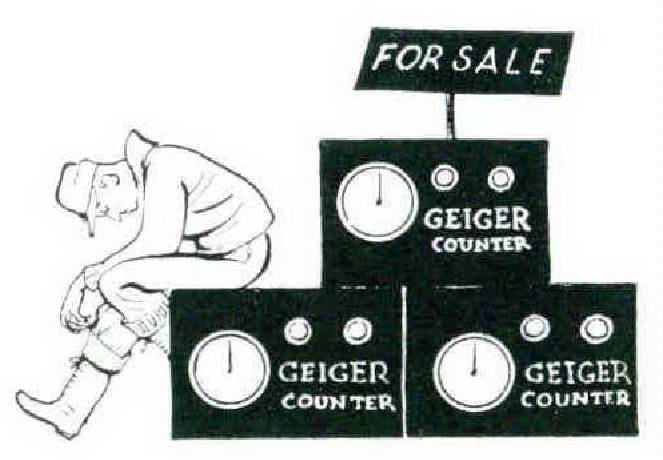
Do you know anyone who wants to buy three used Geiger counters? Not that we’re downhearted. Because we’re buying a new gadget — the latest thing in uranium detectors, a Canadian scintillometer. You see, among other things, it tells the difference between uranium and thorium — not in eight harrowing days, but immediately.