This Month
AMONG a husband’s other uses, most wives find him a handy thing with which to impress other women. Since most husbands are more impressive in absentia, competition along these lines ordinarily develops when three or four wives are gathered together without their consorts. It makes no difference whether they are preparing a rummage sale, dawdling over luncheon, or waiting for the second act curtain. Their chatter is about their husbands and how “difficult” men are, how fickle, how uncontrolled, how formidable, reckless, extravagant. Dashing qualities all, the wife is out to prove that in her spouse they reside more alarmingly than in other men, including Errol Flynn and the late John Barrymore.
A few case histories will disclose the more common of these fantasies.
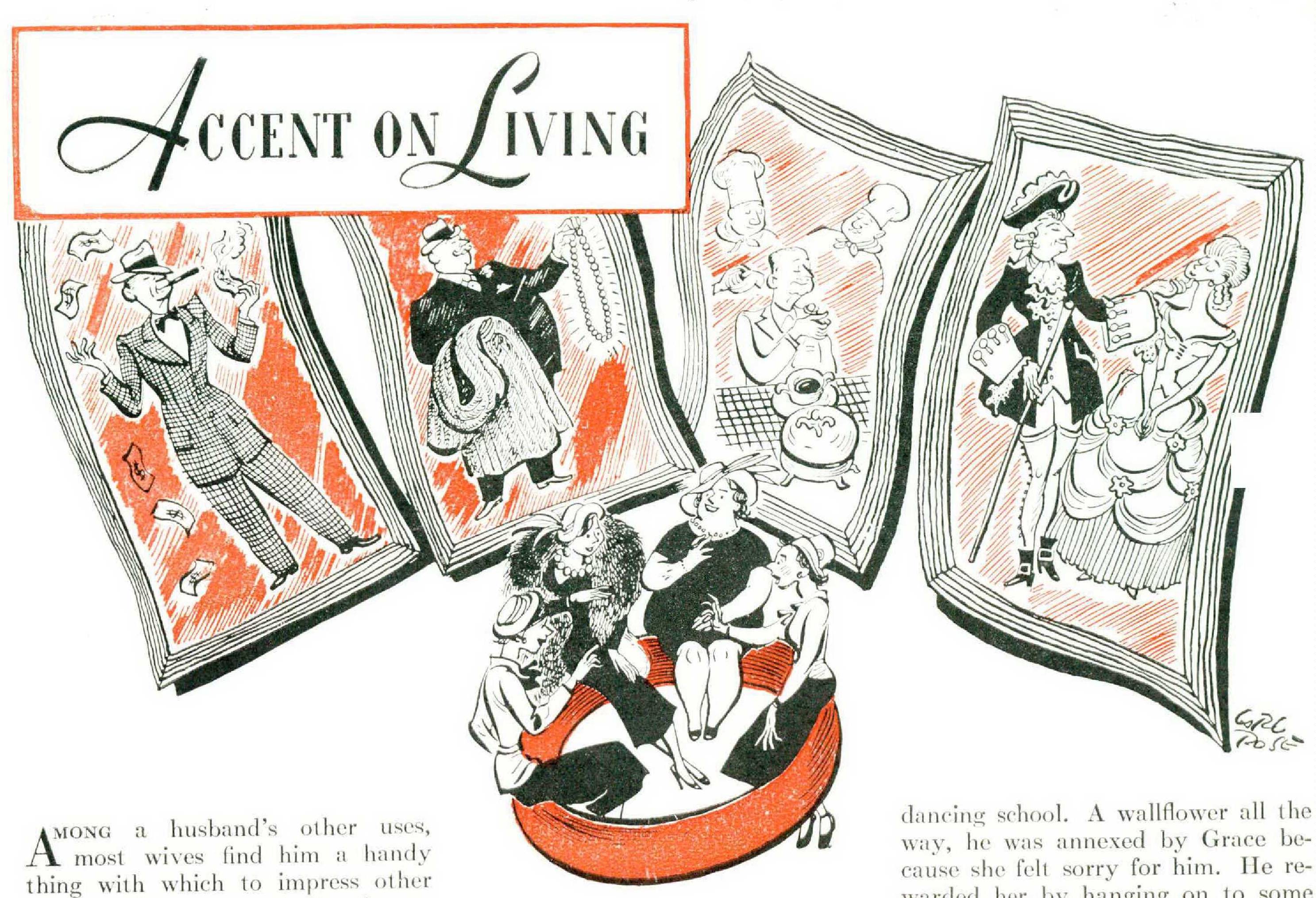
Case 1. — Ralph is very tight, very thrifty. He has to be, on his salary as manager of the Uptown Branch of the First National Bank. But Ralph is also tight by nature, hates letting go of money for any reason whatever. Helen chose carefully when she married him (“My husband is a banker”) after discarding an instructor in chemistry, a cosmetic salesman, and a horse player (the horse player, to Helen’s disgust, subsequently settled down and made a fortune in knitting machines). Ralph belongs to a luncheon club, on account of the bank, but he can’t afford to eat there. He buys his shirts at clearance sales, serves California sherry (from a decanter) instead of cocktails when Helen “entertains.” He is barely able to divert from Helen’s clutch enough money to keep up his insurance payments from which he hopes to receive one hundred dollars a month on retirement.
Helen’s pitch to her friends is that Ralph is a wild spender, hobnobbing with the wealthy and worrying her half to death with his excesses. “I suppose he’s at one of those expensive clubs of his right now,” she tells the luncheon party. “Only last week he brought home a catalogue of first editions and, my dear, the prices of those things were simply staggering.” Only by every feminine wile and seductive art, Helen implies, has she kept Ralph from orgies of expenditure.
Case 2. — George is a pudgy, nondescript man. Now in his forties, he has been uneasy about women ever since his early failures with them in dancing school. A wallflower all the way, he was annexed by Grace because she felt sorry for him. He rewarded her by hanging on to some family real estate which now yields him a large income. He puts in all his time on his stamp collection, attending stamp auctions and corresponding with philatelists.
To hear Grace tell it, George is a gay dog who responds only to most extreme fripperies and froufrou. Grace has stood off various wellequipped rivals by blowing large sums on her wardrobe and personal appearance. Having to lay out so much on furs, for instance, worries Grace, but George likes fine furs; jewelry is another of his weaknesses, Grace insists. Her friends are bound to agree that Grace is protecting her interests skillfully as she unswathes herself from yards of mink and nervously twirls a gigantic emerald-cut diamond ring (new). “These big stones seem vulgar to me,” she explains, but George likes them and what can I do?”
Case 3. — Frank is an easygoing, harmless sort. He works hard, does well, and leaves all other arrangements to Maureen. As long as he gets his meals on time, Frank is unconcerned with food, can’t tell beef from lamb, eats sparingly anything set before him.
Maureen’s version is that Frank is a gourmet, placated only by rich, exotic food. This obliges her to outspend all her friends on elaborate dinners. She must plan, search, and worry to achieve a daily succession of culinary triumphs, for which Frank supplies her with a cook, waitress, and housemaid. What Frank would do if she tried to simplify her dinners, she tells her friends, she dares not imagine. “He’s so accustomed to living this way,” she explains.
Maureen weighs 225.
Case 4. — Henry is terribly remote. An amateur of Elizabethan literature, he counts anything written after the seventeenth century as trash. He is shy, avoids company, believes he is on the verge of proving not only that Bacon wrote Shakespeare but that Bacon was trying to predict, acroslically, World War II somewhere in Act IV of Measure for Measure, In these pursuits Henry is assisted by an elderly stenographer in his office at the college library. Henry does not know where she lives, is not sure of her name, and would not recognize her if they passed on the street.
Henry’s wife, Alice, gets a sympathetic hearing by dark hints that the stenographer is — potentially at least — the “Other Woman” in Henry’s life. “He simply never mentions that Miss What’s-her-name,” Alice says, “and when I ask him this or that about her he just says he doesn’t know.” With some husbands this might be a risky theme leading to gossip and impairment of the man’s fair name, but because Alice is the sole proponent of the theory, she can heat it up or play it down pretty much at will. If Henry is not a potential philanderer, he is a nonentity, and no woman is willing to acknowledge her husband as a complete blank. Hence: “I have half a mind to make him get rid of her, yet she is helping him on this research of his and I suppose, after all, that’s the important thing.” Alice’s place among her friends is thus established: she’s on her toes, nobody’s fool, and proprietress of an almost unfathomable bit of intrigue.
A strict code governs the etiquette of these report sessions. The spirit of fair play prevails. Each wife knows that she is expected to make a colorful contribution, and each is entitled to the full attention of the group. Appropriate squeals, laughter, whoops are accorded each wife’s story. Murmurs of sympathy greet a tale of woe, but most of the exchanges recount victories in high-spirited conflict with husbands, and the hard-luck story as such is trotted out only sparingly.
The session winds up with all the wives talking at once, repeating their own drolleries and affecting to listen, at the same time, to the recapitulations of the others. This last — no mean feat in itself—is achieved by gestures, nods, winks, giggles, and loud outcries distributed impartially, at top speed, around the table while the wife keeps on chattering her own story. Each wife, in the finale, is retelling her yarn as fast as she can talk, and simultaneously giving a veritable ovation to each of the other wives. Only women can do this.
General acceptance of a wife’s report is necessary. Skepticism there will be — naturally — but expressed only in good part as a sour to higher flights of fancy. Effects astonishment, incredulity, and dazzled belief — in that order — must reward each participant. Her basic offer as to the idiosyncrasies of her husband must never be challenged, even though everyone there knows it to be pure moonshine. On rare occasions when a wife loses control of herself, she may come out bluntly with a flat contradiction of another wife’s saga. “I’ve known Herbert since I was five years old,” Gertrude asserts, “and you can never make me believe that he washes the breakfast dishes even for you, my dear.”
Herbert’s wife can only bull her story through against a crack of that kind. All the wives know that Herbert is the only genuinely tough customer among the husbands concerned, and that he would no more wash a breakfast dish than he would accompany Estelle to the Tuesday Morning Musicale. But Gertrude has gone too far. Her sally gets no endorsement, and several wives hasten to testify that Herbert is becoming quite a malleable husband under Estelle’s direction. Wasn’t it Herbert who was seen cutting the grass only recently, and didn’t he go to a Parent-Teacher’s meeting last year — or was it year before last?
There is shocked comment, afterwards, about Gertrude and her rough ways: “I don’t know what’s got into Gertrude — she was positively catty to poor Estelle.” CHARLES W. MORTON