This Month
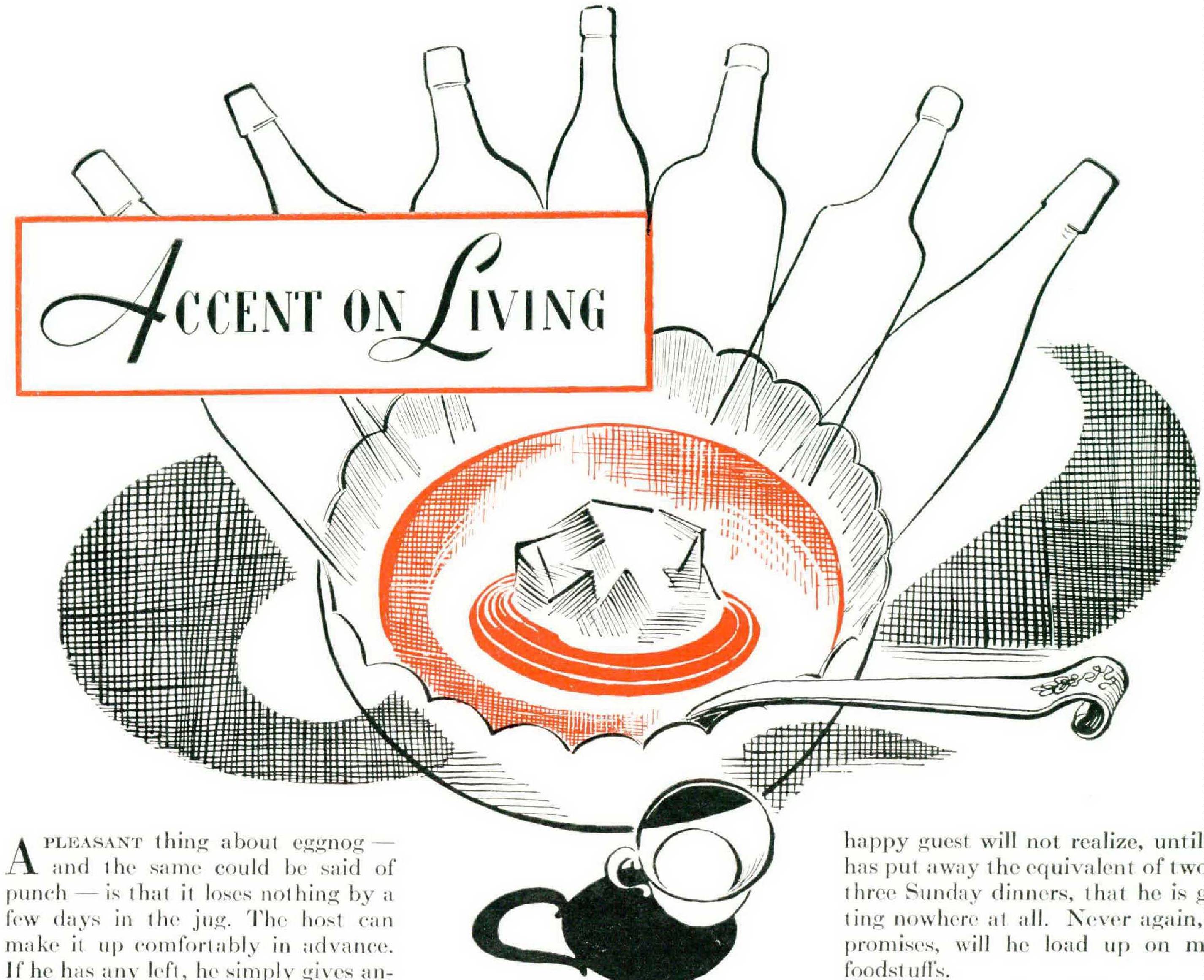
A PLEASANT thing about eggnog — and the same could be said of punch is that it loses nothing by a few days in the jug. The host can make it up comfortably in advance. If he has any left, he simply gives another party. Beef stew is supposed to gain power by twenty-four hours of getting acquainted with itself, and the same seems to be true of what issues from the punch bowl.
Good recipes for eggnog and punch abound. There is great flexibility in what the spirituous base of either drink may contain. Each is easy to serve, especially for a sizable number of guests.
Yet guests in general tend to view even the handsomest punch bowl with misgivings. Given a choice between its ladle and a highball of flagrantly cheap spirits, most of them choose the latter on the reasoning that they at least know what they are getting — how much, how strong, and indeed how bad. The host may have spared no expense on what went into the bowl, but the guest can’t help remembering many other bowls from which he ladled to his ultimate sorrow. From one eggnog party of last year, the guest recalls that he brought away nothing but the sensation of having just won the pancake-eating contest in a preparatory school. Punch he associates with a Niagara of fruit juices (canned) or the witches’ broths of prohibition days, when any ingredient was better not by itself but disguised by as many others as the host possessed.
Eggnog and punch are too useful for party purposes to deserve such low esteem. One of the great qualities of eggnog, for instance, is its ability to hide a phenomenal alcoholic strength. But this very ability to mask its wallop is what lures the stingy host to whittle down his liquor bills and reduce his eggnog to dairylunch mildness. In this case, the unhappy guest will not realize, until he has put away the equivalent of two or three Sunday dinners, that he is getting nowhere at all. Never again, he promises, will he load up on mere foodstuffs.
Honestly made, with at least a fourth of its bulk consisting of highgrade spirits, eggnog is an equally good substitute for a light meal or a drink, with the virtues of both. One engages it tentatively and with some leisure, and on that basis it will accomplish almost any desired result The standard eggnog is based on bourbon, but it comes off just as well with brandy, rum, rum-and-brandy, rye, or Scotch. For a thick one, use cream instead of milk, and home manufacture in any cse instead of a readymade mix. Most bourbon recipes call for a jigger of Jamaica rum as a final flourish of flavor, and an extra jigger will do no harm.
Every old-time club steward has a recipe for punch, but it usually goes somewhat as follows, and would work out at about 90 cents a cup: “Just take three bottles of French champagne to one of a good cognac and a half bottle of Cointreau, pour over a lump of ice, and there you are — very nice punch indeed, very nice.”
For experimental purposes and at considerably less cost, here is a punch recipe worth a trial: One bottle (5th) of New England rum; one bottle (5th) of light West Indian rum; two bottles of a good table wine (red, if you want the color); half a pint of fresh lemon juice; half a pint of fresh lime juice. Sweeten to taste with plain sugar syrup.
To maintain uniformity in the sweetening, it is best to mix any punch in the largest batches possible. Quart soda water bottles are handy containers for storing and serving the punch. The easiest way to control the ultimate strength is to try out the punch by pouring a bottle of it Over a block of ice with an equal amount of sparkling water. The host thereafter increases or cuts down the amount of sparkling water according to the purport of his party; yet it must be admitted that the use of sparkling water has a tendency to diminish as most punch parties continue. The nip of fresh limes can be enhanced by soaking eight or ton squeezed limes in the rum (covered bowl) for a day or two. Worth doing, even though the limes have to be squeezed all over again to extract the rum which they absorb.
By way of weeding out the unfit and protecting the worthy, a Certificate of Ingredients ought to be displayed conspicuously wherever punch or eggnog is offered. A city ordinance to that effect would be helpful; perhaps the eliquette books could be made to lend a hand too. On any undeclared addition of diluent or shorting of the basic spirits, the host would have to turn in his Certificate and suffer a thirty-day suspension. A third offense would prohibit him from further mixtures of any kind, and all his drinks would have to be served from their original containers, labels intact.
Such measures would protect the partygoer from fraud, but no remedy comes to mind that will really work against the host who bobs up — especially in New England — with the barefaced, skinflint technique: (a) invites a big crowd; (b) issues, with a miniature ladle, a half cup of something to all comers; (c) presides thereafter over a lump of ice in an empty bowl, laughing and pretending astonishment with the bland explana tion, “Ha, ha, ha — there isn’t any more.”
By one of nature’s little jests, this is the man who is forever thrusting out an empty glass at other people’s parties and whose intake liability as a guest is t he equivalent of a family of five.
CHARLES W. MORTON