This Month

Karl Zeisler did not send us any before-and-after examples of the editorial policies described overleaf in his confession, “The Hound in the Stadium.” We should like, especially, to hear how his readers received him as a convert. Some of them must have mistaken, through the years, typographical noise for journalistic enterprise. We hope his newly embraced reasonableness will not lead them to suspect that he has gone fishing or taken to afternoon naps.
The act of self-appraisal by the American press is not infrequent, but it usually appears under such headlines as “Finds Newspapers Best Ad Media” or “Chain Store Head Lauds Dailies.” Looking into his mirror, the editor invariably sees the verdict favorable; only the uninformed could be impressed by the seeming muscle sag or a slight pithiness around the eyes. The editor knows they are simply the hallmarks of maturity and not of high living.
If the editor prefers to look on the bright side of himself, he believes others should view him from the same quarter. He has developed a powerful set of conventions to this end: No outsider can possibly understand the intricacies of professional journalism; no professional journalist ought to criticize the press and thereby “foul his own nest.” The critic whose findings are based merely on reading and research in the newspaper field, even though he may have spent a lifetime on that specialty, is brushed off as a well-meaning fool. If the same criticism comes from a newspaperman, he is promptly tagged as a traitor or a psychopath and, in any case, one who fails to savor the finer points of journalistic camaraderie and the fraternity of good fellows.
We must admit to a sense of novelty and refreshment in what Editor Zeisler has to say.
After the Congressional election last fall, Federal tax cuts were freely predicted. A weekly publication picked up the possibility as a red-hot week-to-week subject and for six months or more served up to its readers the latest, confidential, extra special, fivestar, inside inside-stuff bulletin on what was going to happen to taxes. One week it would be a flat 20 per cent cut. Then a 10 per cent cut seemed more likely, then 15, again 20, and two or three 20’s in a row. On one or two occasions the bulletins found that no cut at all was in prospect, but then they began jiggling again through the possibilities — on, off, maybe, not much. I tabulated twenty-six weeks of them, hot and cold, up and down. There was nothing much reported meanwhile in regard to hearings or schemes on which tax cuts would depend, and no authorities were quoted for the changes of forecast.
As a taxpayer I traveled widely during the six months. There was hardly an area of the bracket from zero to twenty on which I did not roost for a week or two, but I wound up exactly where I started. I never did find out why I had been touring so furiously every week. The tax bulletins were harmless stuff. I suppose the editor simply ordered the story one day and nobody ever thought to shut it off.
The tax bulletins represent the same kind of coverage that the press seems to apply to international affairs and the United Nations. It won’t do to acknowledge a dull day among the foreign ministers. There must be action, lights, camera, and preferably a ding-dong contest which can be made to sound like a stake race or a fight in the Garden or a Big Ten game. The advance build-up resembles the old “grudge fight” ballyhoo — in fact the headlines are much more violent before the big conference opens than anything yielded up later on by the proceedings themselves. Ready to hand in the ammunition rack are the trusty headline verbs — Hits, Bars, Flays, Warns, Wrecks, Smashes, Crushes, Balks, Foils, Hurls, and so on. It’s going to be a brawl any way you look at it, and if it doesn’t come off as advertised, blame the rascally diplomats and not the copy desks.
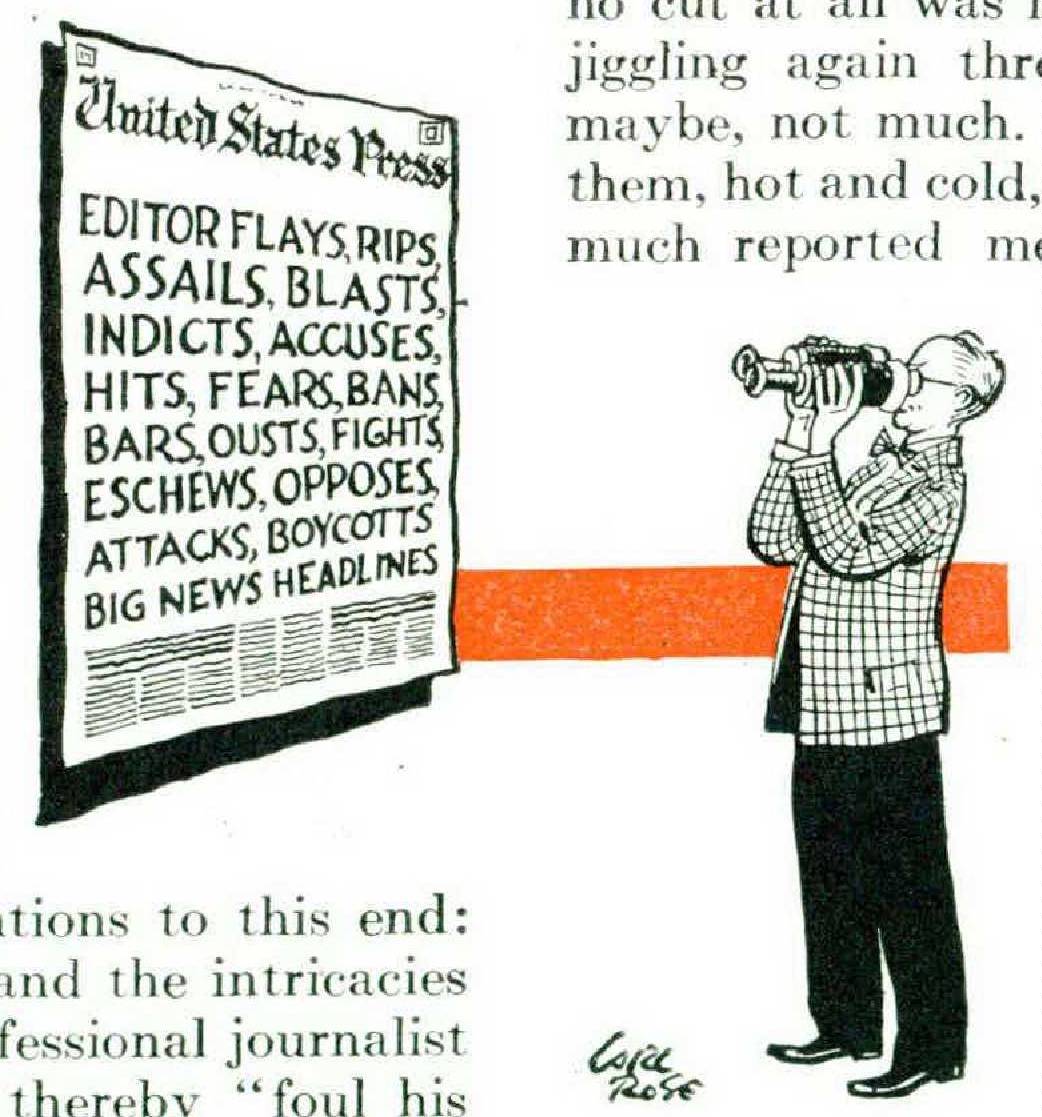
Diplomats who are irked by the headlines they get should simply include in every speech a highly complimentary reference to the American press. The coast-to-coast play on the story in that event would show that international relationships had taken a quick turn for the better. Regardless of what the rest of the speech might mean, the head would be: “CALLS U.S. PRESS FINEST IX WORLD.”
C. W. M.