Home, Squeezed Homo
By EDWIN BATEMAN MORRIS
AT the moment an edifying simplicity controls house design. Exterior aspect has reduced itself to three types: Cape Cod (to avoid the term Colonial), Contemporary (to avoid the term Modern), Ranch House (to avoid the term Et Cetera). Cape Cod has a roof which is visible, Contemporary has a roof which is not visible, Ranch House has a porch. That covers exterior.
Simplicity of plan is somewhat involved. The basic scientific and engineering principles governing present-day plan simplification are complicated. It is first a matter of firm elimination of dispensable, or nearly dispensable, spaces, and then compression. Engineering intent must come first. Sentimental reflections upon the reaction of humans to the houses slow up all processes. Careful laboratory conclusions show that a house designed upon the premise that the occupant must, without comment, fit himself to it is best. In the planning, therefore, the human factor is always eliminated.
The old conception of strictly unbroken rectangular rooms—dating to the knee breeches and silver buckle era — is gone. A room now may be any kind of polygon which increases dovetailing qualities—L-Dshaped, V-shaped, pie-shaped, pear-shaped, or of any other alphabetical or culinary form. Nature currently abhors a right angle.
These fresh and unhackneyed room shapings at times bring frivolous criticism from persons who affect to be displeased with the compressed charm of quaintly angled and many-sided rooms. The perfectly adapted circular plan with pleasant metal, tin-like exterior, they jestingly speak of as a can, with dull inference that there is a certain sardine significance imbedded in the idea.
But these many-purposed, many-angled, manysided rooms have appeal. One thrills to the fall of light and shade on their trapezoids and mysteriously directioned walls. One loves the informality of bulge in living room that indicates bar in kitchen, the off-angle exterior wall giving one at once a refreshing two-cocktail lift.
Inspired room forms and poetic partition directions spell spaciousness, rhythm, movement, restless excitement, the gripping surprise as in a suddenly dropped elevator. Technological developments have thus made available at low initial cost all the necessities for appealing, healthful living, by this compression within economical perimeter.
Man is entitled to the enjoyment of these higher living standards. He is entitled to simplified arrangements: three-sided bedrooms; houses hermetically sealed by glass — looking out on the view, if any. He is entitled to the benefits of pungent thinking which removes the outmoded porch and enables him to sit inside in health and sweet fresh air changed every eight minutes by a fan in the attic. These are his rightful heritages.
Technological inspiration has simplified his life. The modern house diagrams it for him. The wasteful rooms, the too many special places for living, have been forced out. Dead is the dull philosophy which furnished a children’s room for youthful play and study, a library for quiet or for the special visitor, a living room for relaxation, a dining room solely for meals.
Rather, we seek now a smoothed-out pattern. The current diagram for man’s life requires all kinds of living to go on in the same space. Preprandial and postprandial arrangements and table-settings mingle with the radio, the indoor velocipede, the Community Chest promoter, the theory of subtraction, the moaning of playing children, the high-key voice of the older issue telephoning from recumbent posture on the floor.
Such a picture of domestic felicity would have been impossible in an earlier epoch, when a blundering generation sought to segregate the sources of family contentment. It is the informality of the new telescoped living that gives it sweetness. There is no aloof space now for stuffy discussion and dull reading. One has to join in the moods of others.
A householder has no time for discontent, in the modernized, quaintly shaped space which is his spot for living — with blackboard on cocktail table, inner tube on rug, last year’s hornet’s nest against baseboard for possible juvenile scientific investigation.
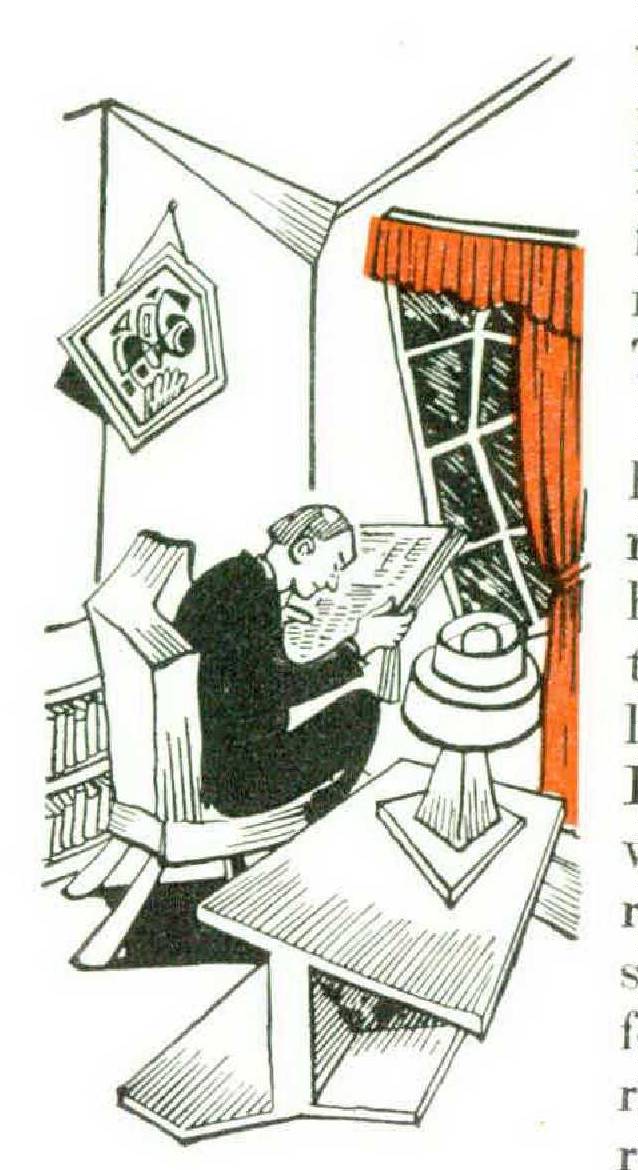
For the first time in centuries life is prearranged, diagrammed, grooved. The master of the house stands beneath his rooftree. There is one place he can spend his waking moments at home— indoors in the combined living, dining, reading, smoking, play, and music room. Its round corners, acute angles, and many sides possibly give him a sense of pace, motion, infinite variety. But, whether they do or do not, that is his place and area — there isn’t any other.