This Month

Elizabeth Ogg’s “Trial by House Party” (page 108) makes me wonder what becomes of the new civil servants once they have met the ingenious tests which she describes. The British method ought to produce, at the hiring stage, a first-rate public official. (I blush to use so crass a word as “hiring,” when approved government terminology
prescribes “recruitment of personnel,” but not even Washington could ever persuade some of the state officials in New England to call it anything but “hiring help.”) Then what? True, the candidates are weighed in a delicate balance; the initiative of Aspirant A is found to dwarf Aspirant B’s; Mr. C is lacking in small talk, yet his mastery of Swahili is compelling. But B has a rich wife, and A knows no French. In the ordinary course of events, A would find himself stamping visas in Bordeaux;
B’s wife would accompany him, with her jewels and furs, to Monrovia; C’s Swahili would turn up, of all places, in Rockefeller Center. I don’t doubt that “trial by house party will disclose the square pegs and the round. But what we have yet to hear from Miss Ogg concerns the house party for Cabinet
Members and Permanent Under Secretaries, to work out the subsequent casting job.
The niceties of appointment are all very well for the British, but the classified civil service of the United States government is something else again. We have all heard, of course, of the terrifying strictures of our State Department: the worldlywise examiners watching to see what the young candidate does with his cigarette butt in the absence of an ash tray; the would-be consul who did not realize that Brahms never wrote a Fifth Symphony; the woeful shirt-tie combination or the brown shoes which flunked still another in his orals. But these are the refinements of the foreign service, not related to the general run of administrative and professional people — another forbidden word — in our Federal agencies. It is not the method of appointing this last and larger group, but the peculiar climate of their employment, which calls for sympathetic inquiry.
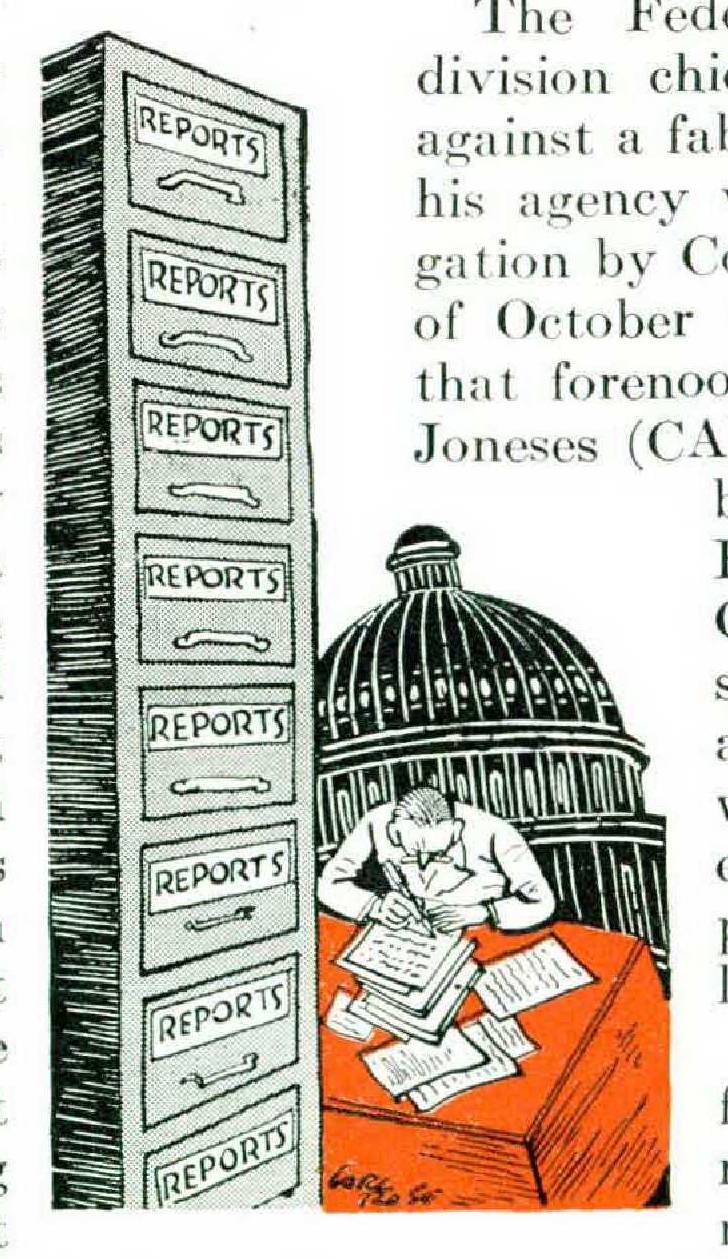
The Federal civil servant — bureau director, division chief, office manager — lives and works against a fabulous Day of Reckoning. On that day his agency will undergo a top to bottom investigation by Congress. Where was Jones on the night of October 14, 1937? What had he done during that forenoon? Why not? If the agency has 426 Joneses (CAF-4, $2394 2845), would not 310 have
been sufficient? What about Smith? Brown? The Day of Reckoning may find Congress impatient with Joneses or crusading against CAF-4’s in general. The agency will have to show up with a wagonload of documents to prove the essentiality of Jones and that the whole program would crack up with anything less than 425 other Joneses (CAF-4).
Congress is capricious and none may foresee its fancies. The agency has to get money from Congress every year. It must be prepared for the worst. Com-
mon sense thus dictates that the agency shall ask for twice what it needs and 50 per cent more than it expects to get things work out happily, the Bureau of the Budget will make a dutiful cut, the House and Senate Committees will achieve a sense of wellbeing by doing the same, and the agency will get its money. On this basis, the most embarrassing thing of all is for the agency to end the year with an unexpended balance. That makes everyone blush, especially the Congressman who finds that he has ladled out more public funds than even a crazed bureaucrat could squander. Just wait until the Congressman has a crack at those 426 CAF-4’s next year!
Thus, everything that the agency does is indispensable. Every penny is hard at work. The agency can prove it — indeed it lives in a perpetual state of proof. If Jones has to write ten letters of a forenoon, he must write a report by way of proving that he did so and why. A supervisor must read the report. Farther up the line, the reports — -F2G of them—must be analyzed and collated. Ultimately, if any Congressman were to doubt that Jones really wrote the ten letters, the agency would confront him with Exhibit 8735, six inches thick, and flabbergast him.
There are two major flaws in the operation: Jones must spend half his time at the job he was hired to fill and the other half writing reports to prove that he filled it; the Day of Reckoning, against which these reports are piled so high, never comes. The Congressman knows the reports are there, were he green enough to ask for them. As a system, I doubt that even the selectees of a British house party could prevail against it. C. W. M.