Why Not Try It?

ByARTHUR POUND
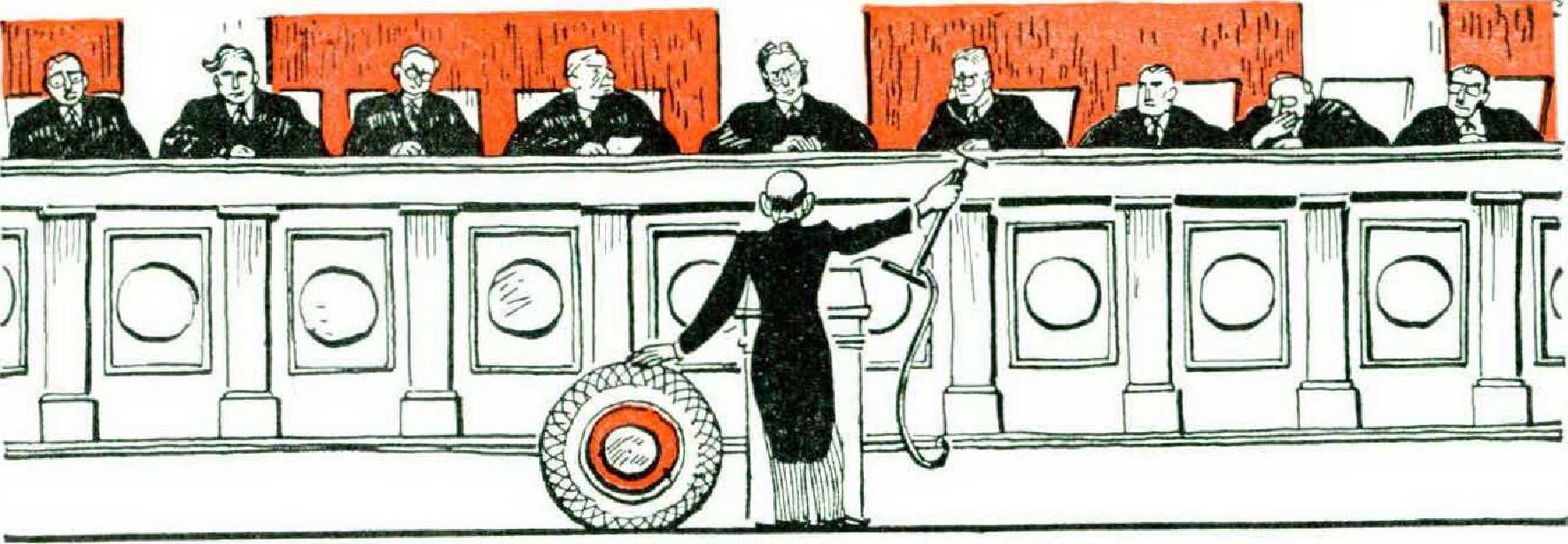
WHEN Laughing Colt v. Struse et al. finally emerges from the Supreme Court, the nation at long last will know who owns the atmosphere and whether a community can do anything about air improperly used in automobile tires. It is a little strange that communities plagued by parking horrors have overlooked the first attempt of any American city to regain control of its streets in the Automotive Age.
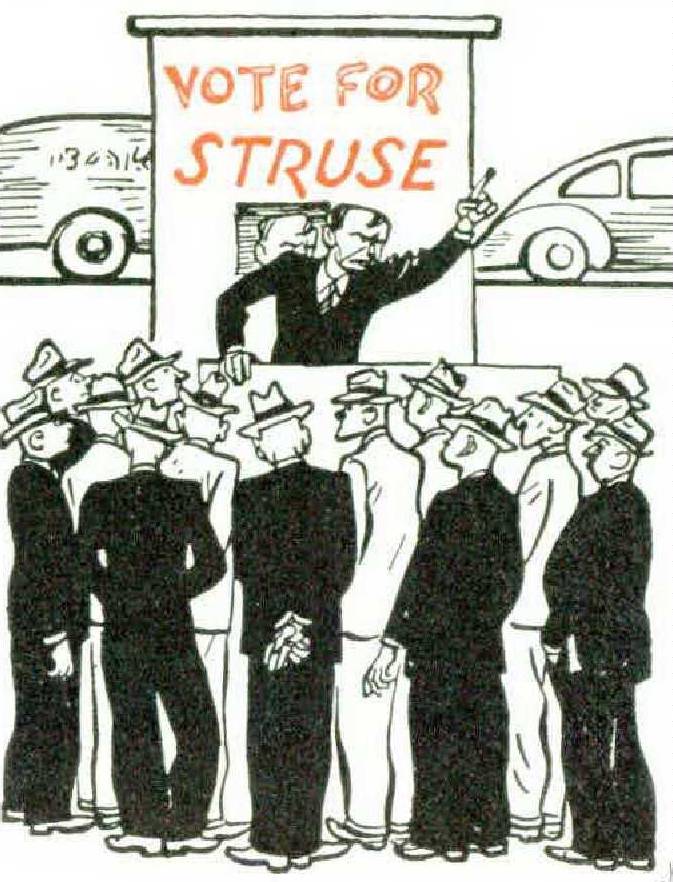
The issue grows out of an address which the Mayor of Boiling Point, a gentleman named Tosh, delivered to the Exchange Club in an effort to explain why he had been unable to halt illegal parking. He was challenged by Abner Struse, a leading citizen, who vowed that he, Struse, could restore strictly legal parking in three days or less.
“How?” demanded Mayor Tosh.
“Wait and see,” snarled Struse. “I’ve decided to run against you. Maybe I’ll tell the voters but I certainly won’t tell you.”
As a matter of fact, the only person to whom Struse told all was the president of the Garage and Parking Lot Association, who straightway went out and collected a Struse war chest. To the electorate, Ab Struse merely said, “Vote for me and you’ll see some fun.” Of course he won.
On his first day in office Mayor Struse personally instructed the police force and told them to hit the line at 4 P.M. At that hour he himself took his stance beside an old red Packard long double-parked in front of a grill. “Friends,” he said to bystanders as the cameras clicked, “here begins a new era in American urban life.” At that he stooped and deftly deflated the front right tire. In each block a policeman did likewise on a double-parked car, and firemen throughout the city moved in force against cars blocking access to fireplugs.
The Mayor hurried to his office and telephoned the Garage Association president to have all hands beg off on downtown trouble calls. “No tow cars, no mechanics, not even a hand pump. Tell the boys to stay at home and prosper.” Chaos descended upon rich and poor alike. It was dark before Main Street was clear, but once clear it stayed that way, and residential districts reported almost no allnight curb parkers. Garages were full.
Next day Mayor Struse went on the air twice to reassure shoppers, in answer to the tremulous petitions of merchants who feared for trade. He could boast that the curbs were free of allday offenders, and that not a soul had been fined, no cars seized, no licenses revoked. “All that has been required of chronic offenders has been a little healthful, forthright effort, the kind of work that made this nation great.” But the otherwise-minded kept phoning.
After a day or two, however, it was seen that Boiling Point had scored a sensational success. Order had indeed replaced chaos. This seemed to infuriate the legal profession, which has a vested interest in chaos, and several challengers had to be repelled in local and county courts. It was charged that a police officer could not unscrew a valve cap because that constituted trespass on property, unwarranted seizure, and perhaps even a tort. Mayor Struse’s lawyers blocked this with a precept from McCulloch v. Maryland in which Chief Justice Marshall ruled more or less to the effect that whatever accomplished a social benefit was a proper means unless specifically banned. Police had a plain duty to maintain the free and open passage of streets and could clear away any obstruction thereto.
The claim of an evildoer against police effort exercised in the common interest must ever have small weight. Mayor Struse said he had yet to see a deflated offender come into court with clean hands.
The decisive long-range attack against the administration, however, came in the Federal courts. Instantly perceiving that this issue involved both the Constitution and air rights, Alonzo Tripp, of Tripp, Tucker, and Turnbull, considered how to get the litigation before the highest tribunal with least delay. Since the Kiwanee Indian Reservation was not far from Boiling Point, some Kiwanees enjoyed oil royalties; hence, Tripp, Tucker, and Turnbull were learned in Indian law and treaties. Accordingly, a deflated redskin was found, and in his name, Laughing Colt, action was begun by Tripp in the Federal District Court, on a petition begging the court to order Mayor Struse and his assistants to show cause why air should not be permitted to remain forever undisturbed in the tires of the Indian and others.
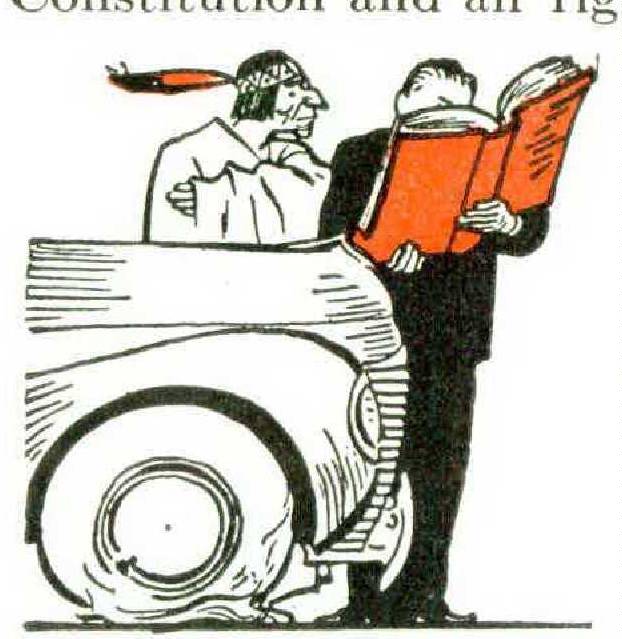
Haled before Spence, J., City Attorney Elser of Boiling Point raised the question of jurisdiction, and asked the court to dismiss the case on the ground that air in small quantities was definitely a local affair, outside the purview of Federal practice. Lawyer Tripp killed this by proving that his client, as a Kiwanee, was a beneficiary of the White Clay Treaty, under which certain natural rights were vested in his tribe “as long as grass grows, water flows, and air blows.” At once the Boiling Pointer told the court that his city would gladly make an exception, airwise, in favor of all aborigines. The tire in question would not have been deflated if the authorities had been aware that the Indian was lying prone above in alcoholic slumber. It was to be lamented that his unnoticed presence had betrayed the police into innocent violation of a sacred treaty.
Mr. Tripp then brought up his heavy precedents. This case was broader than his client or any individual of any color. It involved not only treaty rights but also equally sacred constitutional rights which protect all the people from rapacious officialdom. Nothing less was at stake than the Fourteenth Amendment. Complainant and others had been deprived of lawfully acquired and appropriated air, taken under the good old common-law rule called “the law of capture.” Caught unprepared, the Struse lawyers asked for a continuance. Spence, J., then ruled that a temporary injunction would issue and a hearing would be held two weeks hence on the application for a permanent injunction.
In Boiling Point, the police went back to the routine of chalking tires, and were astonished to find that the public took up where they left off. Eccentric old men and aged viragoes became adepts at deflation. Gangs of schoolboys, undeterred by, and perhaps abetted by, their parents, played a new game, “Parker, parker, where’s your air?” while the law looked the other way. Mayor Struse felt obliged to warn against spite and rowdyism; but inwardly he rejoiced in every instance of public support.
When the combatants again bowed to the courtroom entrance of Spence, J., City Attorney Elser took Mr. Tripp’s traditional wildcat — the law of capture — and wrung its neck. Would the Honorable Court please note that air belonged to society, to the community, and could belong to no one else? Air, in private use, represented merely a borrowing from the common fund. Its possession was not a right, but a privilege ending the instant it was used against the community. The city of Boiling Point, to correct an intolerable nuisance arising through illegal use of loaned-out air, had no other redress than to recover that air, when all other corrective measures had failed. Surely Boiling Point was not unreasonable. It granted to users of deflated tires unlimited refills which they could retain indefinitely as long as they observed the laws, ordinances, and regulations.
The Constitution (continued Attorney Elser) antedated rubber tires but did not antedate air. That the air is subject to regulation, and that its use can be withheld in the public welfare, have long since been settled by Federal legislation and adjudication in the fields of radio communication and airplane operation. And Congress has never sought to void reasonable state and local controls in even those fields, from which it is evident that air in small quantities remains in local jurisdiction.
Mr. Tripp tried to smear these arguments as smalltime stuff, by describing great industries which had arisen to capture, confine, refine, and sell air components such as nitrogen and oxygen. Such activities, praiseworthy as advancing industrial techniques, injure no one because they draw upon inexhaustible resources. No one breathes less freely because of Air Reduction.
The Court cut him short to discuss at length the practical limitations on rule by injunction. “Is there police power willing and able to enforce the Court’s decree, and a public opinion ready to support police action? In this situation neither essential appears to exist. There are not enough Federal marshals in this jurisdiction to keep air in the tires of Boiling Point’s illegally parked automobiles. On so moot an issue, who would contend that we should move Federal troops into that community? The writ of injunction is therefore dismissed in so far as it applies to automobiles owned by citizens of the United States, but is made permanent for the protection of the air rights of Indian wards of the United States. ”
While Mr. Tripp pushes his appeal, Mayor Struse follows Fabian tactics. Already he is being talked of as Governor, while city after city copies his formula for clean parking. Meanwhile the streets of Boiling Point are innocent of illegally parked cars except for automobiles of Indian ownership, which increase in number so fast that certain white owners are suspected of registering cars in Kiwanee names. A brisk demand has set in for valve locks, but these are in short supply as well as in high disfavor as evidencing guilty intent. A boom has developed in garages and parking lot properties. Capital is earnestly seeking labor and materials with which to build car shelters. In nearly every block one or more back yards have been opened to paying guests. Boiling Point has proved that rigid enforcement is good for real estate as well as for general trade.
In general, the Struse principle of “No air for illegal parkers" seems sure of wider application. Even if Laughing Colt v. Struse et al. finally goes against the Mayor, he considers his experiment highly educational and influential on the future. He feels sure that since so many persons have at last beheld a city where traffic laws are intelligently enforced and sedulously obeyed, the public will not retreat toward the confusions and dangers of other days.