The Basic Play
THEATER
DON’T joggle me, I’ve just got hold of a very intricate idea. I’ll need an experimental theater to work it out in, or rather I’ll need a regular commercial theater to experiment in; no Bennington girls need apply.
This has to be an all-union job, Equity cast, everything. You see, my project is simply to put on a play about nothing, a play which poses no problem and advances no idea. It will be a Broadway production, cast and staged as smartly as possible, and I don’t see why it shouldn’t run forever.
Faithful playgoers sometimes confess that one play seems pretty much like another play. This is as far as they ever go, and usually they’re pretty sheepish about saying that much, no doubt fearing that the admission calls their aesthetic perception into question. Well, I think these people are right, and I’ll go them one better: I say they’ve been seeing the same play over and over again. One play is so like another, in all essential respects, that we might with perfect accuracy refer to the sum total of dramatic literature simply as “the play.”
Perhaps it would be better to say the basic play.”After all, Deep Are the Roots is readily distinguishable from State of the Union, Born Yesterday from The Voice of the Turtle. The differences are only superficial, to be sure, but it is the diflerences that get talked about. The basic play is there in every case, and the critics take it for granted and focus their attention on what are, after all, trivial differences between one play and another.
You don’t believe in the existence of the basic play? Well, let’s put it this way. Here’s a playwright who has just had a play successfully produced and has not settled down to work on his next. He doesn’t know what his next play is going to be about; he hasn’t got an idea for it. Nevertheless, he knows, to a large extent, what it is going to be like; and this knowledge constitutes the definition of the basic play. The maddest experimenter among playwrights, the most flaming revolutionist, the most caustic iconoclast, all wind up writing the basic play, simply because there is no other play to be written.
Except for a few speeches on a set subject—the subject being what the play is “about" — a play is just dramatic yard goods with different patterns printed on it by different playwrights. It is a matter of getting people, animals, and objects on and off the stage in various combinations, inventing three logical occasions for raising the curtain and three more for lowering it, introducing the actors to the audience and to one another, moving them about the stage in an interesting pattern, and providing atmosphere, love interest, and comic relief. Of the two-hours-plus time that it takes the average play to unfold, easily an hour and three quarters is just basic play.
Now plot and situation are part of the basic play, and don’t let any Shuberts tell you different. Plot is just people in circumstances that bring them into opposition; situation is merely opposed people confronting one another. Never mind if you don’t understand that right away; just kick it around until it becomes familiar.
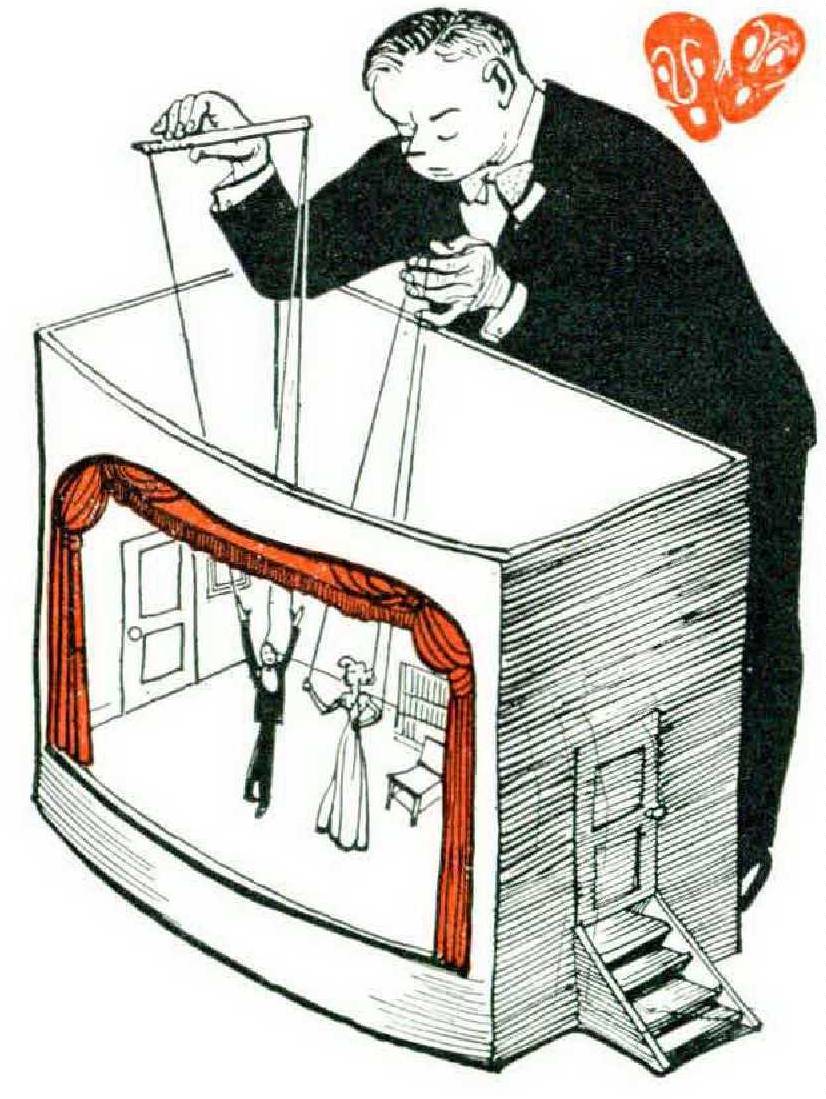
The only part of the play that is not basic is that scene, usually placed late in the second act, when the author sounds off about whatever is on his mind. He feels strongly about something — cartels, racial bigotry, the relations between the sexes, modern marriage, big business, politics, the public school system, the decimal system, the weather—and he halts the progress of the basic play while he has one of the leading actors deliver a speech on this topic to the rest of the cast, who are well paid to sit and listen. You know the sort of thing: “ A es, I’m leaving you, Oliver. There’s one thing that no woman can ever forgive, and that’s . . .’ Or “Yes, Hilda, I’ m having my things sent over to the club. You see, one thing that women don’t realize about men is that . . .” Or “Yes, Senator, the Machine has won again. But some day the voters are going to take things into their own hands, and then God help you and all the other . .
As soon as this actor or actress has had his or her say and has left the stage (slamming the door or not slamming it, according to how author and director feel about such matters) the basic play slides smoothly into gear again, and before you know it the final curtain is down and the audience is out in the street.
But to get back to my idea. I think it would be possible to produce the play in chemically pure form. No message, no theme. About nothing. Just actors in motion on a stage. What would prevent? You might say that no actor would appear in such a play. My answer is, How would the actor know? Most actors — I would guess a good 90 per cent of the membership of Actors’ Equity Association— spend their professional lives opening and closing doors, bowing from the waist, handing one another prop sandwiches and drinks or firing blank revolvers at one another, going in to dinner, answering the telephone, saying hello, saying good-bye, lighting cigarettes and putting them out twenty seconds later, turning the lights down, turning them up, opening windows, closing windows, handing one another things on trays. They are actors in the basic play only. Yes, Oliver and Yes, Hilda are for the few.
And as for the few, the leading actors, they have spent their professional lives perfecting a single performance; they assume, when a producer engages them, that lie wants that performance. And of course they are right. Authors are a dime a dozen, but there is only one, for instance, Tallulah bankhead. How indomitably she rises above the subject matter of her vehicles! I will wager that few of my readers can name her last three plays or their authors. I think I should like her for my production of the basic play. But she will want a reading of it before she makes up her mind. O.K., let’s go.
The topic of a play, the aboutness of it, casts a dim, colored shadow on the entire basic structure. If it is about injustice to coal miners, sets and actors will be grimy; if about Irish freedom, all will be Irish. For the basic play we want that chintzy living room we see so often, with a convenient telephone and radio, doors leading to all parts of the house, and a big floodlight behind the set pouring sunlight through the bay windows at rear. I forgot to say, the title of our play is “bird Cage.” Well, it’s a title, isn’t it?
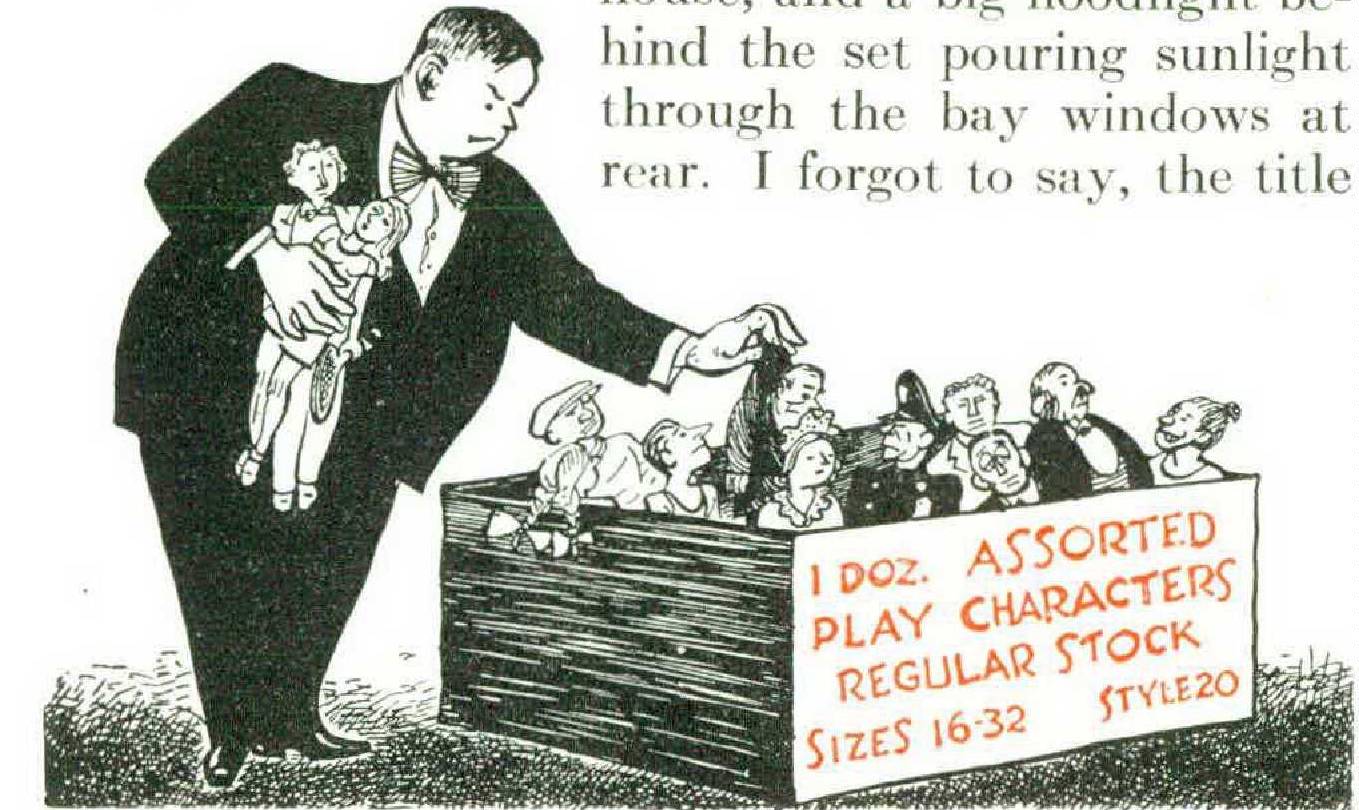
At rise, telephone ringing. Fussy mother answers. Hmm, somebody’s coming to visit them. She doesn’t like it. Makes best of it, hangs up, tells maid to do guest room. So and so, so and so, building up to mild laugh on maid’s exit line. Mother sits at desk, taps pencil on teeth. Daughter enters. Mother, for heaven’s sake. Yes, but you don’t know. Well, then, tell me. No, I can’t. Young man enters, daughters beau. Mother puts on big hat and gardening gloves, exits. Love scene. Only two weeks since we met at. the Country Club dance. Seems like aeons. They embrace, doorbell rings, maid passes through room on way to answer, mild laugh on her line, exits to hall, returns with luggage, followed by this gorgeous woman of the world. Mother didn’t expect you, I got an earlier train, show you to your guest room, boy gazes after her as she goes upstairs, girl says something nasty, he manages to calm her down, another embrace, telephone, maid enters, big laugh this time on her line, what, again, it’s for you, Miss, long distance. Long distance? But I don’t know anybody . . .
Without plunging through to the end, I can give you the chemical analysis of the action. The star (Miss Bankhead, we hope) will require forty minutes in which to be just herself. This will include scenes beginning with the line, “Tell me all about yourself. It’s been so long,” the reply to which is prefaced by a long jet of cigarette smoke through the nostrils and quick, nervous pacing back and forth, well upstage. Another scene with the callow youth. One with the girl. One on the telephone with a man in Australia. (Hang the expense.) Forty minutes is cutting it close.
Ten minutes for the lovers. They quarrel and make up.
Eight minutes for lighting cigarettes and pouring drinks.
Twelve minutes working up to the first, second, and third act curtains, respectively. Any kind of vague, aimless quarrel will do, as long as each line is spoken just a little faster and louder than the one before.
Fifteen minutes for running the household; i.e., “Let’s take our coffee in here, shall we?”
Four minutes for comic relief.
Twenty minutes for explaining things which the audience has seen happen but which several of the actors have not.
And there’s your pure play. To bridge that gap in the second act where the play’s subject is usually introduced, I plan merely to have the star take from her pocket a letter, read it, chuckle softly, and tear it to bits. Just that; no subsequent explanation.
A seasoned actor once told me the principle upon which he operated. Now that I think of it, it seems to sum up what I have tried to say. “Talk loud and fast,” this actor told me, “and nobody will notice what you’re saying.”