Horse Sense

BECAUSE the farm I have been living on has been sold to some horse breeders, I have been thinking about horses lately and I have decided that the equus caballus as a means of transportation or sport is and always was a very poor makeshift.
The horse is in a class with the outdoor privy — and, fortunately, both are practically obsolete. Yes, there are those who still sing nostalgically of the honeysuckle-entwined backhouse. I don’t.
There are also those who say that to know the horse is to love him. I say that anyone who actually loves a horse probably would love his elevator shoes — and for the same reason.
Now whal I have to say about horses here does not apply to the big, comfortable, placid draft animals.
They still have some use in agricultural regions yet untractorable. I am speaking of that beautiful, noble, intelligent, loyal quadruped that generals and gentlemen used to wear between their legs as an insigne of rank.
I do not hate horses.
Neither do I love them, revere them, or respect them. As far as I am concerned, the riding horse is merely an anachronism, except in certain Western ranch areas — and 1 suspect he’s to be supplanted there soon enough by jeep-type vehicles or half-tracks.
Apparently, however, the horse is to be enshrined forever in sentimental hearts along the Eastern seaboard and preserved along with the rest of the phony atmosphere on Western dude ranches.
There is a widespread but curious notion that knowing horses and riding them bring sophistication, glamour, poise, rugged health, and physical tolerance to spiritous liquors impossible for those lesser mortals who either walk or ride mechanical contrivances.
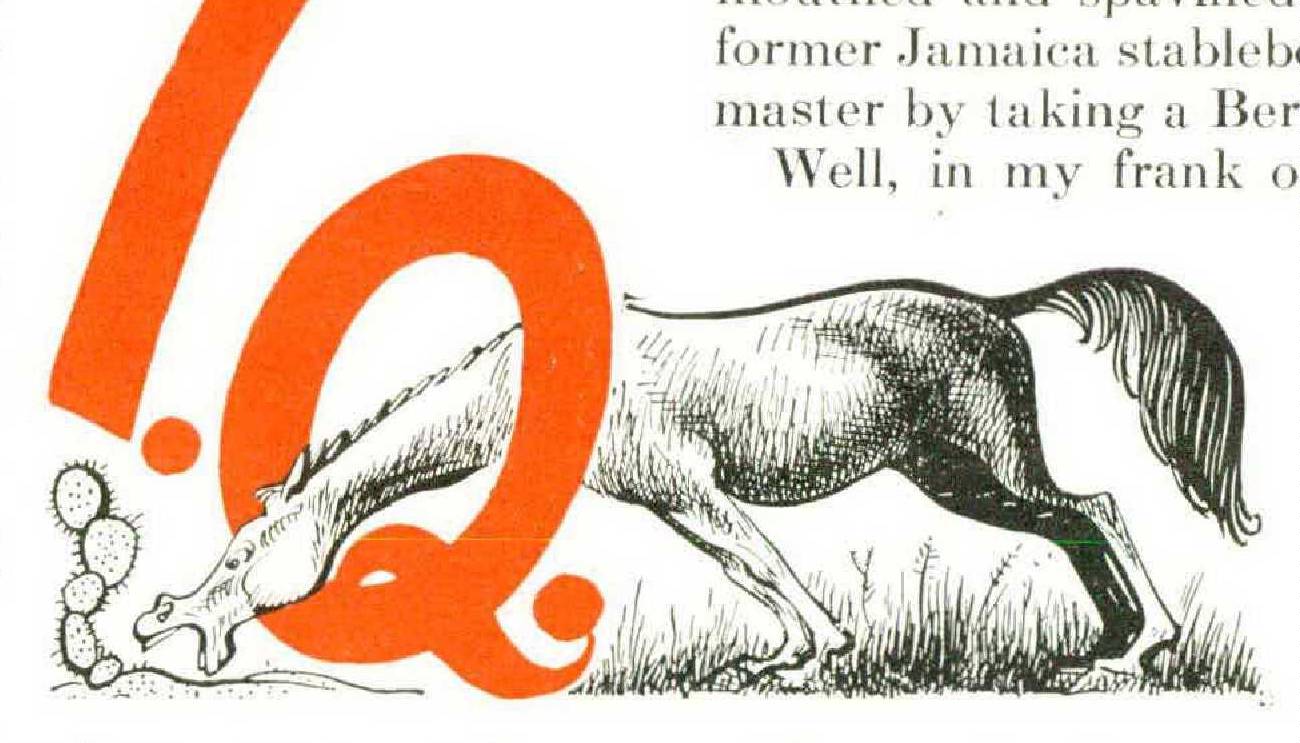
The thing has grown into a cult. Even desultory communicants are most fervent in their devotions and are outraged if a Philistine refers lo some obvious crowbait as a nag, skate, plug, or hay-burner. It seems that a horse is a Horse.
Ah, yes. And if there is anything on earth more soul-satisfying than a brisk canter on a clean-limbed hunter in the fresh and fragrant morn, it’s standing around in your Bergdorf Goodman jodhpurs with cigarette in your left hand and Scotch-and-soda in your right hand, talking in it weary Katharine Hepburn drawl about the intricacies of equitation. This is especially true if the brisk canter actually was a slow walk over Berkshire trails aboard a callousmouthed and spavined livery hack in custody of a former .Jamaica stableboy who has qualified as riding master by taking a Berlitz course in cockney.
Well, in my frank opinion, those who babble of their love and admiration for the horse can be divided into three classes; eccentrics, novices, and fakers.
It is about ten years since last threw a leg over a horse, and it’s all right with me if I never do again. My father was a horse breeder with some local renown as a rider and driver of fractious animals. Outlaws were brought to him from far away and he had extraordinary success in breaking them for the saddle. I myself rode spirited horses when my legs were too short to reach stirrups and I had to put my feet in the loops. I was bucked off and run away with. I stood on a box to groom them and I fed them apples and sugar. I loved horses— I thought.
You may love your horse, but you’re kidding yourself if you think that love is returned. The horse may tolerate you and put up with your whims and even whinny at your approach, but deep down he resents you. Give him a real chance to make an issue and see what happens.
Horses have injured me several times. But almost always it was my own fault — my own fault because I had relaxed my vigilance and momentarily trusted the horse. Now I think the person who trusts a horse is a blood brother of the fool who is careless with firearms or who rocks the boat. Any horse worth riding is dangerous at all times, but your life is brought into actual peril the moment you begin to trust him.

One of the principal troubles with horses is a psychotic sense of inferiority. A horse knows he’s big enough and strong enough and speedy enough to make it ridiculous for him to live as a slave of man. He has just sense enough to resent not having wits enough to remedy the situation, and his sporadic revolts against his master are stupidly tentative and ineffectual.
The only half-smart thing I have ever known any horse to do was try to kill me. Even those clumsy attempts were ill-advised because my elimination probably would have brought the horse nothing but a tougher master. I at least never used a curb bit or rowel spurs.
The sentimental twaddle expended on the intelligence of the horse is astonishing. What is intelligence in any animal? Isn’t it inevitably exemplified in that animal’s capacity for taking care of itself? How, then, does a horse compare with a dog or a cat or a fox or almost any other mammal you can think of, with the exception of the notoriously imbecilic sheep or brainless cow?
A jackass is a genius compared to the most brilliant horse that ever lived. So is a mule, despite the strain of idiocy in his family.
It’s not that the horse has no desire for selfpreservation. The trouble is that a good horse is a bundle of emotions, tied up with a short-circuited nervous system, that seem to make his reactions operate in reverse. He is dreadfully afraid of the unknown, regardless of size or nature. A spirited horse, for instance, will shy so violently at a fluttering bit of paper that he’ll fall down and break a leg. Smart, eh?
Once I was riding a bay gelding that was quite intelligent for a horse, it was alleged, and we were confronted by a small, mangy black bear on a narrow Rocky Mountain trail. The bear was badly frightened by our appearance and skittered as fast as he could go through the timber. The horse was approximately four times as large as this little bear. With his natural weapons, he could have killed the bear if the bear had been foolish enough to attack. And if the horse did not care to fight, he still could have outdistanced the bear easily.
What did this horse do? Even though you profess love for the horse, if you know horses you know what happened. The horse acted like a hysterical fool. Heavens above! There was an awful black animal which the horse’s perfervid imagination enlarged to the proportions of a red barn. And it smelled bad.
I was barely able to keep him from plunging over a 200-foot cliff to our mutual destruction. It was with the greatest difficulty that I persuaded him even to pass the spot on the trail where the bear had been.
In a case of real danger, such as a burning stable, a horse must be blindfolded before he can be led out, and the man who attempts the rescue runs a very real risk of being kicked to death by his charge. On the other hand, a mule, inheriting a modicum of intelligence from the long-eared side of his family, often will, in similar circumstances, break the halter shank that ties him to the stall and even kick down a door to escape the flames.
Despite all the romantic flapdoodle about the cowboy and his cayuse, there never has been any sort of partnership between man and his horse. The cowboy and horse partnership was the same as that of the Western Union messenger boy and his bicycle, or that of the traveling salesman and his Chevrolet coupe.
The cowboy was a lonely and usually simpleminded soul who grew to personify his pony as a pal. He did the same with his saddle and gun, with practically as much response. The romantic relationship of cowboy and pony has been the source of much silly fiction and many movies.
They never, however, show this loyal steed pulling his picket pin at night and running off to leave the cowboy forced to walk twenty miles in high-heeled boots, either carrying his ponderous saddle and other gear or leaving it at his camp site to the mercy of the coyotes or porcupines. No, they never show that. And they never show Smoky or Silver or Old Paint shying so violently at a four-inch prairie owl that he loses his footing, falls down, sprains our cowboy hero’s ankle, and then lopes away. They never show Old Paint stopping a half mile away then to nibble bunch grass and the cowboy limping after him, calling plaintively to his loyal pal, only to see his four-legged partner dash off another half mile when hero approaches within fifty yards. No, despite widely accepted fiction, there never has been a horse-man relationship greater than that of master and more or less reluctant slave.
Prehistoric man had nothing whatever to give the horse. Grass and wild grains grew in abundance for the horse to eat. Horse’s weapons against enemies were his speed of flight, four formidable hoofs, and a mouthful of teeth that could do considerable damage. Horse had no need for man. But man, being comparatively slow-footed and weak, even for his size, discovered early that horse’s feeble intellect made him a ready victim for capture and enslavement, and that, horse’s size, strength, and speed could be utilized to advantage.
A man mounted on a horse had tremendous advantage over men afoot; so the man who owned and rode a horse assumed, as a matter of course, an air of superiority. Thus was born the cavalier, the caballero, the cossack, the mounted cop.
I suspect that those who now ride for sport are imbued with a foggy something similar to knighterrantry. I suspect that, mounted in the saddle, they can picture themselves as romantic heroes of old; that they are playing the grand old game of kidding themselves, recharging their ego batteries, dueling with wooden swords. Well, that’s all right if you like it. That’s all right if you like a game of solo charades. But I cannot go along when they attempt to justify the game by murmuring things about the wonderful exercise.
There is a saying among highway patrolmen that when a spook — meaning a wild-driving nitwit — meets a spook there is usually an accident. Most motor accidents, it appears, result from at least one spook at the wheel.
That word “spook " is very apt, being derived from the Western term for a crazy horse that sees spooks at every turn.
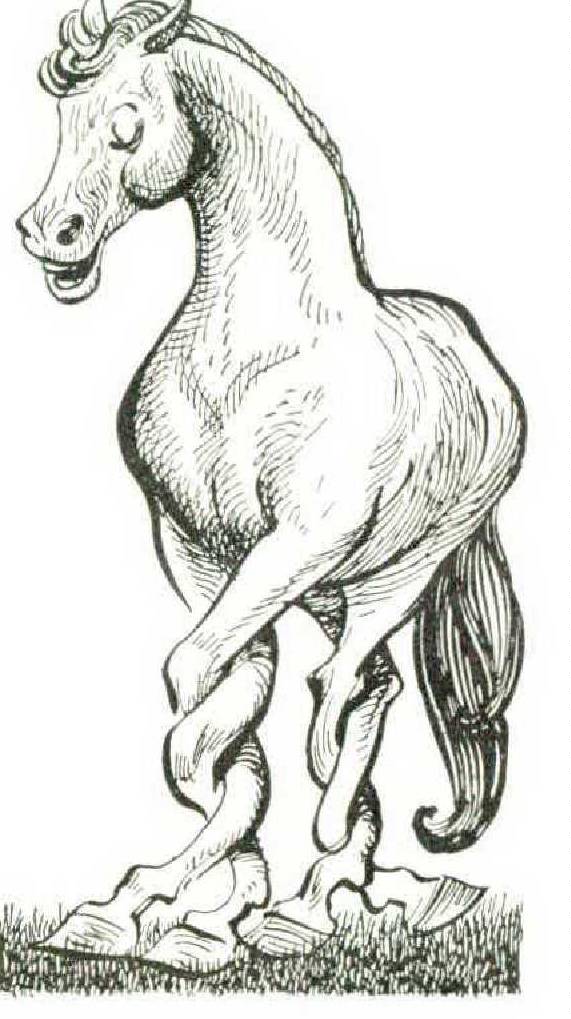
Well, there were spooks driving in the old horse and buggy days, too. And when you had a spook in the driver’s seat, plus a couple of spooks in harness and you were seated high up on a matchwood carriage, you’d have been much safer if you’d stayed at home to blow out some stumps with dynamite.