Paintings and Frames
FINE ARTS
By MACKINLEY HELM
A COLLECTOR who saw some of my Mexican paintings at the San Francisco Museum of Art sent me a telegram: “I like your pictures. Who is your framer?”
I replied that I had found in Boston a man who had enough taste to know that a new school of art needed new treatment in framing, and along with good taste, enough knowledge and skill to use correct ornamentation. I said that I thought he had taken up the framing of pictures exactly where it left off in the early part of the nineteenth century, and I had only given him head.
In the fourteenth century, cabinetmakers worked along with artists and architects to produce suitable settings for portable pictures. They began by copying the frames of immovable paintings in churches and convents, the fixed altarpieces which were often composed of three Gothic arches. Carved of stone, the arches were rigid, and the empty spaces within were filled with pictures painted on plaster. Carved in wood — the wooden version is the wellknown “triptych” — the shrine’s outer arches sometimes swung on hinges, and the wooden panels they framed were painted both inside and outside.
The first picture frames followed the more rigid pattern, with free variations. Sometimes the central columns were dropped, so that a continuous painting could fill the whole space beneath the three arches. Pictures may be seen in such frames in museums today for the reason that the frame and the picture were one. The artist did not make a picture and then go to the ebonist. He bought the frame first and then painted the panels with which the arches were filled. Sometimes he even painted landscapes and figures in flat recesses in the carved sections.
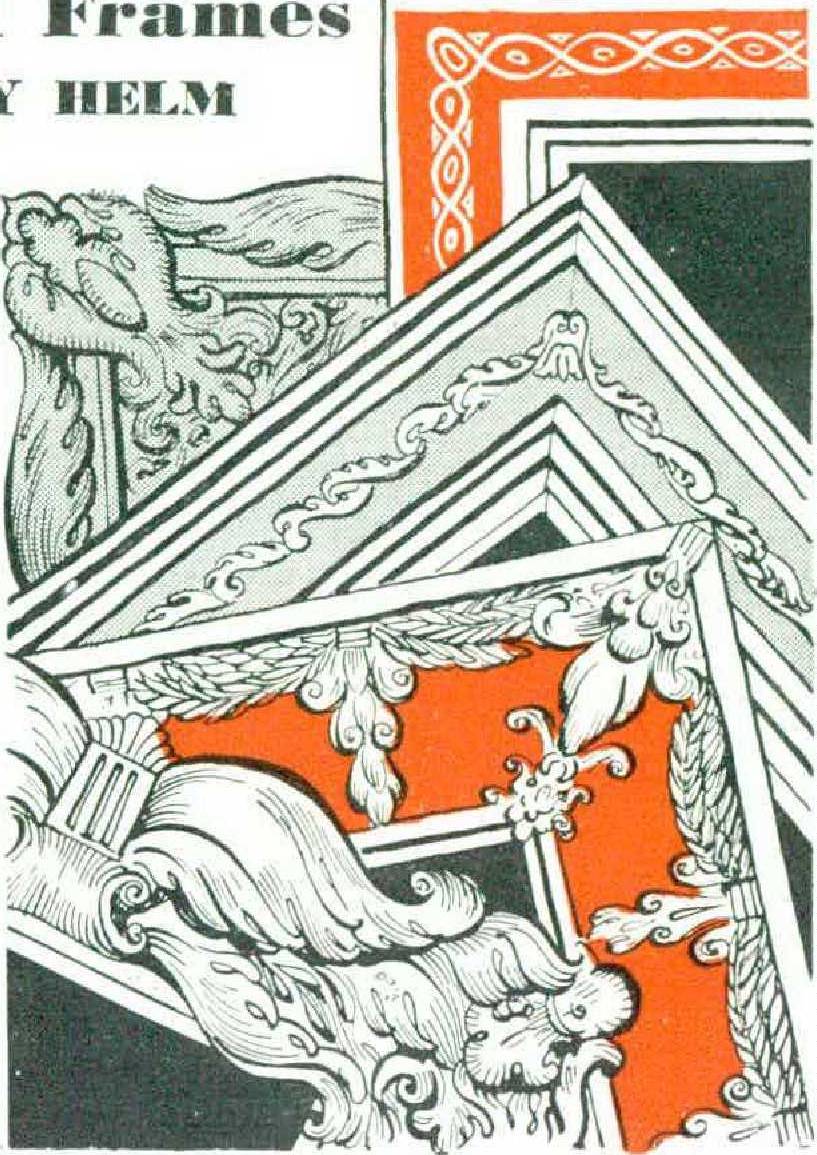
When Italian builders turned from the Gothic style with its pointed arches to follow the flat classical models, the cabinetmakers invented rectangular frames which looked like Greek doorways. Two columns held up a carved frieze of richer design than the plinth. When mitered moldings came into use, the carved fruits and cupids from the earlier friezes often looked odd upside down. On some of the mitered Renaissance frames, inlays of metals and colored ceramics vie with plaster motifs of shields, shells, and flowers. I have seen a hunting scene by Annibale Carracci in a period frame on which wild boars and dogs in gilded relief outrun their flat prototypes in the picture. Yet those frames arouse feeling because they partake of their own epoch’s emotion.
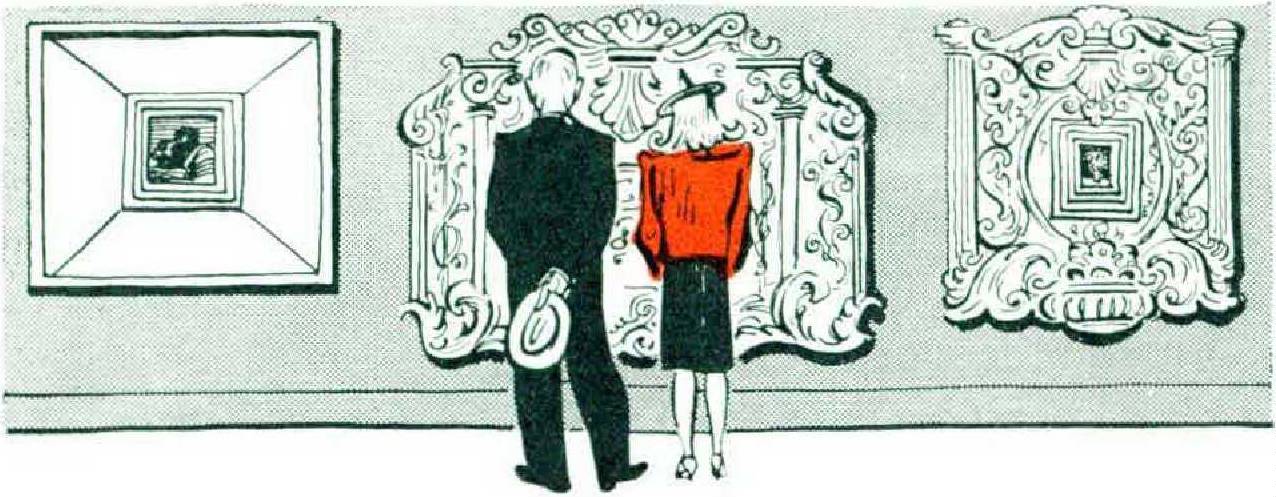
The baroque style soon flowered in Italy, and the rococo in France, and then the designers of frames had their field day. The ubiquitous fancy gold frame of the present descends from a time when baroque architects outlined large spaces of wall with carved moldings and called in the painters to fill in the flat areas. Except in England and Holland, where the old Tudor and Dutch styles called for small pictures in unadorned moldings, flamboyance was the keynote in ornamentation. The works of many romantic French painters, like Watteau, Boucher, and Fragonard, looked well in the fanciful frames; but when the rococo designs were later used to enclose the classical landscapes and portraits of David and Ingres, for example, the result was monstrously out of keeping.
To Ambroise Vollard, a Paris art dealer, must be given the blame for putting the later nineteenthcentury pictures into rococo settings. He showed the works of Cézanne, the iconoclast, in traditional curlicue frames. Other dealers thereupon bought all the old frames they could find, rubbed them down with white lead, for whatever reason, and exhibited all the new paintings in florid surroundings. Those frames, or worse copies, enclose the works of most French and American artists today.
An age which had little dignity in its building could have had none in its ornament. But it does not seem to have followed that with the return of architectural dignity there has been any revival of taste in respect to what goes on at the framer’s. Moldings have been turned out by the score — simple, unadorned moldings of wood and metal which look all right, in themselves, against stucco and steel; but they frequently fail of serving the multiple purpose for which frames are intended. They “contain” the pictures; but how unfeeling they are, and impersonal!
There seem to be not many painters who believe with Whistler that frames do serve some good purpose; yet the people who live with the pictures and look frequently at them discern both a practical and an aesthetic function. A frame, first of all, separates a flat work of art from the flat wall if hangs on, and helps it compete, so to speak, with the three-dimensional objects of the room that it hangs in. Some painters feel that a frame encloses the picture too sharply and prevents its expansion; but for myself— and I have friends who agree — I prefer to have my pictures “contained,” and not expanding and creeping all over the walls.
Beyond the practical purpose of defining the space that a picture inhabits, a good frame provides atmosphere — an ambient air in which a picture can thrive. Unfortunately, most frames cause the pictures to wither.
Today’s correspondence to the great seasons of painting might be found in modernist houses filled with murals by such abstract painters as Braque and Picasso, or Stuart Davis and Feininger. It could be very exciting to live in that kind of house. But most people have to divide the wall space they have (there seems so little in the modern houses) with miscellaneous paintings and prints. It is that mixture of objects which the framer has somehow to bring into the relation of friendship with the house and itself.
When I began to bring Mexican pictures back to the States, I was confronted by this sort of problem: I lived in an illogical house which I happened to like and which I had not the slightest intention of leaving. It had a vaguely French style with high-ceilinged, wallpapered rooms, and in this old house, which yet bore no outward trace of New England, I proposed to hang pictures from a new foreign school.
I dumped the problem into the lap of my friend Boris Mirski, a Lithuanian dealer who keeps a shop in his gallery.
As a boy of fourteen in London, on his way from Vilna to Boston, Mirski picked up a truth through the fabulous medium of the magnified fact. He had grown up with painters and pictures at home, so he had found his way easily to a London gallery where he saw a drawing which he greatly admired. He inquired the price. It was £200.
“How can you hope to get so much for that drawing?” he said to the gallery director. “It is only a sketch on the back of a program.”
“But look at the frame!” the director exclaimed. “ Presentation is everything.”
Years later, in Boston, Mirski set up a shop and began to practice the lesson he had learned in London: that the pleasure of owning a picture is sharpened by giving it all the frame it will take. What he did for my Mexican pictures illustrates the theories he had compounded for the edification of artists whose exhibitions he gave. He developed a style which the catch phrase “out of this world” exactly describes. He gave to new pictures a new world of their own — to each one its mansion. Pictures which at least kept their health in natural wood in my glass and brick house in Mexico City looked homesick among eighteenth-century tables and chairs in a French house in Boston. Yet I could hardly do the place over in Aztec or Mayan or Zapotec style, or even, though I should have liked it, in the Mexican form of baroque unhandily called churriguerresque.
Through Mirski’s researches, I did the second-best thing. I surrounded my pictures with frames which contained hints of the cultures they came from; and if the figures in paintings by Siqueiros, Galván, Tamayo, Cantú, and Meza could remark their surroundings, I should think they would say they are kept mindful of home. The exact meaning of much of the carving, often from Indian sources, may escape the spectator who is used to the shell, the acanthus, the ruffled ribbon, and worse; but I think he will be relieved by the absence of gold leaf and white lead, and see, like the California inquirer, that the framing is right.
Judging from the misadventures of friends, I should say that the good picture framer is as rare a bird in our day as the excellent artist. I have investigated his sources of teaching and found them meager enough. So limited, in fact, is the bibliography of the art of framing that, in one library which I happened to visit, a shelf on that subject contained, in a French volume called Passe-Partout, a novel about a Countess de Casa-Real who, though not virtuous, had some musical taste. On the same shelf, in the book Picture Frames, I found stories. In the absence of handbooks, the average framer goes on using the so-called “French” frames, which are categorically bad however concealed with white lead, or the fashionable moldings of natural wood.
The plain woods are tolerable, though even then rarely distinguished, when the tone of the finish corresponds to the tones of the colors enclosed. Most wood tones are warm and should not be used with cool colors. Painted moldings are better, sometimes with complementary colors and sometimes contrasting hues. The painter’s own colors must not, as a rule, be brashly spread over the frame, lest the original balance of color be rudely disturbed; although I must say that one of my favorite frames surrounds an Orozco with hot reds and vaporous greens close to the artist’s own palette.
I dislike, along with plain moldings, the cloth mats now so much in use with oil paintings. They are used, so it now seems to me, to postpone the impact of irrelevant frames upon the pictures they hold. They are like neutral vestibules where the pictures may pause on the threshold of inharmonious houses. But the doors to the houses stand open, the pictures must enter and stifle. When mats are properly used to protect drawings and gouaches from the glazing, they should receive personal treatment in both line and color.
You cannot, of course, get individuality, distinction, and feeling in twenty-four hours. A good framer builds on acquaintance and knowledge. The frame is his commentary, the result of close understanding. If a painting is all shadow and light, without movement, he must take time to build a still house. If the picture rushes, let him give the frame motion.
To get the idea of what not to do, go to the nearest museum. You will see there a flashing John Marin in a staring white mat and a lifeless white frame, and a quiet, still Rembrandt in whirling rococo.