"...And Selected Short Subjects"
FILMS
By GORDON KAHN
FROM the time of May Irwin’s thirteen-second Kinetoscope Kiss—when everything played in a cloudburst, lit by a plumber’s candle — to last week’s Fitzpatrick Traveltalk, more than a billion feet of oneand two-reelers have snarled through the projector. Enough film to reach from here to Betelgeuse and double back after girdling Elliot Paul and Meade Lux Lewis. Yet, of that entire output, perhaps five — certainly not more than ten — reels have merited anything more than the prudent phrase '. . . and Selected Short Subjects” on the theater marquee.
The first time that standing head came down was for Fight Between Mongoose and Cobra, which was designed as a purely scientific reel. Again, ten years later, in 1933, Walt Disney’s Three Little Pigs, which has not been equaled, even by its maker, was advertised by its title.
An output of advertisable short subjects at the rate of one every ten years gives the producers little to swagger about, but they continue to manufacture 450 titles annually, exclusive of newsreel footage and short subjects under the auspices of the armed forces and the State and Treasury Departments.
Admittedly, nobody is leaving the dishes in the sink to catch the spectacular hoe-down in the sixminute reel called Novak’s Comedy Band, except possibly Novak. And most people can take their Nostradamus or leave him alone. No petition has yet been filed urging Paramount to hurry its release of Pitching Woo at the Zoo. Why not then give the customers their double feature, the current newsreel with trailers of next week’s dual attraction, and have done with the whole gruesome eclecticism of selecting short subjects?
It isn’t that simple. Like the suit with two pairs of trousers, the selected short subject will stay so long as the theatergoer seems to enjoy wearing the original suit and the premium pants at the same time. He wants his show, every last foot of it, particularly since theater admissions have doubled in price in the last six years. Along with his Song of Bernadette he wants Buster Crabbe and Fid D’Orsay in Nabonga; a Who’s Who in Animal Land, an Unusual Occupations reel, and a Puppetoon. If the manager will run Dude Ranch Buckeroos in addition, the customer will hold still for that also.
People who are quiet and patient over some mechanical delay in projection will bay ominously if the exhibitor dares to follow one feature with another without a few shorts in between. In Balaban and Katz tajmahals as well as independently owned bear gardens, the audience wants that segue of selected short subjects to defrost on. Between Gaslight and I Accuse My Parents they will have Hunting the Devil Cat with Howard Hill, The All-Star Melody Masters, and Trifles That Win Wars. And on the way out they will ask what about a Bugs Bunny or a Looney Tune.
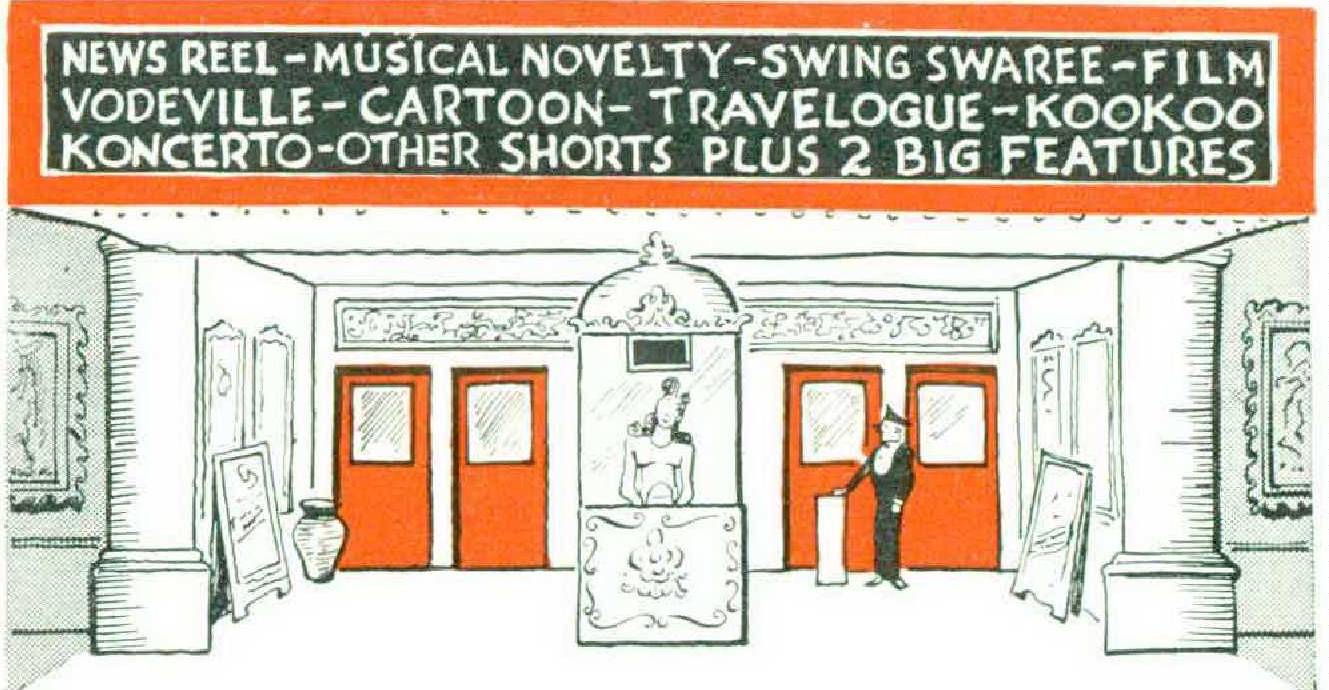
Like the prize in a box of Cracker Jack, “ . . . and Selected Short Subjects” means that there is a little cumshaw—tawdry but not always useless. For every five Puppetoons in which little black Jasper is chauvinistically represented as a handkerchief-head who steals chickens and slobbers over a ham bone, there may be one The Negro Soldier. For every half-dozen Leon Errol and Edgar Kennedy tworeelers that RKO puts out, it releases one of the ”This Is America ” series.
Larded between Double Indemnity and Hat Cheek Honey, MGM’s Nostradamus, in Divination No. 4, may augur through false whiskers and an equally specious script that Hitler is foredoomed to have his throat cut by Heinrich Himmler — all of which he reads in a pious miasma created by pouring henbane over an Alka-Seltzer tablet - but the newsreel saves the show. There is a scene of Marshal Pétain in the accused’s chair during his trial for treason. A close-up shows the hand that signed a million patriots to despair, fluttering like a hooked carp.
Either She Snoops to Conquer or They Stooge to Conga, or both, may be coupled with Laura, but the program still calls for a travelogue. '. . . After the roasting process the coffee is packed in bags and shipped to all parts of the world. . . . And so, with heavy hearts we board the good ship La Cachimba of the Yellow Flag fleet, sailings every two weeks, and bid Aloha Oe to Rio de Janeiro, truly a veritable Atlantic City of the south!” Here again, the newsreel may be a piece of frozen history, perhaps the one which was preceded by the warning title, “Those who do not wish to witness the filming of an actual execution are advised to shut their eyes for 33 seconds.” Those who didn’t, saw Pietro Caruso, the Italian traitor, blasted at twenty paces by a like number of rifle bullets.
In a more recent newsreel, without warning to the squeamish except the title, Death of a Nazi Criminal, the murderer of a wounded American paratrooper was hustled up the steps of a gibbet and exquisitely hanged. The feature that followed was A RoyalScandal and the selected short subjects were Fannie Hurst and Her Pets, and Kehoe’s Marimba Band, a display described as follows by its manufacturers, Columbia Pictures:—
Reg Kehoe and his Marimba Queens are but one of the vaudeville acts on this variety show. Opening the reel in time-honored custom are the acrobats, the Winter Sisters. Following in order come Glenn Miller and his Modernaires, Andy Mayo, made up as “Pansy" the horse, and the featured band brings down the curtain.
Warner Brothers, whose shorts department has been well ahead of the pack in the documentary field, will, however, not be outdone by its rivals who produce filmic vaudeville. Warners’ little afterpiece called Listen to the Hands is described by them as
A medley of four orchestras playing tunes of varied tempos. Glen Gray and his Casa Loma Band play a sprightly number, “Hep and Happy. Joe Reich man gives his version of the “Moonlight Sonata. Skit may Ennis and his crew offer the favorite “Three Little Words.” And Milt Britton winds up with the “Poet and Peasant Overture” slightly swung.
Once, shorts of this type were called “chasers and thrown on the screen in the event of fire or civil disturbance. Nowadays only hunger will drive a patron out of his seat, and he need go no further than the inner foyer, where there is a candy counter heaped with nutritious Turkish Delight and highly vitaminized nut bars.
In the past, when shorts were but one to a program, the animated cartoon comprised the bulk of the minor product. Felix the Cat was the prime character then and he has joined that pantheon of cartoon beasties to which RKO has recently sent the immortal Mickey Mouse. They still have Donald Duck, but Warners’ Bugs Bunny is proving far more popular. MGM publishes Tom and Jerry, a cat and mouse team whose specialty is refined mayhem. This studio also has a shambling cartoon bear who gives the impression that his placket is always open.
Two of Paramount’s attractions in the shorts market are the Popular Science and Unusual Occupations series, which arc photographed in color. A trade publication describes a typical issue:
The items in this reel are many and varied — all the way from São Paulo, Brazil, to the Great Gildersleeve. In between are accounts of orchid growing in Java; an alligator enthusiast in St. Augustine, Fla.; a Cleveland, Ohio, man who makes fish lures from hub caps; and a New York woman who creates personal crests from names and signatures.
Al Capp’s rustic Werther, Li’l Abner, performs in one-reelers for Columbia. Twentieth Century-Fox controls the “March of Time" releases and in its travel reels wisely processes film exposed by scientific expeditions and tourists intelligent enough to aim their cameras where MGM’s Marco Polo, Fitzpatrick, has not yet ventured. In the cartoon division, Twentieth has entered Terrytoons, which must pulse with drama as well as horseplay. Synopsized, the plot of The Cat Came Back reads: —
The Cat, which has been a sore trial to the farmer and his dog, is finally taken for a ride. He returns to plague them, but falls down a well which the farmer boards over and weighs down. Amazingly enough, he finds an escape and stalks triumphantly into possession of the house, while dog and farmer retire in a rout.
There’s the meat of high theater there. One might even say it is a little Wilson.
With a laudable exception, the studios are timid about documentary films, leaving them mainly to private venturers. The studios will cheerfully make “ historicals,” showing how a domestic accident gave us the boon of vulcanized rubber; or how the Mormons were saved from extinction by a flock of gulls that flew a thousand miles inland and destroyed a plague of grasshoppers.
A film like The Fighting Lady plays only once a day in a t heater where Crash Goes the Hash gets four showings. Mouse Trouble wins the Academy Award and With the Marines at Tarawa goes begging. Exhibitors pay handsomely for the rental of Chick-a-Dee-Bom-Bee, but will send back, after one screening, a rent-free War Department reel.
This, in the face of appeals such as this: —
THE BATTLE FOR THE MARIANAS! Free at your Warner Exchange. Show this 100% filmed-underfire two-reeler at every performance! Made by Marine Corps combat photographers, The Battle for the Marianas is filled with actual scenes of Jap snipers at work — Jap mass suicide — Jap civilians under combat conditions. Start it going now! Show it at every performance! Do this for America!
In the same publication which printed that, an exhibitor in rural Indiana responded, “These OWI subjects were supposedly produced to make the public war-minded. They had better close the book on this outfit. . . . As for us, we run no more of them. It is still a free country and I’ll use my own judgment of what I will show my public.”
There’s evidently a man who selects his own short subjects shrewdly. With All This and Heaven Too he may well have shown Bugs Bunny in All This and Rabbit Stew.
Thirty Seconds Over Tokio with Junior Jive Bombers.
Little Clayton the Farmfront Wonder with Dragon Seed.
Delinquent Daughters with To Heir Is Human.
And for that big Founder’s Day quintuple feature, Rhapsody in Blue and I Got Plenty of Mutton.