Yes, I'm Tired
Accent on Living

By PAUL HOLLISTER
THERE is a tradition in American radio, a working credo, that when one side of a matter in controversy is declaimed on the air, the other side of the controversy is offered equivalent air-time to present its case.
A piece appeared in the Atlantic for August cudgeling radio because some of the commercials one hears on the air do not suit the writer of the piece. The moot piece was by Lewis Gannett. He has been on the air occasionally too, but not by trade. For he is a first-rate book reviewer on the New York Herald Tribune, a paper which does not flaunt its affection for radio.
The paper has good, clean, strict rules about what it prints. And (as the footnote to Mr. Gannett’s piece says) the book reviewer is “widely respected for the critical integrity which has always distinguished his daily column.”
That, one would not think of impeaching. What he says about this or that book is all right with me, even if I were to write the book he belabors. But when he leaps sidewise out of his critical specialty to scold radio, then I suspect, he is just another fretful citizen who has got into print because he is an articulate specialist in something else.
How Mr. Gannett reads several books a day, and writes a thousand words of sober review a day, and runs the book section of the Herald Tribune too, and finds time to listen, let him explain. But in his piece in August he says that he came back from six months abroad and got snowbound for two weeks and had to listen to radio. He doesn’t say how long he listened. His sensibilit ies were shocked because he heard some crass commercial pleas about laxatives. He gathered that we are “a nation of sufferers from acid stomach, chronic headaches, inadequate elimination, and general physical incompetence.” It is important that his own precise words be quoted, because they are in fact words and phrases which would not be permitted on the air of any leading radio network in America. So what he “gathered,” he interpreted in his own drastic vocabulary, and then he put into the Atlantic untidy words that are actually not permitted to be broadcast.
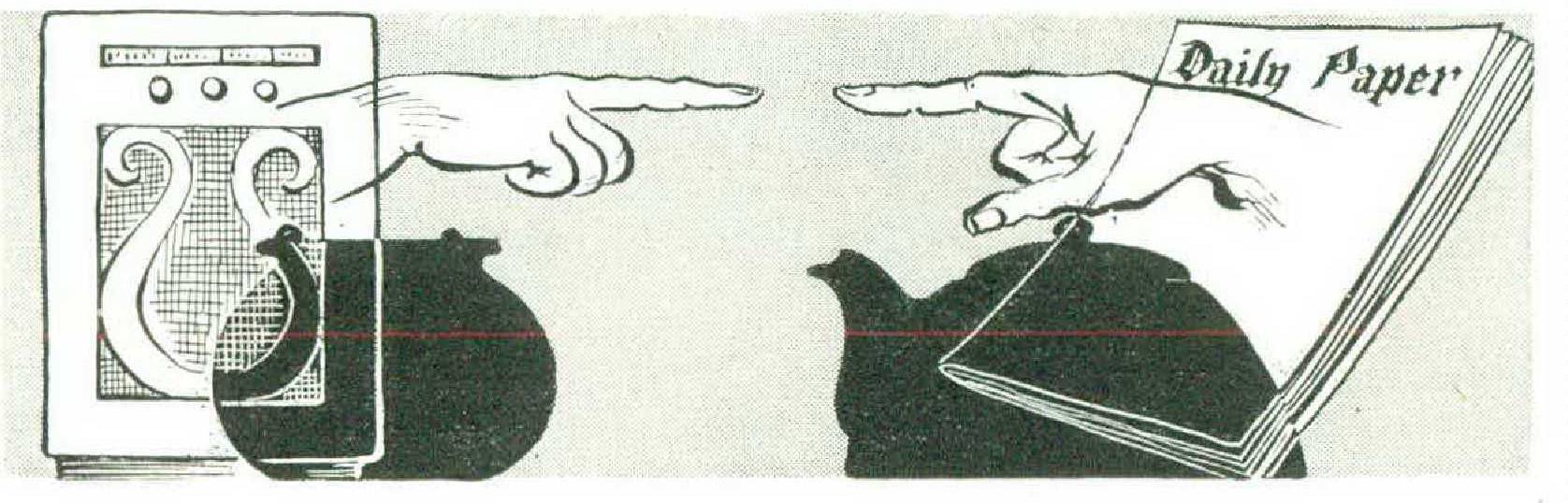
I hope Mr. Gannett doesn’t shock too easily, for reading his own Herald Tribune of September 21, 1945, he would have had a conniption at the following typical sequence of news and advertising, separated only by a hairline so thin I can’t measure it on my ruler: —
Major G—— was graduated from Rensselaer Polytechnic Institute. . . . The engagement was announced this month. The only way to find a whiskey like [Brand] is to try [Brand].
And, in the same issue: —
CALLOUSES! In “Jungle Ways” he described the accomplishment (of eating human flesh) complete with recipes, adding: “The meat tasted like good, fully developed veal. . .
And in the issue of September 20: —
“As the need arises, I shall desire to call upon you for help and counsel. Very sincerely yours, Harry S. Truman.” There’s a youngster who knows her Ex-Lax!
And in the issue of September 19: —
At the Downtown Hospital, 129 Broad Street, his condition was described as serious. Away Go Corns. Instant Relief.
While Mr. Gannett was listening and seeking offense from the commercials (which by common consent and strict rule, too, are confined to considerably less than 15 per cent of the broadcast time of any program on the four coast-to-coast networks) he evidently did not choose to hear the other 85 per cent of the program. If he had, he would have heard world news of momenl, comment of some sober enlightenment; music ranging from Rodzinski, Toscanini, and Koussevitzky to James, Krupa, and the Dorseys; lyric from Ives to Crosby to Melton, from Thomas to Smith to Sinatra, from Munsell to Pons to Farrell; laughter from Allen to McCarthy to Howard to Durante; drama from Hayes to Barrymore — and so forth. In his fortnight snowbound, Mr. Gannett had fielder’s choice of 4 networks × 9 hours × 14 days = 504 hours of the longest a la carte of good listening ever offered for the spiritual emancipation of a slave of the press.
Your present correspondent will bet $100 against a fine timepiece made of red brick that Mr, Gannett didn’t listen even 50 hours in his fortnight. He pretty certainly did hear a handful of dingy spot commercials delivered with the vocal unction that seems to please a lot of people and drives your current correspondent insane, for Mr. Gannett concludes: “The only way to escape the constant oleaginous chatter on these topics was to turn off the radio altogether.”
Another way to escape would have been to go out and shovel snow, peel some potatoes, straighten up his desk, or make himself otherwise useful around the house. But he is of the Drastic strain: all or nothing that is, “All to my taste or nothing.”Dictatorial. Burn down the barn to get rid of the mice in the hayloft, declares Mr. Gannett. I will have none of your delicious shad, says he, for there might be a bone in it.
Of course what pains him is that he wanted so mightily to listen. He says, “I heard a stirring news broadcast, slide into the disease mood” — just as his own paper “slides” from news to advertising through a hairline. He does not say, “I heard a commercial which I am too wise and grumpy to take seriously suddenly burgeon into a truly stirring news broadcast.” I wish that Nielsen’s Radio Index, with one of its recording machines hitched onto Mr. Gannett’s radio, had made a chart of his fortnight called Snowbound, so that we could sec exactly what stations, what programs, Mr. Gannett listened to and tuned out in a huff.
He said he wrote a piece (after he had come home) to the general effect that returning veterans would be pretty shocked to hear commercials on the air. (As a matter of fad soldiers abroad complained a good deal about familiar shows because their equally familiar commercials had been deleted.) Mr. Gannett says he got many concurring letters about his piece. One was from a veteran of World War I, who agreed with him, and who said the matter was “more important to the future of this country than the San Francisco Conference.”Mr. Gannett said the World War I veteran “proclaimed: I would be proud if shot for having written it.’” Tall talk.
By a strange coincidence, anot her ret urned veteran, but a veteran of World War II, expressed himself on exactly the same matter five pages after Mr. Gannett’s piece, in the same August issue of the Atlantic. He said (see page 122, CBS advertisement); —
“We have long been in countries where ire didn’t understand the language, and later when we were in Germainy, not only were we unable to understand the language, but the faces were hostile and sullen. You don’t know what it means to hear language that clinks sweetly in our ears —to hear commercials on the radio and in all it means America to us.“
The speaker was General Dwight D. Eisenhower.
The Genera! doesn’t like tough commercials any better than anybody else. But they don’t “sicken” him. He probably limes them out mentally, as we all have learned to do. Nobody likes a sour note at a line parly. That is why the networks proscribe many topics which find ready acceptance in many a “selfrespecting newspaper or magazine.” The code of the National Association of Broadcasters is very oldmaidish and cross and proper in this matter; the individual codes of the networks are still more rigid. CBS, for instance, simply won’t take programs advertising laxatives, just as a matter of mood — nor any other remedy for the less attractive human ailments or bodily functions. This doesn’t make CBS and Mr. Gannett old prisses; both know anatomy.
But when the learned book-critic Gannett cries, “And if more of us stood up and shouted what we feel as we hear, night after night, the shoddy nastiness of everyday radio commercials, the industry would listen,” he is get ting a little mite shrill. Why? Maybe because his platform is shaky. Thirty-three million American families have come to depend on radio programs put on by advertisers like those who support the Herald Tribune and the Atlantic, and by networks and some 900 stations. Those families, who add up to 90 per cent of all the families there are in our commonwealth, are extraordinarily swifl and perceptive in listening and reacting favorably or unfavorably to what they hear. They don’t have to quote Herbert Hoover as of 1924 and 1925 to support their case, as Mr. Gannett had to. They don’t see the slightest analogy between the service of their radios and the service of billboards, as Mr. Gannett does.
Instead, and in fact, they have created the ideals and standards of desirable and eager acceptance by which the program-makers are primarily guided. They are the U.S.A. The listeners are so far ahead of Mr. Gannett in the matter of keen listening, gracious appreciation, and smart adverse criticism, that your correspondent can’t help feeling a little wistful about him, snowbound so far away from the public pulse.