Light and Shadow
By PATRICK MORGAN
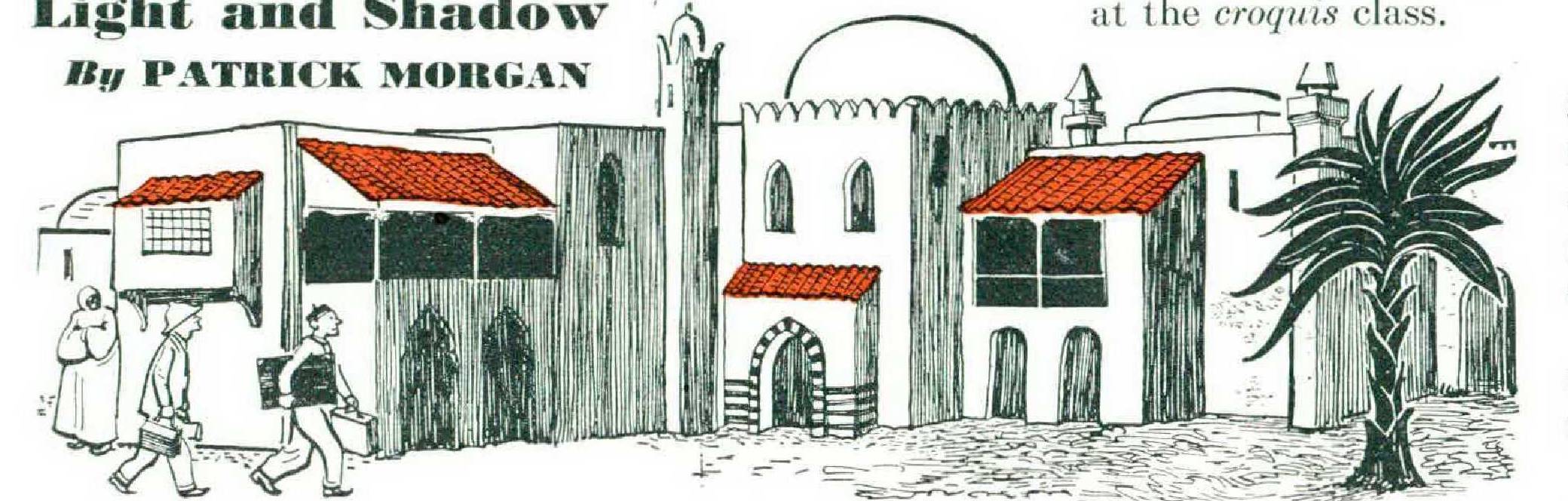
AMDHA was the son, the eldest son, of the high priest of the village mosque. He was also our next-door neighbor. When we rented the house, neither Whitney nor I realized we were moving right into the best Arab neighborhood. There were no agents to build up real-estate values and no Tunisian Times with four pages of attractive homes available in better districts. We merely took the only house on the market, and happened to fetch up between the citadel and the sea, with the high priest on one side and Mamma Djema (an aged one who kept chickens) on the other. Beyond Mamma Djema’s was the tomb of a local saint.
Amdha met us the first day we wandered through town, and asked in broken French if he could show us about. We said, “No, thank you, we prefer to get lost,” and he said, “Comment?” and I said, “N’importe,” and he said something in Arabic and walked off. Whitney said he didn’t see how a league of nations could work under those conditions, but I didn’t argue, because I knew Whitney wanted to be a writer and therefore felt language was the best means of communication, whereas I wanted to be a painter and felt something else.
The day we moved in, Amdha again met us at the town gate and took our suitcases.
Settling in was no trouble. We had no bureaus, so we left our clothes in our suitcases and put James Joyce’s Ulysses, a Dostoevski novel, and the bottle of Italian vermouth on the mantelpiece. There were bedclothes in a closet, and after making our beds we walked back along the beach to the hotel for supper.
The next morning, Amdha climbed over the wall that separated our courtyards.
“It seems we have a visitor,” Whitney called in to me. I was pulling my paintbox in order. I came out, and Amdha suggested that we take a walk to the olive gardens. But we explained that we had both decided to work instead. Whitney went in to sharpen some pencils.
“What is your work, Monsieur?”
“This,”I said, handing him my sketchbook, which opened right to a page of nudes that I had sketched at thecroquis class.
“Monsieur n’a pas mal tout vu!” he said, staring at the page. “The Koran says we should not draw people at all, not even animals.”
“Well, Amdha, ours is more lenient,” I answered, taking back my sketchbook.
“Or more vague,” Whitney murmured in English from the window where he was sharpening pencils.
I turned to a fresh page in the sketchbook and began to draw the banana tree that shaded our court. Its leaves, even the new shiny ones, were shredded to bits by the wind. Their strange tattered shapes belonged to a scene of poverty and destitution, but their brilliant green denied pathos. I thought how unfortunate it would be if Picasso had painted his blue pictures in banana-leaf green, and said idly, “I wish banana leaves were blue.”
“That is a strange wish,” Amdha replied. “Allah has made these leaves invariably green.”
“Perhaps it is just as well. At all events, I could always paint them blue.”
Amdha looked at me with deep suspicion.
The days soon organized themselves into a pleasant monotony. Amdha checked in every morning over the garden wall. Whitney worked in the courtyard, I in the upstairs room that overlooked the sea. We met for lunch, which was invariably lamb, ingeniously disguised by our native servant’s skill. We worked after lunch till late afternoon, then took a walk, usually accompanied by Amdha.
One afternoon Amdha came in early. “Why is your friend always writing so many letters? He must have a broad acquaintance.”
“Those aren’t letters, Amdha,”
“What are they?”
“Stories,”I said.
“But there have been more stories already written than a man could read.”
“And more paintings than a man could see. But he and I hope to crowd the market still further.”
“Why?”
“How should I know? Amdha, you ask difficult questions. Why don’t you stop talking and pose for me? I shall paint a portrait of you.”
He was obviously pleased. “Then,” lie said, “there will be two Amdhas.”
So Amdha came regularly every afternoon. He stood by the window and stayed, on the whole, very still.
I made several sketches in pencil before starting out on a large canvas. I decided to paint him against the grillwork of the window, in a strong side light. The white walls bounced the light back, reflecting into the shadows, so there was no danger of getting dead areas in the darks: and since I had been following the idea of diffused light, I felt this would give me a good workout . I knew it would not be easy to manage, but it was worth a try.
I painted nearly two weeks before Amdha asked if he might see the painting.
“What do you think of it?” I asked.
“There will indeed be two Amdhas,” he said. “When you finish, there will be two. I can see that.”
“I don’t believe I shall do much more. I must heighten the colors out the window. Then I think I shall leave it.”
“You will leave the face as it now is?”
“Probably.”
“But, Monsieur, as it now stands, there is one side of the face light, the other much darker.”
“Mais oui,” I said, “and that modeling is what has taken me much time and care.”
“But one side of the face is dark, the other not.”
“Because of the light from here. So all this is in shadow. And these are reflected lights. Together they give the modeling of your head.”
“I do not understand.”
“The variation in light and shade gives the look of roundness. That is all.”
“But that is not real to make the head partly light, partly dark.”
“Look,” I said, and went over and posed where he had been. “See? Here my face is light, and here there must be a shadow, no?” I felt Amdha was being unusually dense about this thing.
“Yes,” he said, “I see, but still your face is all one color, and so is mine.”
“But it isn’t all one color in this light.”
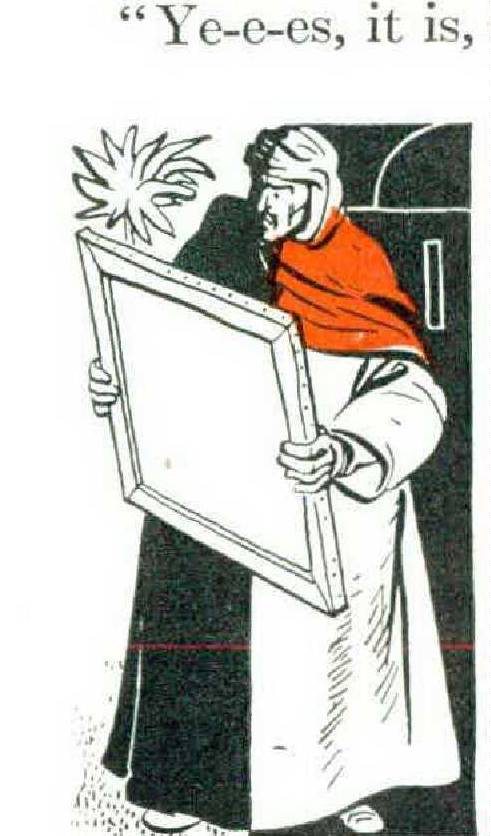
“No, not in that light, but it is one color.” “Ye-e-es, it is, if there is no shadow on it.”
“And you have painted a head that is not of one color. Such heads do not exist.”
“Amdha, it is because of the shadow.”
“Regardless, my face is of one color, I am certain.”
“I can no longer paint,” I said. “I shall clean up. Then let’s take a walk.” Obviously Amdha would never understand.
And he never did. At any rate, he never came to see us again.