The Eagle
Accent on Living
By CAPT. T. McKEAN DOWNS
IT WAS May of 1943, and Battleship Y was anchored at an advanced base in the Aleutians. As dawn broke, the harbor was shrouded in fog, its usual condition. Our nearest neighbors were hidden; in fact our own jack was invisible from the quarter-deck aft. Suddenly there was a light splash in the distance, off to port.
“Did you hear that, Boatswain?” asked the Junior Officer of the Deck.
“Yes, sir,” was the reply, “and I can’t just figger it out. Sounds as though someone threw somep’n over the side of one of the other ships, but it seems to me like they’re too far off for us to hear it.”
“Oh, well, it probably wasn’t anything. Perhaps one of those seals dove and made a noise. If it was a man overboard, he’d yell.”
Gradually the light grew stronger, and presently the fog lifted a little. To port, where the splash had been, something was floating — something evidently alive, for occasionally it struggled convulsively. Even with his glasses, the Officer of the Deck could not make it out. Most probably it was nothing important; but during war, he must make sure.
“Boats, send the whaleboat over and see what that thing is.”
“Aye, aye, sir. Awa-a-ay the wha-a-a-aleboat!”
A short run brought the boat to the floating object. From the ship, we could see the coxswain lean over and lift something from the water. A bird of some sort.
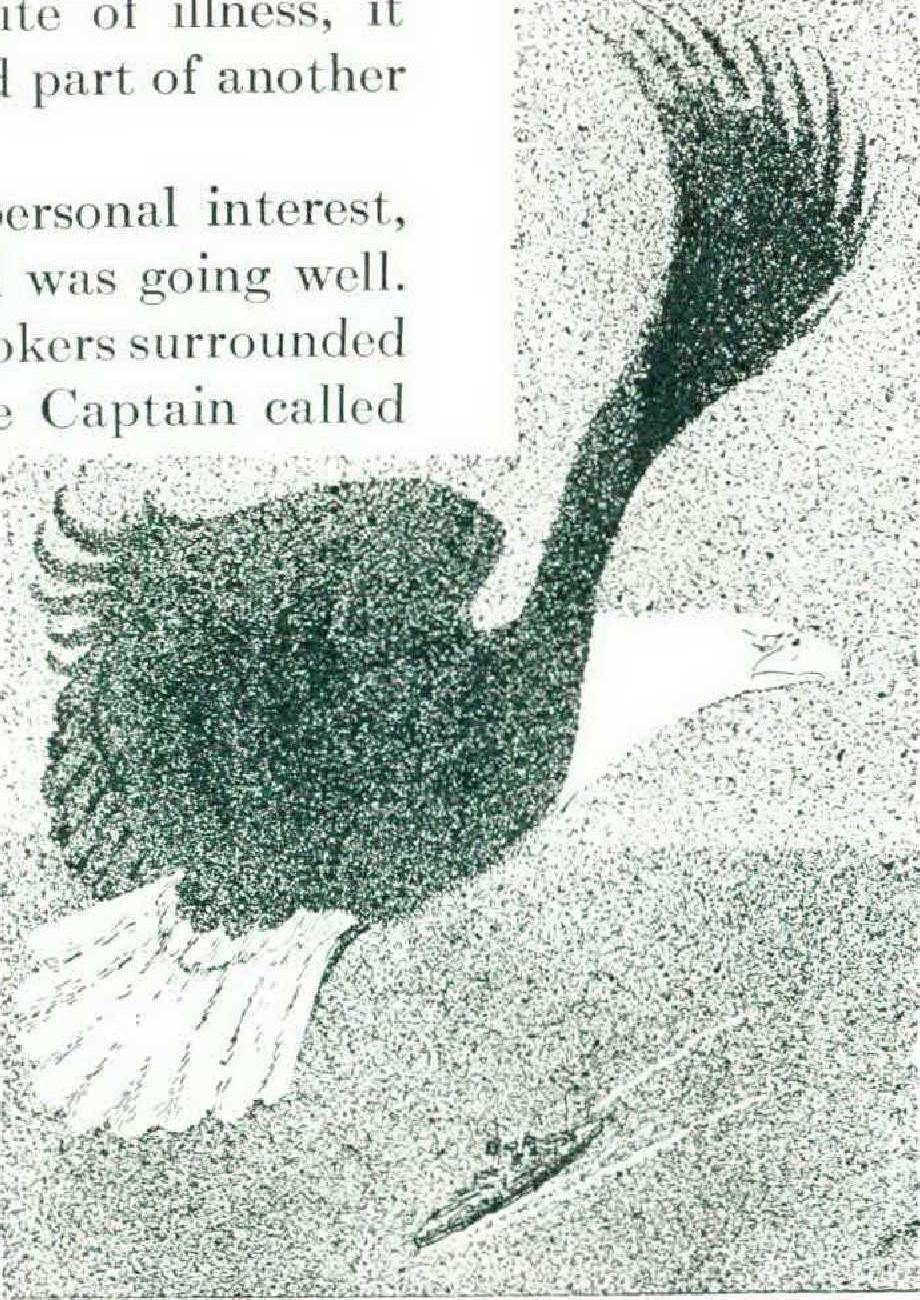
His boat once more secured to the boom, the coxswain scrambled on board with his flotsam. It was a gigantic bald eagle. But it; seemed to have been a waste of his time to rescue it. It was still alive, and occasionally drew a gasping breath, but it was chilled through, its feathers soaked with icy water. It lay limp on the deck, too weak to raise its head.
The word spread through the ship that we had made a rescue, and the crew took charge of our castaway. A crate was soon found for the eagle and made soft with empty flour sacks. There was considerable discussion whether to carry it below. The majority voted against this. If the bird should recover, it might be confused and bewildered in the depths of the ship; better to leave it topside, where it; could see. So a place was found under an exhaust ventilator, where the warm air from below could dry its feathers and warm it, and yet the patient would not feel trapped and confined.
While this was going on, a messenger had been dispatched to the sick bay, for this was obviously a case for the Medical Department.
The patient, I found, was a magnificent specimen of the Alaskan bald eagle, half again as large as the variety that is still occasionally seen in our Eastern states, but emaciated to the highest degree. Though I can claim no skill as a doctor of eagles, it was not hard to make a diagnosis. The emaciated body and weakness pointed to starvation, and to that were added exposure and submersion.
But how did it come to be Starved? I was a little uneasy about making a complete physical examination, even of a bird so nearly dead as this one was. Its talons were long and needle-sharp. A convulsive movement in expiring would be enough to drive them deeply into an examining hand. But the chance must be taken. Turning it over, I found its left foot to be swollen and hot. There was evidently an abscess.
The sequence of events was clear. By an accident, a stone bruise had been caused in the foot, infection had set in, and the abscess had developed. Tenderness and pain had prevented the use of the foot in hunting; so from starvation and fever the bird had rapidly weakened until it. could no longer keep the air. Probably it was during a last desperate effort to find food that the broad wings had collapsed this morning, letting it fall helplessly into the water.
In the draft of warm air from the ventilator, the patient’s feathers were rapidly drying. The violent shivering stopped, and the bird recovered enough strength to lift its head from the deck. It was time to tempt its appetite with a little food. Beef we had on board in abundance, but it seemed too heavy a diet for such a feeble patient. How could it tear a Navy steak into mouthfuls? As usual in matters of special diets for the sick, the Supply and Medical Departments worked in close cooperation, and a Storekeeper solved the food problem by breaking out some cans of salmon. It proved an excellent choice, for it was soft and digestible, and could be torn apart without effort.
The bird was ravenous. In spite of illness, it polished off a whole can and a good part of another before its hunger was satisfied.
Everyone on the ship took a personal interest, and had to see for himself that all was going well. A constant circle of inquisitive onlookers surrounded the sick eagle’s quarters: even the Captain called in person. For the benefit of those on watch, frequent bulletins were issued and carried by word of mouth to all parts of the ship.
“He must be feeling better; he just raised his head.”
“Ain’t he a big fella, though.
Imagine if he got them claws in ya!”
“The Doc says there’s somep’n wrong with his foot. They may have to operate.”
“I betcha he’s gonna get well. Why he’s stronger a’ready.”
Word was eventually passed that the operating room was being set up and that one of the Pharmacist’s Mates thought the patient’s condition was encouraging.
“You better cure him,” said the Main Battery Assistant. “That bird’ll bring us luck.”
And indeed, he expressed the universal feeling. Our bird was more than a patient: he was a symbol. Everyone on board believed that in some mystical way victory depended on our eagle’s life.
Neither I nor any of my assistants had ever operated on a bird. We need not have worried — it went like any other operation; in fact we had less trouble than with many human beings. Besides being a prize patient, the eagle was a most cooperative one. He submitted to being carried below, down ladders and through narrow passageways, without a movement.
When I saw him brought into the operating room, he was alert but quiet. No one had thought to cover his head, with its strong curved beak, or his feet, with their great talons, and I was appalled at the damage he might have done in a moment of alarm. But it was as though the eagle knew what we were doing and agreed to it, for he made no effort at self-defense. A quick stab of a lancet released the pus, and I felt that with reasonable luck the patient would get well.
Recovery was rapid. In a day or two the bird had gained strength enough to stand, and the abscess was healing. He bore his weight on either foot indifferently. His muscles filled out. with plentiful feeding, and the ridge of his breast bone was no longer the knife edge it had been at first.
The crew made plans for going into battle with the eagle perched on our foremast, and detailed a Machinist’s Male, who claimed a knowledge of falconry, to make a pair of jesses to control him by. Until now, our patient had not been confined at all. His weakness had been so great that no restraint was necessary. Later he seemed to know and to show affect ion for the Boatswain’s Mate who had appointed himself principal nurse. We did not expect him to leave us, but. felt it wise to take precautions. We had visions of our mascot becoming as well known as that famous eagle “Old Abe,” whose duty was to lead one of the Wisconsin regiments into battle during the Civil War.
But the jesses were never used. The fourth postoperative day was sunny, for a wonder. The bright afternoon sun and gentle breeze proved more alluring to our mascot than thoughts of unlimited canned salmon. On a sudden the enormous wings were spread, and with a leap the eagle was again in the air. A seaman standing by jumped to intercept; one wing tip brushed his face in passing, but he could not grip the slippery feathers.
Upward the eagle soared in circles, riding an ascending thermal current until he was apparently no larger than a sparrow. Then turning toward the sun he disappeared behind the western mountains and was gone.