Gadgets
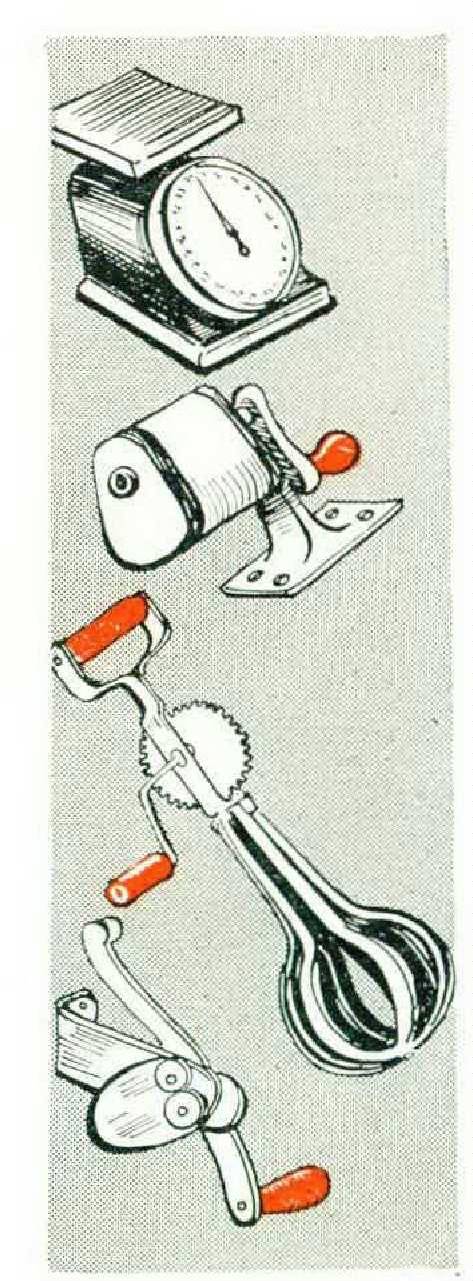
A GADGET (slang) is “a contrivance, object, or device” for doing something. That it’s usually a labor or time saver does not mean that it needs to be tricky; nor does it have to do several things at once or turn from one thing into another or disappear into a wall. So long as it does something, it is a gadget.
It’s true that Americans produce more gadgets and use them more lovingly than any other people on earth. But it’s also true that Americans have always been entirely serious about them. Inspired by a native urge to escape work or trouble, Americans usually fashion their contrivances to do something useful. And in order to be useful to as many people as possible, the gadgets they devise are usually produced as cheaply as possible and distributed as widely as possible. The desire to display ingenuity for its own sake has seldom influenced our gadgetry.
Inventors in other countries have often surpassed us in creating what most people think of as gadgets, but most of these devices have remained no more than novelties and all but useless. In the Victorian Age, during the first violent upsurge of invention and the first general dip into gadgetry, the English produced an astonishing array of tricky mechanisms. Descriptions of them appear in the catalogues of the Great Exhibition of the Industry of All Nations, held at the Crystal Palace in London in 1851. Here are but a few of the English gadgets on display during that fabulous event: —
A collapsible piano for a gentleman’s yacht.
A portable expanding chair. By moving the thumbscrew in the seat it is raised to any suitable height; by moving the other screw it is made to fold up altogether.
A new willow sofa-bed-chair which may be used as a bed, a sofa, or a chair, and only occupy the same space as an ordinary chair.
A table convertible into a bedstead, wardrobe, bed table, suite of drawers, seat, closet, and sponge bath.
A patent portable barrack containing a chest of drawers, a washhand stand, dressing table and glass, iron bedstead with curtains and bedding, reclining chair, towel horse, writing and dressing ease, and having sufficient room in the drawers to contain a complete military outfit, the cases at the same time forming a wardrobe,
A window cleaner for the protection of female servants from fatal accident and public exposure.
A fire-escape dressing table intended to be always ready and in instant motion without the least preparation. The first motion of raising the table top opens the window and lets down iron blinds to any number of lower windows.
Registered silent alarum bedstead. The movement of the hand of a common watch will turn anyone out of bed at any given hour when attached to his bedstead.
A pair of safety swimming stockings and a safety swimming swan to assist persons in escaping from shipwreck.
A medical walking-staff, containing an enemasyringe, a catheter, a test tube and test papers, a pair of forceps, a number of wax matches, and a pill box, divided, containing in each division pills of various medicines.
One more item should be mentioned because it was a favorite with the audience. It was a metal mechanical mannikin which could be expanded or contracted in any part of its frame to suit the precise measurements of any man. It was designed to facilitate the fitting of army uniforms.
The English press curled its lip in disdain at the pedestrian American display which had to compete with all this in the Crystal Palace. It could not find much that was worthy of mention, except a portable bedstead, lamented in one of the English papers as “a terrible instrument for the contemplation of householders with a large circle of familiar friends, since it pretends to enable people to carry their beds about with them as now young ladies carry their roll of music,” and a somewhat bizarre musical instrument described as “a pianoforte with aeolian attachment, a wind instrument of the softest and most delicate tone, so united to the pianoforte that the same keyboard controls both instruments and either one of the two may be used or both together blended in delightful and undistinguishable harmony.”
The American “centripetal spring chair,” however, which was made of metal and could be raised or lowered and revolved on its axis, drew applause. “America,” wrote one of the journals in elucidating the charms of the centripetal chair, “has long been noted for the luxurious easiness of its chairs, which combine in themselves all the means of gratification a Sybarite could wish. Certainly we have never tested a more easy or more commodious article of household furniture.”
The essential difference between the English and American exhibits at the Crystal Palace was not the degree of ingenuity each displayed: it was the motive behind it. The English were sufficiently pleased with the trickiness of their gadgets for the tricks alone, and insufficiently serious about wanting them to save trouble or add to the comforts of life at the same time. In all probability, not one of the British contraptions I have mentioned ever saw actual use in a real household by an ordinary person. Americans, on the other hand, worked earnestly all through the Victorian Age to devise things, regardless of trickiness, which might cut out labor or add agreeable features to the hours which were free from it. Having done this, they proceeded to produce them in huge quantities.
James Bogardus, in the 1840’s, founded a highly successful business in cast-iron building structures. His prophetic and long-forgotten buildings were put up with the greatest of ease by unskilled workmen — and they could be demounted and moved.
A series of Americans, notably Isaac Singer, perfected and promoted the sewing machine and made it cheap enough for any moderately well-to-do family to own. Singer’s shipping container, which upon arrival turned into a sturdy piece of furniture with the machine attached, was in itself no mean contribution to gadgetry. An immediate result of the wide distribution of sewing machines was the development of the inexpensive ready-made clothing industry, an exclusively American institution for years, and one of the greatest labor savers of all time. For a long time, the building trades had used a contrivance known as a hoisting platform; but it took an American named Elisha Graves Otis to devise a safety gadget to keep hoisting platforms from falling unexpectedly, and to produce that time, space, and step saver, the passenger elevator. When Otis gravely demonstrated the functions of his elevator to the crowds at the American Institute Fair in 1854, it was justly the sensation of the day.
By the early 1850’s, Americans were making and selling for moderate prices both ice and iceboxes. It was the English who first developed modern plumbing devices, but the Americans set about installing bathrooms in all new houses, to save the trouble of hauling water up and down stairs in pitchers. They perfected a cheap oil lamp which everybody could own in quantities. Not content with the warmth of fireplaces or even Franklin stoves, they developed heating stoves so efficient that people all but perished from the high temperatures in Victorian parlors. They soon figured out that one larger heating stove in the basement could just as easily do the work of several, thus introducing the furnace. S. S. Pierce pioneered in readycooked food as early as 1848 by selling canned Maine corn to Boston housekeepers.
It was this American accent on comfort and convenience - not for just a few people, but for many people — that impressed European travelers in Victorian America. That’s what caused them to admire so extravagantly the early Pullman hotel cars. Plenty of running water to wash with and comfortable beds made up with clean linen sheets might have been luxury enough. But what enthralled them most was the chef preparing hot coffee, casserole dishes, omelets, and other delicacies.
And that’s why they called our early hotels, led by the pioneering Tremont House of Boston (1829), “palaces of the people.” It wasn’t the gilt and the marble, or the velvet carpets, or the profusion of expensive mahogany, that earned their praise. It was the low price of the 180 rooms, every one with a key of its own to ensure each man’s privacy. It was the public reading and writing rooms and the bathing floors; and finally, it was that wonderful gadget, the “annunciator,” which enabled a guest up on the fourth floor to summon a fleet-footed “rotunda man” in two minutes.
American talent seems thus to have run, not to original invention, but to making useful inventions available to large numbers of people. Ironically, we are still regarded by the rest of the world as a people incurably susceptible to useless innovations.