Talking Birds
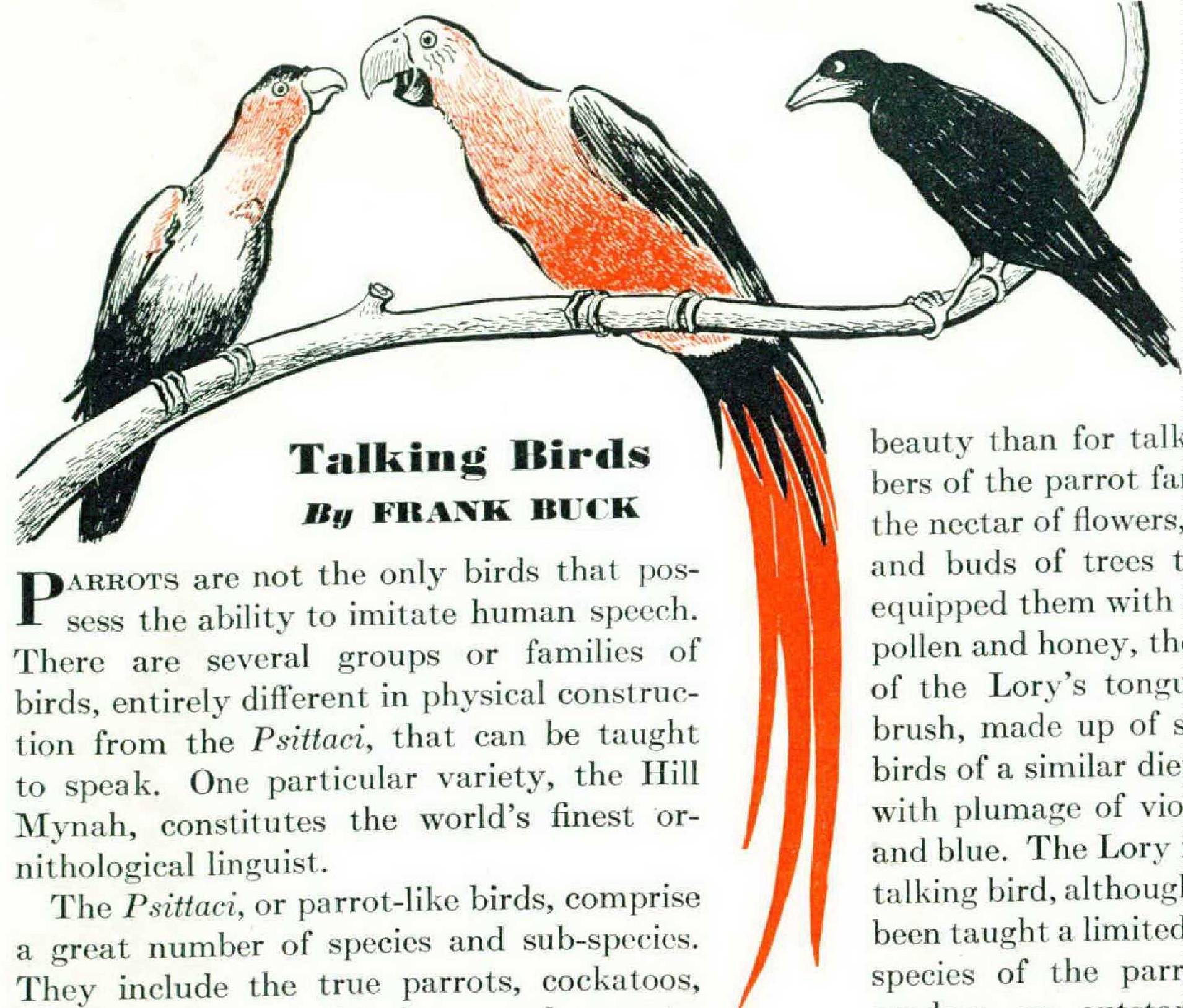
PARROTS arc not the only birds that possess the ability to imitate human speech.
There are several groups or families of birds, entirely different in physical construction from the Psittci, that can be taught to speak. One particular variety, the Hill Mynah, constitutes the world’s finest ornithological linguist.
The Psittaci, or parrot-like birds, comprise a great number of species and sub-species.
They include the true parrots, cockatoos, macaws, lories or brush-tongued parrots, and numerous varieties of the smaller parrotsparakeets, cockatiels, lorikeets, and lovebirds. Many of these — even some of the small varietiescan be taught to talk, or at least speak a few words.
Most fanciers consider the African Gray parrot the best of all talkers. This rather somber-colored bird from Central and West Africa has a reputation not only for a clearer enunciation and a greater vocabulary than any other of the parrots, but also for the capacity to utter longer sentences.
The green parrots of South and Central America — usually referred to by dealers and fanciers as the Amazons — run the African Gray a close second in vocal talents. There have been some outstanding examples of great talkers among these parrots, and some authorities even consider them fully equal to the African Gray.
Cockatoos do not, as a rule, compare with the true parrots as linguists, But if taken young they can usually be taught a few words, and occasionally they have developed into remarkably fine talkersparticularly some of the larger varieties, such as the Great Sulphur-crested, Salmon-crested or Moluccan, and the Slender-billed Cockatoo.
The Macaws, largest and most ornate of the entire group of parrot-like birds, are great favorites among fanciers. These birds are usually kept for the sake of their beauty rather than as talkers, though I have noted a few of them with a vocabulary of a dozen words or so.
Lories or brush-tongued parrots, like the Macaw, have a greater reputation for beauty than for talking. These handsomest members of the parrot family live almost exclusively on the nectar of flowers, with occasional fruits, berries, and buds of trees to vary the diet. Nature has equipped them with a unique method of collecting pollen and honey, their main items of food. The tip of the Lory’s tongue is furnished with a sort of brush, made up of short, bristly hairs. Like most birds of a similar diet, they are very highly colored, with plumage of violet, purple, red, yellow, green, and blue. The Lory is not usually considered a good talking bird, although specimens of this variety have been taught a limited vocabulary. Yet, as with most species of the parrot group, which occasionally produce an outstanding talker where least expected, one out of many hundreds of Lories may develop into a bird of exceptional ability.
Some years ago I was returning to Singapore from a trip to the outlying islands of the Dutch East Indian Archipelago. I had spent several weeks in the Moluccas, Ceram, Flores, and other islands collecting birds. The forward deck of the little Dutch trading boat on which I was traveling was crowded with crates and cages containing one of the finest collections I had ever made. At Macassar I went ashore and visited the local bird bazaar. In one of the cages on display was a Yellow-backed Lory, a particularly fine specimen of this unusually handsome variety with its brilliant scarlet, yellow, and green plumage. As I walked over to the cage, the bird piped up in his shrill voice, “ Apa macham mana boleh? . . . Tidak apa.” A rough translation of this sentence from Malay into English would be: “How can this be? . . . Oh, never mind.” This outburst was surprising, as I had never known a Lory to speak more than a word or two.
I remained by the cage for almost half an hour listening to the many Malay words and expressions the bird used. After considerable bargaining with its Javanese owner, I bought the bird, and later in the day it joined my collection on board ship.
Later at my headquarters compound at Singapore the Lory became a great pet with everybody in the camp and also a star performer for numerous visitors who dropped in from time to time to see the many wild animals, birds, and reptiles there awaiting shipment to America. It took this exceptionally clever bird only a short time to pick up English, which he soon spoke as fluently as he did Malay.
By the time my talented Lory finally reached America he had developed into the most charming pet and one of the finest talkers I had ever possessed. He had forgotten most of his Malay, and not only could speak several complete sentences in English, but could whistle a few bars from the national anthem.
The smaller parrot-like birds can seldom be taught to speak more than an occasional word or two. However, fanciers with a great deal of patience coupled with a natural love for these birds have succeeded in teaching them a short sentence or phrase and a sufficient number of words to make them highly interesting pets.
Among bird fanciers it is considered a great accomplishment to breed the rarer and little-known varieties that have never before been reared outside their natural habitat. I. D. Putnahm of San Diego, California, was the first breeder to rear successfully the beautiful little Hooded Parakeet of Northern Australia.
In 1937 I brought back to this country eleven Hooded Parakeets, the first specimens of this splendid little parakeet ever to reach these shores.
Four pairs of these birds were sold to various fanciers— one in New York and the other three pairs in California. But the remaining three birds, two males and one female, I turned over to my friend Putnahm.
In the wild state this parakeet has the unusual habit of breeding in the nests of termites or white ants, making a burrow in the side of the anthill and hollowing out a chamber at the end. Because of this habit these birds will not use nest boxes, hollow logs, or other containers ordinarily used for breeding parrot-like birds in captivity.
The four different fanciers who had each purchased a pair of the Hooded Parakeets at the time of my arrival in America with them had all tried every way they knew to breed them. Also a number of fanciers in England, where importations had arrived from time to time, had failed over a period of many years to induce these rare parakeets to nest. Putnahm, however, by the use of still clay plastered over a form made of wire netting, constructed a duplicate of an Australian anthill, with a hole left near the top giving the birds access to the hollow inside of his “anthill.”
This did the trick. In a little while he noticed the female going in and out of the hole carrying grass, moss, and other nesting material. Since then he has raised eighteen or twenty of these beautiful, exotic parakeets. His custom is to allow the hen to mate with one of the males, raise a clutch of young, and then put her with the other male for the next clutch, so that the young will not all be full brothers and sisters and future matings will not be too closely related to produce virile stock.
Crows, while poor substitutes for the exotic parrot-like birds, have been taught to imitate human speech, but in every instance that I have known they have barely gone beyond the “Hello” stage. I have heard many stories of various species of the Corvinae family having been taught to speak more or less fluently and distinctly, but I am still skeptical.
During the several years that I had an animal headquarters and show place at Amityville, Long Island, my helpers each spring would bring in a number of fledgling crows taken from nests in the
woods which bordered our property.
These birds were carefully raised and a great deal of pains taken in an attempt to teach them to talk, but only two out of twenty or more ever got beyond the “Caw” or crow-call; one of them on care occasions would say, “Howdy,” and another would sometimes call out, “Chow,” when the keeper arrived with food. But many people contend that all members of the crow family can be taught to speak.
The Corvinae are almost as numerous in varieties as the Psittaci and they are found on every continent on earth. In size they range from the big European raven down to the black and white magpie of our Western plains country.
The most dependable and reliable of all talking birds are the Hill Mynahs. There are several varieties of these birds, the largest of which is the Javan Hill Mynah found in Sumatra, Java, and Borneo. This bird is the finest talker of them all; in my opinion it surpasses even parro’t-like birds in this respect.
If birds are taken in the fledgling stage, when they are about ready to leave the nest, they become tame in only a few days, and after a month or two they usually begin trying to imitate sounds and noises that they hear frequently. A young Mynah, barely out of its pinfeathers, will try to imitate a cock’s crow. He will try time and time again and improve as he grows older, until eventually it is difficult to tell his imitation from the real thing.
It is the same with whistling and with the spoken word. The birds learn quickly to imitate everything around them and are almost constantly whistling, singing, or talking. They seem to take great pride in their accomplishments. I have raised hundreds of these Hill Mynahs from the nestling stage at my compound at Singapore and brought them back to this country for zoos, the pet-shop trade, and individual fanciers.
My Malay boys once returned from Borneo with about three hundred fledgling Mynahs and a half dozen mature birds that they had picked up at Pontianak, the principal port on the West Coast. These mature birds had been raised by native Dyaks as pets, and had been purchased directly from their owners with a few beads, pocketknives, and other trade goods carried along for that purpose. They were all fairly good talkers.
I picked out the best one of the lot and put it into a roomy bamboo cage which was hung on the veranda. The Mynah had no sooner settled in his new location when I heard a distinct and clear Malay voice shout, “Bawa makan,” which is Malay for “ Bring food.” It is the usual expression one uses with Malay servants when calling for breakfast, lunch, or dinner to be served. The order, “Boy, bawa makan,” is one of the familiar sounds of the Far East. At first I thought it was one of my Malay servants shouting to someone, but after the call was repeated several times I walked out on the veranda and found my new Mynah bird stretching his neck and shouting at the top of his voice for food in his best colloquial Malay.