Any Caddies?
By BETTY HICKS
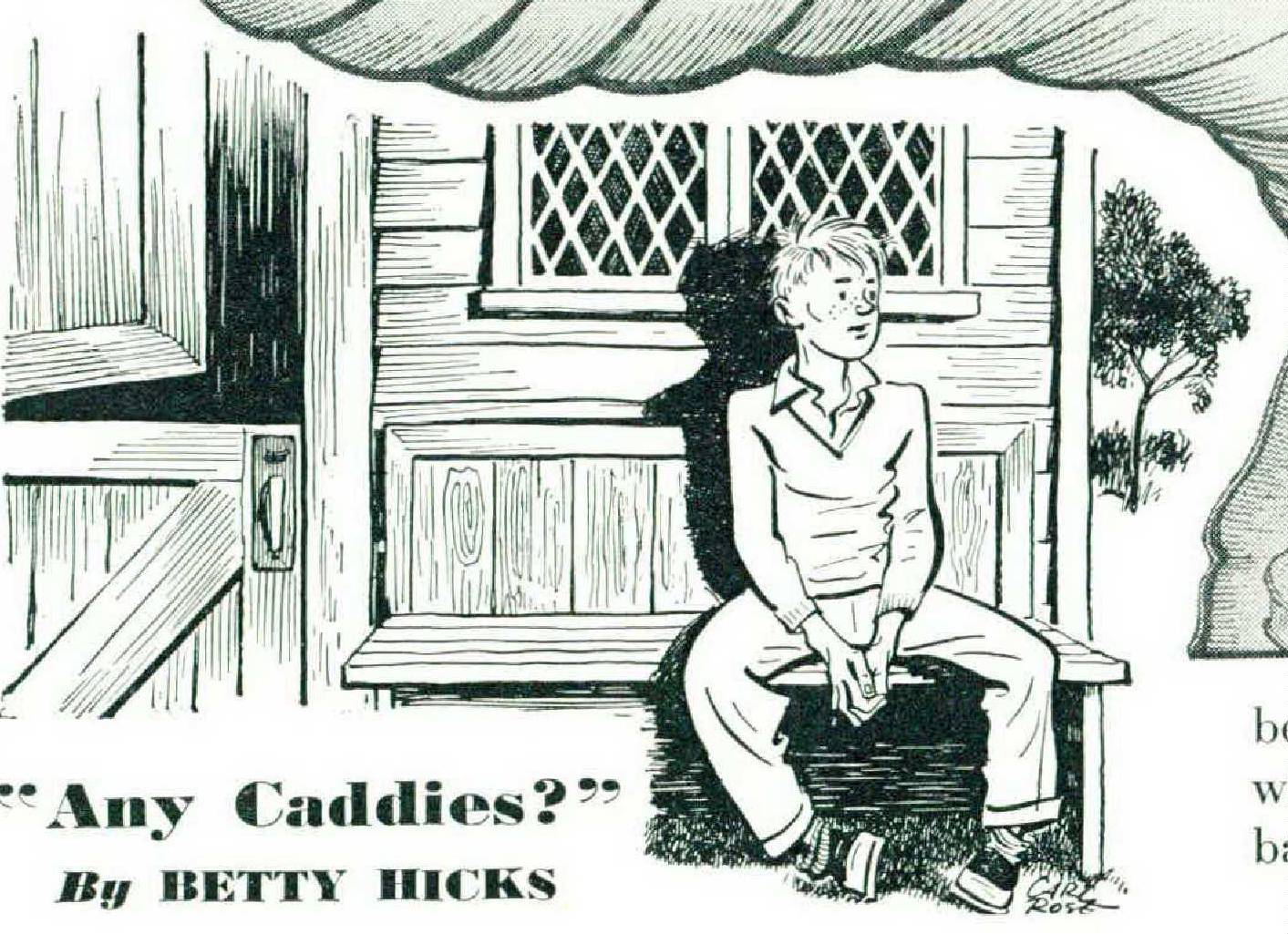
CADDIES, I had no reason to doubt in my early golfing days, were boys who carried a player’s clubs. Since then I have learned of their amazing versatility.
“Red” was the first to march behind me in a tournament. He impressed himself upon me indelibly by telling me once, when I had just shot a 98, that some day I would be a very fine golfer if I practiced and could only improve my disposition. Bed worked for me during the summer of 1938, when I developed a passion for playing thirty-six holes a day. He retired from caddying soon after that. Dad assured me that he, too, would willingly retire on a pension equivalent to what he paid Red for trotting around the course with my clubs on his shoulder.
Fortunately for Red, he was spared the agony that befell his successors. Outside of my efforts in the club championship of 1938, which fell short in the semifinal, he didn’t have to suffer through many matches with me. Laurence Yockey did, and I have no doubt his life will be shorter as a consequence.
My swing is even now no symphony of motion. And in ‘39 it resembled an illustration from one of those “Tied in Knots” liniment ads. It pained me, mentally and physically. It pained Laurence, too, who had been around golf courses for some time and knew just how the Royal and Ancient Game should be played. So he would tell me, not at all tactfully, what was wrong with what and why I didn’t hit the ball right.
I would promptly become angry, not because I was criticized, but because that dearly beloved, if slightly recalcitrant, swing was being dissected before my very eyes. It was all I had in the world. How could he treat it so cruelly?
Then I’d say to Laurence, “O.K., I’ll practice,” and we would walk solemnly to the practice tee at the foot of the hill, and I would start knocking shots up the valley for him to chase. But Satan would tug at my backswing and I would slice a shot far off in the woods to the right and up the hill. Laurence would scurry after it in a cloud of dust and flying eucalyptus leaves. Then Satan would laugh gayly and I would hook the next one up on the hill to the left, 200 yards from where I had hit the first.
Laurence caddied for me in three tournaments. One of them, my first, was a magnificent success. The other two were pitiful failures, much to the delight of my opponents and the ladies who gathered in the locker room to unlace their shoes and their tongues.
Laurence took the tournaments in stride. After all, I was young and likely to shoot 77’s in he second round and 89’s in the third round. I still do, sadly enough. I was also likely to win tournaments. He no doubt contributed materially to my first, championship by delivering a pep talk just before I was about to putt.
The tournament was the Long Beach city championship, and the gallery was local and therefore impatient with local talent. We had to discontinue the pep talk thereafter. The critics said it was too lengthy. But I thought it was wonderful. It sounded just as though Laurence were playing catcher for the Junior College baseball team (which he did).
It went something like this: Come on, now. You can do it. You’re ‘way ahead of her. Stroke it easy. Relax. Take three deep breaths. You’re the kid can do it now. You’ve got this one in the bag.” Little did the gallery realize the psychological import of those words, as we stood there in solemn conference each time before I putted.
He was a great caddie in all, and I’ve since regretted those moments when I not only strained his patience but ripped it from its very moorings. He has graduated from the caddie ranks now and has two daughters. He vows neither of them will ever be a golfer.
Bruce of San Francisco was also cruelly frank about my game. Commented Bruce as I vainly attempted to solve the intricacies of putting the greens of the Olympic Club, “You can’t putt a nickel’s worth!” He said it as though he were shouting to a lowly sinner from the pulpit, his voice charged with all the threats of Hell.
Caddies often prove to be remarkable correspondents as well as conversationalists. One lad in the Middle West, who hadn’t even caddied for me, wrote me the following letter after I won he ‘39 Western Medal Play in Chicago: —
CHARMING MISS E. HICKS:
Congratulations to you of the hightest extent. That was swell. Was thinking and hoping you could do it.
To bad you can’t hit the ball. Every time you complain of your game you play well. Well more cup and Nationals to come and I am sure you are the one to watch.
His contribution to my golfing career was a beaded rabbit’s foot named “Fuzzy.” With the rabbit’s foot came this note: —
Also in the mail is a rabbit’s foot I got way up in Quebec, Can. It’s from an old Indian pro who said it was his putting luck piece. I caddied for him in a tournament and he gave it to me. You can have it if you win either the Western or the National. If not you won’t want it I guess so then you got to send it back. That’s of course if you ain’t to busy. If you are you can throw it away but I would like it back if it don’t help out any. Not that you need it but faith plays a big part. A little thing like that may help along. Do take it and keep it near by. And by all mean’s putt well.
Yours in waiting hope,
KENNY
Ralph was the spirit of Palm Beach, ebony model. When I first saw him on the first tee at Palm Beach Golf Club, with my bag on his shoulder, he was conservatively attired in a bright green cap, purple satin shirt, yellow pants, and blue shoes. He caddied for me in two Palm Beach championships. I won the first one and he was waiting for me the next year, in faith believing, wagering his purple satin shirt and week’s wages that I couldn’t be beaten.
As I paid him after the match that provided my quick exit from the championship another caddie yelled from the caddie yard: —
“Did ja win?”
Ralph turned to him and shrieked, “Did we win? Man, you know what happened to the Hindenbug?”
I paid him eight dollars for the tournament and practice rounds. He counted the money laboriously. “Two mo’,” he said finally, “and Ah’d have made back what Ah bet on you.”
Ralph’s appraisal of my game was cruel. I won the ‘40 tournament at Palm Beach with some golf which I recall with a shudder. I dragged my weary feet through every sand trap on the course, dodged palm trees, and startled sun-bathing Palm Benchers in the privacy of their own back yards with my wandering tee shots. Ralph endured it all silently until the tenth hole of my semifinal match with Betty Jameson.
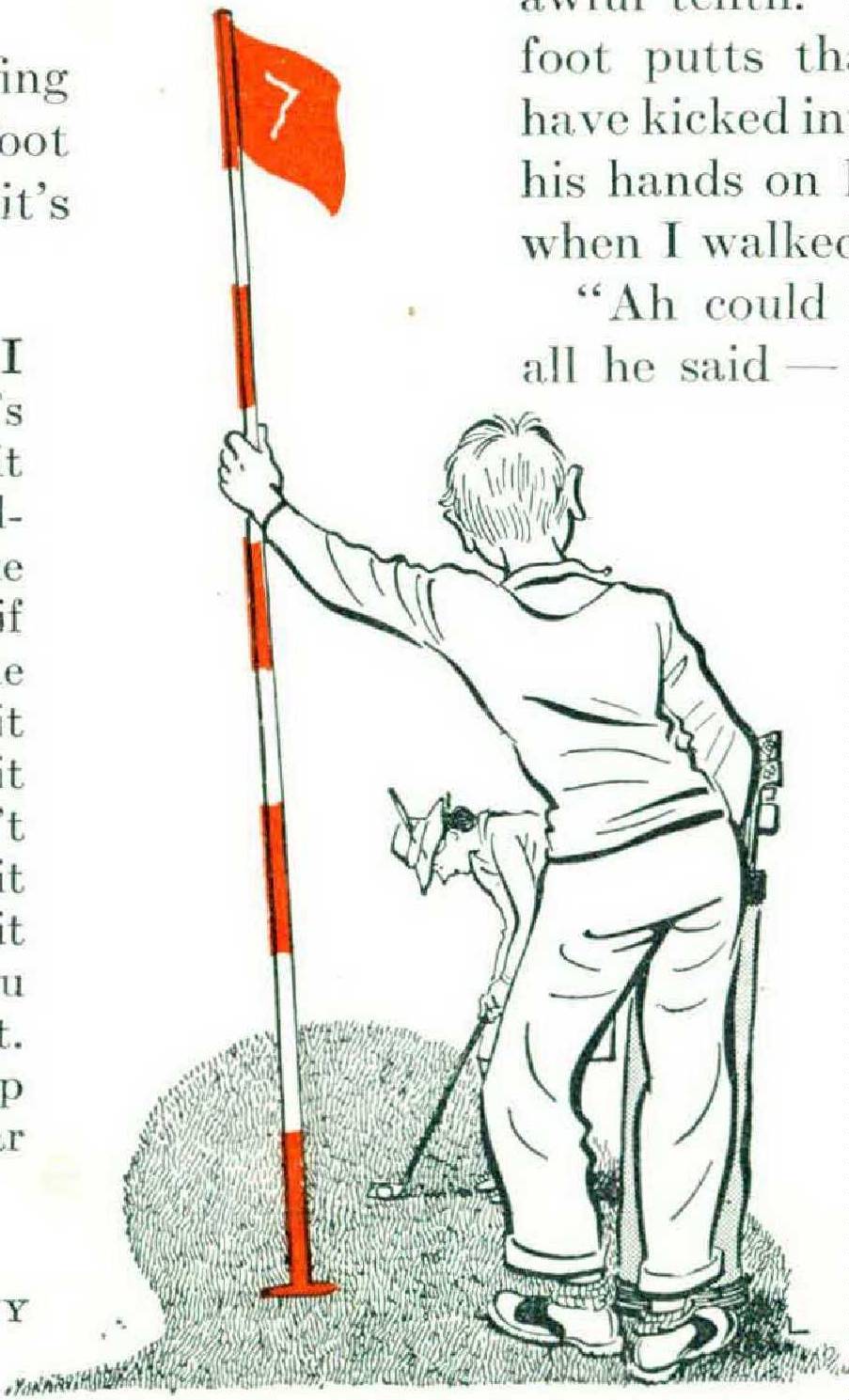
Any casual onlooker would have suspected that Betty and I were bosom friends, endeavoring to lose as many holes to each other as was possible and still break 100. Ralph’s patience wore through on that awful tenth. There Betty and I both missed onefoot putts that any normal three-year-old could have kicked into the hole. Ralph was waiting for me, his hands on his hips, anger trembling on his lips, when I walked off the green.
“Ah could do bettah than that mahse’f!” was all he said — then and for the rest of that nightmarish 23-hole match.
At Ormond Beach I was assigned “Old Frank,” and throughout the week of the 1940 South Atlantic championship I was grateful that I had been. Old Frank was stooped and wrinkled. Just what percentage of his years his forty-odd of caddying were I wouldn’t know, and that was one bit of information about himself he didn’t volunteer. But there were facts Old Frank emphasized like a small boy writing “I shall never say ain’t” on the blackboard one hundred times.
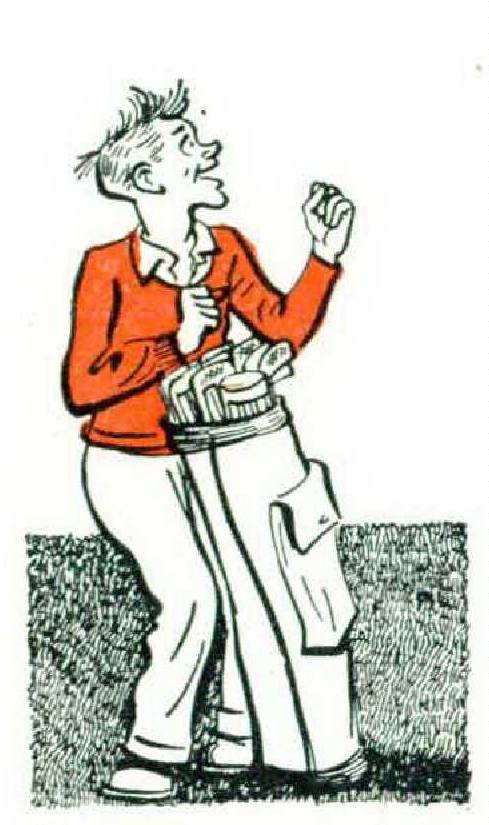
First, he had a son studying to be a doctor. This he repeated with increasing sentimentality as the closing day of the tournarnent approached and with it his pay. Secondly, there wasn’t one square inch of Hotel Ormond Golf Course that he didn’t know, because he had been there before the course was built. Just what he learned about the layout in its prenatal days is something I never could quite figure out. But Frank was convinced of the importance of that knowledge. And third, there wasn’t a thing about the game of golf that Old Frank didn’t know. He dispensed without charge as much of that store of information to me as was possible within a space of ten days.
I won the tournament with the best scoring I’ve ever done in competition. I credit it to Old Frank’s infallible knowledge of the course, however, and not to his remarkable theory on the swing. I can’t remember anything about his lectures — except that I know that my swing did not answer his dream of perfection, but that wasn’t remarkable. My swing never satisfied anyone except my professional, who was reluctant to admit that the silk purse of his teachings had turned into a sow’s ear.
In the caddie’s opinion the player and he are a team. The feeling varies in intensity with different players, but never with the boys. It’s always “we” with them — “we” won today, or “we” parred that tough seventeenth, or “we” sure hutched up that putt on the tenth.
One eager Negro was completely carried away in his corporate concern for his player’s success in a tournament in Carolina several years ago. The player wasn’t exactly championship caliber. She struggled valiantly enough through the tournament, but without much success. (One never gets put completely out of a women’s tournament. There are consolation matches for those beaten in the first round, and then consolations for the unconsoled.)
The caddie was courageous and patient. “We’ll do better tomorrow,” he would tell her.
But tomorrow was never better. Finally, on the last day, the girl walked to the first tee and announced to her caddie that all would be well for that round.
“I had a dream last night,” she said gayly, “and now I know just what was wrong with my swing.”
But there was no cure. She went from tee to traps to woods to traps to rough and back again in an exhibition of why Hell is paved with golf courses.
On the twelfth hole she beat away frantically at her ball in a sand trap, with no more obvious results than much flying sand. The ball finally condescended to bounce feebly over the edge of the bunker on the eighth stroke.
The colored lad handed her the putter and shook his head sadly. “That wasn’t such a good idea we got in bed last night, was it?” he said sympathetically.
Probably the two best caddies I ever had were a Scotchman named Bryce McCabe and a young Irishman, Dennis O’Leary. My partiality might be colored by the fact that I never lost a tournament with Bryce caddying for me, and that Denny proved a Rock of Gibraltar throughout the national championship at Brookline in ‘41.
I remember Denny best as I saw him, at the end of that tournament, rushing up to me with a picture in his hand, exuberance of victory bristling in the blondness of his crew haircut. “Would you sign this, Miss Hicks?” he asked, thrusting at me a photograph taken by the Associated Press of himself and me after the second round. I signed it.
I wrote: “To Dennis O’Leary, the better half of a very lucky team.” And I meant it. No caddie ever contributed more to any player’s win than he.
If he was perturbed at my errors any time through that week, he wisely never let me know it. He knew every hill and bunker and stone and blade of grass and grain of sand on the Country Club course, and his knowledge was my advantage. He knew my game as he would his own — not once during the entire eight rounds of the tournament did he give me the wrong club or inform me incorrectly as to distance. But above all, he had that priceless intuition which so few caddies have —that of knowing when to speak and when to keep quiet, a sixth sense of feeling toward a player’s mood.
Bryce was my home-club caddie from the summer of ‘39 until he went into the Army the last of 1941. He was a slender and wiry boy in his middle twenties, with a profusion of curly black hair and an unsurpassable loyalty. I had the unhappy habit of going East or South and being nothing short of sensational. Then I would return home and promptly get my ears pinned well back by some of the local stars. Unless, that is, Bryce was around to say, “C’mon, this is just like the old days.”
He would swing the clubs over his shoulder and we’d go out to practice — eight hours a day, six days a week. Sundays were occasions of relaxation, with only an 18-hole round to keep in the swing of things. He’d toss balls at me on the green and challenge me with: “Bet you a package of peanuts that you can’t get these all down in two putts.” I’d try, but I wasn’t a very good putter. I’d miss on one of the long ones, inevitably.
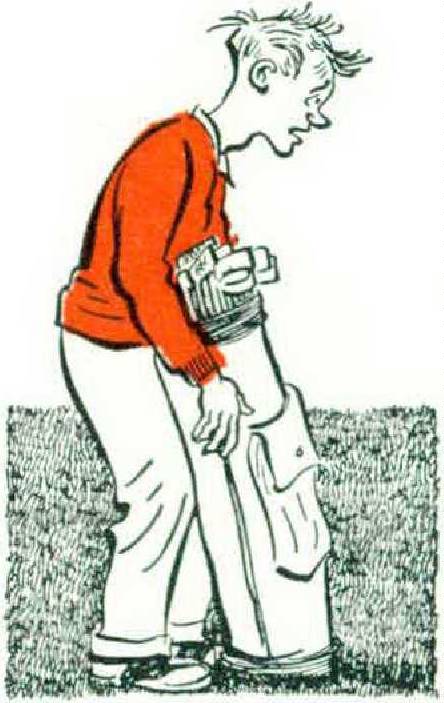
“Double or nothing?” Bryce gave me every chance.
“Double or nothing!”
I went East in the summer of 1940 owing him 2,097,152 packages of peanuts.
He never gave me the pep talks on the greens during tournaments that Laurence used to, He’d just say, “Gurgle, gurgle!” Perhaps he’d laugh then, if we were just playing a practice round. Or maybe he would say it in deadly seriousness as I was stepping up to an important putt in a tournament. Or maybe he would write it to me when I was in the East playing the big tournaments. “Gurgle, gurgle!” sounds silly, but how else would one describe the delightful noise a ball makes dropping into a hole? It was purely descriptive and designed simply to stimulate my interest in knocking 30footers into the back of the hole, when I needed them or when I didn’t, just for the sheer joy of hearing the ball rattle against the inside of the cup.
“O.K. Knock this one in the back. Gurgle, gurgle!” We never considered ourselves even partially insane. Just enthusiastic.
