Lambs Like Grease Paint
By CONSTANCE COLLEIER
I AM devoted to animals; in fact, if I had to choose another profession, I believe I should be quite a success as a kennel maid. But it was a lamb, not a dog, which dominated the greatest happening of my stage adolescence — my first appearance in a leading role.
I was very young and was walking on with the famous actor-manager, Wilson Barrett, in the revival of a Biblical play in which he had starred for years. This play was a “historical pastoral" and called for quite a quantity of curly lambs on stage; actually, Barrett made his first entrance costumed as a shepherd (mainly in a goatskin) and tenderly carrying a lamb with a supposedly broken leg.
One day, during this run, the leading lady was taken ill. There was chaos in the theater. The understudy was found to be in bed with the grippe. The management was in despair and thought it would have to close the theater for the week. But I had taken it on myself to learn every part in the piece.
I timidly offered my services. The stage manager looked surprised, hut he was willing to try anything in the emergency. He gave me a quick run-through, found out I could just manage it, and notified Mr. Barrett. I rehearsed all day with the company. Mr. Barrett did not appear.
At that period, the theater really belonged to the actor-manager. Barrett, for instance, wrote his own plays, directed them, and acted them.
No member of his company spoke to Barrett unless he spoke first. He was a short man with a big head, and he wore his hair like a lion. On the stage, he gave the impression of great height, because he wore unusually tall lifts in his boots. This unbalanced him somewhat, so that he walked stiffly, as if on stilts. Aware of this, he had the habit of standing quite still in the middle of the stage and letting his actors do the moving, with the result that most of them played with their backs to the footlights. He was adored by the female members of the audience and was a true matinee idol.
Pale with excitement at the opportunity of playing opposite this great Star, I rushed out and bought myself a whole new set of make-ups. Returning to the theater. I found myself promoted to the leading lady’s dressing room. I felt like Cinderella going to the ball. I arranged the fresh grease-paint sticks in a row on the pink dressing table, under the big cheval glass surrounded by electric lights. I stayed there through the late afternoon, trying on clothes and saying my lines over to myself. Then, a large bouquet of flowers arrived from Mr. Barrett. I was thrilled. I couldn’t eat anything and my temperature must have gone up several points, I think. The stage-door man sent me a cup of tea and a bun.
I was fully dressed and made up by seven o’clock, though the curtain did not go up till eight-thirty. Suddenly, there was a knock on the door. The assistant stage manager entered, with a small white lamb in his arms. He told me it had to stay in my dressing room during the performance. This, he said, was customary, as the lamb had to get used to the leading lady, so that it would not be frightened of her on the stage.
He explained that, as the play was so successful and ran on and on, the lambs had an inconvenient way of growing into sheep and had to be discarded. They were then given away, with blue ribbons and bells round their necks, to adoring admirers, who kept them as lifelong pets. The one we were to use that night had, as a matter of fact, outgrown its part; so this one had to be got ready for the following week.
At the moment, this all seemed a little disconcerting; but the lamb looked so sweet and helpless that my heart melted. I did not know much about lambs, except Mary’s immortal one that went with her everywhere and had such exemplary manners.
But poets are entitled to poetic license, as I found to my cost. For a minute, after we were left together, the lamb and I stared at each other. Then it gave a leap as if it had been shot, and raced round the room, eventually landing on the top of the wardrobe. The old lady who was dressing me couldn’t get it down, so I had to. I tried to pet it, but it jumped over everything, like a mountain goat, and finally retreated into the cupboard.
I did not dare to shut the cupboard door, for fear it might stifle.
Abruptly, bringing me back to my coming ordeal, the orchestra outside struck up. There was a rap on the door: “Beginners, please.” My heart was beating very high as the dresser and I slipped out of the room, carefully locking the lamb inside.
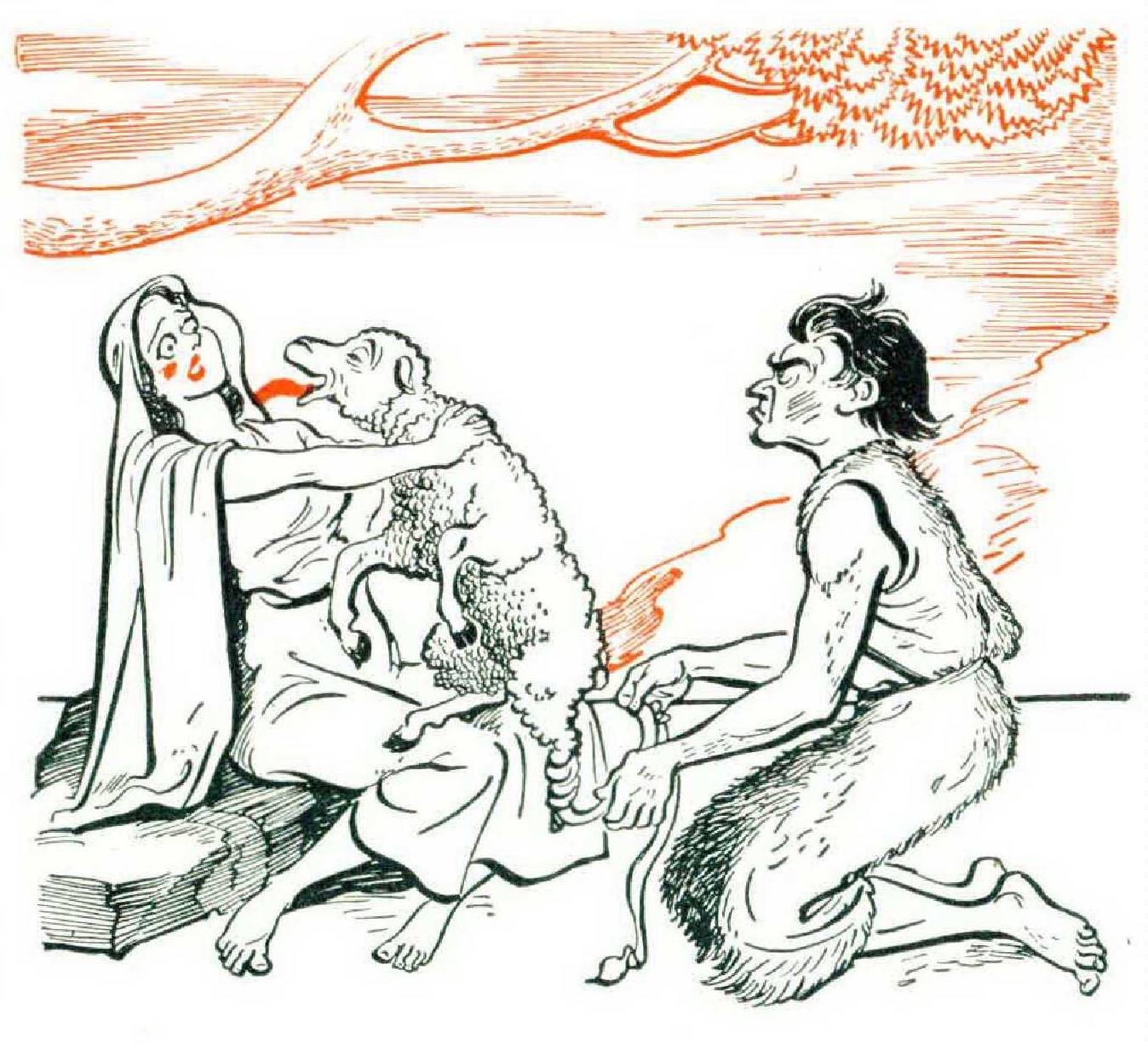
As I took up my stand, off stage, I saw Mr. Barrett in the opposite wing, heroic and handsome in his goatskin and holding what looked like a fully grown sheep. He gave me rather a wintry smile, then stepped on stage, being immediately greeted with a volley of applause. I gulped. The moment had come! I advanced towards him, holding out my arms for his lamb. The weight of it nearly unbalanced me as I staggered towards the painted bank and sat down with it. Mr. Barrett leaned over me to bandage its broken leg. (The audience found this scene very touching.) All went well; the bandage was half on. Then a strange thing happened.
The lamb stirred in my arms, seemed to scent something, perked up. I felt a lick, on my chest. I tried to stop it but there was another lick and another— on my hands, my arms, my neck. Mr. Barrett looked nervous and annoyed. The audience began to titter. But the sheep licked and licked. We tried to hold it down; it kicked out with all four feet, the broken leg forgotten. I stumbled over my words as I struggled with the wretched beast. I held it out at arm’s length; it merely stretched its neck towards me, trying to lick my face. The audience laughed outright. Furiously, Mr. Barrett snatched the animal from my arms, pushed it at a stagehand in the wings, and gave me a cue to cut the scene short.
I left the stage in tears. The stage manager frantically apologized, and comforted me, saying it
was his fault — he had forgotten to tell me not to put on any make-up for this particular scene. Apparently make-up is caviar to lambs—their idea of a true gastronomic delicacy.
When, shattered and shamed by this terrible experience, I opened the door of my dressing room, I found the place a shambles — my clothes scattered everywhere, my bouquet in tatters, and the new lamb on top of the wardrobe, munching the last morsel of my new grease paints.
When I was playing Nancy Sykes in Oliver Twist, with Sir Herbert Tree as Fagin, and Lyn Harding (the kindest of men) as Bill Sykes, we had a wonderful dog, who gave one of the outstanding performances of the production. He was a white bull terrier named Jim.
Jim absolutely adored Mr. Harding, to whom he belonged. He had just the right appearance for the animal in the play, the dog who always accompanies Bill Sykes. From the first day of rehearsal, he seemed to understand his part. When Mr. Harding, as Bill, made his entrance, followed by the dog, Jim would slink in and crouch in a corner, the perfect picture of a usually ill-treated animal — although nobody had ever spoken an unkind word to him in real life. In the scene when Bill called him. in a deep, gruff voice, there was a pause; then he would crawl across the stage, almost on his belly, his tail between his legs, pick up the meatless bone Bill flung to him, and creep back to his corner. You could hear the audience sighing, “Oh!” or “Ah, the poor dear thing!”
But the moment the scene was over and Jim off stage with his master, he would cavort gayly around Lyn; then, in the highest possible spirits, rush out of the theater and over to the public bar on the opposite side of the street. Charging through the swing door, he would leap onto a three-legged stool and have a mug of beer and a sea biscuit. Sadly for us, Jim was run over one day, and another bull terrier was substituted. This one made us realize what an actor we had lost in Jim. For when Bill Sykes offered the new dog the bone, he would walk up cheerfully, prance back to his corner, and gnaw lustily and loudly. This got a laugh, but it spoiled the scene.
The creature simply was not an artist. Like many Thespians, he acted for himself and not for the play.
But the only real villain I ever met, on the stage, was a camel. I don’t think he liked being an actor; in any case, he didn’t like me. This was unfortunate, as I had to ride him. I suppose he considered it pretty undignified for the lord of the desert to have to carry a mere beginner. Or else he blamed me for his run-of-the-play contract.
Everybody assured me he was friendly; but I knew differently. His keeper would tap him on the foreleg, and after a great deal of persuasion he would sink to the ground. I would then, rather gingerly, get up on his back. A practiced hypocrite, he would walk quietly onto the stage and wait until I was in the middle of my speech; then there would be a sickening upheaval beneath me as he started to wiggle his hump to tip me off. However, as the rehearsals went on, he became more docile and apparently had learned that, in spite of his ill-will, he must obey.
The night of the first dress rehearsal arrived. The theater was half full of specially invited guests.
I was wearing my beautiful Oriental robes, fresh from the costume maker, and was feeling very uncomfortable in them. Most actors hate a first dress rehearsal. They feel it the most discouraging moment in the life of a production. Everything goes wrong, one’s clothes never fit, and one invariably forgets one’s lines. In fact, the entire play seems to fall apart.
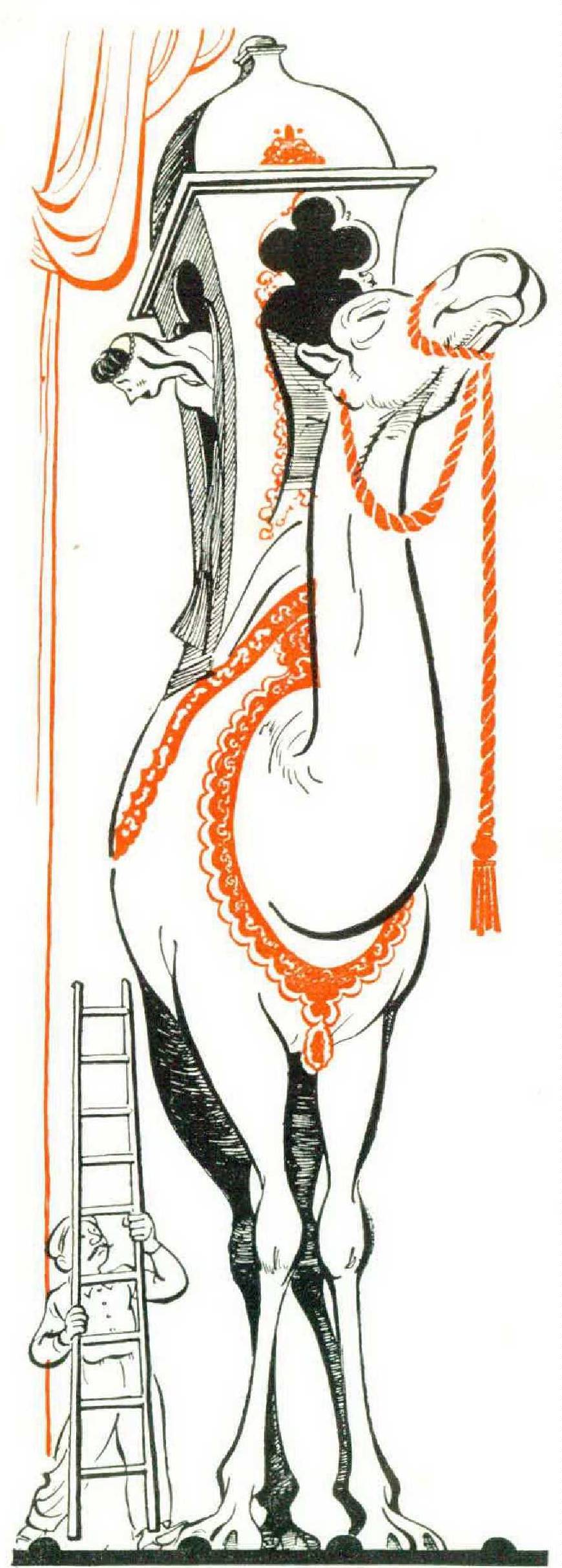
The camel, also, was garbed in splendor, with a golden harness and a magnificent howdah on his back. I couldn’t imagine how I was to get into the howdah; it looked peculiarly inaccessible. However, when the moment came, the camel knelt down submissively, apparently in a most amiable mood, and I was able to climb in quite easily.
We looked regal as we made our entrance, and were received with a round of applause. I gained a little courage and smiled feebly. I got through my speech very well. The camel stood immovable; I was thankful he was behaving.
Then the keeper, dressed as one of my attendants, gently tapped him on the leg to kneel and let me off. I waited for the ungainly creature to fold up. Nothing whatever happened. The keeper yanked at the halter. But the camel had turned to stone.
There was an agonizing pause. Then I heard the quick whiz and thud of the curtain being lowered. Planted like a tree, the camel stood his ground, in the middle of the stage. Out in front, the audience was being dismissed.
In spite of my entreaties and the endeavors of the entire company, the monster kept me up there on his back for two hours. I was hysterical and nearly fainting; I swear the camel was smiling the whole time. I dare say that, if he could, he would have laughed out loud, when at last it was decided to rescue me with a stepladder. This was a dangerous proceeding, as camels are supposed to be able to kick with all four legs at the same time.
When the first night came, I walked on, with the camel loping along behind me, a look of triumph in his sleepy eyes.