The Cold-Nosed Hounds
By J. FRANK DOBIE
IT is impossible for many people, myself included, to be as liberal towards all kinds of dogs as the old-timer was towards whiskey. “Some of it is better,” he said, “but all of it is good.” When I go to a city and see bipeds dressed in pants, derby hat, and white gloves leading a poodle by a string, I feel ashamed of myself for belonging to the same species, and am outraged that this poodle-pamperer can vote. He prejudices me against the poodle. I can’t call myself a dog man at all; yet a real part of my education was Beautiful Joe, classic of all dog books. If I could be a boy again, I would stipulate that our old black mongrel named Joe must be a dog again. Boys and dogs belong to each other like boots and spurs.
Dogs belong to homes in the country as much as coons belong to the land around them. If it is after dark, some pot hound in pursuit of fleas should be thumping an elbow on the front gallery floor as fast as a rivet hammer works. I like to hear any dog howl at the moon. I like to hear a hound trail. I had rather hear a genuine artist—no apology for the word — blow a good hunting horn than listen to any clarinet, bugle, trombone, or flute ever breathed into. I am less of a musician than I am a dog man, yet full of appreciation for some kinds of music and for honest dogs and good dog talk.
Good dog talk is much more than the details of how a dog went up one hill, down a creek, through a fence, over a log, under vines, and on and on until he finally put his cat up a tree. Good dog talk, to me, consists mainly of stories, natural history observations, and delineation of characters of both dogs and men associated with dogs.
2
Jim Ballard belongs among those rememberers who, slaves to neither books nor business, go on down the years sipping with a fine gusto the flavorsome experiences of the past. Because of the power and joy of remembering what’s interesting and good, at the same time paying no mind to what’s drab and dull, Jim Ballard and his rare kind live not only their lives but, in a way, the lives of their ancestors. For instance, flour was plentiful before he was born, but Jim Ballard recalls through his grandmother Hallett, dead long ago, how because of their rarity — they were a Sunday treat — biscuits were called “Billy Seldom,” whereas unvarying corn bread was called “Johnny Constant.”
Jim Ballard, without ever having been what you’d call “a fool about a dog,” has had plenty of experiences with them and with dog men. He’s a whittler from ‘way back, and while whittling red cedar on his front gallery here in Beeville, he’s been remembering dogs, and men of dogs, for me.
His father, W. P. Ballard,—Pal Ballard, “Pal” being short for Palestine, — had sixty long-eared hounds that he kept to run deer with out of the Devil’s Pocket on the Navidad River, out of Tiger’s Bend and other bottom thickets. In early days, as the old-timers tell, deer used to run like antelopes on Golden Rod Prairie, between the Navidad and Lavaca rivers, but fifty years or more ago most of them in that part of Texas had taken to the thickets.
Pal Ballard was sheriff, and the finest piece of furniture in his house was a gun case. He had a hunting horn that be could make sound for miles. He didn’t keep but about twenty hounds around his home at Hallettsville, and these he fed mostly on corn bread. The other forty dogs he left in good hands over the country. He had many friends, and sometimes on an organized deer hunt he would scatter them at stands by the dozen.
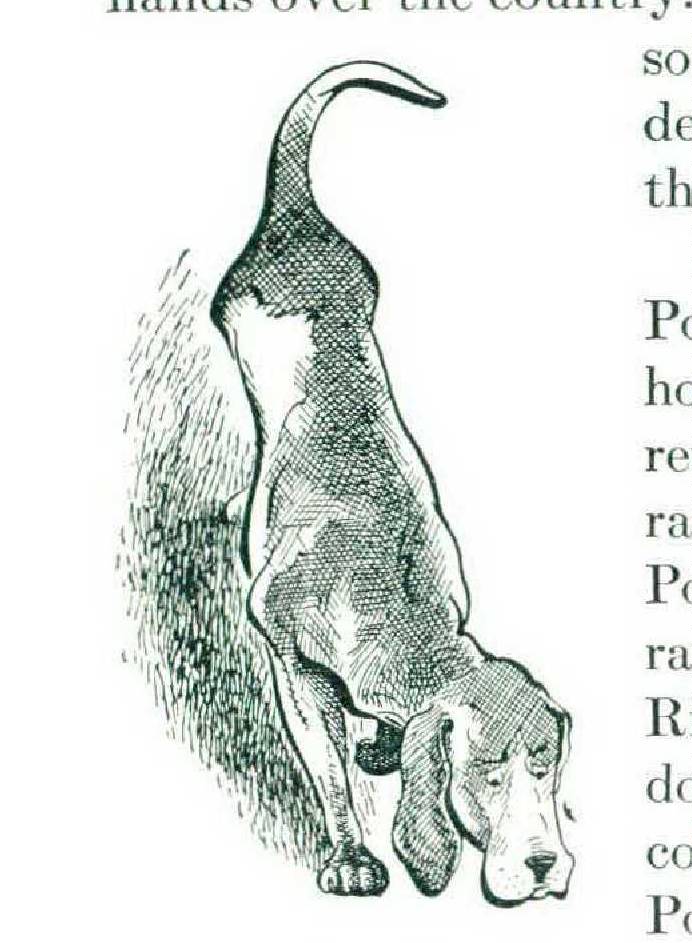
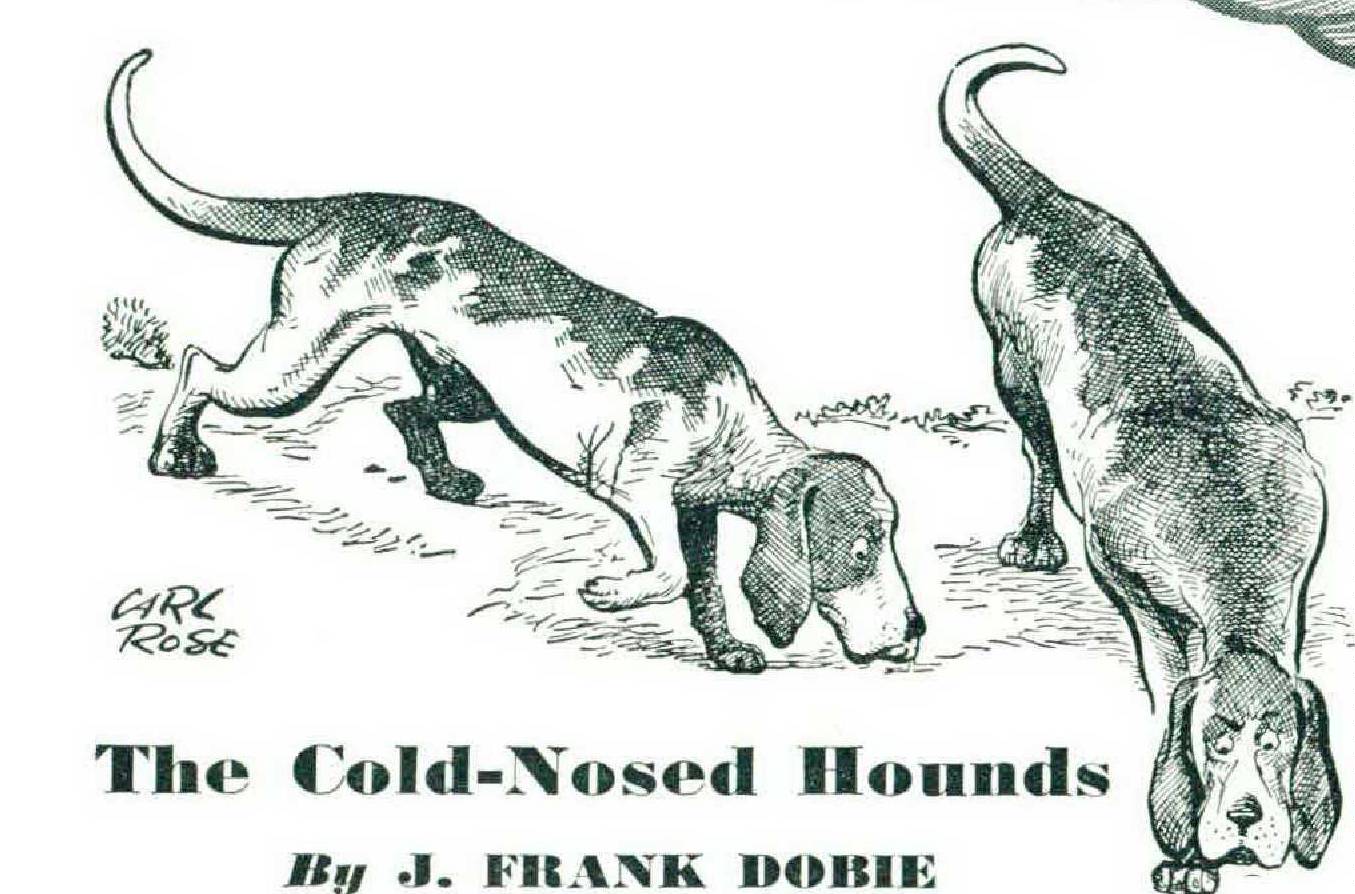
Jim Ballard considers Jeff Porter’s pair of cold-nosed hounds as probably the most remarkable dogs that ever ran in Southern Texas. Jeff Porter imported them to his ranch on the San Antonio River years ago. A cold-nosed dog is a dog that can follow a cold trail. These two that Jeff Porter brought in and trained got so that hardly any trail was too old and cold for them to follow. They would snuff the cobwebs out of some coon’s trail, warm it up with their breath, and follow it.
Jeff Porter was mighty proud of them, understood their voices as if they were talking to him in Mexican or English, and had absolute confidence in their abilities.
3
Late one fall he invited his friend Jim Borroum to come over for a coon hunt. The dew had fallen, and maybe it was ten o’clock that night when the two ranchers stopped and made a fire. Bowie and Bonham — those were the names of the two cold-nosed hounds — didn’t seem very eager to hunt. They hadn’t scented a thing so far. Now, for a brief time, they tarried with the men.
Directly, Bowie sat on his haunches and let out one of those long, long lonesome howls that seem to go up to the remotest nebulae of the Milky Way and back through the ages to the night when sorrow became a companion of man. Bowie howled and Bonham howled after him, and their howls awakened memories in Jeff Porter and Jim Borroum that actually brought tears. If you have never heard that longest and lonesomest of all l-o-n-g, l-o-n-e-s-o-m-e hound howls, you cannot conceive its effects. This night the howls of Jeff Porter’s cold-nosed hounds made the leaves on a knock-away tree close to them flutter and fall; actually they nearly covered Bowie up.
Then the dogs set out to hunt. After they took off, Jeff Porter boiled a can of coffee. He and Jim Borroum smoked, heard the first sand-hill cranes flying south, talked about the way wild turkeys hold a strutting party, and felt better.
Then a sound that comes to a hunter like the break of dawn of the Promised Day galloped over the air.
“Listen,” Jeff Porter said, raising his hand. “That’s Bowie, and he’s struck a trail sure as shooting. . . . He’s working it. Listen. Now he’s on the royal highway and headed fer the throne. Amazing grace! Jest listen!”
It did sound as if Bowie was going home. And then, away over to the right, the other hound opened up.
“That’s Bonham, and he’s hit another trail,” Jeff Porter announced. “ It’s cold, but wait and he’ll warm it up. . . . Listen. . . . Listen. Now that coon ain’t got no more chance of hiding himself than the North Star has on a clear night.”
For an hour or so the hunters listened to the bayings of the hounds coming over the almost frosty air. “By ganny, the trails are going to cross,” Jeff Porter said. “By ganny, they have crossed. Now Bonham’s on the right of Bowie.”
The men put some more dry mescjuite limbs on the fire and waited, always listening. “Denied if the trails ain’t coming back together,” Jeff Porter said. “Yes, sir, they’re nearly side by side now and still going. Let’s ride.”
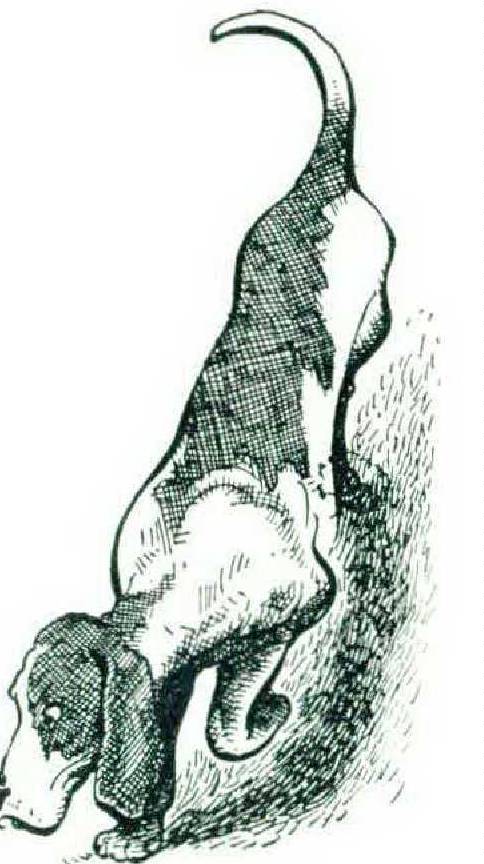
They rode, but not so fast that they could not continue to enjoy the hound music. After a long gallop Jeff Porter pulled up. “By ganny,” he said, “they’re barking treed.”
“Sounds that way,” Jim Borroum agreed.
“Yes, sir, treed, and two coons from two different directions climbing into the same tree at the same time. That is peculiar.”
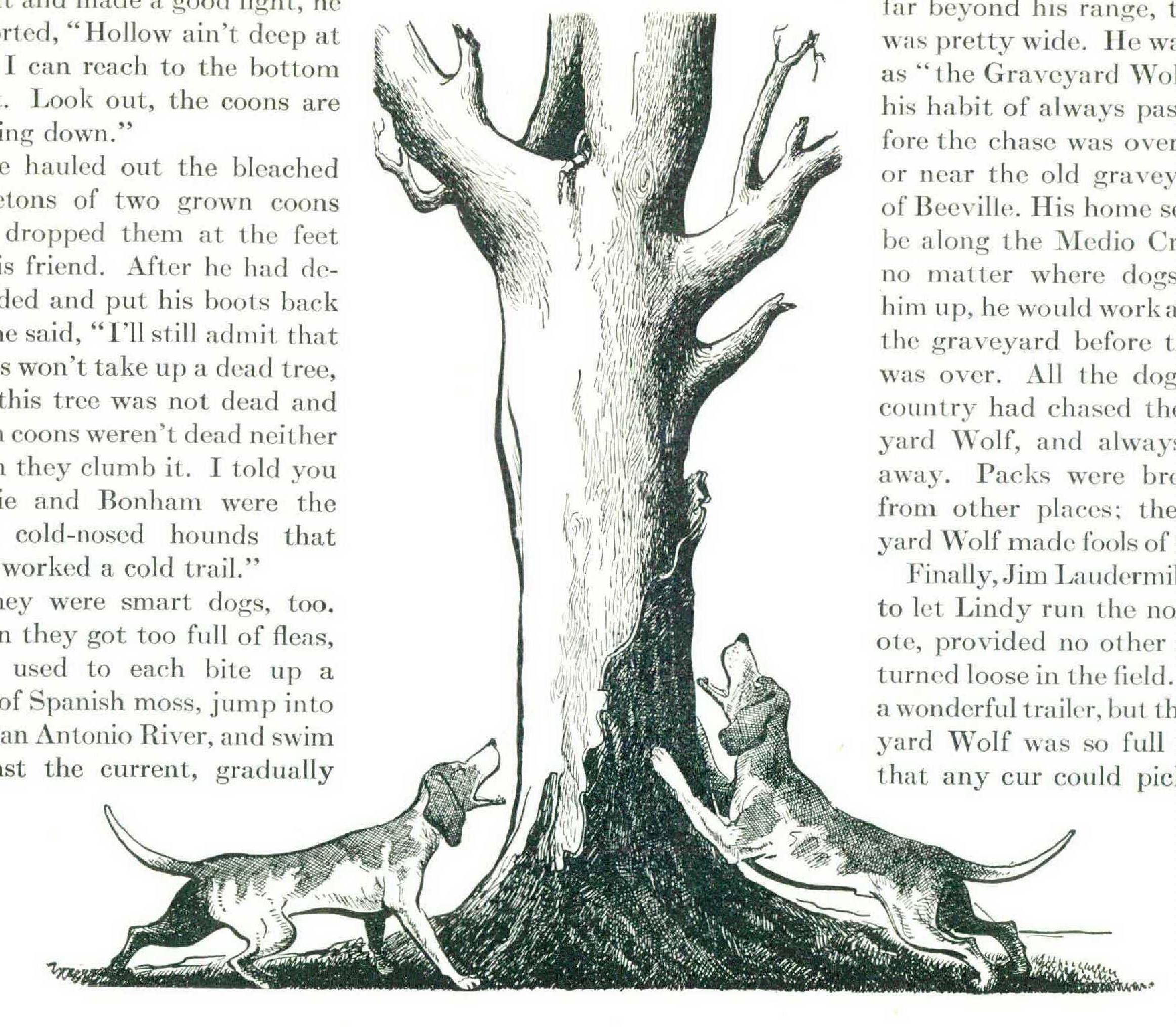
A full moon was overhead and the first light of dawn was in the sky when the hunters came up to the dogs, now only intermittently barking. They seemed to be interested in a dead live-oak tree — dead so long that its bark had fallen away, leaving the trunk and a few stubby limbs bleached and bare. It stood apart, in clear ground, not far from a motte of timber.
“Now listen, Jeff,” Jim Borroum said, “you don’t mean to tell me that those fine dogs you been talking about are barking up that old dead tree. Why, who in the nation ever heard of a coon going up a dead tree?”
“Yes, a coon wants cover and I’ve never seen one take to anything but a tree with leaves and moss on it, Jeff Porter admitted. “But when Bowie and Bonham tell me something, I know it’s true, and all your laws about coons can just be blowed.”
About this time Bowie reached his forepaws up on the trunk of the dead oak and gave a few scratches. Then Bonham did the same thing.
“Coons in that tree, shore,” Jeff Porter yelled.
“Jest as well talk about razorback hogs smelling honeysuckle when they could be picking up acorns,” Jim Borroum answered. “Look, You can see for yourself all the coons there are in this tree.”
By now Porter was off his horse. “Help me pull off my boots,” he said. “I’m going to skin up and show you something.”
He climbed to a fork. “Here’s.the hollow they went into,” he yelled.
He lit a match and held it in the opening. “Pitch me up some old dry moss,” he requested. After he got it and made a good light, he reported, “Hollow ain’t deep at all. I can reach to the bottom of it. Look out, the coons are coming down.”
He hauled out the bleached skeletons of two grown coons and dropped them at the feet of his friend. After he had descended and put his boots back on, he said, “I’ll still admit that coons won’t take up a dead tree, but this tree was not dead and them coons weren’t dead neit her when they dumb it. I told you Bowie and Bonham were the best cold-nosed hounds that ever worked a cold trail.”
They were smart dogs, too. When they got too full of fleas, they used to each bite up a wad of Spanish moss, jump into the San Antonio River, and swim against the current, gradually sinking lower and lower into the water until nothing but the tips of their noses and the moss remained above it. The fleas would retreat from the water, and when they had taken refuge in the moss the dogs would let go.
4
Bowie and Bonham probably had just a little of the edge on Lindy as respects trailing, but they were not so smart. He was a Walker hound, st raight from Mr. Walker’s own kennels. Jim Laudermilk, who is an automobile mechanic in Beeville, imported him back in the good days before government trappers caught out most of the coyotes, ruined hunting, increased the jack rabbit and rat pests, and did nobody any good except themselves. Laudermilk used to take Lindy out alone and chase down many a coyote. He wouldn’t let Lindy work with other dogs. He said that in the first place Lindy would not work with them, he’d simply work ahead of them; in the second place, his superiority would make the owners of the other dogs feel bad.
About the time that Lindy reached the zenith of his powers and fame, a certain coyote of the region was also coming into fame. His reputation spread far beyond his range, though it was pretty wide. He was known as “the Graveyard Wolf,” from his habit of always passing, before the chase was over, around or near the old graveyard east of Beeville. His home seemed to be along the Medio Creek, but no matter where dogs started him up, he would work around to the graveyard before the night was over. All the dogs in the country had chased the Graveyard Wolf, and always he got away. Packs were brought in from other places; the Graveyard Wolf made fools of them all.
Finally, Jim Laudermilk agreed to let Lindy run the noted coyote, provided no other dog was turned loose in the field. He was a wonderful trailer, but the Graveyard Wolf was so full of brass that any cur could pick up his trail. Out close to the Medio, Lindy picked it up. His owner had permitted several hunters to come along to watch the hound work.
After they heard Lindy open up, they went back close to the graveyard to await developments. It wasn’t an hour before they heard Lindy coming. Then he did a remarkable thing. When he got up close to the ground from which the wolf habitually made his getaway, he stopped, howled a lone howl or two, and started back the way he had come.
Jim Laudermilk at first seemed sort of embarrassed. Then he caught on to the hound’s sagacity. “Just be patient,” he said. “Just give Lindy time.”
The other hunters, tired of what appeared to them nothing but nonsense on the part of both dog and man, were going in when Laudermilk explained. Lindy had realized that he was not cunning enough to catch up with the Graveyard Wolf. Now he was backtracking to calch him as a pup coming up. And — he actually caught the pup, though it took him thirty-six hours to do it.