Dr. Goebbels's Awkward Squad
By JOHN O. RENNIE
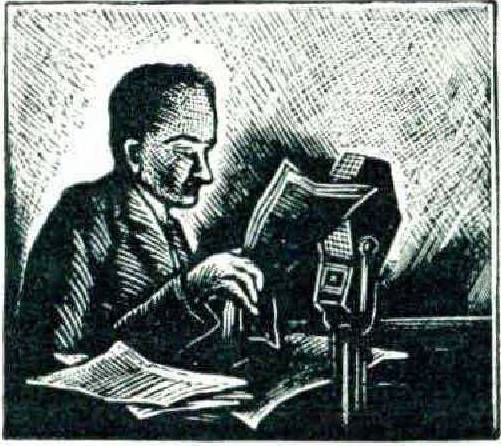
A SURPRISINGLY large proportion of the eight hours of radio propaganda beamed to North America every day by the German short-wave stations is devoted to programs other than news or talks. Comedy programs — a playlet, a knockabout act, or just a collection of puns — are especially dear to the hearts of the Propaganda Ministry, and in time of victory or defeat they have always held their own.
On the night of November 7, 1942, American and British stations opened up with radio’s equivalent of the Alamein barrage. Wherever one turned the dial there seemed to be either the Marseillaise or Mr. Roosevelt’s “Mes amis!” Naturally, radio monitors the world over awaited with some tension the first Axis version of the North African landings.
Every Saturday night the Berlin radio features a program called “ Fritz and Fred, the Friendly Quarrelers.” Faithfully that eventful night, at their appointed hour, Fritz and Fred swung into action. They had taken a lot of trouble with their script, and even a second front wasn’t going to make any difference. The printed word cannot do justice to the talents of this pair of frustrated End Men, but they were heard exactly as follows: —
FRITZ: You should be happy that someone teaches you common sense.
FRED: You!
FRITZ: Me, yes — who else?
FRED: Say, if I did not teach you occasionally what’s what, why, you would have landed in the idiot asylum long ago.
FRITZ: Oh, Lordy, you are a corker, my boy.
With imperturbability and devotion did Fritz and Fred remain at their posts in the great crisis, their high comedy intact, their wit as nimble as ever.
Fritz and Fred are also devotees of the Axis radio’s “word game.” Encouraged by the occasional success of a synthetic political catch phrase in the United States, the minor Axis broadcasters are always trying to ring the bell themselves. Here they are on April 17, 1943: —
FRED: Here’s what would happen after the war. . . .
FRITZ: Powarp! Powarp!
FRED: Now listen, my dear fellow. If you are too dumb to understand, I can’t help it. But if you keep calling me names. . . .
FRITZ: I’m not calling you names. A Powarp is a member of a new British-American fraternity, the “PostWar Planners.”
FRED: Ha, ha! That sure sounds mean.
2
Goebbels has analysts and commentators to spare, but he has also gathered around him an assortment of virtuosi whose pseudonyms, selected with all the delicate discrimination of a Calypso singer, suggest their capacities: Mr. Everybody, Mr. Guess Who, Bingo Bill, White Oak. These are Goebbels’s awkward squad, serving in a kind of propagandist K.P. Some of them have been on the payroll for six or seven years. For the most part they stick closely enough to the directives they are given, but sheer whimsy overtakes them almost every time.

Fred W. Kaltenbach, star performer on the Berlin radio since 1937, once took eight hundred words to tell the story about the American who told an Englishman that Americans cat what they can and can what they can’t.
Some performers like poetry. Robert H. Best, late of North Carolina and Vienna, favored Kipling parodies. On April 14, 1942, he urged on his audience some stanzas of his own composition. He hoped the audience would be inclined to “sing it occasionally to your friends”: —
Where the worst is like the best,
Where John Bull broke all commandments
And British is the word for pest.
Hark! The Jappy boys are marching
And out there soon boss will be,
While from the old Moulmein Pagoda
The Brits are running for the sea.”
Robert Best liked his verses so well that he read them twice at dictation speed and followed up, on May 12, with another fifteen lines which contained the following passage: —
Get you out of Mandalay.
Get you out of Mandalay.
Let the Japs in Burma play.”
It was inevitable that word of the success of the “singing commercial ” on the American radio should seep through to Berlin. A favorite interval signal (now, understandably enough, no longer used) was sung to the chorus of “Santa Lucia”: —
Oh dear, oh dee-ee-a!”
The top men in the Propaganda Ministry are desperately willing to accept anyone with a British or American passport at his own professional valuation. To them Douglas Chandler (alias Paul Revere) was a columnist for the largest evening paper in the South. No one, it appears, ever told them that Chandler’s column dealt with the highly parochial doings of the Eastern Shore of Maryland — and in rhyming couplets at that.
From time to time a female camp-follower turns up; but they never last long. Jane Anderson has never reappeared since the Donovan office played back to Germany, by transcription, her account of gorging herself at the Adlon. One Mildred left, somewhat coyly to be a June bride after a series of amazing programs which included commercials for Kellogg’s Corn Flakes.
The Italians once worked out an appeal, which they directed to North America as well as to England, in their “Alice” programs. One had its locale in America and the other, somewhat more roguishly, was entitled “Alice in Great Bruton.” A typical excerpt from the latter concerns Alice and the “Queen Liar” (wearing a Derby and smoking a cigar): —
QUEEN : Do you want to become one of us, my dear? You know your name is suitable, Alice ... Allies ... All lies!
ALICE (sings): “London Bridge is falling down.” But I’m sure you will win the war.
QUEEN: Ah, that is the biggest lie I have heard yet. Now you are one of us!
That this was counted as something of a coup can be deduced by Its reappearance a year later in a Fritz and Fred dialogue: —
FEED: That’s all lies.
FRITZ: Exactly. That is why they call themselves Allies. (Prolonged laughter)
3
The most peculiar German program of them all featured a homespun old man and his little grandchild aged about six. They made a pretty pair an old Kaspar and a little Wilhelmine, wired for sound. For several programs they lobbed platitudes back and forth in a pleasant enough way. Then one night something happened. Either they got a new script writer or the old one stopped reading the works of Robert Southey and took to Clausewitz, because grandfather turned abruptly to ballistics.
One moment they were discussing the Hitler Youth and carol singing, and the next the old man was telling the child all about the muzzle velocity of an 88millimeter gun. This was no ordinary moppet, though; she had apparently cut her teeth on a slide rule. A couple of minutes later she had straightened Grandpa out on the wing loading of the Ju. 88.

From then on, until the program eventually went off the air, the quavering voice of the old man and the piping tones of his granddaughter were joined, twice weekly, in technical discussions.
The fact that Goebbels has maintained and even increased the proportion of comedy programs in the North American transmission shows that, by and large, he is satisfied with his stable of comics.
The Nazi propagandist has been told that in America variety and comedy programs outrank all others both in time on the air and in Crossley rating. So he has gone into business for himself.
The German, having adopted the tank, the plane, and the submarine, counts it a mere stroke of the pen to match or excel the native humor of England or the United States; and his faith in the parody or the pun is based on the honest conviction that he can master the intricacies of any foreign language so neatly as to astound even the natives.
The hand, then, is the hand of Nietzsche, but the voice is strictly Joe Miller.