How to Be a Radio Announcer
By PAUL HOLLISTER
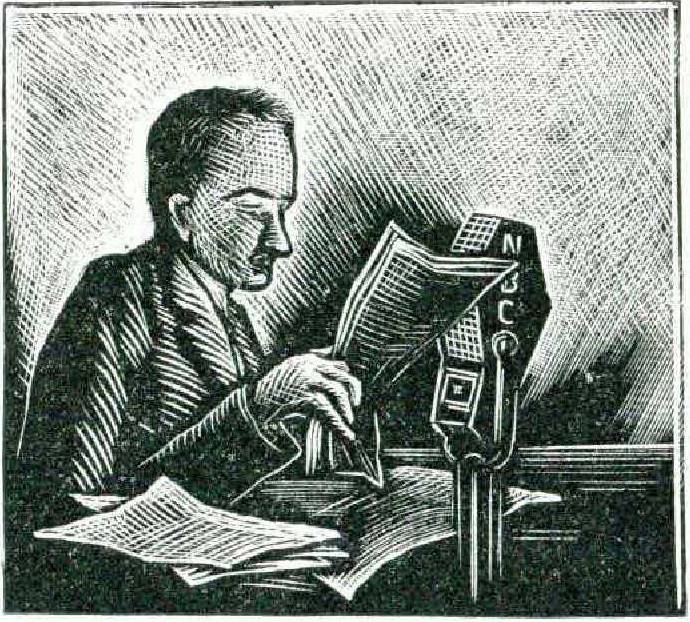
Now that you are going to be a radio announcer it is time, Junior, that you learned how to talk right. For if you do not learn how to talk, Junior, you can quickly make a failure of yourself, especially in pronunciation, especially in English, and especially in the matter of proper nouns — especially names of places.
There is no better place to start to learn how to pronounce the names of places than in England, where the mother tongue herself came from. And there is no better authority to ask than the late Mr. A. Lloyd James, sometime University Reader in Phonetics at the School of Oriental Studies in London (lon-don), England. He put it all into a book for the guidance of announcers of the British Broadcasting Corporation, or BBC, or brit-tish brode-cahsting cawpaw-ray-shun.
So here we are in dear old Cholmondeley in Cheshire—the starting point of all traditional British circum-phonetics, which, as everybody has long known, is called chumly.
Do you realize, Junior, that we are now hardly a stone’s throw from Cholmondeston? And how would you pronounce Cholmondeston? You are quite correct. Chomson is correct! The same rule applies here as that which compresses our own city of Minneapolis into murlap. Chomson, murlap; two syllables each, neither one particularly derivative.
You may be called upon any day now to report, on the air, that “enemy activity was observed last night from Chaddlehanger to Catcleugh,” and unless you are forearmed you will make a proper mess of the news. So let us go over Chaddlehanger first. How do you pronounce Chaddlehanger? If you’re a literalist you pronounce it chaddlehanger, but if you aren’t you just call it challinger, the “g” being hard as in chaddlehanger or saddlebag. Catcleugh (Northumb.), however, does not become catcall, catkin, or glowworm, but catcluff, with an optional switch to catcleef if you are in the mood, which is pronounced mood.
Or take Launceston, in Cornwall. If you were to follow the chaddlehanger line, you would naturally call it lawn-sess-tun, as in Cirencester, or syrensester or sissiter, but nature herein Cornwall has provided a crossroads at which you may stop, finger in mout h, and take your choice of four directions, any one of which will leave your American radio audience well out on the limb. Launceston you may call laanslon, Iaanson, lawnson, or (to lapse into the musical idiom) lavvant, a nickname for a town in Sussex known as Lavant.
Cornwall, in fact, is full of jolly booby-traps. There is Po ugh ill, which by all the laws of Poughkeepsie ought to be poe-ill or pugle. But is it? It is in fact poffill and puffill, but if you move over to Poughill in Devonshire the old home town is powill, a good deal like William, or Thin Man, or Vive La Loy.
And another thing, Junior, before we go any further. You know there is a great deal of talk about improving the relations between our country and England. You know that nothing uprousos our 100 per cent scorn much more readily than to hear a visitor (pronounced cousin from overseas) refer in all familiarity to A-hya as Oheeo. Well, get a load of Trottiscliffe in Kent. Mow would you feel if you pulled up at the right (pronounced Left) side of the road in Kent and asked civilly which way to Trottiscliffe, and the burgher gave you the leering-mute treatment ? For Trottiscliffe is spoken as trossly —just as San Antonio, Texas, is sanchez, as Newton Lower Falls, Mass., is nossly, and as Anniston, Alabama, is pronounced exactly like Tudeley (Kent) or toodly. So just know that whatever you are doing is for the jernt advancement of two nations who speak the same tongue, and never the twain shall etc.
There are still plenty of people west of Elkhart (Ind.) who call Worcester (Mass.) wurr-ses-ter and Gloucester glah-ses-ter, and it drives the natives of woosta and glosta bats when they hear it. The natives of Dover (N. H.) still have enough A-gas to drive to Exeter once in a while, but it is either oxla or ex’ta or ex-a-ta. But when you land on the name Utloxeter (Staffordshire), pick your landing. The odds are four to one against you if you clamber through the obvious ut-tox-e-ter and say here am I. For the more used, and mischievous, and knowing versions of the name are yewtoxeter, uxeter, uxter, and utcheter. Thus Wednesfield is not only wensfield (as in wensday for Wednesday) but also wodgefeeld.
Weston Bampfylde in Somersetshire is weston bamfeeld — a pronunciation not so far apfylde from the spfelling, after all. Greenwich you know of old (in spite of the New Haven brakeman who calls it green-witch) as grinnidge, grmnioh, and grennich; Bromwich you know, or can fumble out, as brommich, brummidge, brommidge, or brummich; but what’s going to happen to you in Cwmtillery or Cwm if you start calling them crummitch instead of coom-till-airy or coom? Coom-till-airy I-yay, I-yay, coom-till-airy I ya-a-ay; I don’t care what be-Cwms of me. . . .
The general pronunciation of English place names is logical, phonetic, and proper, and with the help of a couple of irregular verbs and three days’ rations you will have no trouble in finding your way to Belaugh, which is beelaa, beelaw, beelo, beeloo — or to Boggart Hole Clough in Lancashire. The Boggart is naturally boggart. The Hole is hole. The Clough is cluff, and you cannot gel trousers with coughs on them any more.
And so, as we leave our friends in Easton Mauduit and Ebbw Vale, in Erewash and Exeat, in Eype and Farrington Gurney and Faugh or faff or faaf, in Fernyhalgh or furnyhuff and Figheldean or fyledeen, in Greenhalgh or greenhawlsh and in Kingston Bagpuize, let us just remember this, Junior: —
They certainly got some strange customs, but one thing you will admit — they never serve a pictorial women ‘s-magazine salad in a bird bath before a meal, the way they do practically every place west of Nyack and most aggressively in California.