"Carpe Diem"
ByLESLIE PRINCE THOMPSON
Of all the fish that swim the watery mead Not one in cunning can the Carp exceed.
DATE: June 20, 1939.
PLACE: Medfield Meados, Charles River. Water low and reasonably clear.
WEATHER: Cloudy. Warm. Clearing after rain in the morning, and the sun showing.
FISH: One Carp. Weight 18 lb. 1 oz.
BAIT: Corn niblets on a Number 5 hook.
ROD: 10½-foot spinning rod.
REEL: American Multiplier holding 100 yards 15-pound test silk line.
RECORD OF THE DAY
My favorite carp-swim, near the railroad bridge beyond Dover, has been discovered and now looks like a buffalo wallow; many forked sticks line the bank. I must find it quiet place.
The map leads me to a broken-down bridge on a narrow country road several miles upriver. Arriving at Medfield Meadows at 4.00 P. M. and standing on the bridge I study the water; below is a fair current and a number of dace are dimpling the surface — I cannot see far upriver because of a sharp bend and a screen of trees and bushes.
As I am standing there looking and studying, I hear quiet voices beyond the trees — an old and husky voice, and a young one. Then a tremendous splash. The husky voice remarks, “That must be one of the big carp I’ve been telling you about.”
I assemble my gear carefully: campstool, greentopped rod rest, long-shafted gaff, stewed corn — all complete. Crossing the broken bridge and going beyond the trees, I discover two honest anglers fishing for horn-pout. The older man, in white overalls, is not only an honest angler but an honest painter — house, not portrait. “Yes, that must have been a big carp that splashed — all of fifteen pounds.”
Seated on the campstool (I’ve given up the old striped one and changed to one with a brown seat and green woodwork, which harmonizes rather better with the hickory-shafted, green-topped rod rest and the bethabarra-butted and split-bamboo-tipped rod),I fill the long-handled spoon with juicy corn from the special corn-jar, and with a flip and carrythrough stroke shower niblets on the surface of the water. They sink to the bottom. Five or six minutes, and the baited hook, the drilled bullet, and the sliding float follow.
The hours roll by, punctuated from time to time by a pout, taken by the pair eighty yards upstream.
At 7.30 P. M. the float trembles, a run, and the hook is in a six-inch “shiner.” I admire his brassy sides and red fins and return him to the river.
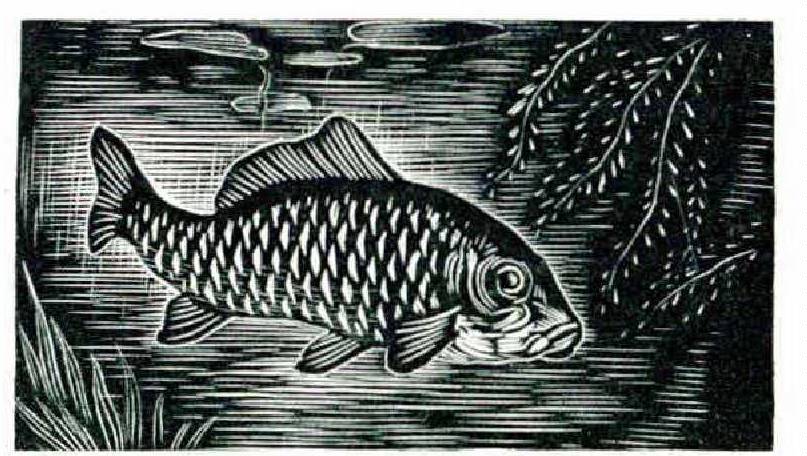
At 8.00 P. M. the float trembles again, stops, trembles once more, and then moves away six feet, ten feet, fifteen feet, and the hook is in something solid which fortunately does not bolt downstream as is the custom of the Cyprinus carpio. Possibly the round pool in which the very slow current circles about in an eddy four feet below me accounts for this obliging behavior of the big fish. Both bethabarra and bamboo are getting good exercise, but finally the fish sails slowly near the surface, under the bank, and the point of the gaff is under her, just behind the gills. The afternoon has been hot, and I have removed my short rubber carp boots; my stockinged feet give me a good toe-hold.
She is on the grass, and my friends from upriver move down to have a look. During the play they have remained perfect stationary — never a shout, never a word of direction, never a helpful suggestion; in short, they are fishermen.
Old and husky voice says, “Something should be done about this.” I agree but remind him that my ear is quite a distance down the road and across the bridge. He walks to his basket, and after a few words of apology concerning glasses, we do something about it. It is getting dark, but before we leave, my host, glancing at the gaff, says, “You expected to get one, and I say, Yes, I did.”
It is pretty late when I get home. Margaret is asleep, but Jack is in the bathtub, and his right arm looks strong. On the bathroom scales The Carp goes exactly 18 pounds 1 ounce. A hen fish in fine condition — not a scale missing— heavy with roe.
ST. BOTOLPH CLUB, June 22, 1939
The flesh is firm and sweet — not a trace of “pondy” flavor. The temperamental chef in the kitchen insists on serving it with his own sauce. Well — there are two schools of thought: he likes his, I like mine. Mine is Dr. T.’s receipt in The Compleat Angler, John Major’s Edition, 1824. The enormous roe, like a sheet of golden corn-bread, is delicious, however, either as an hors d’oeuvre or with the fish, and Monsieur C., fellow member of the Hook and Slice Club, mighty driver of golf balls and wine expert, produces the proper Bordeaux wine.
Hearty congratulations of the small fishing fraternity, and the usual hostile and antagonistic attitude of the dull common herd. Yes, they have seen them at Fontainebleau, have fed them bread, and they have warts on their noses (I mean the carp). A friend in New York only the other day sent them a forty-pound salmon from the Cascapedia. Nevertheless, each one gobbles three helpings of Carp àa la Walton, while they are talking about themselves, Czechoslovakia, and Franklin Roosevelt.