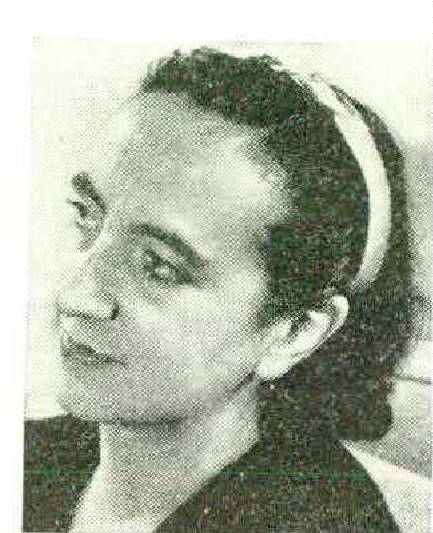
In Place of Splendor
by
[Harcourt, Brace, $3.00]
CONSTANCIA DE LA MORA’S autobiography — ’the autobiography of a Spanish woman’ — is having a well-deserved success. It deserves that success not only because it affords an insight that is both wide and profound into the nature of woman in war, but because as a book it is unique. Its author is not, primarily, a writer; this is, so far as I know, her only published work. But she is a woman of such inherent nobility of character and such considerable achievement that both this nobility and this achievement shine through every page of her story. And her story becomes, as a result, a document for all humanity.
As a woman in Spain, Constancia de la Mora’s life spanned two epochs and two traditions. Born into the Spanish monarchist aristocracy, she lived to become a republican. That this transition involved a break with tradition that was both violent and painful should be commonplace knowledge to those who know anything about the position of women in Spain before the establishment of the first republic in 1931.
It is difficult for us, living in a country founded on equalitarianism (no matter how widely our reality may depart from our ideals), to understand the chasm that lay between the Spanish gentry and the Spanish masses. Step by step Miss de la Mora, as though driven by inner necessity and with little consciousness of what she was doing, bridged that chasm. She scandalized her society by discarding her first husband; she horrified it by going to work for her living. In her own family she witnessed the nature of the schism that brought about the greatest of Spanish tragedies — the foreign intervention of 1936-1939, which resulted in the imposition of Fascism upon Spain.
But with the first days of the new Republic she took her stand beside the people of her country, and became an avowed enemy of and a ‘traitor’ to her class— those who lived in ease upon the sweat and the starvation of the masses. She married again — a young Air Force officer who was later to become chief of the Republican Government’s aviation — General Ignacio Hidalgo de Cisneros. She participated in that great upheaval from its first days to its tragic finale, rising in the councils of her government from organizing children’s colonies that protected the young of Barcelona from Hitler’s and Mussolini’s bombers to the post of chief of the Loyalist Government’s foreign press service. In that capacity she was known to hundreds of the world’s most distinguished personalities, newspaper men, foreign diplomats, visitors — and to many common soldiers of the International Brigades. This post she carried out with distinction.
And this story of her life, which other critics have described as the story of Spain for the past three decades, she has written with distinction, with charm, and with passion. Of more importance, however, than the transition from ' splendor ‘ to the service of the people (after all an individual and personal history) are the issues of that conflict which Miss de la Mora so cogently sets forth. No reader will end her story without agreeing with her final statement: ‘By now nobody in the world can doubt what we said over and over during the two and a half years of the war: the Spanish war was not a civil war, but the invasion of a peaceful democracy by Hitler and Mussolini.’ For the issues of this conflict, both patent and implicit, have borne the fruit we now see before our eyes — the second world war.
ALVAH BESSIE