Young Man With a Horn
[Houghton Mifflin, $2.50]
Now that even college professors are in the know about swing, it was only a question of time until someone turned out a novel that borrowed all the lingo of the jitterbugs, and tried to re-create in words for the young intellectuals the hot sensation of their latest fad. But Dorothy Baker has n’t written that book. She knows music and loves it, but she also knows that you cannot translate one art into another, or suggest the cadences of swing by ‘evocative’ description. You can create rhythm in a novel only if your ear is throbbing to a lull experience of human beings.
What Dorothy Baker has built her book of is the story of the short, violent career of a trumpet player like Bix Beiderbecke, who was so possessed by his talent that it burned out his life. But she does not make her effect depend on the biographical interest of her plot. On the contrary, she adopts an unusual device: she gives away the whole outline of her hero’s tragedy in her opening half-dozen pages, and, having thus robbed herself of all the tricks of dramatic suspense, she then goes ahead to live up to the hardest task that a novelist can set himself — the realization of significant characters.
Her hero, Kick Martin, is a kid who quit high school in Los Angeles to teach himself how to pick out tunes on a piano, and who got his first big job playing the horn with Jack Stuart’s Collegians at Balboa beach. But he is also a genius, as Mrs. Baker does not hesitate to assert for fear of being thought ‘arty.’ Only she does not just assert it. Before she is through she has portrayed with restrained poignance what it means to be ‘burdened with that difficult baggage, the soul of an artist,’ without ‘the thing that should go with it . . . the ability to keep the body in check while the spirit goes on being what it must be.’
She contrasts the strained nervous intensity of Rick, who has nothing to sustain him in the rootless, denatured city middle class from which he sprung, with the warm, full-blooded aplomb of the communal Negro life of his friend the drummer, Smoke Jordan. And in drawing the relationship between them as it ripened from hesitance and suspicion to the most sympathetic understanding that Rick ever knew, Mrs. Baker reveals that her perceptions of the complexities of American society are unfailingly discerning.
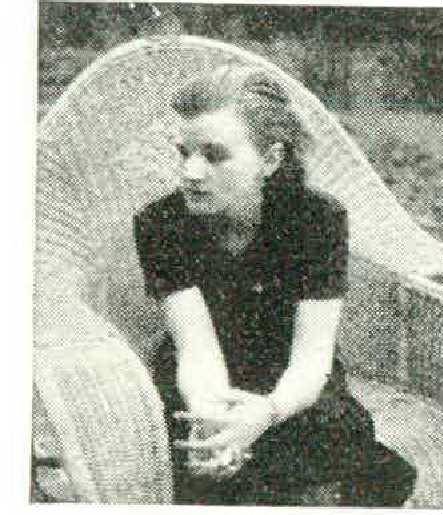
She may be a little less convincing in handling the mature Kick drinking himself to death in New York than she is with his adolescence, but she has not written merely a ‘promising’ first novel. Waiting until she was thirty before issuing a book, Dorothy Baker has mastered a clean fresh prose that is capable equally of tenderness and of humor. Her talent seems to stand closest to that of Katherine Anne Porter, for both are quietly opening up tracts of native experience that most of our ablest male writers have been too hard-boiled to perceive.
F. O. MATTHIESSEN