The Size Oe Living Things
SEPTEMBER, 1929
I
THE size of things has a fascination of its own. There is a certain thrill in hearing that a fish weighing hundreds of pounds has been caught with rod and line; that one of the big trees of California has an archway cut through its bole capable of letting a stagecoach pass; that the bulkiest of men have attained a quarter of a ton weight; that it takes two harvest mice to weigh as much as a halfpenny; that an average man contains only about two and a half cubic feet; or that many bacteria, capable of producing virulent diseases, are so small that it would take over three hundred, end to end, to get from one side to the other of the full stop at the end of this sentence.
But when we look into the subject more systematically, the passing thrill of surprise gives place to a deeper interest. For one thing, we shall find ourselves confronted by the problem of the limitations of size. Why has no animal ever achieved a weight of much more than a hundred tons? Why are the predatory dragon flies never as large as eagles, or these social beings, the ants, as big as those other social beings, men? Why do lobsters and crabs manage to reach weights more than a hundred times greater than the biggest insect, but more than a thousand times smaller than the biggest vertebrates? Why, to choose something which at first sight seems to have nothing to do with size — why do you never see an insect drinking from a pool of water? As we follow up the clues, we shall begin to understand some of life’s difficulties in a new way — the difficulties attendant upon very small size, the quite different difficulties attendant upon great bulk; and we shall realize that size, which we are so apt to take for granted, is one of the most serious problems with which evolving life has had to cope.
Reflection upon our own size will also help us toward an estimate of our position in the universe — of how we stand between the infinitely big and the infinitely little. It has been only in the last few decades that this estimate could be justly made. We knew the bulk of the big trees and whales; but not till quite recently did the existence of filter-passing viruses reveal to us the lower limit of size in life. And when we pass to the lifeless background, we seem, in discovering the electron, to have attained to the ultimate degree of smallness, to the indivisible unit of world stuff; and the development of Einstein’s theory has made it possible to state at least a minimum weight for the entire universe. Where does the physical body of man stand? Is he nearer in size to whale or to bacterium ? How many electrons are there in a man? And how does this number compare with the number of men it would take to weigh down the earth? — the sun? — the entire universe?
Copyright 1929, by The Atlantic Monthly Company. All rights reserved.
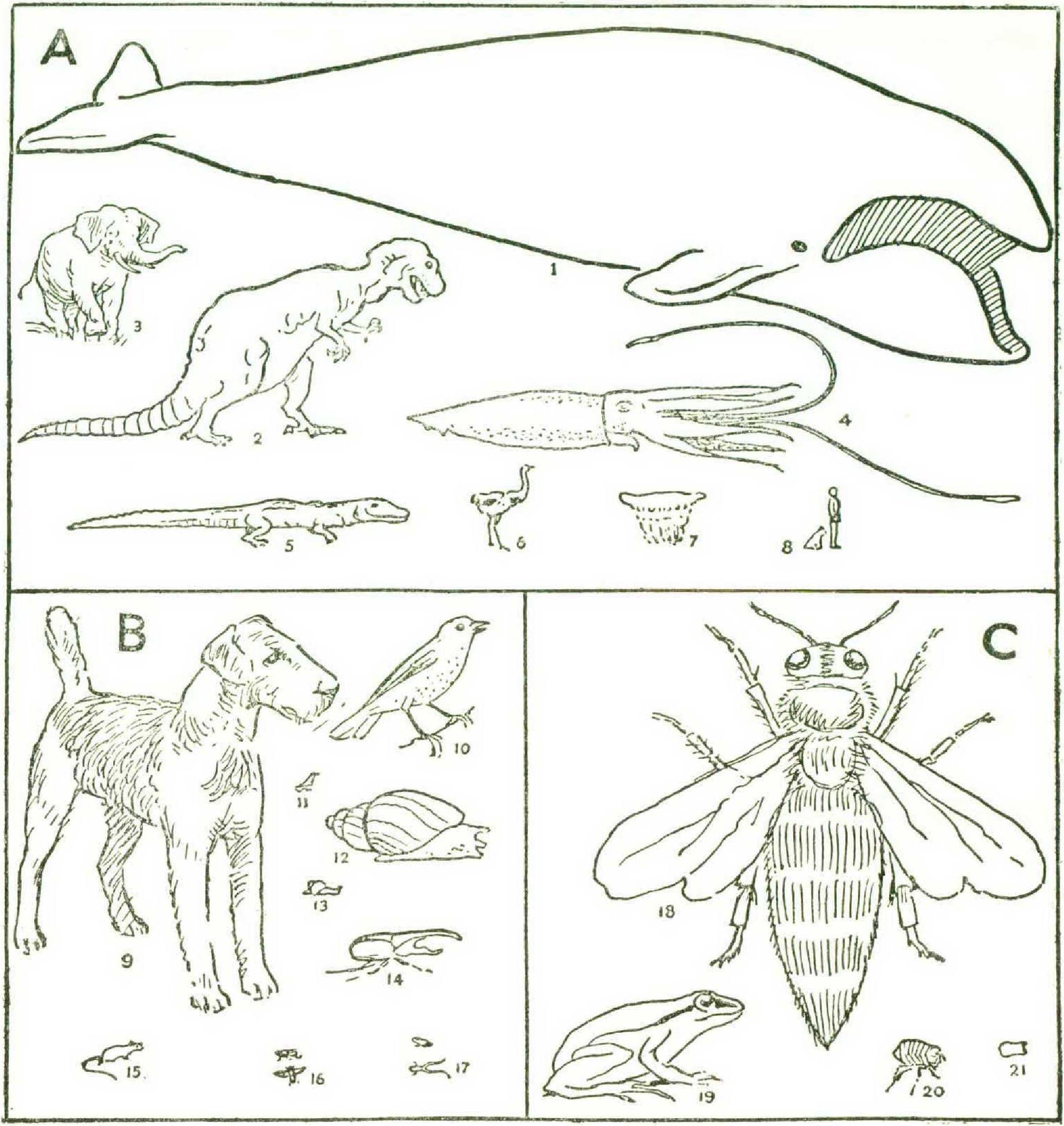
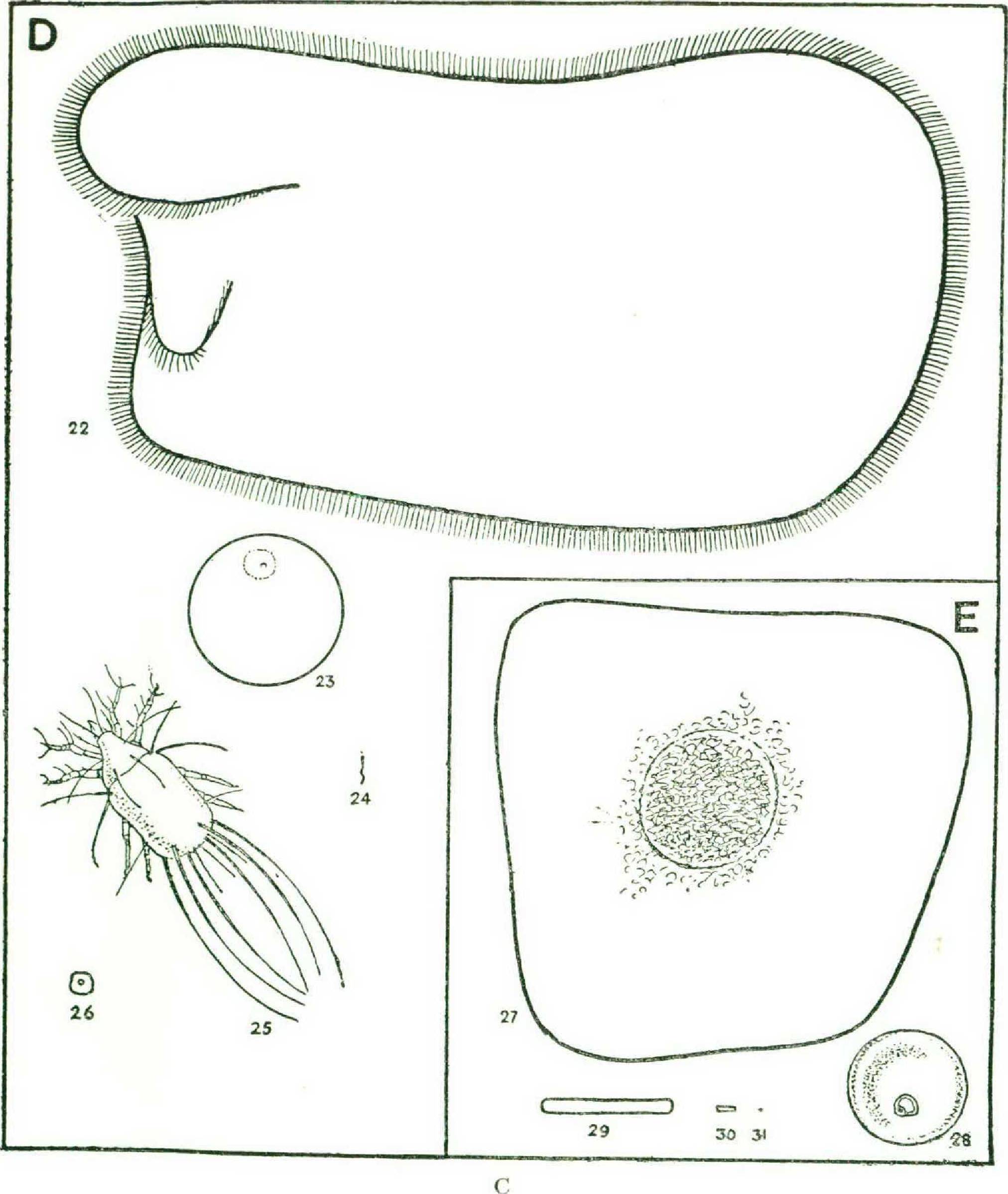
A diagram of relative sizes. In each major division (A, B, C, D, E) of the diagram, all the creatures are drawn to the same scale. The smallest of each division is enlarged to make the
largest of the division following
A
B
1. A very large whale
2. The largest known land carnivore, the extinct reptile Tyrannosaurus
3. A large elephant
4. A giant cuttlefish
5. The largest recorded crocodile
6. An ostrich
7. The largest known jellyfish
8. A man and a dog
9. The dog (8) enlarged
10. A thrush
11. A humming bird
12. A giant land snail
13. The common snail
14. The bulkiest insect
15. A mouse
16. A queen bee
17. The smallest vertebrate
18. The queen bee (16) enlarged
19. The frog (17) enlarged
20. A flea
21. A very large single-celled animal (Bursaria)
D
E
22. Bursaria (21) enlarged
23. A human unfertilized ovum
24. A human sperm
25. A cheese mite
26. A human gland cell
27. The gland cell (26) enlarged
28. A human red blood corpuscle
29. A very large bacterium
30. A small bacterium
31. An ultramicroscopic filter-passing virus
Let us begin with a foundation of hard fact, giving the weights in grams. A gram is about 1/28 of an ounce; a thousand grams make a kilogram, close to 2 1/5 pounds; a thousand kilograms make a metric ton, almost identical with an English ton. A milligram is a thousandth part of a gram. But both upward and downward the weights prolong themselves to regions where we have no units to deal with them. The simplest way to bring them home is to express them all in grams, but in powers of ten. The exponent, or little number after and above the ten, represents the number of ciphers to put into the figure for grams. When, for instance, the weight of the moon is given as 1024 x 7 g., this means 7 x 1,000,000,000,000,000,000,000,000 grams, or, since there are one million grams to the ton, seven million million million tons
— that is, seven trillion tons. When the exponent has a minus sign in front of it, it denotes a fraction of a gram, and again the number of ciphers in the denominator of the fraction is given by the exponent. Thus one of the insulin-secreting cells of our pancreas weighs about 10-9 gram. This is 1/1,000,000,000 gram, or one millionth of a milligram.
In most cases, since the specific gravity of protoplasm is very close to that of water, the weight in grams is close to the volume in cubic centimetres. With trees, this volume will be considerably greater than the weight; while with armored creatures like crabs or some dinosaurs the weight in grams will exceed the volume in cubic centimetres.
Let us also remember that volumes go up as the cube of the linear dimensions. An animal weighing a ton, for instance, would be just balanced by a cubic vessel full of water measuring one metre each way. The corresponding cube of water which would balance a human insulin-producing cell would measure 10-3 centimetre along each side, which is 1/1000 centimetre, or 1/100 millimetre, or 10μ, one μ being 1/1000 millimetre.
Since the weights of animals and plants are variable, since many are not very accurately known, and others have to be calculated, with a certain unavoidable margin of error, from their linear dimensions, we do not pretend to give precise weights, but only put organisms between certain limits of weight, the upper limit of each pigeonhole being ten times as heavy as the lower. Thus most men come in the class between 104 and 10 5 grams — between ten and a hundred kilograms. Men are near the upper limit of the class; in the same class, in descending order, come sheep, swans, and the largest known crustaceans.
II
So much for necessary introduction; now for the facts. The largest organisms are vegetables, the big trees of California, with a weight of nearly a thousand tons. A number of other trees exceed the largest animals in weight, and a still greater number in volume. The largest animals are whales, some of which considerably exceed one hundred tons in weight. They are not only the largest existing animals, but by far the largest which have ever existed, for the monstrous reptiles of the secondary period, which are often supposed to hold the palm for size, could none of them have exceeded about fifty tons. Some of the lazy great basking sharks reach about the same weight; so, since we shall never know the exact size of the dinosaurs, the second prize must be shared between reptiles and elasmobranch fish.
The largest invertebrates are to be found among the mollusks; some of the giant squids weigh two or three tons. The runner-up among invertebrate groups is a dark horse; very few even among professional zoölogists would guess that it is the cœlenterates. But so it is. In the northern seas, specimens of the jellyfish Cyanea arctica have been found with a disk over seven feet across and eighteen inches thick, and great bulky tentacles five feet long hanging down below. One of these cannot weigh less than half a ton, with bulk equal to that of a good-sized horse. The clams come next, if we take their shell into account, for Tridacna may weigh nearly as much as a man. If, however, we go by bulk of living substance, the giant clam is beaten by a crustacean, the giant spider crab from Japanese seas.
Then come a number of groups, all of which manage to exceed one kilogram, but fall short of ten. There are the hydroid polyps, with the deepwater Branchiocerianthus which, rooted in the mud, and with gut subdivided into hundreds of tiny tubes for greater strength, stands over a yard high and sifts the slow-passing deep-sea currents for food with its net of tentacles, adjusted by being hung from an obliquely set disk. There are the largest marine snails; the largest lamp shells; the largest sea urchins, starfish, sea cucumbers, and sea lilies; and, rather surprisingly, the largest bristle worms, both marine forms and earthworms. Possibly the largest tapeworms, such as Bothriocephalus latus, which may reach a length of over seventy feet of coiled living ribbon in human intestines, just come into this class, though their flatness handicaps them.
The insects and spiders come far below, the largest beetles and tarantulas not exceeding two or three ounces. The pigmy among animal groups is that of the rotifers or wheel animalcules, the most gigantic among which fails to weigh ten milligrams! They comprise, too, the smallest of all multicellular animals, some of their adult males weighing considerably less than a thousandth of a milligram, so that it would take about a thousand of them to equal one of our striated muscle fibres, and over a million of them to weigh as much as a hive bee.
Even the biggest rotifers are much smaller than the biggest among the Protozoa, or single-celled animals. Some of the extinct nummulites, flattened disk-shaped Foraminifera, were bigger than a shilling, and must have weighed well over a gram. They easily beat many small fish and frogs in size, and were bigger than the largest ants, which, though the most successful of all invertebrates, never reach one gram in weight, and are usually much less. The largest ant colonies known possess a million or so inhabitants. This whole population would weigh about as much as one large man. Indeed, the small size of most insects is at first hearing barely credible. Three average fleas go to a milligram. If you bought an ounce of fleas, you would have the pleasure of receiving over eighty thousand of them. Even the solid hive bee weighs less than a gram — over five hundred bees to the pound, nearly a hundred thousand to outweigh a single average man!
The lower limit of size among the various groups is much more constant than the upper. The smallest insects, Crustacea, most groups of worms, and cœlenterates, all lie between one hundredth and one thousandth of a milligram. Some very primitive worms run down one class further, and rotifers two. The smallest mollusks, lamp shells, and echinoderms are between ten and a thousand times larger, while the smallest vertebrate is four classes up — ten thousand times as big. Even so the difference between the maximum sizes attained by different main groups is greater by a hundred thousand times than the difference between their minima.
There is clearly a lower limit set to a multicellular animal by the fact that it must consist of at least several hundred cells. But it seems to be impossible or unprofitable to construct a vertebrate out of less than several hundred million cells. The vertebrates, both at top and at bottom, are the giants of the animal kingdom.
It is a surprise to find a frog that weighs as much as a fox terrier. It is a still greater surprise to know that there exist fully formed adult insects — a beetle or two, and several parasitoid wasplike creatures —of smaller bulk than the human ovum and yet with compound eyes, a nice nervous system, three pairs of jaws and three pairs of legs, veined wings, striped muscles, and the rest! It is rather unexpected that the smallest adult vertebrate is not a fish, but a frog; and it is most unexpected to find that the largest elephant would have ample clearance top and bottom inside a large whale’s skin, while a full-sized horse outlined on the same whale would look hardly larger than a crest embroidered on the breast pocket of a blazer.
Then we come to single cells. By far the largest is — or was — the yolk of the extinct Æpyornis’s egg, which must have weighed some ten pounds. But eggs are exceptional cells; so are multinucleated cells like striated muscle fibres and the biggest nummulites. Of cells with a single nucleus, some protists such as Foraminifera may reach over a milligram — gigantic units of protoplasm; and the ciliate Bursaria is nearly as big. But among ordinary tissue cells of Metazoa the largest are only about one hundredth of a milligram, while average cells of a mammal range between a thousandth and a tenmillionth of a milligram. In our own frames, the body of a large nerve cell is well over ten thousand times bulkier than a red blood corpuscle or a spermatozoön — a difference five or ten times greater than that between the largest whale and the average man. (In these calculations the outgrowths of the nerve cells have been left out of account, as peculiar products of cell activity. If they are included, then the spinal sensory and motor nerve cells, supplying the limbs of the giant dinosaurs and of giraffes, take the palm for size; but even they can only reach a few milligrams, in spite of being over ten feet long.)
The smallest free-living true cells are in the same size-class with the smallest tissue cells; but parasitic Protozoa, which live inside other cells, may be a hundred times smaller. Bacteria are built on a different scale. The largest of them are little bigger than the smallest tissue cell, and the average round bacterium or coccus is a thousand times smaller. These finally pass below the limits of microscopic vision, until, with the filter passers, such as the virus of distemper or yellow fever, we reach organisms with only about a thousand protein molecules. Somewhere near these we may expect to find the lower limit of size proscribed to life; for several hundred molecules are probably as necessary in the construction of an organic unit as are several hundred cells for the construction of a multicellular animal.
III
Having made a little voyage of discovery among the bare facts, it is time to begin a quest for principles. The great bulk of land vertebrates range from ten grams to a hundred kilograms. What is it that has led to this comparatively narrow range of weight — not a fifth of that found in animal life as a whole — being most popular in the dominant group?
A disadvantage in being very small is that you are not big enough to be out of reach of annoyance by the mere inorganic molecules of the environment. The molecules of a fluid like water are rushing about in all directions at a very considerable speed. They run against any object in the water, and bounce off again. When the surface of the object is big enough for there to be thousands of such collisions every second, the laws of probability will see to it that the number of bumps on one side will be closely equal to that on the other; and the steady average effect of the myriad single bumps we know and measure as fluid pressure. But when the diameter of the object falls to about 1μlg, it may quite easily happen that one side of it momentarily receives an unusually heavy rain of bumps while the other is spared, and the object will be pushed bodily in one direction. The result is that the smallest organisms (like the old lady in the nursery rhyme) can never keep quiet; they are in a constant St. Vitus’s dance, christened Brownian movement after its discoverer.
Such hectic existences are only possible when the surface is absolutely very small; but let us not forget that an absolutely very small surface must be relatively a big one. This question of relative surface is perhaps the most important single principle involved in our dealings with size. Simply magnify an object without changing its shape, and, without meaning to, you have changed all its properties. For the surface increases as the square of the diameter, the volume as its cube; and so the amount of surface relative to bulk must diminish with size. Let us take an example or so. The filterpassing organisms photographed by Barnard with ultra-violet light are 1/10μ across; the yolk or true ovum of an emu’s egg is about 10 centimetres across — a million times greater. Both are of the same shape; but the proportion of surface to bulk is one million times greater in the filter passer than in the bird’s egg. In other words, if the substance of the bird’s egg were divided into round pieces each as big as one of the filter passers, the same weight of material would have a million times more surface than before. Or again, a big African elephant is roughly one million times as heavy as a small mouse. The amount of surface for each gram of elephant is only one hundredth of what it is in the mouse.
The most familiar effect of this surface-volume relation is on the rate of falling. The greater the amount of surface exposed relative to weight, the greater the resistance of the air. So that it comes about that the spores of bacteria or ferns or mushrooms, or the pollen grains of higher plants, are kept up by the feeblest air currents; and even in still air they cannot fall fast. They float down, like Alice down the well, rather than falling. If a mouse is dropped down the shaft of a coal mine, the acceleration due to gravity soon comes up against the retardation due to air resistance, and after a hundred feet or so a steady rate is reached, which permits it to reach the bottom dazed but unhurt, however deep the shaft. A cat, on the other hand, is killed; a man is not only killed, but horribly mangled; and if a pit pony happens to fall over, the speed at the bottom is so appalling that the body makes a hole in the ground, and is so thoroughly smashed that nothing remains save a few fragments of the bones and a splash on the walls.
The same principles hold good for the much slower rate of falling through water; and consequently the microscopic animal will have to make much less effort to prevent itself sinking than any fish unprovided with a gas bladder.
Relative surface is also important for temperature regulation in warmblooded animals; for the escape of heat must be proportional to the surface, through which it leaks away. As the heat is derived from the combustion of the food, a mouse must eat much more in proportion to its weight than a man to make up for this extra heat loss which its small size unavoidably imposes Upon it. The reason that children need proportionately more food than grown-ups is not only due to the fact that they are growing, but also to the fact that their heat loss is relatively greater. A baby of a year old loses more than twice as much heat for each pound of its weight than does a twelvestone man. For this reason, it is doubtful whether the attempt should be made to harden children by letting them go about with bare legs in winter; their heat requirements are greater than their parents’, not less.
IV
The intake of food and oxygen is another function with which surfaces are concerned. When a cell doubles its linear size, the bulk to be nourished increases eightfold, but the surface through which nourishment is to be absorbed increases only fourfold. It is obvious that such a process could not go on indefinitely, any more than could the growth of a nation dependent on foreign trade if its ports and harbor facilities fell progressively behind the increase of its population. The biggest single cells (excluding such mere storehouses as egg yolks) have only attained their size by adopting some device for increasing relative surface—they are flattened, or cylindrical, or, like Foraminifera, have much of their substance in the form of a network of fine living threads, or possess long thin processes like nerve cells.
With many-celled animals, similar considerations still hold good. Food must be absorbed from a surface — the surface of the intestine. In small forms, enough surface is provided by a straight, smooth tube, but this would never work in larger animals. To get over the difficulty, all sorts of dodges have been adopted. In large flatworms, the whole gut is branched; in large Crustacea like lobsters and crabs, absorption mostly goes on in the feathery ‘liver,’ which provides thousands of tubes instead of one; in the earthworm, the absorptive surface of the intestine is nearly doubled by a projecting fold; in ourselves, not only is the effective inner surface of the intestine multiplied many times by the myriads of miniature fingerlike villi, but the intestine itself is coiled; and in some herbivores the coiling is prodigious. Among lower animals without a fixed adult, size, the period for which rapid growth can continue must often depend upon the inherited construction of the intestine. For instance, in flatworms, if the gut is a simple tube, increase of bulk rapidly brings down the relative surface, and the animal while still quite small can only eat enough to keep itself going, but not to grow; while if the gut is elaborately branched, growth will not be slowed down until a much larger bulk has been reached.
The same sort of arguments apply equally well to other processes, such as respiration and excretion, whose amount depends on amount of available surface. In small animals gills can be unbranched; in big ones they must be feathery. Large vertebrates like us could not breathe if their lungs were not partitioned off into millions of tiny sacs. The coiling and multiplication of kidney tubules in large animals are equally necessary. An embryo frog excretes by means of three pairs of kidney tubules. An adult frog would die from accumulation of waste substances if he possessed only six large tubes of equivalent proportions, even if their walls remained thin enough for secretion; what he needs is many thousands of small tubules.
When the animal is small, no transport system is necessary to get the food or water or oxygen to the cells from the original absorptive surface; all goes well by diffusion alone. But bulk brings difficulties here too. The flatness of the larger flatworms is partly due to the need for having every cell near enough to the surface to be able to get oxygen by diffusion. The elaborate branching of their intestines and all other internal organs is needed to ensure that no cell shall be more than a microscopic distance away from a source of digested food. Mahomet and the mountain meet halfway. With the biological invention of a blood system, this need for branching disappears. The enormous area of surface which is needed is now furnished by the linings of innumerable tiny vessels, and the organs themselves can revert to a compact form. Finally, insects and spiders have developed a breathing system which supplies air direct to the tissues, providing a large surface for gas exchange in the tiny end branches of the air tubes, which penetrate even into the individual cells.
In swimming and flying, too, surface comes into play. No large animal could move with sufficient rapidity by means of the microscopic ‘hairs’ we call cilia, since the size of a single cilium can never be more than microscopic, and their number depends on the extent of surface. The largest animals provided with cilia are new-hatched tadpoles, and all they can achieve is an exceedingly slow gliding.
When muscles are employed in swimming, their force must be applied to the water through the intermediary of some surface — the body may be wriggled, or its motions communicated to an enlargement at the tail, or limbs developed as oars or paddles. When the animal is small, these swimming surfaces are relatively so big that little or no special adaptations are needed; but once it grows bulky, the swimming surface must be enlarged. The body itself is expanded sideways, as in leeches; or up and down, as in sea snakes; a regular tail fin is developed, as in most fish; or the limbs are expanded into flat plates, as in swimming crab or turtle.
The necessary increase of surface in swimming limb or tail can at first be achieved by stiffening and multiplying hairs and spines; but as soon as the animal exceeds a few millimetres in length this ceases to be enough, and the organ itself must be expanded. The change is beautifully seen within the individual development of many Crustacea.
The same applies to wings. All flying animals more than a fraction of a gram in weight require a broad and continuous expanse to fly with, whether this be a sheet of skin, as in bats, a marvelous compound structure such as the wing of a bird, or the thin hinged flap of an insect’s wing. But if they are much smaller, a double row of hairs on either side of a central rod will serve perfectly well. This is seen in some minute insects, such as the little thrips, which include several plant pests, and some of the tiny parasitoid wasps like the Myrmaridæ. The lovely plume moths are a little larger, and are intermediate in wing construction; their flight surface is made of hairs, but it is only rendered sufficient by a multiplication of the number of hair-fringed rods.
V
There are many other ways in which the big animal inevitably fails to be a mere scale enlargement of its smaller relatives. The relative size of many organs decreases instead of increasing with total absolute bulk, so that in a big animal they do not have to be proportionately so large as in a small one. Relative wing size is a case in point.
Then everyone knows the small-eyed look of an elephant or, still more, of a whale. To obtain a good image, an eye has to be of a certain absolute size; this is because the image even in our own eyes is really a mosaic, each sensory cell in the retina behaving as a unit. The image we see is built up out of unitary spots of color, just as a half-tone picture in a newspaper is built up out of combinations of single black and white dots. To get an image of a reasonably large field, they must be numerous. Once a certain absolute size of eye is reached, any advantage due to further enlargement is more than counterbalanced by the material used and the difficulties of construction, just as very little advantage is to be gained in photography by making a camera over full-plate size. Even in a giraffe, which has an exceptionally large eye for a big animal, the eye’s relative weight is small compared with that of a rat.
Most sense organs behave in a similar way. This is especially true of the organs of touch and temperature in the skin. It matters to a mouse to be able to deal with things the size of bread crumbs. But such trivialities do not concern an elephant; the elephant accordingly can, and does, have its skin sense organs much more thinly spread over its surface.
This in turn has an effect on the size of the nervous system; for the fewer the sense organs, the fewer sensory nerve cells are needed, and the smaller the size of the ganglia on the spinal nerve roots which are composed of sensory nerve cells. Since the sense organs of touch are distributed over the surface, we should only expect these ganglia to grow proportionately to surface, and not to bulk, even if the sense organs were as thickly scattered over the skin of a big as of a small animal; but as they are more sparsely scattered in the big animal the weight of the ganglion does not even keep up with the size of the animal’s surface, and its growth is actually only just more than proportional to the square root of the weight.
As a matter of fact, when the nervous system as a whole, or the brain by itself, is compared in a series of related mammals or birds of different size, it is found to increase only about as fast as the surface, instead of keeping pace with the weight; and the same is true of the heart. It would take us too far to go into the detailed reasons for this; but the fact that a large animal does not need a brain or heart of the same proportional size as a small model of the same type is important. It warns us not to be too hasty in drawing conclusions as to intelligence from percentage brain weight, or as to the efficiency of circulation from percentage heart weight. Size itself reduces the percentage weight; we must know the proper formula before we can tell whether an individual, a sex, or a species has a brain weight effectively above or below that of another individual, sex, or species of different magnitude. In man, comparisons (often invidious) have frequently been made between the brain size of men and women; but not until Dubois and Lapicque worked out the proper formulæ for change of brain proportion with size was it possible to say whether the smaller brain of women meant anything save that the bodies of women were smaller.
Another such example, but of a rather different type. We marvel at the size of an ostrich’s egg, which would provide a large party with breakfast, and is the equivalent by weight of about twenty hen’s eggs. But we forget to marvel at the ostrich itself, which weighs as much as about forty or fifty hens. The size of birds’ eggs, in fact, does not increase as fast as the size of the birds that lay them. A humming bird lays an egg 15 per cent of its own weight; that of a thrush is 9 per cent, that of a goose some 4 per cent, and that of an ostrich only 16 per cent. Two competing forces are here at work. It is advantageous to have large eggs, since they give the young bird a better start in life; but the purely physical fact that all the new material for the egg enlargement must pass through the egg’s surface will, as bulk grows, slow down egg increase below body increase. And, as a matter of fact, we find that in quite small birds, below the size of a goose or swan, egg weight increases only a little faster than body surface.
These figures apply to averages only. Adjustments can be made in response to special needs. In wading birds the young must run about immediately on being hatched; and accordingly their egg size is well above that of equalsized birds whose young are born naked and fed in the nest. The common cuckoo, to deceive its hosts, must have an egg not too unlike theirs in size; and accordingly its egg is uniquely small — appropriate to a bird one third of its body weight. The limitation of egg size is prescribed by laws which apply to dead as well as to living matter; its regulation within these inexorable limits is the affair of the interplay of biological forces.
VI
We come back again to the advantages and disadvantages of size. At the outset, it is not until living units are quit of the frenzy of Brownian movement that they themselves become capable of accurately regulated locomotion. The first desirable step in size is to become so much bigger than ordinary molecules that you can forget about them.
But even then you are still microscopic, still wholly at the mercy of anything but the most imperceptible currents. Only by joining together tens or hundreds of thousands of cells can you begin to make headway against such brute forces. About the same level of size is necessary for any high degree of organization to be achieved. Size also brings speed and power, and this is of advantage in exploring more of the environment. But the effective range (apart from involuntary floating with the wind or the current) of any creature below about half a million cells and a hundredth of a gram is extremely limited. Ants with fixed nests make expeditions of several hundred yards, and mosquitoes migrate for a mile or so. When we get to whole grams, however, winged life at least has the world before it. Many migratory birds that regularly travel thousands of miles weigh less than ten grams. Swimming life soon follows suit; think of the migrations of tiny eels across the Atlantic, or of baby salmon down great rivers. Most land life lags a little; though driver ants are always on the move, and mice shift their quarters readily enough, controlled migration hardly begins in land animals till weight is reckoned by the pound.
If a certain size is needed for any degree of emancipation from passive slavery to the forces of environment, it is equally needed to achieve active control over them. Before anything worthy of the name of brain can be constructed, the animal must consist of tens of thousands of cells. The insects with best-developed instincts run from a milligram to a gram. But while a very efficient set of instincts can be built up with the aid of a few hundred or thousand brain cells, rapid and varied power of learning demands a far greater number. For instincts are based on fixed and predetermined arrangements of nerve paths, while efficient learning demands the possibility of almost innumerable arrangements. The facts are that no vertebrates of less than several grams weight (such as small birds) show any power of rapid learning, and none below several ounces weight (such as rats) are what we usually call intelligent, while even the smallest human dwarf has a body weight to be reckoned in tens of pounds. We are far from knowing the precise size needed; but the intelligence of a rat would be impossible without brain cells enough to outweigh the whole body of a bee, while the human level of intellect would be impossible without a brain composed of several hundred million cells, and therefore with a weight to be reckoned in ounces, outweighing the very great majority of existing whole animals. In any case, a very considerable size was a prerequisite to the evolution of the human mind.
Size too means a disregarding of obstacles: the rhinoceros crashes through the bush that halts and tangles man; the horse gallops over the grass that is a jungle to the ant. Size may help to intimidate or to escape from enemies, or may enable the carnivore to attack new and larger prey; and it usually goes with longevity.
Size thus holds out many advantages for life. But size brings disadvantages as well as advantages, and so life finally comes up against a limit of size, where disadvantages and advantages balance.
The limits are different for different kinds of animals, for they depend upon the construction of the type, and upon the world which it inhabits. Singlecelled animals, as we have seen, soon reach a limit on account of the surfacevolume relation. Organisms that must swim and have only cilia to swim with come to a limit even earlier. Whether they be oneor many-celled, the limit is at about a milligram. Those which use cilia not to swim, but to produce a food current, are not handicapped until much later; by folding the currentproducing surface, and arranging neat exits and entrances for the current, many lamp shells and bivalve mollusks reach several ounces; but as the current-producing cilia are confined to a surface, there comes a limit, which is attained when the soft parts reach a weight of a few pounds.
With most slow-moving sea animals, it is the food question which restricts size. It is usually more advantageous to the race to have a number of mediumsized animals utilizing the food available in a given area than to put all the biological eggs into the single basket of one big individual. Without some greater degree of motility than these possess, sea urchins or sea cucumbers as big as sheep would be inefficient at exploiting the food resources of the neighborhood. The only such slow creatures above a few pounds weight of soft parts are jellyfish, the largest of which manage to obtain sufficient food in the crowded surface waters of cold seas by spreading prodigious nets of poisonous tentacles.
Insects and spiders have so low a limit of size because of their air-tube method of breathing, which is inefficient over large distances. Crustacea are limited by their habit of moulting. A crab as big as a cow would have to spend most of its life in retirement growing new armor plate. Land vertebrates are limited by their skeleton, which for mechanical reasons must increase in bulk more rapidly than the animal’s total bulk, until it becomes unmanageable. And water animals are presumably limited by their food-getting capacities.
VII
At last we come to the position of man, as a sizable object, within the universe. Eddington begins his fascinating Stars and Atoms by pointing out that man is almost precisely halfway in size between an atom and a star.
The sun belongs to a system containing some 3000 million stars. The stars are globes comparable in size with the sun, that is to say, of the order of a million miles in diameter. The space for their accommodation is on the most lavish scale. Imagine thirty cricket balls roaming the whole interior of the earth; the stars roaming the heavens are just as little crowded and run as little risk of collision as the cricket balls. We marvel at the grandeur of the stellar system. But this probably is not the limit. Evidence is growing that the spiral nebulæ are ‘island universes’ outside our own stellar system. It may well be that our survey covers only one unit of a vaster organization.
A drop of water contains several thousand million million million atoms. Each atom is about one hundred-millionth of an inch in diameter. Here we marvel at the minute delicacy of the workmanship. But this is not the limit. Within the atom are the much smaller electrons pursuing orbits, like planets round the sun, in a space which relatively to their size is no less roomy than the solar system.
Nearly midway in scale between the atom and the star there is another structure no less marvelous — the human body. Man is slightly nearer to the atom than to the star. About 1027 atoms build his body; about 1028 human bodies constitute enough material to build a star.
We can pursue this train of thought a little further. The size range of living beings, the amount by which the big tree is bigger than the filter passer, is 1024; in other words, the biggest single organism is a quadrillion times larger than the smallest. Among different phyla only one has a range over half as great, and this is the unexpected group of the Protozoa. Mollusks and cœlenterates have a range of 1011, and vertebrates, arthropods, and worms one of 1010 — ten thousand million. Echinoderms have only a range of a million times, rotifers even less. As proof of how soon the size of insects and of flying birds is cut short, we find they have ranges of only a million and ten thousand, respectively.
Man is a very large organism. During his individual existence he multiplies his original weight a thousand million, and comes to contain about a hundred million million cells. He is a little more than halfway up the size scale of mammals, and nearly two thirds up that of the vertebrates.
Then we look at the range of life as a whole, and compare it with the size ranges of not-living objects above and below the limits of living things; here too there are surprises. The sun is almost precisely as much heavier than a big tree as the big tree is heavier than the filter passer; but the range from the filter passer downward to the ultimate and smallest unit of world stuff, the electron, is only half this — only as much as from the big tree to such an easily visible creature as the flea. It takes more tubercle bacilli to weigh one man than there are electrons in a tubercle bacillus.
It is possible to calculate, on the Einstein hypothesis, a minimum weight for the whole universe, a minimum figure for the totality of matter. This is nearly 1024 times as much as the sun — in other words, the sun is halfway between the big tree and the whole universe in size.
Although the molecules of living matter are, for molecules, enormous, yet the smallest living organisms are far down on the world’s size scale. Once started, however, life has achieved a size range which is two fifths of that from electron to star, and probably well over a quarter of the whole range of size within the universe. Man is almost halfway between atom and star; he is nearly two fifths up the cosmic scale from electron to the allembracing weight of the universe. But so vast is that scale that to be halfway up he would have to be as big as a million big trees rolled into one. Even if we were to take the thousand million people who now inhabit the globe as constituting but one single organism, this would still be more than ten times too small. The individual man is all but halfway between atom and star; humanity entire stands in the same position between electron and universe.