Railroad Efficiency: Past and Present
I
IT is safe to say that no industry has been more continuously and scarchingly investigated than the steam railroads, and no other industry has had such wide and merciless publicity in reference to its practices and business methods.
The railroads were taken over by the Government on January 1, 1918; and, after twenty-six months of Federal operation, were returned to their owners on March 1, 1920, with a heritage of $1,800,000,000 of debt (according to Senator Cummins) saddled on the taxpayers of the country, — a loss of $2,280,000 for every day of Government control, — and with the proper relation of expenses to revenue completely destroyed.
The President had given assurances to security-holders, when he took over the railroads, that ‘Investors in railway securities may rest assured that their rights and interests will be as scrupulously looked after as they would be by the directors of the several railway systems’; and thereafter, that ‘The common administration will be carried on with as little disturbance of the present operating organizations and personnel of the railways as possible.'
These promises, and the guaranty of Congress that the roads should be maintained in as good repair and in as complete equipment as when taken over, were completely ignored; percentage of expenses to earnings was raised from 70.48to 93.47 per cent; renewal of rails, ties, and ballast was skimped to the danger-point; and the equipment, scattered all over the United States, had been given scant attention and was in the worst condition ever known.
Testimony given before the Senate Committee on Interstate Commerce in May and June, 1921, shows to some extent the embarrassing problems that confronted railroad-owners on the return of their properties, and the very slight extent to which they can remedy unsat isfactory conditions, and control their destinies. The root of the railroads’ trouble is that they were ordered to spend more in increased wages than they were able to earn from increased rates. Consequently, net income for 1920 well-nigh disappeared.
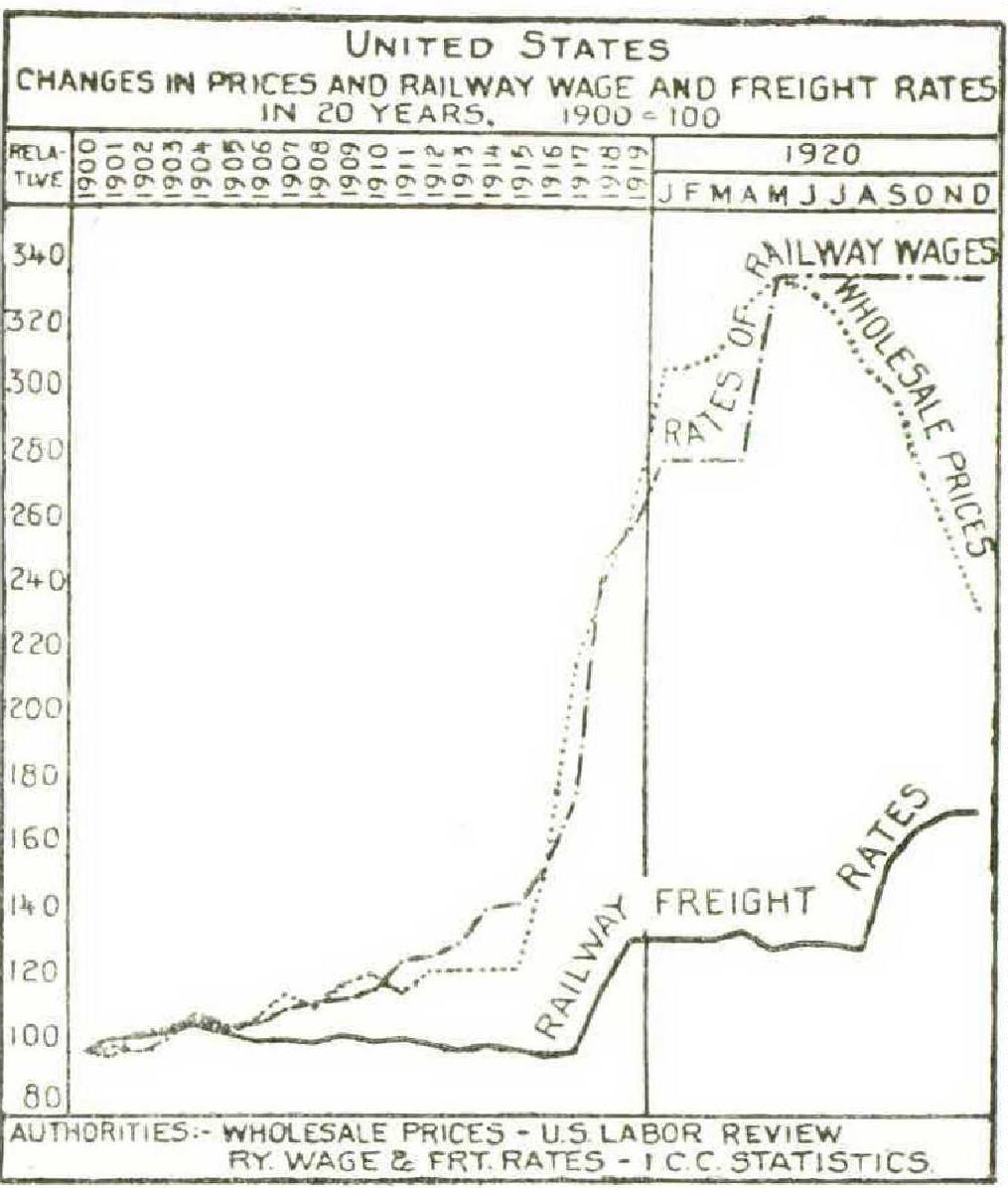
About 1900, as shown in the chart, wholesale prices and railway wages began to rise; and in May, 1920, they finally reached a level never before dreamed of. In 1905 the average freight-rate started to fall. It declined uninterruptedly, until it reached the lowest level in seventeen years, in 1910 and 1917. Decisions of the Interstate Commerce Commission in three applications for increased rates, in 1914, 1915, and 1917, afforded but slight relief; so that, at the end of private control, in 1917, freight-rates were one per cent, less and wholesale prices 120 per cent greater than in 1900.
The Federal Railroad Administration made a substantial rate-increase in June, 1918, which, however, fell far short of establishing a proper relation between freight-rates and costs of labor and commodities. It is a just cause of complaint against the Director-General that he refused to recognize the moral obligation he was under to make an increase in the revenues of the carriers corresponding to the enormous and destructive burden of expense which he had placed on them. He left, to the owners the unpopular task of seeking before the public an increase of revenue to meet this increase of expense. It was easy to shift this burden to the carriers, who, at the threshold of resuming their relations with the public, were confronted with the necessity of asking a large increase of rates. In equity this obligation was not theirs — it was the obligation of those who had created the necessity.
In July, 1920, the Federal Labor Board, in a decision made retroactive to May, 1920, raised wages an average of 21 per cent, to a level 240 per cent, above that of 1900; wholesale prices then were also 240 per cent higher than in 1900, while freight-rates were but 30 per cent higher. The rate increase finally authorized by the Interstate Commerce Commission about the first of September, 1920, raised freight-rates to a level only 74 per cent higher than in 1900, although wholesale prices, which then had fallen, were still 160 per cent to 180 per cent, higher than in 1900, and railway wages remained 240 per cent higher.
For the last twenty years all industries except railroads, which were strictly restrained by law , raised prices currently with rising costs, so that, when the 1920 rate-increase was finally granted, the railroads found themselves without adequate and sufficient surplus, or accumulated profits, on which to convalesce from the long financial famine through which they had gone.
Publication of revenues, expenses, and net railway-operating income of large, or Class I,1 roads for the years 1920 and 1919 occurred at a time of great industrial disturbance and readjustment, with prices falling and the purchasing power or the purchasing inclination of the consuming public substantially reduced. This fact caused great anxiety, and a study of the situation was instituted by the carriers, to determine what bearing, if any, the then level of transportation charges had on the depressed condition of business.
A consolidation, by the Bureau of Railway Economics, of statistics compiled from reports of the Interstate Commerce Commission, shows, with reference to Class I roads, that operating revenues were $1,026,698,147 greater in 1920 than in 1919; operating expenses, taxes, and joint-facility rents $1,419,754,474 greater in 1920 than in 1919; and that net railway-operating income was $393,056,327 less in 1920 than in 1919, notwithstanding the fact that opera! ing revenues were more than a thousand millions larger.
As to the disproportion between expenses and revenues, it should be understood that, except as the totals were possibly affected by bad management, the Government controlled the operating income and more than 64 per cent of the operating costs, that percentage representing disbursements for labor. The Government fixed these charges in both years; and in 1920 it also bought a, very substantial part of the materials and supplies through the Federal Railroad Administration, which charged its bills for these items against the railroads. In other words, the Government not only prescribed the rates from which the operating revenues of the carriers were derived, but likewise fixed the wages, which constituted more than 64 per cent of the operating expenses; and the prices of the materials and supplies that the carriers must have were fixed either by Government or by economic forces beyond the control of the carriers.
Out of every dollar of operating expenses there were paid 64 cents for labor at prices fixed by the Government; 15 cents for materials and supplies at prices fixed by the Government; and 3.5 cents for other expenses incurred by the Government in the first two months of 1920. Thus, a total of 82.5 cents out of every dollar of expenses for the year 1920 was paid out at prices directly fixed by the Government itself. The materials and supplies used during the last ten months of 1920, costing 15 cents out of every dollar, were purchased by the carriers at prices fixed by general market conditions beyond their power to control. In other words, prices fixed by the Government or by market conditions covered 97.5 cents out of every dollar of operating expenses.
The story of Government operation of the railroads is eloquently told by the following figures: —
CLASS I ROADS
Excluding switching and terminal companies
| Year | Met Railway Operating Income | Relative | Payrolls Relative | Percentage Return on Investment |
| 1917 | $934,000,000 | 100.0 | 100.0 | 5.20 |
| 1918 | 039,000,000 | 68.4 | 150.3 | 3.51 |
| 1919 | 455,000,000 | 18.7 | 163.4 | 2.40 |
| 1920 | 62,000,000 | 6.6 | 212.6 | 0.32 |
| 1921 (Jan. and Feb.) | 8,214,542 Def. | 0.0 | 0.00 |
The baneful effects of Government practices continued after the return of the properties, and, not withstanding strenuous efforts to correct them, are still responsible for the unsatisfactory condition of the railroads.
A canvass made in January, 1921, showed that thirty-five railroads — among them the Erie, Great Northern, Philadelphia & Reading — failed to earn even operating expenses; and twenty-eight others — including such prominent lines as the Pennsylvania, Baltimore & Ohio, Atlantic Coast Line, Chicago, Rock Island & Pacific, Missouri Pacific — earned operating expenses only, but failed to earn taxes and fixed charges.
The labor costs of Class I carriers were 113 per cent higher in 1920 than in 1917, preceding Federal control; and if the increased wage-scale had been in effect during twelve, instead of only eight, months of 1920, the increase would have been about 125 per cent. The Government during its control allowed gross revenues to increase less than 54 per cent. Labor-costs have risen since the Government took charge of them in 1916. under the Adamson law, from $1,468,576,000 to $3,698,216,000, the total amount paid to labor during 1920 being rery nearly .sixty times the 861,628,626 of net income yielded by the operation of the railroads.
The history of the direct labor increase is interesting and important.
The labor bill of Class I curriers in 1916, before the Adamson law took effect, stood at. $1,468,576,394
In 1917, when the Adatnson law WHS in effect, the labor bill was 1,739,482,142
An increase over 1916 of . . . $270,90.5,748
This was increased by the Railroad Administration in 191S to 2.613,813,351
Oran increase over 1917 of 874,331,209
This was further increased by the Railroad Administration in 1919 to. 2,843.128,432
Or an increase over 1918 of 229,315,081
This was further increased by the Railroad Labor Hoard in 1920 to. 3,698,216,351
Or $10,132,000 for every day of the year.
The increase in labor alone, from 1916 to 1920, was $2,230,000,000—nearly equal to $2,357,000,000, the total operating expenses of all Class I roads in 1916, which include, not only cost of labor of every description, but cost of materials, fuel, depreciation, loss and damage to freight, injuries to persons, insurance, and the rest.
After the return of the railroads to their owners, they were made to perform the greatest transportation task in their history. They moved more freight and passengers, loaded their cars more heavily, and moved larger train-loads. That it cost too much to do this was due, as shown, almost entirely to causes beyond the railroad managers’ control.
II
The experience of the public with over two years of arbitrary and wasteful Government operation, and the experience of the carriers with a public generally hostile and non-cooperative, had had a chastening effect on both, from which a mutually tolerant spirit had arisen.
Little more than a year ago, the Transportation Act was passed, in response to the public demand that Government. operation should cease and the railroads be quickly returned to their owners. After the act took effect, all went well for a while, and both the public and the railroad owners felt that the long-hoped-for era, in which mutual trust and cooperation were to replace the acrimonious relations of the past, had arrived.
Under the provisions of the act an adequate income was guaranteed to the carriers until September 1, 1920. It was to be paid out of the public treasury, whether earned or not. In fact, it never was earned, and never could be earned, under the operating expenses inherited from the Federal Railroad Administration. In order to anticipate conditions that, would arise after September 1, the railroads applied to the Interstate Commerce Commission for the relief that the Transportation Act provided. The hearing was had in the summer of 1920. The application for rate-advances was based on estimated traffic-volume and operating expenses of a constructive year ending October 31, 1919, which included known increases in costs of wages and materials, to which the Interstate Commerce Commission, before rendering their decision, added the amount of the Labor Board’s award of July, 1920, which increased wages by $618,000,000.
The operations of the constructive year showed a deficit of $399,000,000, after paying operating expenses, taxes, equipment rents, and joint-facility rents. Therefore, under the provisions of the Transportation Act, 1920, the carriers asked for a sum to yield a return of $1,233,000,000, or six per cent on the valueof the properties dedicated to public use, plus $399,000,000, to make good the deficit — a total of $1,632,000,000. Commercial bodies and shippers, both individually and as organizations, joined the railroads in advocating the increase, which was granted. Becoming effective August 26, 1920, it was designed to yield $1,533,000,000 more revenue, the Commission’s estimate of a six per cent return being $100,000,000 less than that of the carriers.
Agitation for reduction in freight - rates began early in 1921. Encouraged by speeches and propaganda to iho effect that the depression in business was caused by the rate-increase of September 1, 1920, although Interstate Commerce Commission figures showed that revenue ton-mileage increased seven per cent in the four months following the allowance in rates, the demands became relentless.
We have shown that the policy of the Government for many years was not to raise rates in normal or good times sufficiently to yield adequate revenues. If rates are now to be lowered because of bad times, where will this leave the railroads? The chart already referred to shows that other indust ries, in good times, reaped large profits from higher wholesale prices, out of which surpluses could be accumulated for use in bad times; it also shows how the railroads were denied the enjoyment of this right. Yet there is a country-wide demand that, the rates, which were but recently raised, shall undergo a general reduction, before the carriers shall have enjoyed the long-delayed relief provided by the Transportation Act of 1920.
In the Senate inquiry, witnesses testified that the inevitable deflation of warprices, preceding the slump in business, started with a sharp drop in wholesale prices in May, 1920, the result of tightening markets and of lessened ability of the consuming public to absorb production. The wild orgy of spending that followed the restraints of war, coupled with rising wages and falling efficiency, had come to an end. Other symptoms showed that business depression preceded higher freight-rates; Dun and Co. reported 1627 commercial failures, with about $30,000,000 liabilities, in the first quarter of 1920, and 2031, with $80,000,000 liabilities, in the last quarter.
Total bank clearings fell 16 per cent from March, 1920, to the following August. Construction reports show that the floor-space of projected new buildings fell 33 per cent, from 129,000,000 square feet, in the second quarter of 1920 to 86,000,000 in the third quarter.
Any one of the foregoing signs by itself would indicate an approaching commercial storm; taken together, they give overwhelming support to the theory that the railroads are not responsible for our commercial depression.
Any horizontal increase of rates, such as that of 1920, inevitably produces inequalities which, if not adjusted, may check traffic. Although thousands of rates have already been adjusted by the carriers in conferences with shippers, the public has been misled into believing that the stagnation of business is caused by unreasonably high rates, that, railroad management, is inefficient, and that private control is a failure: thus the unfortunate coincidence of higher rates and a business depression has, in little over a year, changed public confidence and sympathy into suspicion and hostility.
It should require little explanation to show that the contemplated statutory return of $1,134,000,000 on the value of the railroads can be produced only in one of two ways: either by moving the same traffic-volume as in the constructive year at the rates fixed by the Interstate Commerce Commission, or by moving a greater traffic-volume at lower rates. Therefore, if a general reduction of rates is made without a concurrent increase in traffic well in excess of the volume of the constructive year, the return of $1,134,000,000 may be so deeply cut as to imperil the solvency of the railroads.
This is what occurred: traffic fell rapidly early in 1921, and has continued to fall ever since; returns for the first six months show the net operating income of all Class I carriers, derived from the carriage of a very much smaller traffic at the increased rates, to be $142,000,000 only, or three fourths of one per cent of the Commission’s valuation of the properties, instead of three per cent. This is not enough by $109,000,000 to pay accrued interest on the debt of the carriers, which, according to the latest. Commission figures (1918), amounts to $251,000,000.
Therefore, when it is urged that railroad shareholders, in times of stress, should share the burdens of the farmers and forego some of their profit for the common good, it should be remembered that, for the first six months of 1921, they earned no dividends, and, moreover, had to provide $109,000,000, from outside sources, to pay interest on their bonds, in order to escape receiverships. In the case of the shareholders, these losses are irretrievable, for, unlike the public, they are not allowed to offset them by high returns in times of great prosperity.
III
The logical consequence of the representations of propagandists that the depression in business is caused by high transportation charges has been to engender a state of hostile public opinion willing to believe anything as to the inefficiency of railroad management. This is seen in the ready acceptance of the claims made by Mr. Henry Ford as to his wonderful achievements in operating his recently acquired Detroit, Toledo & Ironton Railroad, and of the sensational assertions, meant to focus public at tent ion on the alleged waste of a billion dollars a year in the management of railroads, made by W. J. Lauck, advocate of organized labor, in the hearing before the Federal Labor Board in Chicago, in April, 1921.
In a rate-hearing before the Interstate Commerce Commission in 1910, charges were based on the testimony of Mr. Harrington Emerson, an efficiency expert, that, by adopting certain methods used in manufacturing plants,$300,000,000 annually could be saved in railroad operating expenses. This estimate, incorrectly construed, gathered force as it traveled, and soon became ‘a million dollars a day.’
In an admirable article in the Quarterly Journal of Economics for May, 1911, Mr. William .J. Cunningham, James J. Hill Professor of Transportation in Harvard University, who discussed the subject personally with Mr. Emerson, explained how that gentleman arrived at his estimate. He took the last statistical report of the Interstate Commerce Commission, and applied to each class of employee and to cost of materials the percentage of efficiency obtaining in railroad operation at that time, according to his judgment, and translated the margins between these percentages and 100 per cent into money values, to produce his estimate.
His figures were arbitrary, with no evidence of resting on any experience in railroad operation other than that acquired in a seven-year experiment on the Santa Fé system under abnormally favorable conditions, the results of which did not nearly equal those on neighboring railroads similarly situated, and made so little impression on the Commission that in its decision it said: ‘We can hardly find that these methods could be introduced into railroad operations to any considerable extent ; much less can we determine the definite amount of saving which could be made.’
To argue that shop-repair work, involving hundreds ol different operations, in which safety and avoidance of delay are paramount considerations, conducted at several thousand points, widely separated over the 242,000 miles of line in existence at that t ime, and impossible of close supervision, could be as efficiently conducted as in a large manufacturing plant, repeating indefinitely a few easily defined operations under close supervision, is so unwarranted as to appeal at once to one’s sense of unfairness.
In maintenance of roadbed, track, and structures, entrusted to 35,000 or 40,000 gangs, whose duties demand unremitting vigilance, close daily inspection of every mile of line, and immediate repair of defects in storm or sunshine, by day or by night, and, above all, without interruption to passage of trains, — this requirement frequently increasing cost to an extraordinary extent,— it is obvious that profit and efficiency as understood in manufact uring must be absolutely subordinated to celerity and safety.
Transportation in 1909 was manufactured power generated in 57,212 power-plants or locomotives, manned by 114,424 engineers and firemen, who were carefully inst ructed as to methods of using coal and steam, but perforce scantily supervised during most of their hours on duty.
The output of the transportation industry, measured in units of tons and passengers carried one mile, is to be sold to the public, which is vitally interested in knowing how efficiently the machine functions and the quantity and quality of the product. If a railroad as a whole fulfills its fundamental duties to the public, the character of its management is inevitably reflected in the proved results.
Statistics show, in the period from 1890 to 1920, as the result of the management of the railroads of our country, the miles run per passenger-car nearly doubled; revenue freight per freight-car more than doubled; revenue freight per train-mile increased 209 per cent; tonmiles and equated passenger-miles — three times the passenger-miles — per employee increased 80 per cent, following large capital expenditures to reduce grades and curvature, provide heavier locomotives, and the like.
From 1890 there were constant and, in most items, remarkable increases in excellence of design and also in ihe use of every unit, both inanimate and human, up to and including 1910, and thereafter, also, to 1920. Notwithstanding large increases in additional main tracks, sidings, locomotives, and cars, the capital per mile of road increased but slightly in thirty years, while the public service per dollar of capital increased 136 per cent, and per dollar of net income increased 1221 percent. The uninterrupted improvement in efficiency of operation is most impressive: it would have been impossible without faithful and efficient performance of duty by all employees involved, and without constant, close scrutiny of expenditures and results by managers.
The better operation for the ten years immediately preceding the 1910 hearing effected a saving of 420,200,000 train-miles in that, year through heavier train-loads, valued very conservatively at $373,983,000.
Thus, while bitter attacks on the competence of railroad managers for nol adopting methods peculiarly suited to manufacturing shops were being made, they were, by efficiency methods of their own, actually operating their properties at a saving of $1,025,000 a day over the cost of ten years earlier.
The supreme lest of railroad management is safety. During the same period, there was a constant reduction in fatalities per passengers carried one mile and per 1000 employees. In 1900 a passenger’s risk of being killed on a train was one in 182,000,000 miles run, in 1910 one in 196,000,000 miles run — numbers hard to conceive. A train running 60 miles an hour, and covering 525,600 miles in a year, would require 378 years to run 196,000,000 miles. Put differently, the deal hs of passengers in train-travel in 1910 were 26 per cent less than in 1890, and from walking on tracks at stations and crossings, 54 per cent. less. Ten years later, in 1920, deaths of passengers in train-accidents were one third only as frequent as in 1890, and from other causes less than one fourth as frequent.
IV
Mr. Henry Ford’s purchase of the Detroit, Toledo & Ironton Railroad in March, 1921, and the wonderful things he claims to have done, have been given such publicity as to cause misunderstanding and trouble unless corrected.
The reports rendered by the Detroit, Toledo & Ironton Railroad to the Interstate Commerce Commission, show clearly the following facts, which dispel the mystery surrounding the operations of this road since it came under Mr. Ford’s control. For the four months ending June, 1921, operating revenue increased 73 per cent, with 21 per cent less freight and 13 per cent less passenger traffic. A large reduction in operating expenses was to have been expected, but they were substantially identical in the two periods.
Tons per car and tons per train — the controlling factors in efficient operation both show large declines. The total tons carried in the quarters ending June, 1920, and June, 1921, were substantially the same, but the quantity of automobiles and other vehicles, on which very high rates are paid, increased 230,000 tons, or 3496 per cent, while products of agriculture, mines, and forests, on which the rates are low, decreased 216,000 tons. Accordingly, the average rate per ton-mile rose from 8.1 mills in 1920 to 18.8 mills in 1921, or 132 per cent.
Had the Detroit, Toledo & Ironton’s increased revenue per ton per mile been the same only as that of adjacent lines, it would have shown a larger deficit, — $208,000 — for the four months of Mr. Ford’s management than in the previous year. Conversely, had Class I carriers, only, enjoyed the same average revenue per ton per mile as the Detroit, Toledo & Ironton, they would have earned $1,080,000,000, — a full six per cent on their value, — and would have been able to return $2,368,000,000 to the public in lower rates, an amount equivalent to more than half the entire freight revenue now collected.
The average numbers and daily wages of employees, published, quarterly only, by the Interstate Commerce Commission, show that in 1921 the number of employees was 12 per cent greater than in 1920, and the average daily wage in 1921 was $5.81, or only one cent greater than in 1920.
It is evident that the Detroit, Toledo & Ironton was bought as an adjunct to the Ford Motor-Car Works, to be used for trading purposes in securing tonnage and forcing better divisions of through rates from connections. It might easily carry all its less-than-carload freight free and still yield a fair return on its cost.
Mr. Ford’s accomplishments in the automobile world make him one of the big men of our country; but if the exaggerated claims as to his railroad management were not refuted, it would, by default, be an admission of gross incompetence and inefficiency by the managers of American railroads.
Mr. W. J. Lauck, consulting economist for the labor-unions, asserted before the Labor Board in Chicago in April, 1921, that by efficient management railroad operating expenses could be reduced $578,500,000 in certain items, thus: —
| Modernizing locomotives | $272,500,000 |
| Locomotive operation, firing methods | 50,000,000 |
| Shop-organization improvements | 17,500,000 |
| Power-plant fuel savings | 10,000,000 |
| Water-consumption savings | 12,600,000 |
| Service-of-supply savings | 75,000,000 |
| Shop-cost-accounting savings | 10,900,000 |
| Labor-turnover savings | 40,000,000 |
| Loss-and-damage savings | 90,000,000 |
| Total estimated annual savings | $578,500,000 |
Mr. Lauck stated that enough more could be saved in a large number of other items to bring the total to well over a billion a year. By means of other possible economies, such as the consolidation of railroads into a few large systems, changes in methods of financing, and the like, Mr. Lauck says it would be possible to save another billion a year.
Wherever these vague statements admit of check, their unreliability becomes patent. For instance, $673,000,000 was spent for fuel in 1920. Mr. Lauck asserts that the modernizing of locomotives and the use of better firing methods would save $322,500,000, or 48 per cent. Fuel-saving devices of proved merit, which have generally been adopted, are the brick arch, now on 43,000 locomotives, or 66 per cent of all those in use, which saves about 10 per cent, and the superheater, nowon 35,000 (54 per cent, of all locomotives in use), which saves 20 per cent. If the remaining 34 per cent of locomotives were equipped with brick arches, the future saving therefrom would be 10 per cent of 34 per cent, or 3.4 per cent. By equipping the remaining 46 per cent of locomotives with superheaters, the fuel biil might be reduced 20 per cent of 46 per cent, or 9.2 per cent more. Feed-water heaters, not yet fully proved, might possibly save 10 per cent of the 70 per cent (or 7 per cent) of fuel left after the 10 per cent and 20 per cent saved, respectively, by arches and superheaters. By cooperation of railroad officials and employees, an additional saving of 6 per cent is considered possible — a total from all these sources of 25.6 per cent. Using the round figure of 26 per cent, the total saving on the fuel bill of 1920 might be $174,980,000.
The Baltimore & Ohio Railroad has made actual estimates of what it would cost if all Class I railroads were to replace antiquated locomotives with the most modern types of heavy locomotives with fuel-saving appliances, and of the incidental costs of heavier turn-tables, larger round-houses, heavier rails and bridges, and more solid permanent way. The expenditure for all Class I roads, if they could raise the capital, would be $4,000,000,000 the interest on which at 6 per cent would exceed by $65,000,000 the limit of possible saving.
It must be borne in mind that other possible economies, such as the consolidation of railroads into a few large systems, changes in methods of financing, and so forth, whereby Mr. Lauck says it would be possible to save a second billion a year, were freely used by the United States Railroad Administration, which not only did not save a second billion a year, but actually lost nearly that much or $833,000,000 a year.
Mr. Lauck bases his estimates of possible savings on 1920 figures, evidently assuming that the changes could be made at once. Otherwise, methods and practices devised by railroad managers, long used, used by the Federal Railroad Administration, and still used by our railroads, could produce large savings in future years only. The cumulative effect of these practices from 1890 to 1920 made it possible to move the traffic of the latter year in one third the number of train-miles that would have been required if the methods of 1890 had prevailed, thereby saving $6,742,000,000 in the public’s transportation bill.
Mr. Lauck’s estimates, if related to 1930 operations, — ten years lienee, — might be reached if the control of railroad managers over operations were unhampered by economy-forbidding restrictions, which unfortunately is not now the case. Furthermore, the total operating expenses and taxes of Class I roads for 1920 amounted to $6,048,000,000. Excluding pay of general officers, Government-controlled wages, the reduction of which Mr. Lauck does not suggest, cost $3,651,000,000; taxes cost $279,000,000; depreciation, fixed by the Commission’s regulations, $152,500,000. The total for these three items, $4,082,500,000, leaves only $1,966,000,000, out of which two billions are to be saved. That is, all operating expenses would have to disappear, even salaries of general officers, on whom Mr. Lauck places the entire burden of saving the two billions.
VI
The data used herein are mainly from statistics kept under the immediate direction of the Interstate Commerce Commission, and represent the fruits of carefully and constantly developed efficiency methods, which were in use many years before Mr. Emerson made his sweeping condemnation of railroad management in 1910; they were used without change by the Federal Railroad Administration, which thereby gave them the stamp of its approval; and they are still in use, achieving continuous improvement in operation, and consequent money-saving, year after year.
Never before in the history of railroads has the pressure for advanced methods been so great as now; and never before have managers, imbued with the sentiments of the late Mr. Harriman, — ‘Never dissatisfied, always unsatisfied,’ — responded more heartily.
The railroads maintain two associations, embracing substantially all important lines.
One, the Association of Railway Executives, formulates general policies and represents the railroads in their relations with Congress, the administrative agencies of the Government, the Interstate Commerce Commission, and the rest. It has an advisory committee, composed of eleven railroad presidents, charged, among other things, with making special investigations relating to common use of terminals and other facilities, through skilled engineers and specialists. The Association maintains a fully equipped ‘ Bureau of Railway Economics,’to study economic questions and to prepare bulletins of information for the use of its members. The Bureau issues a monthly statement of operating data of all Class I carriers, minutely detailed to show the principal requisites of efficient management, from a study of which every manager can measure his accomplishments or shortcomings by comparison with those of his neighbors.
The second organization, the American Railway Association, of which substantially all railroads are members, studies questions relating to construction, maintenance, and operation. Its organization embraces seven divisions, which give special attention to Operation, Transportation, Traffic, Engineering, Alechanical Problems, Purchases and Stores, and Freight-Claims.
Mr. W. M. Acworth, an English student of railway operations, recognized as a high authority, has said: —
‘It has always been my opinion that in actual economy of operation the railways of the United States are first in the world. In number of tons per car, cars per train; in the fullest utilization of locomotives; in the obtaining of the greatest measure of result for each unit of expenditure, they are not equaled by the railways of any other nation.’
The late Honorable Franklin K. Lane, then a member of the Interstate Commerce Commission, on his return in 1910 from the International Railway Congress held in Berne, said: —
‘The conference established beyond question, I think, the supremacy of the American railroad from the standpoint of efficiency.’
The managers of our railroads are men of broad enough vision to welcome, not resent, criticism, — preferably fair criticism, if it shows a reasonable respect for facts, — as it stimulates study that inevitably leads to improvement. Judging by what they have accomplished, — notably, in keeping their properties alive through seventeen years of fasting verging on famine, while all other industries were well fed and fattening, — faith is inspired that, if initiative is not altogether stifled by too-strict regulation, they will continue so to operate the railroads that their future will be assured.
- Roads with operating revenues over $1,000,000 per annum.↩