Biology and Human Progress
THE humble and hard-working scientific investigator, when occasionally he looks up from his microscope or dissecting-table, is apt to perceive — sometimes in reality, at other times in imagination — a supercilious individual, not invariably a college president, asking, “What’s the use?” At the moment he may find this simple query somewhat disturbing to his nervous system, and he is to be congratulated if he can think of a suitable retort before it is too late. Franklin’s apt reply, “What’s the use of a new-born baby?”—so brilliantly justified by the later developments of electricity — was a spark off the wheel of genius, and no such fire is at the command of the ordinary plodder along scientific paths.
I have acknowledged a certain irritation upon hearing the query, “What’s the use ? ” and yet, upon reflection, I must confess that it is a very proper question — one which must be answered if science is in any sense to be justified. Value, in the long run, is the test of everything, from our human standpoint, and we can conceive of no other. What, then, is the use, the value, of scientific research ? The question is a metaphysical one, and science, as such, gives no answer. Science may show that such and such a research has produced, or has assisted to produce, in the course of years, turnips, or sugar-beets, or oranges: or has saved the lives of so many people; or has prevented railroad collisions; or has, if you please, lodged rascals in jail and set the innocent free. All these things and many others science may do, but then—what’s the use? Regarded from the standpoint of pure science, what atom is better than another, or what combination of atoms ? Do we feed you, clothe you, house you, from day to day ? What then ? why are you, as an individual walking the earth, better than the clay of former individuals on which you walk ? All is equally orderly, equally wonderful, equally obedient to what we call the laws of nature,—is, in short, what it is,— and is that by reason of everything else. The cosmos is a unit, equally indispensable in all its parts,— for and by itself. What is the use of God ? No answer is thinkable, to the monist or monotheist.
Nevertheless, the man who recognized no use, or value, would be insane. There is a practical dualism which lies at the very foundation of our nature, makes our lives worth while, and enables us to respect those of others. We are ends in ourselves; a moment of pleasure, of intellectual or spiritual insight, of love,— even of anger or hate,— is its own justification, is the culmination of the socalled blind forces of nature in sight. Thus it may be said that those things are of value which, entering the field of human consciousness, serve to enrich it.
Science, however, enables us to distinguish what may be termed direct and indirect, or contributory, values. The idea of causation, or the necessary sequence of events, leads us to perceive that certain things which at the time were quite unknown to us, or if known did not impress us as valuable, were antecedent to some of our most precious experiences, and that the latter directly resulted from the former. These indirect values began to come into prominence in the intellectual field as soon as science was systematically studied, and to-day they are perceived to be as numerous, in relation to any particular direct value, as our ancestors in relation to ourselves. To the scientific mind they appeal so strongly that it becomes difficult to believe that any fact will not have “ useful ” posterity; but the lay mind is apt to be as skeptical as we might be if requested to let a notorious burglar out of jail, on the ground that he might prove, in the sixteenth generation, to be a necessary ancestor of some great man.
This, however, is true only when the lay imagination is required to be unduly stretched. Money has no direct value whatever; all the value it has is of a contributory nature. Yet we do not accuse the public of inability to appreciate money, for all that it is not even the father of any direct value (unless cupidity be one), but at most its grandfather. The unscientific will go back even farther than this, and see value in the crop which may be sold for money, —even in the land and seed, which brought together will produce the crops. Somewhere, however, we come to the beginning of things as understood, to the “ This is the house that Jack built; ” and back of that the story does not tell.
Perhaps, then, I should say that the first, and in some ways most important, use of scientific research, and a knowledge of its results, is to enlarge the imagination. The eye of the mind must be taught to see and understand. How many follies, how many crimes, are committed from lack of imagination! Alas, in this poor state of ours to-day, how much is going on which would not be tolerated for an instant, did we but have the insight, the imagination, to see what it all means and is likely to mean for coming generations! The story is told that, on a recent Antarctic expedition, “ the voyagers started with a train of dogs to drag their sledges, to penetrate as far as they could the frozen hills. They were reduced to very small rations of food, and the dogs, though willing and friendly enough, began to collapse and fail with fatigue and want of nourishment. They were obliged to kill them one by one. Each of the party in turn had to lead the dog that seemed most exhausted away from the camp, put him to death, and return with his body, which was presently eaten by the other dogs. The poor creatures at last grew to understand that when, in the evening, one of the sledge-party left the tents accompanied by a dog, it meant a speedy prospect of food. And so the ceremony was always heralded by an outburst of cheerful and excited barking from the rest of the troop. The victim himself always shared in the excitement and accompanied his executioner wagging his tail and uttering joyful barks, under the impression that he was specially favored by being led to the source of the desired food.” 1
It is well for the dog, thus about to perish, to have no anticipatory terror; but for ourselves, we have been provided, for good or for evil, with the power to anticipate and prevent many misfortunes, and damned are we if we don’t use it. The “knowledge of good and evil ” is indeed a two-edged sword, and to be unskillful in its use is to endure the severest penalties ever meted out to living beings.
Yet, how like we are to the dogs in the story — before the event; how unlike, in our remorse and misery after it. How cheerfully, to avoid a little trouble or expense, do we submit to poisoned food, foul water, the contamination of our blood or morals; how bitterly do we complain of disease and death, of hereditary incapacity, of crookedness, — when they affect us directly. Without disparaging the other sciences, it must be claimed for biology that, since we are living creatures, it is of the first importance for the understanding of our vital problems, for the cultivation of that foresight which we are bound by our contract with the Almighty to practice.
As a means of culture, I hold it invaluable for the development of that type of mind which is ready to connect series of facts, and so perceive the danger before it is at the door, the advantage before it has passed by. From this point, of view there is a positive gain to the individual in any scientific research pursued in a sufficiently broad and open-eyed way. It is not necessary to prove that the study of a particular group of beetles or centipedes will eventually “mean money;” it is fruitful at the very moment in cultivating an alert attitude of mind; provided, as I first said, that it is not too narrowly construed. That it also has a direct value, only to be properly appreciated by those who have received it, is a different but no less important consideration.
The scientific imagination is not merely of value for the purpose of connecting facts, but also for that of disconnecting fiction. To believe an impossible thing does not usually require much imagination, but the reverse. Thus, to the simpleminded people of old it seemed quite possible that the sun “ stood still in the heavens ” on an occasion narrated in history. To the scientific man it is apparent that for this to happen either the earth would have to cease revolving on its axis, or else the sun would be obliged to proceed with fearful speed out of its usual path, to keep opposite the same terrestrial point. Either of these things seem to him less likely than the hypothesis that the story is a poetic fiction. It is because he can imagine the implications of the statement, that he does not believe it.
All our educational problems may be said to centre around questions of “ nature and nurture;” in other words, heredity and environment. They are, therefore, problems for the biologist; or, if not exclusively for him, at any rate largely of his concern. To what extent can we, by our educational methods, affect the character of the individual ? To what extent is it legitimate or desirable to do so ? Education, in a broad or biological sense, does not begin in school; it does not even begin at birth, but long before. It may be defined as being the provision of the best means for developing the several characteristics or abilities of the individual to the best personal and social uses. In this sense it includes adequate nourishment on the one hand, adequate stimuli on the other. Do we yet know enough about these things, or apply what we know ? Most assuredly not.
A number of years ago Dr. H. M. Vernon made some experiments with the eggs of sea-urchins to determine the effect of various kinds of treatment upon subsequent development. He found that exposure of the ova for an hour to a temperature of about 8° C. at the time of impregnation, instead of the normal temperature of about 19° C., produced an average diminution of 4.1 per cent in the size of the larvæ. Temperatures a few degrees above the normal acted even more unfavorably, one of 25.5° producing an average diminution of 5.9 per cent. It was thus evident that the ova were extraordinarily sensitive to changes in temperature at this early period, and, as it was also found that they were very sensitive to changes in the salinity of the water. Dr. Vernon inferred that practically all changes in the environment would affect them. Among the higher animals, Professor Ewart made experiments with rabbits. He constructed an artificial slum in the basement of a house with little light or air, and there permitted a doe rabbit to live and give birth to litters of young. The effect was disastrous in the extreme. Many were born dead others were so weakly as to be scarcely able to live. Afterwards the same mother was removed to healthy surroundings, and her offspring were all that could be desired. Biology teaches, then, that living organisms are very easily affected in the earliest stages of their existence; and if we find such gross and palpable effects as have just been described, it may reasonably be assumed that there are others of a more subtle nature, perhaps not less serious in the long run. Indeed, it may fairly be questioned whether it is not a lesser evil to destroy the potential individual at the beginning, than to cause him to go through life handicapped by some frailty resulting from early injury.
Those who oppose the demolition of the slums sometimes accuse their opponents of sentimentalism. How can you cure, say they, something which has its root in the vicious habits of the people, — and, incidentally, subserves great commercial interests ? Well, we have this to say, that it is absolutely certain that, given any human stock this world ever produced, it would deteriorate in the slums; the individuals of each succeeding generation would be stunted and their lives cut short; they would fare like Dr. Vernon’s sea-urchins or Professor Ewart’s rabbits. Who and what are the causes of the conditions permitted to exist in all great cities ? Where should we assign the blame ? The past cannot be undone, but we are responsible for the future, because we are able to bring about a change. That the slums could not be destroyed in a few years, if the people of this country really wished it, is impossible to believe. The trouble is, that we either hold property (if it belongs to us or our associates) to be more valuable than life or health (if they belong to others), or else we do not recognize the true causes of the existing evil. In the latter case science and education should help us, in the former we justify revolution.
Nor is it merely a matter of altruism. The conditions which obtain in all crowded centres of population weigh heavily upon every one of us. The great cities are undoubtedly prosperous in a narrow commercial sense, but the corruption and rascality which they foster and shelter have become a menace to the state. Boulder, where I write may be taken as a type of the town of the future, at least in its better features. With natural surroundings of extraordinary beauty, as good a climate as might be desired, and a population no worse than the average, there seems a possibility of maintaining indefinitely such conditions as are suitable for human beings. Vet there are many good men and women who would sacrifice the best of all this; who would fill our streams with filth and our air with smoke and gases, would crowd our streets with the poor and miserable, would have us even as Denver or Chicago is to-day, — all for the sake of that form of prosperity represented by commercial profit!
But stop, you say, — the world’s work must be carried on. We must have cities and factories, and mills. Where would you be if all these things suddenly ceased to exist ? Do you not daily and hourly use their products ? Does not our very civilization depend upon them ?
To all this, so plausible but so shortsighted, the biologist can have but one answer. Nothing is right which interferes with the normal healthy life of human beings; nothing so interfering is justifiable if preventable. You have already accepted this doctrine in relation to your chickens, your cattle, yes, even your pigs; but when you come to your own species, there you stop. It is true, indeed, that the world’s work must be carried on. The social organism must be maintained; we desire neither anarchy nor savagery. But at present it is suffering from chronic indigestion in an aggravated form, and without some change of habits, the doctor cannot help.
The biologist has observed that, when a country is nearly uniform from one end to the other, the animals and plants will show a similar uniformity; but that when it is broken up into mountains, or consists of islands, several races of many genera will be developed, each adapted to its peculiar locality. The historian and the sociologist have made similar observations. The British Islands, the mountains of Switzerland, the peninsulas of Greece, Italy, and Scandinavia, have been the homes of the finest races the world has known. In a certain sense, the United States and the Federation of the World are magnificent conceptions, ever to be upheld; but please observe, these are States which are united, and the world is to be a Federation, not a monarchy. The best peoples have been the offspring of mixed blood, living under stable and characteristic conditions for long periods of time. It may be that the intermixture of new blood is necessary for racial vitality, but it is absolutely certain that the lack of a reasonable degree of stability is fatal to high culture, which always means racial and personal individuality. By stability I do not refer to political or intellectual conditions, which should always exhibit progressive change, but to racial constancy sufficient to call forth abilities suited to the peculiar genius of the people.
I confess that I am alarmed lest the indiscriminate mingling of peoples now going on should give us a sort of dull uniformity of mediocrity, stamping out “ provincialism ” altogether. We are Americans, to be sure; but we should also be living examples of the peculiar and unique virtue which emanates from our own half-acre. I should welcome the adoption of some particular sign — some feather in our cap — that would mark us as coming from a special state or town, if it were indicative of real characteristics such as we ought to possess. Provincialism, of the right sort, is a virtue, not a vice; we who live in this place, not quite like any other in the world, should live the lives and think the thoughts adapted to it, — not indeed in ignorance of the beyond, but as men who are able to use that which Providence has bestowed upon them.
If the migratory habits of Americans in general constitute a certain danger to our culture, what is to be said of the injection of apparently unlimited quantities of foreign blood ? Putting aside for the moment the question whether Japanese, Slavs, and others are more or less desirable as citizens than those who already occupy the country, what is to be said of the indiscriminate mixture ? Supposing that some one were to introduce miscellaneous blood into the choice herds of cattle in Colorado, without so much as consulting the owners, what would be said and done ? But nobody asks, apparently, what the Coloradoan of the future is likely to be, as the consequence of the intermixture of half a dozen alien races. I do not pretend to know how it will all work out, but the matter is open for investigation and no little evidence is already available. In the mean time, the horse will doubtless be over the horizon before we think of closing the stable-door.
It is well known to the biologist that all living organisms vary, the several individuals not being exactly alike. It is also recognized that this variation follows certain general laws; so that, for instance, examples of extreme difference from the average are rarer than those of slight difference. It is known further that the race inherits certain types of variability, so that if individuals of a certain kind appear now, they may be looked for in the future. Arguing from such general considerations, which are of course supported by innumerable specific cases, we may infer that the white population of Colorado ought to produce a certain percentage of ability of various kinds. Just what the maximum poetic ability — for instance — of any race or stock may be, we cannot say, since it is probable that no circumstances have ever arisen which would utilize and develop all the potential poets of a nation. Possibly the conditions existing in ancient Athens at her best were the most favorable that have ever prevailed for securing the maximum possible output of certain kinds of ability; and it may well be that these will never be repeated, — for the one reason, among others, that modern human society necessarily scatters its intellectual energies much more, having a far wider field. The proper intellectual output of a country, just like its proper output in physical achievement, can be estimated only in a general way and in the bulk; nor would it be desirable that all those capable of work in certain intellectual fields should be directed thereto, any more than would be the case with manual occupations. Nevertheless, we have the right to expect a certain average performance — a certain minimum of distinction — in every race, and if it is not forthcoming, the biologist, at least, knows that something is wrong.
Professor J. McKeen Cattell of Columbia University has lately been gathering some very interesting statistics regarding the distribution of American men of science. He gives figures showing the origin and present whereabouts of a thousand of the most successful or best known. It is curious to note that, whereas some states have to-day about as many as were born within their borders (for example Pennsylvania, sixty-six born, sixty-five present), and thus may be said to have retained the talent they produced, others show notable gains or losses. Ohio, for example, gave birth to seventy-five of the leading thousand now living, but has to-day only thirty-four. California gave birth to eleven, but has fifty-three, as might be anticipated from the youth of the state and the rapid increase of population. Colorado, for similar reasons, while giving birth to only three, is now credited with eight. The three, however, was over 87 per million of the population in 1860, while the eight was only 14.8 per million in 1900. The latter figure shows a higher percentage than most states without universities of the largest size, and is about ten times as favorable as the figures for the South Central states.
While the selection of Professor Cattell’s thousand shows a great many individual anomalies and oversights, yet it does very well to bring out such general facts as have just been mentioned. It is to be wished that the same might be done for the other fields of activity, so that we might see how far each state was taking advantage of its own native ability.
Biology has something to say about the purpose and scope of republican institutions. Originally the idea of a king was one of the most brilliant and fruitful conceptions of the world. Long before mankind knew anything about Galtonian curves or polygons of frequency, it was discovered that there existed in every society certain exceptional individuals, capable of being put to exceptional uses. This discovery is not peculiar to man, of course, but he has been able to give it new meanings and uses. “ The Divine Right of Kings ” is not an empty phrase, but may be taken to mean that it is wise and therefore right for those capable of leading to assume this office. The pro test of the republican was against the abuse rather than the use of this high function; and it is a singular and significant fact that under the guise of republicanism we have given our temporary monarch more power than the King of England. Just now, some of us are inclined to complain that this individual is using too freely his peculiar opportunities; a protest singularly ill-timed, since he is the first of a considerable series to show any real ability to fill the office. What, then, should be the powers and functions of a President of the United States, or of any other president ? The biological formula is a simple one: he should be allowed to do whatever he can do with advantage to those he serves. He should not be allowed to appoint postmasters in every village in the United States, because it is beyond human possibility that he can do this intelligently; he should be permitted to express his opinions on public questions, especially when, from his position, he has special knowledge of them. If he has been wisely selected, he represents, not merely the material interests, but the best ideals, the honor, of his country. He may and should stand for the integrity of these against all comers, even as David stood against Goliath. Yet it should be open to the humblest citizen to criticise his words and actions and to drive his criticisms home if he can.
The ideal republic must be a union of more or less kindred spirits, with more or less kindred aims, and yet with sufficient diversity to represent the free play of human activities. Where is it to be found ? Nowhere so clearly, I think, as in the field of science. In the Republic of Science there is the necessary common bond, while its citizens are scattered in the four corners of the earth. There is the common language of scientific terms. There is the full recognition of authority, with the equal recognition of the right of any one to question that authority. There are no artificial sanctions or, if there are, they count for little. There is a reasonable balance preserved between the authority of custom and the right to change it. There are, of course, places encrusted over, needing to be broken by violence; there are little whirlwinds of anarchy; perfection has not been reached, but, take it all in all, the Republic of Science is the best of modern republics, and to be a citizen of it is in itself an education in the science of government.
I wish to add a few remarks on the causes of human progress, regarded in the most general way. Any group of living beings, arranged in respect to the development of any particular character, may be represented by a diagram, thus: Each dot may be taken to represent one individual: A is the point of the minimum, B of the maximum development of the character. Of course, the sharpness of the corners of the figure will differ much according to the species and character chosen, but the general principle will remain unaltered. Dimorphic forms will of course give a more complicated figure, but these need not be considered at present. It will be seen at once that, as our common experience would suggest, there tire many more individuals midway between the extremes than at either end. Thus, there are more persons of ordinary height, or approximately so, than Goliaths or Tom Thumbs.
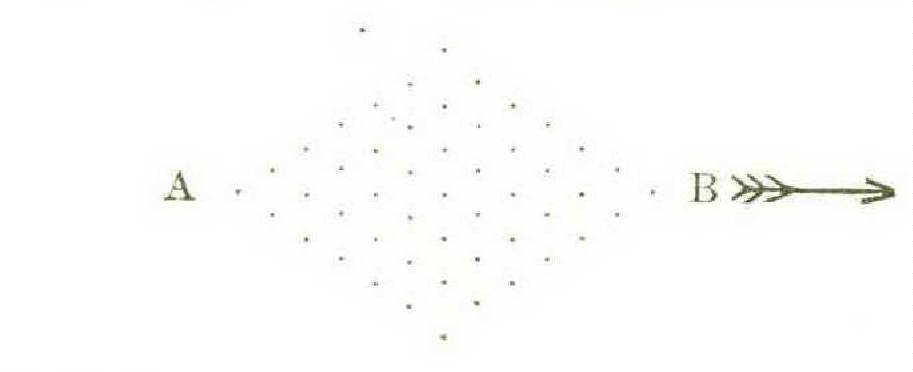
Suppose now that the group is not stationary, but shows progress in the direction indicated by the arrow, that is, toward the increase of the given character. This means that the first individual, or, more likely, his representative in a later generation, moves forward so much, the second also, and in short the whole group advances one or two places. This is illustrated very well by the progress of political opinion in such a country as England. To-day the Conservative party stands where the Liberals of former days stood; the Liberals are semi-socialistic in their aims, socialism has become a force in practical politics, while, on the other hand, the old-fashioned Tory is practically extinct.
It is evident from the diagram that vox populi is not, from an idealistic standpoint, vox dei. It would be, if the population had reached perfect equilibrium, so that any change or “ progress ” was undesirable. Few of us, I imagine, consider that any civilized nation can afford to rest on its laurels today, even for the briefest time. Hence, in respect to any particular movement, there must be men who are more enlightened than the majority,—men who, having advanced farther, can see more of the road ahead. That some who profess to have this advantage are looking at the wrong road, does not alter the fact that there are some who are fitted to lead and who should he followed to the extent that they are right.
Here, however, comes a difficulty. How is the mass of mankind to know the front of the phalanx from the rear? How is it to distinguish true from false guides ? Has it not always stoned the prophets, and can it well avoid doing so ?
I venture to suggest that there are ways of escaping from this difficulty, or at least of mitigating the evil. It is undoubtedly true that those in the middle of the group can rarely see the foremost, or understand his description of the road. But the second can understand the first, and interpret the message to the third, and so along the line, until even those in the rear have some glimmering of what’s about. Formerly, the advantages of education, including especially contact with leading spirits, were confined to the few; to-day, by means of the school and the press, they are spread broadcast. The indications are that these increased advantages do not benefit men of the first ability so much as those of the second and lower grades. The result is, that the whole shape of the figure may be changed and it becomes “ skew,” as the biometricians say: —
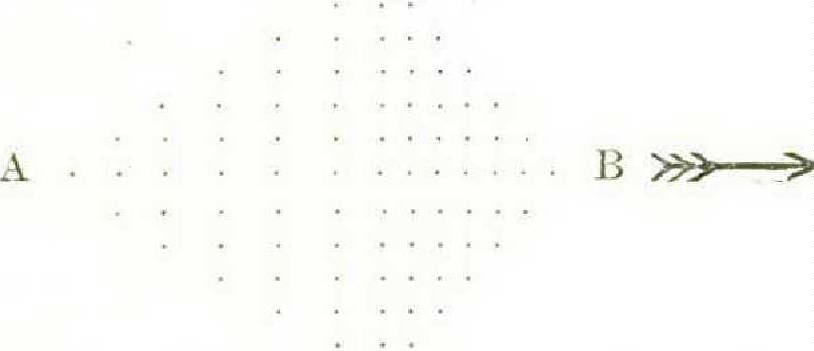
Thus, the mass is closer to the leaders and better able to understand the trend of progress and the reasons therefor. The “ great men ” no longer stand out so prominently, so totally apart from the rest of mankind; but perhaps their influence is greater.
Another and most potent cause of progress among the masses is of course the sense of direction already taken. If we have advanced so much toward certain ideals, we are the more ready to take additional steps, even without reference to those ahead. This, however, is true only when some advance has already been made, and is not a means of initiating reform. It also, unfortunately, is so blind a force that it is not rarely the means of leading a nation over the precipice, rather than to the summit of the mountain.
It will be observed that I have made the last diagram kite-shaped and have spoken of it as “ skew.” It could be made so, and often has in past times, by a process quite different from that just suggested, namely that of cutting off the heads of the more advanced. This would lead to a similar homogeneity, but without the factor of progress, or rather, with progress backwards.
It will also be remarked that the tail behind does not necessarily result from the process of education; that this process could affect the worst advantageously and, while the whole group would become more compact, it would not become skew. This is an exceedingly debatable point; but I have ventured to assume, as indeed I believe, that the advantages of education would be felt most by the “ average man,” and that the very poor minds would fail to be similarly affected, just as the very good ones. In this case the stragglers would straggle even more than before, and we might have an increase of crime and lunacy, for the very reason that more persons were out of joint with the world. This would be a disadvantage, but certainly with this compensating advantage, that the worst minds would not have so much influence to the detriment of the mass.
Finally, we have to ask, what are the real causes of progress after all ? If reformers cause reform, it is equally true that reform causes reformers. In other words, the existence of the leader is, biologically speaking, absolutely dependent on the mass behind. He is but the nose on its face, as it were.
Progress in human society may come about in two ways, which in actual fact will be combined. It may result from variation of the germ-plasm, that is to say, actual and fundamental change in the make-up of the individuals; or it may result from acquired characteristics.
That the germ-plasm varies, with resulting variations in the individuals developing, is well known. Among animals and plants, this variation is the normal cause of change or progress. Among domesticated and cultivated forms, the selection of suitable variations has been most potent in transforming races, so that the cabbage and the turnip, for instance, have little resemblance to their wild ancestors. Has progress of this sort occurred within historic times in the human species ? It certainly has, in respect to certain diseases owing to the elimination of the unfit. It has also, as the result of the mingling of races; the English nation is no doubt a conspicuous example of it. These, however, are secondary considerations, compared with the effects of the accumulation of social wisdom and the resulting possibilities in the way of education. It is impossible to say if, and how much, the average newborn child of America to-day is better than the new-born children who were its ancestors in the tents of the ancient Britons, the Gauls, or the Goths. One may suspect that the difference, after all, is slight for the number of generations since savagery has been very few.
While so much has been done by selection to improve domesticated animals, the king of “ tame creatures,” man, has been left to go his way unheeded. There has, no doubt, been a large amount of selection of a kind, — that which takes place whenever man and woman wed, as the result of their own free choice. There is a preference for the fit, leaving the unfit often childless, and even coeducation may subserve good biological ends by bringing together the best intellects of the day. Yet all this is often erratic enough, owing to false social standards and poor ideals; so we must welcome especially the better education of women, in the hope that they will raise the rougher sex by establishing new values.
However, whatever may be said of the choice of the fit, there is little doubt that the most conspicuous and practicable advantages will result from the elimination of the unfit. This will be one of the great issues of the future, I doubt not, and it will come to be an axiom that insanity, imbecility, hereditary disease, and the like, shall not be increased by breeding. In that remarkable skit, Erewhon, it is related that the Erewhonians regarded disease as we regard moral faults, and persons showing signs of it were locked up, while those very severely affected were liable to be executed. We may never reach precisely the Erewhonian point of view, but with all kindness and compassion we shall find it necessary to see that those conspicuously defective, while having the best lives they are capable of without harm to society, do not continue their defects into the next generation.
The slowness and difficulty of the alteration of our fundamental natures — if such can be said to have taken place at all in recent times — serve to emphasize the importance and value of acquired characteristics, — in a broad sense, of education. Education, in the hands of man, aided by “ social inheritance,” has made our modern civilization out of barbarism, and gives us hope for the most backward races. We are tempted to believe that it can do everything; and no doubt it is so far from having reached the limit of its possibilities that we cannot form any idea what those may be. Yet, there must be a limit somewhere, given mankind as it is to-day; and the only way to get more tether will then be to improve the race itself. Already, it does not take sharp eyes to see clogs on the wheels of progress, and it will require the utmost wisdom at our command to prevent an ultimate stoppage or breakdown. In all this, much depends upon our ideals. It is difficult to explain why some of us look forward to endless progress and think of stable equilibrium as a catastrophe. It arises no doubt largely from the fact that progress is all we know; still more from the psychological fact that all consciousness, all real life, as we understand it, is the accompaniment of change. It is curious to recall that the old idea that man was created once for all and would reach a condition of stability in heaven, was the fruit, not of idealism, but rather of the lack of it; and the picture reminds us altogether too much of the happy condition of the oyster to-day. And is not the oyster happy ? Satisfied, practically the same from cretaceous times, it lets the tide of progress flow on, while it is founded on a rock. It is a success, from one point of view, but that is not ours.
In our complicated modern society no citizen, however active, can guard all his interests, much less those of his children and fellows. As Professor Ross has recently well said, there is an ever shifting but wide margin of opportunity in which the criminaloid disports himself, and it is not for the common man to catch up with him. It becomes increasingly necessary to delegate numerous duties to special individuals, and nobody knows this better than the biologist. It may be true that the law gives John Smith power to prosecute the man who puts formalin in his milk, but his baby is probably dead before he discovers it. He can no more keep a private scientific library and laboratory for the purpose of detecting all infringements upon the integrity of the things he buys than he can keep a private policeman to take care of the wandering burglar, or a private arsenal to warn off the belligerent foreigner. Even if he is well trained in science, he cannot chase the criminaloid around every post; he must delegate this work to others specially trained for its performance.
The time will come, I have no doubt, when every county or municipality will employ a considerable staff of scientific men. Some will look after the foodsupply, others will examine the water, others the clothing offered for sale, with particular regard to its origin and manufacture. There will be those who will make a study of the children and determine the conditions under which they should work in school; others will investigate trades and manufactures and report anything detrimental to the workers. There will be statisticians and economists, students of production and distribution, all endeavoring to bring about the best results from human labor. All of these, at the same time, will endeavor to guard the public honor and it will not be tolerated that some are underpaid and overworked because of their necessity, others overpaid and underworked because of their positions of vantage. All this, I hope, will be done more locally than nationally; partly because a national system is apt to become too inflexible, too little responsive to special needs, and partly because the average, as represented by the nation, will never be so good as some of the parts, and the more progressive and enlightened communities should be able to take full advantage of their good qualities. On the other hand, it will doubtless be considered justifiable for the nation or the state to step in and clean up localities which are especially backward or corrupt, regarding them as public nuisances. While all this is going on in every township, there will be other scientific men employed to work on the general problems which underlie all the practical applications just indicated. Some of the researches will occupy many men for many generations, others will be more brief or circumscribed; but all will redound to the intellectual and material prosperity of the people. Facilities for work of all kinds will be freely provided, and the rich man will be, not he who has most, but he who can use most, and to the best ends.
The revivification of science will go hand in hand with the new birth of the arts. With leisure on the one hand and imagination on the other, men will come to a fresh appreciation of beauty; new values will be created and human life immeasurably enriched. Envy, hatred, and malice will not be destroyed, but most of the wickedness of modern life will perish from lack of motive or opportunity. When or how this will all come about, we do not know; say, if you please, that it is but a golden dream; I reply that it is at least a dream worth dreaming.
- The Gate of Death, 1906, p. 220.↩