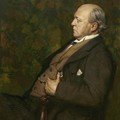
Émile Zola
IF it he true that the critical spirit to-day, in presence of the rising tide of prose fiction, a watery waste out of which old standards and landmarks are seen barely to emerge, like chimneys and the tops of trees in a flooded land, –if it be true that the anxious observer, with the water up to his chin, finds himself asking for the reason of the strange phenomenon, for its warrant and title, so we likewise make out that these credentials rather fail to float on the surface. We live in a world of wanton and importunate fable, we breathe its air and consume its fruits; yet who shall say that we are able, when invited, to account for our preferring it so largely to the world of fact ? To do so would be to make some adequate statement of the good the product in question does us. What does it do for our life, our mind, our manners, our morals–what does it do that history, poetry, philosophy, may not do, as well or better, to warn, to comfort and command the countless thousands for whom and by whom it comes into being? We seem too often left with our riddle on our hands. The lame conclusion on which we retreat is that “stories ” are multiplied, circulated, paid for, on the scale of the present hour, simply because people “like” them. As to why people should like anything so loose and cheap as the preponderant mass of the “output, ” so little indebted for the magic of its action to any mystery in the making, is more than the actual state of our perceptions enables us to say.
This bewilderment might be our last word if it were not for the occasional occurrence of accidents especially appointed to straighten out, a little, our tangle. We are reminded that if the unnatural prosperity of the wanton fable cannot be adequately explained, it can at least be illustrated with a sharpness that is practically an argument. An abstract solution failing, we encounter it in the concrete. We catch, in short, a new impression –or, to speak more truly, we recover an old one. It was always there to be had, but we throw off, ourselves, an oblivion, an indifference, for which there are plenty of excuses. We become conscious, for our profit, of a case, and we see that our mystification was in the way cases had appeared, for so long, to fail us. None of the shapeless forms about us, for the time, had attained to the dignity of one. The one I am now conceiving as suddenly effective –for which I fear I must have looked on it as somewhat in eclipse –is that of Émile Zola, whom, as a manifestation of the sort we are considering, three or four striking facts have lately combined to render more objective, and, so to speak, more massive. His close connection with the most resounding of recent public quarrels ; his premature and disastrous death; above all, at the moment I write, the appearance of his last-finished novel, bequeathed to his huge public from beyond the grave –these rapid events have made him more evident, made him loom abruptly larger; much as if our pedestrian critic, treading the dusty highway, had turned a sharp corner.
It is not, assuredly, that Zola has ever been veiled or unapparent; he had, on the contrary, been digging his field, for thirty years and for all passers to see, with an industry that kept him, after the fashion of one of the grand, grim sowers or reapers of his brother of the brush, or at least of the canvas, JeanFrançois Millet, duskily outlined against the sky. He was there, in the landscape of labor –he had always been ; but he was there as a big natural or pictorial feature, a spreading tree, a battered tower, a lumpish, round-shouldered, useful hayrick, confounded with the air and the weather, the rain and the shine, the day and the dusk, merged more or less, as it were, in the play of the elements themselves. We had got used to him, and, thanks in a measure to this stoutness, precisely, of his presence, to the long regularity of his performance, had come to notice him hardly more than the dwellers in the market place notice the quarters struck by the town-clock. On top of all, accordingly, for our skeptical mood, the sense of his work, a sense determined afresh by the strange climax of his personal history, –rings out almost with violence as a reply to our wonder. It is as if an earthquake, or some other rude interference, had shaken from the townclock a note of such unusual depth as to compel attention. We therefore once more give heed, and the result of this is that we feel ourselves, after a little, probably as much answered as we can hope ever to be. We have worked round to the so marked and impressive anomaly of the adoption of the “cheap ” art by one of the stoutest minds and stoutest characters of our time. This extraordinarily robust worker has found it good enough for him, and if the fact is, as I say, anomalous, we are doubtless helped to conclude that by its anomalies, in future, the bankrupt business, as we are so often moved to pronounce it, will most recover credit.
What is at all events striking for us, critically speaking, is that, in the midst of the dishonor it has gradually harvested by triumphant vulgarity of practice, its pliancy and applicability can still plead for themselves. The curious contradiction stands forth for our relief, — the circumstance that, thirty years ago, a young man of extraordinary brain and indomitable purpose, wishing to give the measure of these endowments in a piece of work supremely solid, conceived and sat down to Les RougonMacquart rather than to an equal task in physics, mathematics, politics, economics. He saw his undertaking, thanks to his patience and courage, practically to a close; so that, precisely, it is neither of the so-called constructive sciences that happens to have had the benefit, intellectually speaking, of one of the few most constructive achievements of our time. There then, provisionally at least, we touch bottom; we get a glimpse of the pliancy and variety — the ideal of vividness — on behalf of which our equivocal form may appeal to a strong head. In the name of what ideal, on its own side, however, does the strong head yield to the appeal? What is the logic of its so deeply committing itself? Zola’s case seems to tell us, as it tells us other things. The logic is in its huge freedom of adjustment to the temperament of the worker, which it carries, so to say, as no other vehicle can do. It expresses fully and directly the whole man, and, big as he may be, it can still be big enough for him without becoming false to its type. We see this truth made strong, from beginning to end, in Zola’s work; we see the temperament, we see the whole man, with his size and all his marks, stored and packed away in the huge hold of Les Rougon-Macquart as a cargo is packed away on a ship. His personality is the thing that finally pervades and prevails, just as, so often, on a vessel, the presence of the cargo makes itself felt for the assaulted senses. What has most come home to me in reading him over is that a scheme of fiction so conducted is in fact a capacious vessel. It can carry anything — with art, with force, in the stowage; nothing in this case will sink it. And it is the only form for which such a claim can be made. All others have to confess to a smaller scope — to selection, to exclusion, to the danger of distortion, explosion, combustion. The novel has nothing to fear but sailing too light. It will take all we bring, in good faith, to the wharf.
An intense vision of this truth must have been Zola’s comfort from the earliest time, — the years, immediately following the crash of the Empire, during which he settled himself to the tremendous task he had mapped out. No finer act of courage and confidence, I think, is recorded in the history of letters. The critic in sympathy with him returns again and again to the great wonder of it, in which something so strange is mixed with something so august. Entertained and carried out almost from the threshold of manhood, the high project, the work of a lifetime, announces beforehand its inevitable weakness, and yet speaks in the same voice for its admirable, its almost unimaginable, strength. The strength was in the young man’s very person — in his character, his will, his passion, his fighting temper, his aggressive lips, his squared shoulders (when he “sat up ”) and overweening confidence; his weakness was in that inexperience of life from which he proposed not to suffer, from which he in fact suffered, on the surface, remarkably little, and from which he was never to suspect, I judge, that he had suffered at all. I may mention, for the interest of it, that, meeting him during his first short visit to London — made several years before his stay in England during the Dreyfus trial —I received a direct impression of him that was more informing than any previous study. I had seen him a little, in Paris, years before that, when this impression was a perceptible promise, and I was now to perceive how time had made it good. It consisted, simply stated, in his fairly bristling with the betrayal that nothing whatever had happened to him in life but to write Les Rougon-Macquart. It was even, for that matter, almost more as if Les Rougon-Macquart had written him, written him as he stood and sat, as he looked and spoke, as the long, concentrated, merciless effort had made and stamped and left him. Something very fundamental was to happen to him, in due course, it is true, shaking him to his base; fate was not wholly to cheat him of an independent evolution. Recalling him from this London hour one strongly felt, during the famous “Affair,” that his outbreak in connection with it was the act of a man with arrears of personal history to make up, the act of a spirit for which life, or for which at any rate freedom, had been too much postponed, treating itself at last to a luxury of experience.
I welcomed the general impression, at all events — I intimately entertained it; it represented so many things, it suggested, just as it was, such a lesson. You could neither have everything nor be everything — you had to choose; you could not at once sit firm at your job and wander through space inviting initiations. The author of Les RougonMacquart had had all those, certainly, that this wonderful company could bring him; but I can scarce express how it was implied in him that his time had been fruitfully passed with them alone. His artistic evolution struck one thus as, in spite of its magnitude, singularly simple, and evidence of the simplicity seems further offered by his last production, of which we have just come into possession. Vérité truly does give the measure, makes the author’s high maturity join hands with his youth, marks the rigid straightness of his course from point to point. He had seen his horizon and his fixed goal from the first, and no cross-scent, no new distance, no blue gap in the hills to right or to left ever tempted him to stray. Vérité, of which I shall have more to say, is in fact, as a moral finality and the crown of an edifice, one of the strangest possible performances. Machine-minted and solidified by an immense expertness, it yet makes us ask how, for disinterested observation and perception, the writer had used so much time and so much acquisition, and how he can, all along, have handled so much material without some larger subjective consequence. We really rub our eyes, in other words, to see so great an intellectual adventure as Les Rougon-Macquart terminate in unmistakable desert sand. Difficult truly to read, because showing him at last almost completely a prey to the danger that had, for a long time, more and more dogged his steps, the danger of the mechanical, all confident and triumphant, the book is nevertheless full of interest for a reader desirous to penetrate. It speaks with more distinctness of the author’s temperament, tone, and manner than if, like several of his volumes, it had a really successful life of its own. Its heavy completeness, with all this, as of some prodigiously neat, strong, and complicated scaffolding constructed by a firm of builders for the erection of a house whose foundations refuse to bear it and that is unable therefore to rise — its very betrayal of a method and a habit more than adequate, on past occasions, to similar ends, carries us back to the original rare phenomenon, the grand assurance and grand patience with which the system was launched.
If it topples over, the system, by its own weight, in these last applications of it, that only makes the history of its prolonged success the more curious and, speaking for myself, the spectacle of its origin more attaching. Readers of my generation remember well the publication of La Conquête de Plassans and the portent, indefinable but irresistible, after perusal of the volume, conveyed in the general rubric under which it was a first installment, Natural and Social History of a Family under the Second Empire. It loomed large, the announcement, from the first, and we were to learn promptly enough what a fund of life it masked. It was like the mouth of a cave with a signboard hung above, or better still perhaps like the big booth at a fair with the name of the show across the flapping canvas. One strange animal after another stepped forth into the light, each in its way a monster bristling and spotted, each a curiosity of that “natural history ” in the name of which we were addressed, though it was doubtless not till the appearance of L’Assommoir that the true type of the monstrous seemed to be reached. The enterprise, for those who had attention, was even at a distance impressive, and the nearer the critic gets to it retrospectively, the more so it becomes. The pyramid had been planned and the site staked out, but the young builder stood there, in his sturdy strength, with no equipment save his two hands and, as we may say, his wheelbarrow and his trowel. His pile of material –of stone, brick, and rubble, or whatever –was of the smallest, but that he apparently felt as the least of his difficulties. Poor, uninstructed, unacquainted, unintroduced, he set up his subject wholly from the outside, proposing to himself, wonderfully, to get into it, into its depths, as he went.
If we imagine him asking himself what he knew of the “social” life of the second Empire to start with, we imagine him also answering in all honesty: “I have my eyes and my ears — I have all my senses: I have what I’ve seen and heard, what I’ve smelled and tasted and touched. And then I’ve my curiosity and my pertinacity; I’ve libraries, books, newspapers, witnesses, the material, from step to step, of an enquête. And then I’ve my genius– that is, my imagination, my sensibility to life. Lastly, I’ve my method, and that will be half the battle. Best of all, perhaps even, I’ve an incomparable absence of doubts.” Of the paucity of his doubts indeed, of his inability, once his direction taken,to entertain so much as the shadow of one, Vérité is a positive monument –which again represents in this way the unity of his tone and the meeting of his extremes. If we remember that his design was nothing if not architectural, that a “majestic whole, ” a great balanced façade, with all its orders and parts, that a unity of effect, in fine, was before him from the first, his notion of picking up his bricks as he proceeded becomes, in operation, heroic. It is not in the least as a record of failure for him that I note this particular fact of the growth of the long series as the liveliest interest, on the whole, it has to offer. “I don’t know my subject, but I must live into it; I don’t know life, but I must learn it as I work ” –that attitude and programme represent, to my sense, a drama more intense on the worker’s own part than any of the dramas he was to invent and put before us.
It was the fortune, it was in a manner the doom, of Les Rougon-Macquart to deal with things almost always in gregarious form, to be a picture of numbers, of classes, crowds, confusions, movements, industries –and this for a reason of which it will be interesting to attempt some account. The individual life is, if not wholly absent, reflected in coarse and common, in generalized terms; whereby we arrive precisely at the oddity just named, the circumstance that, looking out somewhere, and often woefully athirst, for the taste of fineness, we find it not in the fruits of our author’s fancy, but in a different matter altogether. We get it in the very history of his effort, the image itself of his lifelong process, comparatively so personal, so spiritual even, and, through all its patience and pain, of a quality so much more distinguished than the qualities he succeeds in attributing to his figures even when he most aims at distinction. There can be no question, in these narrow limits, of my taking the successive volumes one by one –all the more that our sense of the exhibition is as little as possible an impression of parts and books, of particular “plots ” and persons. It produces the effect of a mass of imagery in which shades are sacrificed, the effect of character and passion in the lump or by the ton. The fullest, the most characteristic episodes affect us like a sounding chorus or procession, as with a hubbub of voices and a multitudinous tread of feet. The setter of the mass into motion, he himself, in the crowd, figures best, with whatever queer idiosyncrasies, excrescences, and gaps, as a being of a substance akin to our own. Taking him as we must, I repeat, for quite heroic, the interest of detail in him is the interest of his struggle, at every point, with his problem.
The sense for crowds and processions, for the gross and the general, was largely the result of this predicament, of the disproportion between his scheme and his material –though it was certainly also in part an effect of his particular turn of mind. What the reader easily discerns in him is the sturdy resolution with which breadth and energy supply the place of penetration. He rests to his utmost on his documents, devours and assimilates them, makes them yield him extraordinary appearances of life; but in his way he too improvises in the grand manner, the manner of Walter Scott and of Dumas the elder. We feel that he has to improvise for his moral and social world, the world as to which vision and opportunity must come, if they are to come at all, unhurried and unhustled — must take their own time, helped, doubtless, more or less, by bluebooks, reports, and interviews, by inquiries, “ on the spot, ” but never wholly replaced by such substitutes without a general disfigurement. Vision and opportunity reside in a personal sense and a personal history, and no short cut to them in the interest of plausible fiction has ever been discovered. The short cut, it is not too much to say, was with Zola the subject of constant ingenious experiment, and it is largely to this source, I surmise, that we owe the celebrated element of his grossness. He was obliged to be gross, on his system, or neglect, to his cost, an invaluable aid to representation, as well as one that apparently struck him as lying close at hand ; and I cannot withhold my frank admiration from the courage and consistency with which he faced his need. His general subject, in the last analysis, was the nature of man; in dealing with which he took up, obviously, the harp of most numerous strings. His business was to make these strings sound true, and there were none that he did n’t, so far as his general economy permitted, persistently try. What happened then was that many –say about half, and these, as I have noted, the most silvered, the most golden –refused to give out their music. They would only sound false, since (as with all his earnestness he must have felt) he could command them, through want of skill, of practice, of ear, to none of the right felicity. What therefore was more natural than that, still splendidly bent on producing his illusion, he should throw himself on the strings he could thump with effect, and should work them, as our phrase is, for all they were worth? The nature of man, he had plentiful warrant for holding, is an extraordinary mixture, but the great thing was to represent a sufficient part of it to show that it was, solidly, palpably, commonly, the nature. With this preoccupation he doubtless fell into extravagance– there was so much, obviously, to encourage him. The coarser side of his subject, based on the community of all the instincts, was, for instance, the more practicable side, a sphere the vision of which required but the general human, scarcely more than the plain physical, initiation, and dispensed thereby, conveniently enough, with special introductions or revelations. A free entry into this sphere was undoubtedly compatible with a youthful career as hampered, right and left, even as Zola’s own.
He was in prompt possession, thus, of the range of sympathy that he could cultivate, though it must be added that the complete exercise of that sympathy might have encountered an obstacle that would somewhat undermine his advantage. Our friend might have found himself able, in other words, to pay to the instinctive, as I have called it, only such tribute as protesting taste (his own dose of it) permitted. Yet there it was again that fortune and his temperament served him. Taste as he knew it, taste as his own constitution supplied it, proved to have nothing to say to the matter. His own dose of the precious elixir had no perceptible regulating power. Paradoxical as the remark may sound, this accident was positively to operate as one of his greatest felicities. There are parts of his work, those dealing with romantic or poetic elements, in which the inactivity of the principle in question is sufficiently hurtful; but it surely should not be described as hurtful to such pictures as Le Ventre de Paris, as L’Assommoir, as Germinal. The idea on which each of these productions rests is that of a world with which taste has nothing to do, and though the act of representation may be justly held, as an artistic act, to involve its presence, the discrimination would probably have been in fact, given the particular illusion sought, more detrimental than the deficiency. There was a great outcry, as we all remember, over the rank materialism of L’Assommoir, but who cannot see, to-day, how much a milder infusion of it would have weakened the whole strong treatment of the subject ? L’Assommoir is the nature of man, but it is not his finer, nobler, cleaner, or more cultivated nature; it is the image of his free instincts, the better and the worse, the better struggling as they can, gasping for light and air, the worse making themselves at home in darkness, ignorance, and poverty. The whole handling makes for emphasis and scale, and it is not to be measured how, as a picture of conditions, the thing would have suffered from timidity. The qualification of the painter was precisely his strength of stomach, and we scarce exceed in saying that to have captured less of the air would, with such a resource, have meant the waste of a faculty.
I may add, in this connection, moreover, that refinement of intention did, on occasion, and after a fashion of its own, unmistakably preside at these experiments ; making the remark in order to have done, once for all, with a feature of Zola’s literary physiognomy that appears to have attached the gaze of many persons to the exclusion of every other. There are judges, in these matters, so perversely preoccupied that for them to see anywhere the “improper ” is for them straightway to cease to see anything else. The said improper, looming supremely large and casting all the varieties of the proper quite into the shade, suffers thus in their consciousness a much greater extension than it ever claimed, and this consciousness becomes, for the edification of many and the information of a few, a colossal reflector and record of it. Much may be said, in relation to some of the possibilities of the nature of man, of the nature in especial of the “people,” on the defect of our author’s sense of proportion. But the sense of proportion of many of those he has scandalized would take us further yet. I recall, at all events, as relevant –for it comes under a very attaching general head– two occasions, of long ago, two Sunday afternoons in Paris, on which I found the question of intention very curiously lighted. Several men of letters of a group in which almost every member either had arrived at renown or was well on his way to it, were assembled under the roof of the most distinguished of their number, where they exchanged free confidences, on current work, on plans and ambitions, in a manner full of interest for one never previously privileged to see artistic conviction, artistic passion (at least on the literary ground) so systematic and so articulate. “ Well, I on my side,” I remember Zola’s saying, “am engaged on a book, a study of the mœurs of the people, for which I am making a collection of all the ‘ bad words, ’ the gros mots, words of the language, those with which the vocabulary of the people, those with which their familiar talk, bristles.” I was struck with the tone in which he made the announcement –without bravado and without apology, as an interesting idea that had come to him and that he was working, really to arrive at character, with all his conscience; just as I was struck with the unqualified interest that his plan excited. It was on a plan that he was working –formidably, almost grimly, as his fatigued face showed; and the whole consideration of this interesting feature of it partook of the general seriousness.
But there comes back to me also, as a companion-piece to this, another day, after some interval, on which the interest was excited by the fact that the work on behalf of which the brave license had been taken was actually under the ban of the daily newspaper that had engaged to “serialize” it. Publication had definitively ceased. The thing had run a part of its course, but it had outrun the courage of editors and the curiosity of subscribers –that stout curiosity to which it had, evidently in such good faith, been addressed. The chorus of contempt for the ways of such people, their pusillanimity, their superficiality, vulgarity, intellectual platitude, was the striking note on this occasion; for the journal in question had declined to proceed, and the serial, broken off, been obliged, if I am not mistaken, to seek the hospitality of other columns, secured indeed with no great difficulty. The composition so qualified for future fame was none other, as I was later to learn, than L’Assommoir; and my reminiscence has perhaps no greater point than in connecting itself with a matter always dear to the critical spirit, especially when the latter has not too completely elbowed out the romantic –the matter of the “ origins, ” the early consciousness, early steps, early tribulations, early obscurity, as so often happens, of productions finally crowned by time.
Their greatness is for the most part a thing that has originally begun so small; and this impression is particularly strong when we have been in any degree present, so to speak, at the birth. The history is apt to tend preponderantly in that case to enrich our stores of irony. In the eventual conquest of consideration by an abused book we recognize, in other terms, a drama of romantic interest, a drama often with large comic no less than with fine pathetic interweavings. It may of course be said in this particular connection that L’Assommoir had not been one of the literary things that creep humbly into the world. Its “success ” may be cited as almost insolently prompt, and the fact remains true if the idea of success be restricted, after the inveterate fashion, to the idea of circulation. What remains truer still, however, is that for the critical spirit circulation mostly matters not the least little bit, and it is of the success with which the history of Gervaise and Coupeau nestles in that capacious bosom, even as the just man sleeps in Abraham’s, that I am speaking. But it is a point on which I can speak better a moment hence.
Though a summary study of Zola need not too anxiously concern itself with book after book –always with a partial exception from this remark for L’Assommoir–groups and varieties none the less exist in the huge series, aids to discrimination without which no measure of the presiding genius is possible. These divisions seem to me, roughly speaking, however, scarce more than three in number –that is, if the ten volumes of the Œuvres Critiques and the Théâtre he left out of account. The critical volumes in especial abound in the characteristic, as they were also a wondrous addition to his sum of achievement during his most strenuous years. But I am forced to neglect them. The two groups constituted after the close of Les Rougon-Macquart– Les Trois Villes and the incomplete Quatre Évangiles –distribute themselves easily among the three types, or, to speak more exactly, stand together under one of the three. This one, so comprehensive as to be the author’s main achievement, includes, to my sense, all his best volumes –to the point in fact of producing an effect of distinct inferiority for those outside of it, which are, luckily for his general credit, the less numerous. It is so inveterately pointed out in any allusion to him that one shrinks, in repeating it, from sounding flat; but as he was admirably equipped, from the start, for the evocation of number and quantity, so those of his social pictures that most easily surpass the others are those in which appearances, the appearances familiar to him, are at once most magnified and most multiplied.
To make his characters swarm, and to make the great central thing they swarm about “as large as life,” portentously, heroically big, that was the task he set himself very nearly from the first, that was the secret he triumphantly mastered. Add that the big central thing was always some highly representative institution or industry of the France of his time, some seated Moloch of custom, of commerce, of faith, lending itself to portrayal through its abuses and excesses, its idol-face and great devouring mouth, and we embrace the main lines of his attack. In Le Ventre de Paris he had dealt with the life of the huge Halles, the general markets and their supply, the personal forces, personal situations, passions, involved in (strangest of all subjects) the nutrition of the monstrous city, the city whose victualing occupies so inordinately much of its consciousness. Paris richly gorged, Paris sublime and indifferent in her assurance (so all unlike poor Oliver’s) of “more,” figures here the theme itself, lies across the scene like some vast ruminant creature breathing in a cloud of parasites. The book was the first of the long series to show the full freedom of the author’s hand, though La Curée had already been symptomatic. This freedom, after an interval, broke out on a much bigger scale in L’Assommoir, in Au Bonheur des Dames, in Germinal, in La Bete Humaine, in L’Argent, in La Débâcle, and then again, though more mechanically, and with much of the glory gone, in the more or less wasted energy of Lourdes, Rome, Paris, of Fécondité, Travail, and Vérité.
Au Bonheur des Dames handles the colossal modern shop, traces the growth of such an organization as the BonMarché or the Magasin-du-Louvre, sounds the abysses of its inner life, marshals its population, its hierarchy of clerks, counters, departments, divisions and subdivisions, plunges into the labyrinth of the mutual relations of its personnel, and above all traces its ravage amid the smaller fry of the trade, of all the trades, pictures these latter gasping for breath in an air pumped clean by its mighty lungs. Germinal revolves about the coal-mines of Flemish France, with the subterranean world of the pits for its central presence, just as La Bête Humaine has for its protagonist a great railway, and L’Argent makes supremely personal and “intimate ” the fury of the Bourse and the money-market. La Débâcle takes up, magnificently, the first act of the Franco-Prussian war, the collapse at Sedan, and the titles of the six volumes of The Three Cities and The Four Gospels sufficiently explain them. I may mention, however, for the last lucidity, that, among these, Fécondité manipulates, with an amazing misapprehension of means to ends, of remedies to ills, no less populous a subject than that of the decline in the French birth rate, and that Vérité presents a fictive equivalent of the Dreyfus case, with a vast and elaborate picture of the battle, in France, between lay and clerical instruction. I may even further mention, to clear the ground, that with the close of Les Rougon-Macquart the diminution of freshness in the author’s energy, the diminution of intensity and, in short, of quality, becomes such as to render sadly difficult a happy life with some of the later volumes. Happiness of the purest strain never indeed, in old absorptions of Zola, quite sat at the feast; but there was mostly a measure of coercion, a spell without a charm. From these last-named productions of the climax everything strikes me as absent but quantity Vérité, for instance, is, with the possible exception of Nana, the longest of the list) ; though indeed there is something impressive in the way his quantity represents his patience.
There are efforts here, at stout perusal, that, frankly, I have been unable to make, and I should like in fact, in connection with the vanity of these, to dispose on the spot of the sufficiently strange phenomenon constituted by what I have called the climax. It embodies, truly, an immense anomaly; it casts back over Zola’s prime and his middle years the queerest gray light of eclipse. Nothing, moreover,– nothing “literary,”–was ever so odd as, in this matter, the whole history, the consummation so logical yet so unexpected. Writers have grown old and withered and failed; they have grown weak and sad; they have lost heart, lost ability, yielded in one way or another –the possible ways being so numerous –to the cruelty of time. But the singular doom of this genius –and which began, for that matter, to threaten ten years before his death –was to find, with life, at fifty, still rich in him, strength only to undermine all the “authority” he had gathered. He had not grown old and he had not grown feeble; he had only grown mortally insistent, set himself to wreck, poetically, his so massive identity –to wreck it in the very waters in which he had formerly arrayed his victorious fleet. (I say “poetically ” on purpose, to give him the just benefit of all the beauty of his power.) The process of the disaster, so full of the effect, though so without the intention, of perversity, is difficult to trace in a few words; it may best be indicated by an example or two of its action.
The example that perhaps most comes home to me is again connected with a personal reminiscence. In the course of some talk that I had with him during his first visit to England I happened to ask him what opportunity to travel (if any) his immense application had ever left him, and whether in particular he had been able to see Italy, a country from which I had either just returned, or which I was, luckily, –not having the Natural History of a Family to count with, –about to revisit. “All I ’ve done, alas,” he replied, “was, the other year, in the course of a little journey to the south, to my own pays –all that has been possible was then to make a little dash as far as Genoa, a matter of only a few days.” Le Docteur Pascal, the conclusion of Les Rougon-Macquart, had appeared shortly before, and it further befell that I asked him what plans he had for the future, now that, still dans la force de l’âge, he had so cleared the ground. I shall never forget the fine promptitude of his answer –“Oh, I shall begin at once Les Trois Villes.” “And which cities are they to be ? ” The reply was finer still– “Lourdes, Paris, Rome.”
It was splendid for confidence and cheer, but it left me, I fear, more or less gaping, and it was to give me afterwards the key, critically speaking, to many a mystery. It struck me as breathing to an almost tragic degree the fatuity of those whom the gods ruin through their blindness. He was an honest man –he had always bristled with it at every pore; but no artistic reverse was inconceivable for an adventurer who, stating in one breath that his knowledge of Italy consisted of a few days spent at Genoa, was ready to declare in the next that he had planned, on a scale, a picture of Rome. It flooded his career, to my sense, with light; it showed how he had marched from subject to subject, and how he had “got up ” each in turn –showing also how consummately he had reduced such getting-up to a science. He had success, he had a rare impunity, behind him; but nothing would now be so interesting as to see if he could again play the trick. One would leave him, and welcome, Lourdes and Paris –he had already dealt, on a scale, with his own country and people. But was the adored Rome also to be his on such terms, the Rome he was already giving away before having acquired an inch of it ? One thought of one’s own frequentations, saturations –a history of long years, and of how the effect of them had somehow been but to make the subject too august. Was he to find it easy through a visit of a month or two with “introductions ” and a Bædeker ?
It was not indeed that the Bædeker and the introductions did n’t show, to my sense, at that hour, as extremely suggestive; they were positively a part of the light struck out by his announcement. They defined the system on which he had brought Les RougonMacquart safely into port. He had had his Bædeker and his introductions for Germinal, for L’Assommoir, for L’Argent, for La Debacle, for Au Bonheur des Dames; which advantages, which researches, had been, clearly, all the more in character for being documentary, bibliographic, a matter of renseigne-ments, published or private, even when most mixed with personal impressions snatched, with enquêtes sur les lieux, with facts obtained from the best authorities, proud and happy, in so famous a connection, to cooperate. That was, as we say, all right, all the more that the process, to my imagination, became vivid, was wonderfully reflected back from its fruits. There were the fruits –so it had n’t been presumptuous. Presumption, however, was now to begin, and what omen might n’t there be in its beginning with such serenity ? Well, time would show –as time, in due course, effectually did show. Rome, as the second volume of The Three Cities, appeared, with high punctuality, a year or two later; and the interesting question, an occasion really for the moralist, was by that time not to recognize in it the mere triumph of a mechanical art, a “receipt” applied with the skill of long practice, but to do much more than this –really to give a name, that is, to the particular shade of blindness that could constitute a trap for so great an artistic intelligence. The presumptuous volume, without sweetness, without antecedents, superficial and violent, has the minimum instead of the maximum of value; so that it betrayed or “gave away,” just in this degree, the state of mind, on the author’s part, responsible for it. To put one’s finger on the state of mind was to find out, accordingly, what was, as we say, the matter with him.
It seemed to me, I remember, that I found out as never before when, in its turn, Fécondité began the work of crowning the edifice. Fécondité is physiological, whereas Rome is not, whereas Vérité likewise is not; yet these three productions joined hands, at a given moment, to fit into the lock of the mystery the key of my meditation. They came to the same thing, to the extent of permitting me to read into them together the most precious of lessons. This lesson may not, barely stated, sound remarkable; yet without being in possession of it I should have ventured on none of these remarks. “The matter with” Zola then, so far as it goes, is that, as the imagination of the artist is, in the best cases, not only clarified but intensified by his equal possession of Taste (deserving here, if ever, the old-fashioned honor of a capital), so, when he has, lucklessly, never inherited that auxiliary blessing, the imagination itself inevitably breaks down as a consequence. There is simply no limit, in fine, to the misfortune of being tasteless; it does n’t simply disfigure the surface and the fringe of your performance –it eats back into the very heart and enfeebles the sources of life. When you have no taste you have no discretion, which is the conscience of taste, and when you have no discretion you perpetrate books like Rome, which are without intellectual modesty, books like Féconditd, which are without a sense of the ridiculous, books like Vérité, which are without the finer vision of human experience.
It is marked that in each of these examples the deficiency has been directly fatal. No stranger doom was ever appointed for a man so plainly desiring only to be just than the absurdity of not resting till he had buried the felicity of his past, such as it was, under a great flat leaden slab. Vérité is a plea for science, as science, to Zola, is all truth, the mention of any other kind being mere imbecility; and the simplification of the human picture to which his negations, his exasperations, have here conducted him was not, even when all had been said, credible in advance. The result is amazing when we consider that the finer observation is the supposed basis of all such work. It is not that even here the author has not a queer idealism of his own; this idealism is on the contrary so present as to show, positively, for the falsest of his simplifications. In Fécondité it becomes grotesque, makes of the book the most energetic mistake of sense probably ever committed. Where was the judgment of which experience is supposed to be the guarantee when the perpetrator could persuade himself that the lesson he wished in these pages to convey could be made immediate and direct, chalked, with loud taps and a still louder commentary, the sexes and generations all convoked, on the blackboard of the “family sentiment? ”
I have mentioned, however, all this time, but one of his categories. The second consists of such things as La Fortune des Rougon and La Curée, as Eugène Rougon and even Nana, as PotBouille, as L’œuvre and La Joie de Vivre. These volumes may rank as social pictures in the narrower sense, studies, comprehensively speaking, of the manners, the morals, the miseries –for it mainly comes to that –of a grossly materialized bourgeoisie. They deal with the life of individuals, of the liberal professions, of political and social adventurers, and offer the personal character and career, more or less detached, as the centre of interest. La Curée is an evocation, violent and “romantic, ” of the extravagant appetites, the fever of the senses, supposedly fostered, for its ruin, by the hapless Second Empire, upon which general ills, turpitudes at large, were at one time so freely and conveniently fathered. Eugéne Rougon carries out this view in the high color of a political portrait, not other than scandalous, for which one of the ministerial âmes damnées of Napoleon III., M. Rouher, is reputed, I know not how justly, to have sat. Nana, attaching itself by a hundred strings to a prearranged table of kinships, aeredities, transmissions, in the large, crowded epos of the daughter of the people, filled with poisoned blood and sacrificed, as well as sacrificing, on the altar of luxury and lust; the panorama of such a “progress ” as Hogarth would more definitely have named– the progress across the high plateau of “pleasure ” and down the facile descent on the other side. Nana is truly a monument to Zola’s patience; the subject being so ungrateful, so formidably special, that the multiplication of illustrative detail, the plunge into pestilent depths, represents a kind of technical heroism.
There are other plunges, into different sorts of darkness; of which the æesthetic, even the scientific, even the ironic, motive fairly escapes us –explorations of stagnant pools like that of La Joie de Vivre, as to which, granting the nature of the curiosity and the substance worked in, the patience is again prodigious, but which make us wonder what pearl of philosophy, of suggestion, or just of homely recognition, the general picture, as of rats dying in a hole, has to offer. Our various senses, sight, smell, sound, touch, are, as with Zola always, more or less convinced; but when the particular effect upon each of these is added to the effect upon the others the mind still remains bewilderedly unconscious of any use for the total. I am not sure indeed that the case in this respect is better with the productions of the third order –La Faute de l’ Abb£ Mouret, Une Page d’Amour, Le Rêve, Le Docteur Pascal –in which the appeal is more directly, is in fact quite earnestly, to the mind; so much, on such ground, was to depend precisely on those discriminations in which the writer is least at home. The volumes whose names I have just quoted are his express tribute to the “ideal, ” to the romantic and the charming –fair fruits of invention intended to remove from the mouth, so far as possible, the bitterness of the ugly things in which so much of the rest of his work had been condemned to consist. The subjects in question then are “idyllic” and the treatment poetic– concerned essentially to please, on the largest lines, and involving at every turn that salutary need. They are matters of conscious delicacy, and nothing might interest us more than to see what, in the shock of the potent forces enlisted, becomes of this shy element. Nothing might interest us more, literally and might positively affect us more, even very nearly to tears, though indeed sometimes also to smiles, than to see the constructor of Les Rougon-Macquart trying, “for all he is worth,” to be delicate, trying to be finely tender, trying to be, as it is called, distinguished, in the face of constitutional hindrance.
The effort is admirably honest, the tug at his subject splendidly strong; but the consequences remain of the strangest, and we get the impression that –as representing discriminations unattainable –they are somehow the price he paid. Le Docteur Pascal, for instance, which winds up the long chronicle on the romantic note, on the note of invoked beauty, in order to sweeten, as it were, the total draught –Le Docteur Pascal, treating of the erotic ardor entertained for each other by an uncle and his niece, leaves us amazed at such a conception of beauty, such an application of romance, such an estimate of sweetness, so eccentric a sacrifice, in short, to poetry and passion. Of course, we definitely remind ourselves, the whole long chronicle is explicitly a scheme, solidly set up and intricately worked out, lighted, according to the author’s pretension, by “science,” high, dry, and clear, and with each part involved and necessitated in all the other parts, each block of the edifice, each “morceau de vie ” physiologically determined by previous combinations. “How can I help it, we hear the builder of the pyramid ask, if experience (by which alone I proceed) shows me certain plain results –if, holding up the torch of my famous ‘ experimental method, ’ I find it stare me in the face that the union of certain types, the conflux of certain strains of blood, the intermarriage, in a word, of certain families, produces nervous conditions, conditions temperamental, psychical, and pathological, in which nieces have to fall in love with uncles and uncles with nieces? Observation and imagination, for any picture of life, ” he as audibly adds, “know no light but science, and are false to all intellectual decency, false to their own honor, when they fear it, dodge it, darken it. To pretend to any other guide or law is mere base humbug.”
That is very well, and the value, in a hundred ways, of a mass of production conceived in such a spirit can never (when robust execution has followed) be small. But the formula really sees us no further. It offers a definition which is no definition. “Science” is soon said; the whole thing depends on what is meant by it. Science accepts, surely, all our consciousness of life; even, rather, the latter closes maternally round it –so that, becoming thus a force within us, not a force outside, it exists, it illuminates, only as we apply it. We do emphatically, in art, apply it. But Zola would apparently hold that it much more applies us. On the showing of many of his volumes, then, it makes a dim use of us, and this we should still consider the case even were we sure that the article offered us in the majestic name is absolutely at one with its own pretension. This confidence we can, on too many grounds, never have. The thing is a matter of appreciation, and when an artist answers for science who answers for the artist –who, at the least, answers for art ? Thus it is with the mistakes that affect us, I say, as Zola’s penalties. We are reminded by them that the game of art has, as the phrase is, to be played. It cannot, with any sure felicity for the result, be both taken and left. If you insist on the common you must submit to the common; if you discriminate, on the contrary, you must, however invidious your discriminations may be called, trust to them to see you through.
To the common, then, Zola, often with splendid results, inordinately sacrifices, and this fact of its overwhelming him is what I have called his paying for it. In L’Assommoir, in Germinal, in La Débâcle, productions in which he must most survive, the sacrifice is ordered and fruitful, for the subject and the treatment harmonize and work together. He describes what he best feels, and feels it, more and more, as it naturally comes to him –quite, if I may allow myself the image, as we zoölogically see some mighty animal, a beast of a corrugated hide and a portentous snout, soaking with joy in the warm ooze of an African riverside. In these cases everything matches, and “ science, ” we may be permitted to believe, has little hand in the business. The author’s perceptions go straight, and the subject, grateful and responsive, gives itself wholly up. It is no longer a case of an uncertain smoky torch, but of a personal vision, the vision of genius, springing from an inward source. Of this genius L’Assommoir is, to my sense, the most extraordinary record. It contains, with the two companions I have given it, all the best of Zola, and the three books together are solid ground –or would be could I now so take them –for a study of the particulars of his power. His strongest marks and features abound in them ; L’Assommoir, above all, is (not least in respect to its bold, free linguistic reach, already glanced at) completely genial, while his misadventures, his unequipped and delusive pursuit of the intimate and fine, are almost completely absent.
It is a singular sight enough, that of a producer of illusions whose interest, for us, is so independent of our pleasure, or at least of our complacency –who touches us, deeply, even while he most “puts us off,” who makes us care for his ugliness and yet himself pitilessly (pitilessly, that is, for us) plays with it, who fills us with a sense of the rich which is, none the less, never the rare. Gervaise, the most immediately “felt,” I cannot but think, of all his characters, is a lame washerwoman, loose and gluttonous, without will, without any principle of cohesion, the sport of every wind that assaults her exposed life, and who, rolling from one gross mistake to another, finds her end in misery, drink, and despair. But her career, as presented, has fairly the largeness that, throughout the chronicle, we feel as epic, and the intensity of her creator’s vision of it and of the dense sordid life hanging about it is to my sense one of the great things the modern novel has been able to do. It has done nothing more completely constitutive and of a tone so rich and full and sustained. The tone of L’Assommoir is, for mere “keeping up,” unsurpassable, a vast, deep, steady tide on which every object represented is triumphantly borne. It never shrinks nor flows thin, and nothing for an instant drops, dips, or catches; the high-water mark of sincerity, of the genial, as I have called it, is unfailingly kept.
For the artist in the same general “line” such a production has an interest almost inexpressible, –a mystery, as to origin and growth, over which he fondly but rather vainly bends. How, after all, does it so get itself done– the “done” being, admirably, the sign and crown of it ? The light of the richer mind has been, elsewhere, as I have sufficiently hinted, frequent enough, but nothing truly, in all fiction, was ever built so strong or made so solid. Needless to say there are a thousand things with more charm in their truth, with more beguilement of every sort, more prettiness of pathos, more innocence of drollery, for the spectator’s sense of truth. But I doubt if there has ever been a more totally represented world, anything more founded and established, more provided for all round, more organized and carried on. It is a world practically workable, with every part as much done as every other, and with the parts all chosen for direct mutual aid. Let it not be said, either, that the equal doing of parts makes for repletion or excess; the air circulates and the subject blooms; deadness comes only, in these matters, when the right parts are absent and there is vain beating of the air in their place –the refuge of the fumbler incapable of “doing ” at all.
The mystery I speak of, for the reader capable of observation, is the wonder of the scale and energy of Zola’s assimilations. This wonder besets us above all throughout the three books I have placed first. How, all sedentary and “scientific,” did he get so near ? By what art, inscrutable, immeasurable, indefatigable, did he arrange to make of his documents, in these connections, a use so vivified? Say he was “near ” the subject of L’Assommoir in imagination, in more or less familiar impression, in temperament and humor, he could not after all have been near it in personal experience, and the copious personalism of the picture yet remains its note and its strength. When the note had been struck in a thousand forms we had, by multiplication, as a kind of cumulative consequence, the finished and rounded book; just as we had the same result, by the same process, in Germinal. It is not of course that multiplication and accumulation, the extraordinary pair of legs on which he walks, are easily or directly consistent with his projecting himself morally ; this immense diffusion, with its appropriation of everything it meets, affects us, on the contrary, as perpetually delaying access to what we may call the private world, the world of the individual. Yet as the individual –for it so happens –is simple and shallow, our author’s dealings with him, as frankly met, maintain their resemblance to those of the lusty bee who succeeds in plumping for an instant, of a summer morning, into every flower-cup of the garden.
Grant –and the generalization may be emphatic –that the shallow and the simple are all the population of his richest and most crowded pictures, and that his “psychology, ” in a psychologic age, remains thereby comparatively coarse –grant this and we get but another view of the miracle. We see enough of the superficial among the novelists at large, assuredly, without deriving from it, as we derive from Zola at his best, the concomitant impression of the solid. It is in general–-I mean among the novelists at large –the impression of the cheap, which the author of Les Rougon-Macquart, honest man, full, after all, of his own delicacies, manages to spare us even in the prolonged sandstorm of Vérité. The Common is another matter; it is one of the forms of the superficial –pervading and consecrating all things in such a book as Germinal –and it only adds to the number of our critical questions. How in the world is it made, this deplorable, democratic, malodorous Common, so strange and so interesting? How is it taught to receive into its loins the stuff of the epic and still, in spite of this association with poetry, never depart from its nature ? It is in the great lusty game he plays with the shallow and the simple that Zola’s mastery resides, and we see of course that when values are small it takes innumerable items and combinations to make up the sum. In L’Assommoir and in Germinal, to some extent even in La Débâcle, the values are all, morally, personally, of the lowest (the highest is poor Gervaise herself, richly human in her generosities and follies), yet each is as distinct as a brass-headed nail.
What we come back to, accordingly, is the rare phenomenon of the combination of the writer’s parts. Painters, of great schools, often of great talent, have responded, liberally, on canvas, to the appeal of ugly things, of Spanish beggars, squalid and dusty-footed, of martyred saints, or other convulsed sufferers, tortured and bleeding, of boors and louts soaking a Dutch proboscis in perpetual beer; but we had never before had to reckon with so literary a treatment of the vulgar. When we others of the Anglo-Saxon race are vulgar we are, handsomely, and with the best conscience in the world, vulgar all through, too vulgar to be in any degree literary, and too much so therefore to be reckoned with, critically, at all. The French are different –they separate their sympathies, remain more or less outside of their worst disasters. They mostly contrive to get the idea, in however dead a faint, down into the lifeboat. They may lose sight of the stars, but they save in some such fashion as that their intellectual souls. Zola’s own reply to all puzzlements would have been, at any rate, I take it, a simple summary of his inveterate professional habits. “It is all very simple –I produce, roughly speaking, a volume a year, and of this time some five months go to preparation, to special study. In the other months, with all my cadres established, I write the book. And I can hardly say which part of the job is the hardest.”
The story was not more wonderful for him than that, nor the job more complex ; which is why we must say of his whole process and its results that they constitute together perhaps the most extraordinary imitation of experience that we possess. Balzac appealed to “science ” and proceeded by her aid ; Balzac had cadres enough and a tabulated world, rubrics, relationships and genealogies; but Balzac affects us, in spite of everything, as personally overtaken by life, as fairly hunted and run to earth by it. He strikes us as struggling and all but submerged, as beating, over the scene, such a pair of wings as were not soon again to be wielded by any visitor of his general air and as had not, at all events, attached themselves to Zola’s rounded shoulders. His bequest is, in consequence, immeasurably more interesting; yet who shall declare that his adventure was, in its greatness, more successful? Zola “pulled it off,” as we say, supremely, in that he never but once found himself obliged to quit, to our vision, his magnificent treadmill of the pigeonholed and documented– the region that I qualify as that of experience by imitation. His splendid economy saw him through ; he labored, to the end, within sight of his notes and his charts.
The extraordinary thing, however, is that on the single occasion when, publicly, –as his whole manifestation was public, –life did swoop down on him, the effect of the visitation was quite perversely other than might have been looked for. His courage in the Dreyfus matter testified admirably to his ability to live for himself and out of the order of his volumes –little indeed as living at all might have seemed a question for one exposed, when his crisis was at its height and he was found guilty of “ insulting ” the powers that were, to be literally torn to pieces in the precincts of the Palace of Justice. Our point is that nothing was ever so odd as that these great moments should appear to have been wasted, after all, for his creative intelligence. Vérité, as I have intimated, the production in which they might most have been reflected, is a production unrenewed and unrefreshed by them, spreads before us as somehow flatter and grayer, not richer and more relieved, by reason of them. They arrived, really, I surmise, too late in the day; the imagination they might have vivified was already fatigued and spent.
I must not moreover appear to say that the power to evoke and present has not even on the dead level of Vérité its occasional minor revenges. There are passages, whole pages, of the old fullbodied sort, pictures that elsewhere in the series would, in all likelihood, have seemed abundantly convincing. Their misfortune is to have been discounted by our intensified, our finally fatal sense of the procédé. Quarreling with all conventions, defiant of them in general, Zola was yet inevitably to set up his own group of them –as, for that matter, without a sufficient collection, without their aid in simplifying and making possible, how could he ever have seen his big ship into port? Art welcomes them, feeds upon them, always; no sort of form, at least, is practicable without them. It is only a question of what particular ones we use –to wage war on certain others. The convention of the blameless being, the thoroughly “scientific ” creature, possessed, impeccably, of all truth and serving as the mouthpiece of it and of the author’s highest complacencies –this character is for instance a convention inveterate and indispensable, without whom the “sympathetic ” side of the work could never have been achieved. Marc in Vérité, Pierre Froment in Lourdes and in Rome, the wondrous representatives of the principle of reproduction in Fécondité, the exemplary painter of L’Œuvre, sublime in his modernity and paternity, the patient Jean Macquart of La Débâcle, whose patience is as guaranteed as the exactitude of a wellmade watch, the supremely enlightened Docteur Pascal even, as I recall him, all amorous nepotism, but all virtue too and all beauty of life, –such figures show us the reasonable and the good not merely in the white light of the old George Sand novel and its improved moralities, but almost in that of our childhood’s nursery and schoolroom, that of the moral tale of Miss Edgeworth and Mr. Thomas Day.
Yet let not these restrictions be my last word. I had intended, under the effect of a reperusal of La Débâcle, Germinal, and L’Assommoir, to make no discriminations that should not be in our friend’s favor. The prolonged incident of the marriage of Gervaise and Cadet-Cassis, and that of the Homeric birthday feast later on, in the laundress’s workshop, each treated from beginning to end and in every item of their coarse comedy and humanity, still show the unprecedented breadth by which they originally made us stare, still abound in the particular kind and degree of vividness that helped them, when they appeared, to mark a date in the portrayal of manners. Nothing had then been so sustained and, at every moment of its grotesque and pitiful existence, lived into as the nuptial day of the Coupeau pair in especial, their fantastic processional pilgrimage through the streets of Paris in the rain, their bedraggled exploration of the halls of the Louvre Museum, lost as in the labyrinth of Crete, and their arrival at last, ravenous and exasperated, at the guinguette where they sup at so much a head, each paying, and where we sit down with them, in the grease and the perspiration, and succumb, half in sympathy half in shame, to their monstrous pleasantries, acerbities, and miseries. I have said enough of the mechanical in Zola; here in truth is, given the elements, almost insupportably the sense of life. It is equally in the historic chapter of the miners’ strike in Germinal, another of those illustrative episodes, viewed as great passages to be “rendered,” as to which our author established altogether a new measure and standard of handling, a new energy and veracity: something, absolutely, since which the old trivialities and poverties of treatment of such occasions have become incompatible, for the novelist, with either rudimentary intelligence or rndimentary self-respect.
As for La Débâcle, finally, it takes its place with Tolstoi’s very much more universal, but very much less composed and condensed epic as an incomparably human picture of war. I have been rereading it, but with, I confess, a certain timidity –the dread of perhaps impairing the deep impression received from it at the time of its appearance. I recall the effect it then produced on me as a really luxurious act of submission. It was early in the summer; I was in an old Italian town; the heat was oppressive, and one could but recline, in the lightest garments, in a great dim room and give one’s self up. I like to think of the conditions and the emotion, which melt for me together into the memory I fear to imperil. I remember that, in the glow of my admiration, there was not a reserve I had ever made that I was not ready to take back. As an application of the author’s system and of his supreme faculty, as a triumph of what these things could do for him, how could such a performance be surpassed ? The long, complex, horrific, pathetic battle, captured, mastered, with every crash of its squadrons, every pulse of its thunder and blood resolved for us, by reflection, by communication from two of the humblest and obscurest of the military units, into immediate vision and contact, into deep human thrills of terror and pity –this bristling centre of the book was “done ” (to come back to our word) in a way to shut our mouths. That doubtless is why a generous critic, nursing the sensation, may desire to drop, for a farewell, no word into the other scale. That our author was clearly great at congruous subjects –this may well be our last. If the others, subjects of the private and intimate order, gave him more or less inevitably “away,” they yet left him the great distinction that the more he could be promiscuous and collective, the more even he could be –to repeat my imputation –common, the more he could strike us as penetrating and true. It was a distinction not easy to win and that his name is not likely soon to lose.
Henry James.