Rawdon Brown and the Gravestone of "Banished Norfolk"
IT is live years since Rawdon Brown died. His name is not widely known, but the students of the history of Venice are familiar with it as that of the author and editor of invaluable books, and of the scholar who knew the city and its story as no one else did. The readers of the Stones of Venice and of Ruskin’s later writings will recall his not infrequent affectionate and grateful references to Mr. Brown, his “ old and tried friend; ’ and so long as any one remains alive who was honored by Rawdon Brown’s friendship, his memory will be cherished with a peculiar tenderness and freshness of regard. He was one of the kindliest of men; an English gentleman in the full meaning of the term ; Oxford bred, of the old-fashioned conservative type, hating modern innovations, loving the poetry and the picturesqueness of the past; solitary in his mode of life, but of a social disposition, and with a pleasant vein of humor, a wide range of culture, and quick sympathies that made him a delightful host. He had come to Venice as a young man, and he spent the last fifty years of his life there, never, I believe, revisiting England during all that time. “ I never wake in the morning but I thank God,” he said, “that he has let me spend my days in Venice; and sometimes of an evening, when I go to the Piazzetta, I am afraid to shut my eyes, lest when I open them I should find it had all been a dream.” This century of democracy, the common modern men and common modern manners, were not to his liking. " My friends now and then ask me if I am not coming back to England. I tell them no, I could not live in England ; I have been living too long with gentlemen.” He did not mean with contemporaries, — there are few gentlemen left in Venice ; the old families have died out, or gone away; he meant with the gentlemen such as built the palaces of Venice, such as Tintoret and Titian painted.
His home for many years was the upper part of the so-called Casa della Vida, “ the house of the vine,” once the Casa Gussoni, on the reach of the Grand Canal just above the Ca’d’ Oro. The Gussoni were great people in the sixteenth century, and when this palace was built its front wall was painted by Tintoret, with two grand figures suggested by Michelangelo’s Dawn and Twilight. Faint traces of them remained twenty years ago, but in the last century, though already much faded, enough of them was visible to admit of their being engraved by Zanotti in his precious volume on the Paintings in Fresco by the principal Venetian masters. The engravings are illdrawn and coarsely executed, but they are sufficient to give an impression, to one who knows Tintoret’s work, of the power and splendor of the original design. In his apartment, furnished with English comfort, Mr. Brown had surrounded himself with a store of Venetian treasures, gradually accumulated during his long residence in the city at a time when the old houses were breaking up and their possessions were scattered. His means had enabled him to gratify his tastes as a scholar and an antiquary. His working-room was filled with manuscripts, books, documents, and adorned with paintings and engravings and a hundred pieces of minor art and curiosity. The walls of his dining-room were painted with cheerful scenes from Venetian life in the eighteenth century, taken from the designs of Longhi, the Goldoni of painting, whose pictures are always lively, gay, and full of the character of a charming, vanished society, which even in its decay retained a more poetic quality than was to be found elsewhere in Europe.
One day, sitting here after dinner, he told me the story of his coming to Venice. It was in the summer of 1833. His friends warned him against going there, for fear of cholera, but he was young and fearless, and he was inflamed with curiosity to find the burial-place of Mowbray, Shakespeare’s Duke of Norfolk. He had been inspired by the noble verses in Richard II., in which, Bolingbroke having declared that Norfolk shall be repealed, —
To all his lands and signories,” —
the Bishop of Carlisle replies, —
Many a time hath banish’d Norfolk fought
For Jesu Christ in glorious Christian field,
Streaming the ensign of the Christian cross
Against black pagans, Turks, and Saracens ;
And toil’d with works of war, retired himself
To Italy; and there at Venice gave
His body to that pleasant country’s earth,
And his pure soul unto his captain Christ,
Under whose colours lie had fought so long.”
“ It was with these verses in my head that I came to Venice,” said Mr. Brown, “ to find Mowbray’s grave if I could. The Venetian scholars to whom I brought letters had never heard of Mowbray. They could tell me nothing. I got access to the archives of state, and to the store of historical manuscripts in the library of St. Mark’s. I grew more and more interested in the search, and through it in the history of Venice ; but for a long time I could discover nothing. I gathered, indeed, that Mowbray had been honorably interred within the precinct of St. Mark’s, and that not longafter his death his family had asked leave from the Signory of Venice to take his body from ‘ that pleasant country’s earth,’ and to carry it home. The request was refused, but at length, in 1533, one hundred and thirty-four years after Mowbray’s death, after more than one renewal of the petition, permission was granted, and his bones were taken to his native land. This was all ; the exact place where he had been buried, the monument that had marked his grave, were unknown. But I was now settled in Venice, and I never gave up the hope of finding out. “You see,” continued Mr. Brown, “ what armoiries parlantes it shows. Freschot explains them all with great diffuseness as symbols of the majesty and sovereignty of Venice. But strangely arranged as they are, with no heraldic propriety, any eye versed in English heraldry sees instantly that they are English in origin and significance. The plate, says Freschot, represents a sculptured marble on the outer wall of the Ducal Palace, under the gallery that faces the Canal, looking toward San Giorgio Maggiore. It instantly struck me that this was the monumental slab set over his tomb in memory of Mowbray. Here was the banner of Richard II., borne by Mowbray as the Earl Marshal of England. At the sides were the three Feathers of the Principality of Wales, which, owing to the king’s having no son, remained merged in the crown from 1377 till the murder of Richard in 1399. Beneath the banner was the Mowbray Lion and Cap of Maintenance. To the left was the White Hart in a pale, the cognizance of Richard II., attached by a chain to a helmet which is beneath the Mowbray Cap and united to it by the collar of the Garter. This helmet conceals the head of the White Swan, the cognizance of Henry of Hereford, Bolingbroke. The Swan has a coronet round his neck, attached by a chain to the staff of the banner and to a collar of the Garter beyond. The meaning seems clear : it is Mowbray’s boast, symbolized by his Lion standing upon the Helmet that covers the Swan, that it was Richard’s protection alone that saved the Swan from the Lion, or, in plain words, that sheltered Bolingbroke from Mowbray’s power. With a little study it all came out clear. But where was this monumental stone now ? It was no longer where Freschot had seen and copied it. What had become of it since 1682 ? I consulted my old friend the librarian of St. Mark’s, a good antiquary, but he had never heard of the stone ; he could only fancy that it might have been taken from the place where Freschot saw it, during the French occupation of the city, in the first years of the century, when some ruthless changes and repairs were made in the palace. The proto, or master mason of the works done at that time, was dead, but his brother, who had worked with him, was still alive, and with a friend I hurried off to see him. He was old and ill in bed, but we insisted, and got speech of him. All to no purpose; he could remember nothing about such a stone, was sure he had never seen it. ' Why should 1 trouble a sick man about such a silly trifle ? ’ Well, there was nothing to be got from him, and nothing from any one else whom I asked.
“ Years passed, and nothing more turned up, till one day, by mere chance, turning over the pages of a little volume published in 1082 by a Frenchman named Freschot, who was living then in Venice, supporting himself by his rather scanty wits, my eye fell on a most remarkable plate. Let me get the book.” The book was called Li Pregi della Nobiltà Veneta abbozzati in un Giuoco d’ Arme. It had but one plate, but that certainly was curious enough. Here is a copy of it, of the size of the original.
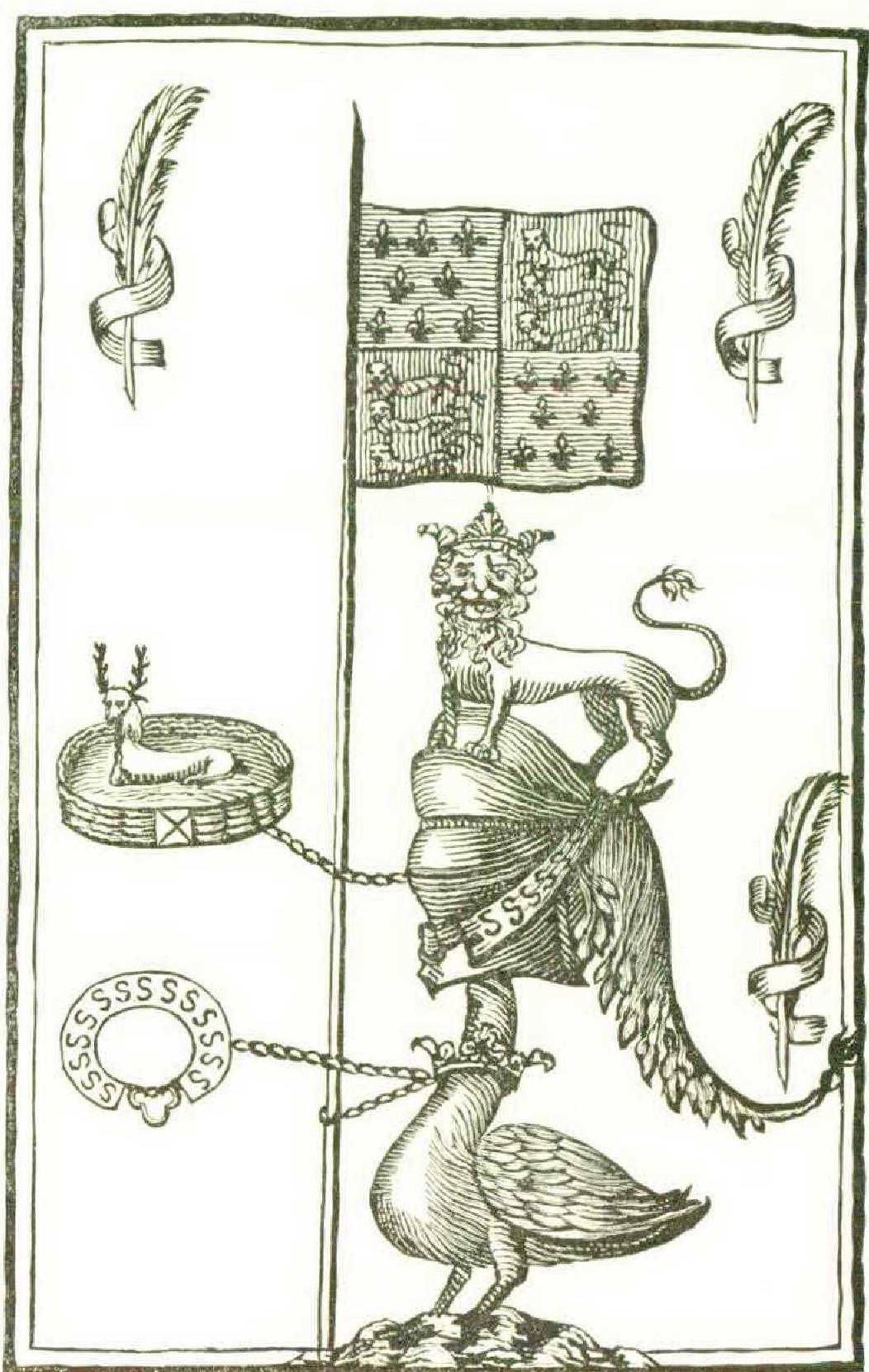
“ So time went on. But one Christmas Day, or the day before Christmas, I was rowing over to the Lido, and as I passed in front of the palace I thought of the stone, and it came into my head that I had never asked about it of an old mason named Spira, the worthiest of masons, a genuine conservative, whom I had employed when I was putting the Ca’ Dario in order, and whom I had often noticed for the care and reverence which he had for the old work. So, when I came back from my row, I took Freschot from the shelf, and gave it to Tony here, bidding him carry the book to Spira, show him the plate, and ask him if he had ever seen anything like it. Then the thing went out of my head; but that evening, as he was serving me at dinner, Tony said to me that Spira knew all about it, and was waiting outside to tell me what he knew. I could n’t believe my ears. I had Spira in at once, and said to him, ' Good God ! Spira, do you know about that stone ? Be careful what you say.' ' But, your Signoria,’ said he, ' I know all about it, and I am the only man in Venice who does, and I have a good right to know it. I almost lost my life for that stone.’ Then he went on to tell me that he had been one of the workmen employed when the French—Lord bless them!
—were hacking away, French fashion, on the Doge’s palace. They took this stone out of the wall on the front, as good a stone as ever was, and they had it put in the court; and one day the overseer of the works ordered him to chip off the carving and make the face smooth, so that it might serve for a block in the pavement. But Spira did not like the job, and employed himself otherwise, till a day or two afterwards, the Frenchman, noticing that his order had not been obeyed, grew angry, bade Spira do what he was ordered, and directed that the stone should be laid in the pavement of the terrace that joins the church and the palace. 'So’ said Spira, 'I still would not spoil the stone. I thought it would answer as well to work the other side; ’ and he turned the stone over, face down, smoothed the back, cut away as little as possible round the edges to fit it to the space where it was to go, and then got help as speedily as possible to hoist it to the terrace, and have it laid, face downward still, before the Frenchman should come round again and find out that the carving had not been touched. ' But are you sure said I, ' that this was the very stone ? ’ ' Sure ? ’ replied he. 'I’ am not likely to be mistaken, for when we were hoisting it. into place I got such a fall from the ladder as to stun me, and they took me up for dead; and when they found I was not killed, they cut the mark of a cross on the stone on which I fell, and there, your Signoria, you can see it any day with your own eyes.' And there, the next day, Spira showed it to me, and showed me too, in the pavement above, the back of the Mowbray stone 1 had been hunting for so long.
“ Then I laid my plans to get it. There would be no use in asking the Austrian authorities for permission to remove it. They were too suspicious; they would have fancied some plot. So I told Spira I must have that stone, but must get it secretly, and bade him make a slab of precisely similar quality and dimensions. Then I went to the good old librarian, and asked leave to go freely upon the terrace, access to which was through the rooms under his charge, to make a drawing from it, I asked also that ray servant might come and go with me, to carry my easel and other things. My old friend made no difficulty, and so day after day I went, till people got used to seeing persons at work in this place, which was commonly closed and vacant. Before long Spira came to tell me the new stone was ready ; then I told him to get a man whom he could trust, and with him and Tony to bring the stone down that afternoon, with all the means for raising the old one and setting the new in its place, and to do the work as quietly and expeditiously as possible. When it should be done, and the Mowbray slab should be in my boat, at the back entrance to the palace on the Canal, Tony was to come to me, who would be in the library, at hand to explain if any question should arise or any unforeseen difficulty be encountered. All went well. it was late in the winter afternoon when Tony appeared and said the boat was waiting to take me home. I went down, and there it was, covered with a cloak. I got it safely to ray house, and then looked at it. Yes, it was the real stone that had been set up as a memorial of Norfolk, just as Spira had said, just as Freschot had engraved it, except that at the top it bore the inscription, omitted in the engraving and affording a new proof of its genuineness, ADI XXII SETEMBRIO MCCCIC, — the date of Mowbray’s death.
“ The next thing was to get it out of Venice and to England. An English vessel was in port, and I arranged with the captain to take it. He was to sail in about three weeks. Before it should go I thought I would have a cast of it made. But this was not done when, one day, much short of the appointed time, the captain sent me word that he must sail early the next morning. I bade Tony fetch the formatore and his man at once, and keep them at work, with abundant supply of wine, till the mould should be made. They were to work all night, if needful. It was three in the morning when Tony came to tell me the work was done, but that there was such a fog that you could not see your hand before you. Never mind ; I knew the way down the Canal blindfold. The stone was put in the boat, Tony and I, Spira and his man, at the oars. It was dark indeed, and, to my shame be it said, I missed the place where the vessel was moored, and brought up at San Giorgio instead of close to the Piazzetta. But then I knew just where we were, made for the vessel, and found that she had sailed an hour before ! We must chase her, and just as we got to the entrance of the port the sun was near rising and the fog lifted a little. I looked up, and there was the stern of the vessel above me. The slab was hoisted on board. It got safely to England, and when you are next there you must go to Corby Castle and see it.”
Not long afterwards, Mr. Brown went on to relate, he told the authorities in Venice what he had done, and gave them a cast from the stone. They took it all in good part, and the cast was set up in that hall in the Ducal Palace from which one enters the stairway above which is Titian’s fresco of St. Christopher. There is a glowing inscription beneath the cast in honor of Rawdon Brown, the illustrious investigator of the history and monuments of Venice. The love of Rawdon Brown for Venice and his services to her deserved this public record. In a letter written when he had been almost fifty years a Venetian, he said, speaking of the death of an old English friend, “ It seems to me to bode my own speedy departure hence, and always with gratitude to the Almighty for having been allowed to pass so great a portion of my life here.”
Charles Eliot Norton.