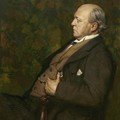
The Aspern Papers: In Three Parts. Part Second
V.
I WAS seldom at home in the evening, for when I attempted to occupy myself in my apartments the lamplight brought in a swarm of noxious insects, and it was too hot for closed windows. Accordingly I spent the late hours either on the water (the moonlight of Venice is famous), or in the splendid square which serves as a vast forecourt to the strange old basilica of Saint Mark. I sat in front of Florian’s café, eating ices, listening to music, talking with acquaintances : the traveler will remember how the immense cluster of tables and little chairs stretches like a promontory into the smooth lake of the Piazza. The whole place, of a summer’s evening, under the stars, and with all the lamps, all the voices and light footsteps on marble (the only sounds of the arcades that enclose it), is like an open-air saloon, dedicated to cooling drinks and to a still finer degustation — that of the exquisite impressions received during the day. When I did n’t prefer to keep mine to myself there was always a stray tourist, disencumbered of his Bädeker, to discuss them with, or some domesticated painter rejoicing in the return of the season of strong effects. The wonderful church, with its low domes and bristling embroideries, the mystery of its mosaic and sculpture, looked ghostly in the tempered gloom, and the sea-breeze passed between the twin columns of the Piazzetta, the lintels of a door no longer guarded, as gently as if a rich curtain were swaying there. I used sometimes, on these occasions, to think of the Misses Bordereau and of the pity of their being shut up in apartments which, in the Venetian July, even Venetian vastness did n’t prevent from being stuffy. Their life seemed miles away from the life of the Piazza, and no doubt it was really too late to make the austere Juliana change her habits. But poor Miss Tita would have enjoyed one of Florian’s ices, I was sure ; sometimes I even had thoughts of carrying one home to her. Fortunately, my patience bore fruit, and I was not obliged to do anything so ridiculous.
One evening, about the middle of July, I came in earlier than usual — I forget what chance had led to this — and instead of going up to my quarters made my way into the garden. The temperature was very high ; it was such a night as one would gladly have spent in the open air, and I was in no hurry to go to bed. I had floated home in my gondola, listening to the slow splash of the oar in the narrow, dark canals, and now the only thought that solicited me was the vague reflection that it would be pleasant to recline at one’s length, in the fragrant darkness, on a garden bench. The odor of the canal was doubtless at the bottom of that aspiration, and the breath of the garden, as I entered it, gave consistency to my purpose. It was delicious — just such an air as must have trembled with Romeo’s vows when he stood among the flowers and raised his arms to his mistress’s balcony. I looked at the windows of the palace, to see if by chance the example of Verona (Verona being not far off), had been followed ; but everything was dim, as usual, and everything was still. Juliana, on summer nights, in her youth, might have murmured down from open windows at Jeffrey Aspern, but Miss Tita was not a poet’s mistress, any more than I was a poet. This, however, did n’t prevent my gratification from being great as I became aware, on reaching the end of the garden, that Miss Tita was seated in my little bower. At first I only made out an indistinct figure, not in the least counting on such an overture from one of my hostesses ; it even occurred to me that some sentimental maid-servant had stolen in, to keep a tryst with her sweetheart. I was going to turn away, not to frighten her, when the figure rose to its height and I recognized Miss Bordereau’s niece. I must do myself the justice to say that I did n’t wish to frighten her either, and much as I had longed for some such accident I should have been capable of retreating. It was as if I had laid a trap for her by coming home earlier than usual and adding to that eccentricity by creeping into the garden. As she rose she spoke to me, and then I reflected that perhaps, secure in my almost inveterate absence, it was her nightly practice to take a lonely airing. There was no trap, in truth, because I had had no suspicion. At first I took for granted that the words she uttered expressed discomfiture at my arrival ; but as she repeated them — I had n’t caught them clearly — I had the surprise of hearing her say, “ Oh, dear, I’m so very glad you have come ! ” She and her aunt had in common the property of unexpected speeches. She came out of the arbor almost as if she were going to throw herself into my arms.
I hasten to add that she did nothing of the kind; she did n’t even shake hands with me. It was a gratification to her to see me, and presently she told me why — because she was nervous when she was out-of-doors, at night, alone. The plants and bushes looked so strange in the dark, and there were all sorts of queer sounds — she could n’t tell what they were — like the noises of animals. She stood close to me, looking about her with an air of greater security, but without any demonstration of interest in me as an individual. Then I guessed that nocturnal prowlings were not in the least her habit, and I was also reminded (I had been struck with the circumstance, in talking with her before I took possession), that it was impossible to overestimate her simplicity.
“ You speak as if you were lost in the backwoods,” I said, laughing. “ How you manage to keep out of this charming place, when you have only three steps to take to get into it, is more than I have yet been able to discover. You hide away mighty well so long as I am on the premises, I know; but I had a hope that you peeped out a little at other times. You and your poor aunt are worse off than Carmelite nuns in their cells. Should you mind telling me how you exist without air, without exercise, without any sort of human contact ? I don’t see how you carry on the common business of life.”
She looked at me as if I were talking some strange tongue, and her answer was so little of an answer that I was considerably irritated. “ We go to bed very early — earlier than you would believe.” I was on the point of saying that this only deepened the mystery, when she gave me some relief by adding, “ Before you came we were not so private. But I never have been out at night.”
“ Never in these fragrant alleys, blooming here under your nose ? ”
Ah,” said Miss Tita, u they were never nice till now! ” There was a melancholy reference in this, and a flattering comparison, so that it seemed to me I had gained a small advantage. As it would help me to follow it up to establish a sort of grievance, I asked her why, since she thought my garden nice, she had never thanked me in any way for the flowers I had been sending up in such quantities for the previous three weeks. I had not been discouraged — there had been, as she would have observed, a daily armful; but I had been brought up in the common forms, and a word of recognition now and then would have touched me in the right place.
“ Why, I did n’t know they were for me ! ”
“ They were for both of you. Why should I make a difference ? ”
Miss Tita reflected, as if she might be thinking of a reason for that, but she failed to produce one. Instead of this, she asked abruptly, “ Why in the world do you want to know us ? ”
“ I ought, after all, to make a difference,” I replied. “ That question is your aunt’s ; it is n’t yours. You would n’t ask it if you had n’t been put up to it.”
“ She did n’t tell me to ask you,” Miss Tita replied, without confusion; she was the oddest mixture of the sensitive and the placid.
“ Well, she has often wondered about it herself, and expressed her wonder to you. She has insisted on it, so that she has put the idea into your head that I am insufferably pushing. Upon my word, I think I have been very discreet. And how completely your aunt must have lost every tradition of sociability, to see anything out of the way in the idea that respectable people, living as we do, under the same roof, should occasionally exchange a remark ! What could be more natural? We are of the same country, and we have some, at least, of the same tastes, since, like you, I am very fond of Venice.”
My interlocutress appeared incapable of grasping more than one clause in any proposition, and she declared, quickly, eagerly, as if she were answering my whole speech, “ I am not in the least fond of Venice. I should like to go far away ! ”
“ Has she always kept you back so ? ” I went on, to show her that I could be as irrelevant as herself.
“ She told me to come out to-night; she has told me very often,” said Miss Tita. “ It is I who would n’t come. I don’t like to leave her.”
“ Is she too weak, is she failing ? ” I demanded, with more emotion, I think, than I intended to show. I judged this by the way her eyes rested upon me in the darkness. It embarrassed me a little, and to turn the matter off I continued, genially, “ Do let us sit down together, comfortably, somewhere, and you will tell me all about her.”
Miss Tita made no resistance to this. We found a bench less secluded, less intimate, as it were, than the one in the arbor; and we were still sitting there when I heard midnight ring out from those clear bells of Venice which vibrate with a solemnity of their own over the lagoon, and hold the air so much more than the chimes of other places. We were together more than an hour, and our interview gave, as it struck me, a great lift to my undertaking. Miss Tita accepted the situation without a protest; she had avoided me for three months, yet now she treated me almost as if these three months had made me an old friend. If I had chosen, I might have inferred from this that, though she had avoided me, she had given a good deal of consideration to doing so. She paid no attention to the flight of time — did n’t worry at my keeping her so long away from her aunt. She talked freely, answering questions and asking them, and not even taking advantage of certain longish pauses, with which they inevitably alternated, to say she thought she had better go in. It was almost as if she were waiting for something — something I might say to her — and she wished to give me my opportunity. I was the more struck by this as she told me that her aunt had been less well for a good many days, or at any rate had fallen into a condition without precedent. She was weaker ; at moments it seemed as if she had no strength to speak of, yet more than ever before she wished to be left alone. That was why she had told her to come out — not even to remain in her own room, which was alongside ; she said her niece disturbed her, made her nervous. She sat still for hours together, as if she were asleep ; she had always done that, to a certain extent, but at such times, formerly, she gave, at intervals, some small sign of life, of interest, and she liked her companion to be near her with her work. Miss Tita confided to me that at present her aunt was so motionless that she sometimes feared she was dead, and she took hardly any food ; she did n’t see what she lived upon. The great thing was that she still, on most days, got up ; the serious job was to dress her, to wheel her out of her bedroom. She clung to as many of her old habits as possible, and she had always, little company as they had received for years, made a point of sitting in the parlor.
I scarcely knew what to think of all this — of Miss Tita’s sudden conversion to sociability and of the strange circumstance that the more the old lady appeared to decline towards her end the less she should desire to be looked after. The story did n’t hang together, and I even asked myself whether it were not a trap laid for me, the result of a design to make me show my hand. I could n’t have told why my companions (as they could only by courtesy be called) should have this purpose — why they should try to trip up so lucrative a lodger. At any rate, I kept on my guard, so that Miss Tita should n’t have occasion again to ask me if I had an arrière-pensée. Poor woman ! before we parted for the night, my mind was really at rest as to any capacity on her own part for entertaining one.
She told me more about their affairs than I had hoped ; there was no need to be prying, for it evidently drew her out simply to feel that I listened, that I cared. She ceased wondering why I cared, and at last, as she spoke of the brilliant life they had led years before, she almost chattered. It was Miss Tita who judged it brilliant; she said that when they first came to live in Venice, years and years before (I saw that her mind was essentially vague about dates and the order in which events had occurred), there wasn’t a week that they had n’t some visitor or that they did n’t make some delightful passeggio in the city. They had seen all the curiosities; they had even been to the Lido, in a boat (she spoke as if I might think there was a way on foot) ; they had had a collation there, brought in three baskets and spread out on the grass. I asked her what people they had known, and she said, Oh, very nice ones— the Cavaliere Bombicci and the Contessa Altemura, with whom they had had a great friendship. Also English people — the Churtons, and the Goldies, and Mrs. Stock-Stock, whom they had loved dearly ; she was dead and gone, poor dear. That was the case with most of their pleasant circle (this expression was Miss Tita’s own), though a few were left, which was a wonder, considering how they had neglected them. She mentioned the names of two or three Venetian old women ; of a certain doctor, very clever, who was so kind — he came as a friend, he had really given up practice ; of the avvocato Pochintesta, who wrote beautiful poems and had addressed one to her aunt. These people came to see them, without fail, every year, usually at the capo d’anno, and of old her aunt used to make them some little present — her aunt and she together : small things that she, Miss Tita, made herself, like paper lamp-shades, or mats for the decanters of wine at dinner, or those woolen things that in cold weather were worn on the wrists. The last few years there had n’t been many presents; she could n’t think what to make, and her aunt had lost her interest and did n’t suggest. But the people came all the same; if the Venetians liked you once they liked you forever.
There was something affecting in the good faith of this sketch of former social glories ; the picnic at the Lido had remained vivid through the ages, and poor Miss Tita evidently was of the impression that she had had a brilliant youth. She had, in fact, had a glimpse of the Venetian world, in its gossiping, home-keeping, parsimonious, professional walks, for I observed for the first time that she had acquired, by contact, something of the manner of the familiar, soft-sounding, almost infantile speech of the place. I judged that she had imbibed this invertebrate dialect, from the natural way the names of things and people — mostly purely local — rose to her lips. If she knew little of what they represented, she knew still less of anything else. Her aunt had drawn in — her failing interest in the table-mats and lamp-shades was a sign of that — and she had not been able to mingle in society, or to entertain it, alone; so that the matter of her reminiscences struck one as an old world altogether. I found myself falling into the error of thinking of her, too, as one of Jeffrey Aspern’s contemporaries ; this came from her having so little in common with my own. It was possible, I said to myself, that she had n’t even heard of him; it might very well be that Juliana had not cared to lift even for her the veil that covered the temple of her youth. In this case, she perhaps would n’t know of the existence of the papers, and I welcomed that presumption — it made me feel more safe with her — until I remembered that we had believed the letter of disavowal received by Cumnor to be in the handwriting of the niece. If it had been dictated to her she had of course to know what it was about; yet, after all, the effect of it was to repudiate the idea of any connection with the poet. I did n’t believe, at all events, that Miss Tita had read a word of his poetry. Moreover, if, with her companion, she had always escaped the interviewer, there was little occasion for her having got it into her head that people were “ after ” the letters. People had not been after them, inasmuch as they had n’t heard of them, and Cumnor’s fruitless feeler would have been a solitary accident.
When midnight sounded Miss Tita got up ; but she only stopped at the door of the house after she had wandered two or three times with me round the garden. “ When shall I see you again ? ” I asked, before she went in ; to which she replied, with promptness, that she should like to come out the next night. She added, however, that she should n’t come — she did n’t do everything she liked.
“ You might do a few things that I like,” I said, with a sigh.
“ Oh, you — I don’t believe you ! ” she declared, at this, looking at me with her simple solemnity.
“ Why don’t you believe me ? ”
“ Because I don’t understand you.”
“ That is just the sort of occasion to have faith.” I could n’t say more, though I should have liked to, as I saw that I only mystified her; for I did n’t want seriously to have it on my conscience that I might pass for having made love to her. Nothing less should I have seemed to do, had I continued to beg a lady to “believe in me,” in an Italian garden, on a midsummer night. There was some merit in my scruples, for Miss Tita lingered and lingered ; I perceived that she felt that she should n’t really soon come down again, and wished therefore to protract the present. She insisted, too. on making the talk between us personal to ourselves, and altogether her behavior was such as would have been possible only to a completely innocent woman.
“ I shall like the flowers better, now that I know they are also meant for me.”
“ How could you have doubted it ? If you will tell me the kind you like best, I will send a double lot of them.”
“ Oh, I like them all best! ” Then she went on, familiarly, “ Shall you study — shall you read and write — when you go up to your rooms ? ”
“ I don’t do that at night, at this season. The lamplight brings in the animals.”
“ You might have known that when you came.”
“ I did know it! ”
“ And in winter, do you work at night ? ”
“ I read a good deal, but I don’t often write.” She listened as if these details had a rare interest, and suddenly a temptation, quite at variance with the prudence I had been teaching myself, associated itself with her plain, mild face. Ah yes, she was safe, and I could make her safer! It seemed to me, from one moment to another, that I could n’t wait any longer — that I really must take a sounding. So I went on : “ In general, before I go to sleep — very often in bed (it’s a bad habit, but I confess to it), I read some great poet. In nine cases out of ten, it’s a volume of Jeffrey Aspern.”
I watched her well as I pronounced that name, but I saw nothing wonderful. Why should I, indeed ; and was n’t Jeffrey Aspern the property of the human race ?
“Oh, we read him — we have read him,” she quietly replied.
“He is my poet of poets — I know him almost by heart.”
For an instant Miss Tita hesitated; then her sociability was too much for her.
“Oh, by heart — that’s nothing!” she murmured, smiling. “ My aunt used to know him — to know him ” — she paused an instant, and I wondered what she was going to say — “to know him as a visitor.”
“ As a visitor ? ” I repeated, staring.
“He used to call on her, and take her out.”
I continued to stare. “ My dear lady, he died a hundred years ago ! ”
“Well,” she said, mirthfully, “my aunt is a hundred and fifty.”
“ Mercy on us ! ” I exclaimed ; “ why did n’t you tell me before ? I should like so to ask her about him.”
“ She would n’t care for that— she would n’t tell you,” Miss Tita replied.
“I don t care what she cares for! She must tell me — it’s not a chance to be lost.”
“ Oh, you should have come twenty years ago: then she talked about him.”
“And what did she say?” I asked, eagerly.
“ I don’t know — that he liked her immensely.”
“ And she —did n’t she like him ? ”
“ She said he was a god.” Miss Tita gave me this information flatly, without expression; her tone might have made it a piece of trivial gossip. But it stirred me deeply, as she dropped the words into the summer night; it seemed such a direct testimony.
“ Fancy, fancy ! ” I murmured. And then, “ Tell me this, please — has she got a portrait of him ? They are distressingly rare.”
“ A portrait ? I don’t know,” said Miss Tita; and now there was discomfiture in her face. “ Well, good-night’ ” she added ; and she turned into the house.
I accompanied her into the wide, dusky, stone-paved passage which, on the ground floor, corresponded with our grand sala. It opened at one end into the garden, at the other upon the canal, and was lighted now only by the small lamp that was always left for me to take up as I went to bed. An extinguished candle, which Miss Tita had apparently brought down with her, stood on the same table with it. “ Good-night, goodnight ! ” I replied, keeping beside her as she went to get her light. “ Surely you would know, would n’t you, if she had one ? ”
“ If she had what ? ” the poor lady asked, looking at me queerly over the flame of her candle.
“ A portrait of the god. I don’t know what I would n’t give to see it.”
“ I don’t know what she has got. She keeps her things locked up.” And Miss Tita went away, towards the staircase, with the sense, evidently, that she had said too much.
I let her go — I did n’t wish to frighten her — and I contented myself with remarking that Miss Bordereau would n’t have locked up such a glorious possession as that — a thing a person would be proud of and hang up in a prominent place on the parlor wall. Therefore, of course, she had n’t any portrait. Miss Tita made no direct answer to this, and candle in hand, with her back to me, she ascended two or three stairs. Then she stopped short and turned round, looking at me across the dusky space.
“ Do you write — do you write ? ” There was a tremor in her voice ; she could scarcely bring out what she wished to ask.
“ Do I write ? Oh, don’t speak of my writing on the same day with Aspern’s ! ”
“ Do you write about him — do you pry into his life ? ”
“ Ah, that ’s your aunt’s question; it can’t be yours ! ” I said, in a tone of slightly wounded sensibility.
“ All the more reason, then, that you should answer it. Do you, please ? ”
I thought I had allowed for the falsehoods I should have to tell; but I found that in fact, when it came to the point, I had n’t. Besides, now that I had an opening, there was a kind of relief in being frank. Lastly (it was perhaps fanciful, even fatuous), I guessed that Miss Tita personally would n’t, in the last resort, be less my friend. So after a moment’s hesitation, I answered, “ Yes, I have written about him, and I am looking for more material. In Heaven’s name, have you got any ? ”
“ Santo Dio ! ” she exclaimed, without heeding my question; and she hurried up-stairs and out of sight. I might count upon her in the last resort, but for the present she was visibly alarmed. The proof of it was that she began to hide again, so that for a fortnight I never beheld her. I found my patience ebbing, and after four or five days of this I told the gardener to stop the flowers.
VI.
One afternoon, as I came down from my quarters, to go out, I found Miss Tita in the sala ; it was our first encounter on that ground since I had come to the house. She put on no air of being there by accident; there was an ignorance of such arts in her nude, diffident directness. That I might be quite sure she was waiting for me she informed me of the fact, and told me that Miss Bordereau wished to see me ; she would take me into the room at that moment, if I had time. If I had been late for a love-tryst I would have stayed for this, and I quickly signified that I should be delighted to wait upon the old lady. “ She wants to talk with you — to know you,” Miss Tita said, smiling, as if she herself appreciated that idea; and she led me to the door of her aunt’s apartment. I stopped her a moment before she had opened it, looking at her with some curiosity. I told her that this was a great satisfaction to me, and a great honor; but, all the same, I should like to ask what had made Miss Bordereau change so suddenly. It was only the other day that she would n’t look at me. Miss Tita was not at all embarrassed by my question ; she had as many little unexpected serenities as if she told fibs, but the odd part of them was that they had, on the contrary, their source in her truthfulness. “ Oh, my aunt changes,” she answered ; “ it’s so terribly dull — I suppose she’s tired.”
“ But you told me that she wanted more and more to be alone.”
Poor Miss Tita colored, as if she found me over-insistent. Well, if you don’t believe she wants to see you — I have n’t invented it! I think people often are capricious, when they are very old.”
“ That’s perfectly true. I only wanted to be clear as to whether you have repeated to her what I told you the other night.”
“ What you told me ? ”
“ About Jeffrey Aspern — that I am looking for materials.”
“ If I had told her, do you think she would have sent for you?”
“ That’s exactly what I want to know. If she wants to keep him to herself she might have sent for me to tell me so.”
“ She won’t speak of him,” said Miss Tita. Then, as she opened the door, she added, in a lower tone, “ I have told her nothing.”
The old woman was sitting in the same place in which I had seen her last, in the same position, with the same mystifying bandage, as it seemed to me, over her eyes. Her welcome was to turn her almost invisible face to me and show me that while she sat silent she saw me clearly. I did n’t advance to shake hands with her; I felt too well, on this occasion, that that was out of place forever. It had been sufficiently enjoined upon me that she was too sacred for that sort of reciprocity — too venerable to touch. There was something so grim in her aspect (it was partly the accident of her green shade), as I stood there to be measured, that I ceased on the spot to feel any doubt as to her knowing my secret, though I didn’t in the least doubt that Miss Tita had just spoken the truth. She had not betrayed me, but the old woman’s brooding instinct had served her; she had turned me over and over, in the long, still hours, and she had guessed. The worst of it was that she looked terribly like an old woman who, at a pinch, would burn her papers. Miss Tita pushed a chair forward, saying to me, “ This will be a good place for you to sit.” As I took possession of it I asked after Miss Bordereau’s health; expressed the hope that in spite of the very hot weather it was satisfactory. She replied that it was good enough — good enough ; that it was a great thing to be alive.
“ Oh, as to that, it depends upon what you compare it with! ” I exclaimed, laughing.
“ I don’t compare — I don’t compare. If I did that, I should have given everything up long ago.”
I liked to think that this was a subtle allusion to the rapture she had known in the society of Jeffrey Aspern — though it was true that such an allusion would have accorded ill with the wish I imputed to her to keep him buried in her soul. What it accorded with was my constant conviction that no human being had ever had a more delightful social gift than his, and what it seemed to convey was that nothing in the world was worth speaking of if one pretended to speak of that. But one did n’t! Miss Tita sat down beside her aunt, looking as if she had reason to believe some very interesting conversation would come off between us.
“ It’s about the beautiful flowers,” said the old lady ; “ you sent us so many — I ought to have thanked you for them before. But I don’t write letters, and I receive only at long intervals.”
She had n’t thanked me while the flowers continued to come, but she departed from her custom so far as to send for me as soon as she began to fear that they would n’t come any more. I noted this ; I remembered what an acquisitive propensity she had shown when it was a question of extracting gold from me, and I privately rejoiced at the happy thought I had had in suspending my tribute. She had missed it, and she was willing to make a concession to bring it back. At the first sign of this concession I could only go to meet her. “ I am afraid you have n’t had many, of late, but they shall begin again immediately — to-morrow, to-night.”
“ Oh, do send us some to-night! ” Miss Tita cried, as if it were an immense circumstance.
“ What else should you do with them ? It is n’t a manly taste to make a bower of your room,” the old woman remarked.
“ I don’t make a bower of my room, but I am exceedingly fond of growing flowers, of watching their ways. There is nothing unmanly in that: it has been the amusement of philosophers, of statesmen in retirement; even, I think, of great captains.”
“ I suppose you know you can sell them — those you don’t use,” Miss Bordereau went on. “ I dare say they would n’t give you much for them; still, you could make a bargain.”
“ Oh, I have never made a bargain, as you ought to know. My gardener disposes of them and I ask no questions.”
“ I would ask a few, I can promise you,” said Miss Bordereau : and it was the first time I had heard her laugh. I could n’t get used to the idea that this vision of pecuniary profit was what drew out the divine Juliana most.
“ Come into the garden yourself and pick them; come as often as you like; come every day. They are all for you,” I pursued, addressing Miss Tita and carrying off this veracious statement by treating it as an innocent joke. “ I can’t imagine why she does n’t come down,” I added, for Miss Bordereau’s benefit.
“ You must make her come ; you must come up and fetch her,” said the old woman, to my stupefaction. “ That odd thing you have made in the corner would be a capital place for her to sit.”
The allusion to my arbor was irreverent ; it confirmed the impression I had already received that there was a flicker of impertinence in Miss Bordereau’s talk, a strange, mocking lambency which must have been a part of her adventurous youth and which had outlived passions and faculties. None the less I asked, “Wouldn’t it be possible for you to come down there yourself ? Would n’t it do you good to sit there in the shade, in the sweet air ? ”
“ Oh, sir, when I move out of this it won’t be to sit in the air, and I’m afraid that any that may be stirring around me won’t be particularly sweet! It will be a very dark shade indeed. But that won’t be just yet,” Miss Bordereau continued, cannily, as if to correct any hopes that this courageous allusion to the last receptacle of her mortality might lead me to entertain. “ I have sat here many a day, and I have had enough of arbors in my time. But I’m not afraid to wait till I’m called.”
Miss Tita had expected some remarkable talk, but perhaps she found it less genial on her aunt’s side (considering that I had been sent for with a civil intention) than she had hoped. As if to give the conversation a turn that would put our companion in a more favorable light, she said to me, “ Did n’t I tell you, the other night, that she had sent me out ? You see that I can do what I like ! ”
“ Do you pity her — do you teach her to pity herself ? ” Miss Bordereau demanded, before I had time to answer this appeal. “ She has a much easier life than I had when I was her age.”
“You must remember that it has been quite open to me to think you rather inhuman.”
“ Inhuman ? That’s what the poets used to call the women a hundred years ago. Don’t try that; you won’t do as well as they ! ” Juliana declared. “ There is no more poetry in the world — that I know of, at least. But I won’t bandy words with you,” she pursued, and I well remember the old-fashioned, artificial sound she gave to the speech. “You have made me talk, talk! It is n’t good for me at all.” I got up at this, and told her I would take no more of her time; but she detained me to ask, “ Do you remember, the day I saw you about the rooms, that you offered us the use of your gondola?” And when I assented, promptly, struck again with her disposition to make a “ good thing” of my domestication and wondering what she now had in her eye, she broke out, “ Why don’t you take that girl out in it and show her the place ? ”
“ Oh, dear aunt, what do you want to do with me?” cried the “girl,” with a piteous quaver. “ I know all about the place! ”
“ Well, then, go with him as a cicerone ! ” said Miss Bordereau, with an effect of mockery in her quiet, sweetvoiced readiness — an incongruous suggestion that she was a sarcastic, profane, cynical old woman. “ Have n’t we heard that there have been all sorts of changes, in all these years ? You ought to see them, and, at your age (I don’t mean because you ’re so young), you ought to take the chances that come. You ’re old enough, my dear, and this gentleman won’t hurt you. He will show you the famous sunsets, if they still go on — do they go on ? The sun set for me so long ago. But that’s not a reason. Besides, I sha’n’t miss you ; you think you are too important. Take her to the Piazza; it used to be very pretty,” Miss Bordereau continued, addressing herself to me. “ What have they done with the funny old church? I hope it has n’t tumbled down. Let her look at the shops; she may take some money, she may buy what she likes.”
Poor Miss Tita had got up, discountenanced and helpless, and as we stood there before her aunt it would certainly have seemed to a spectator of the scene that the old woman was amusing herself at our expense. Miss Tita protested, in a confusion of exclamations and murmurs ; but I lost no time in saying that if she would do me the honor to accept the hospitality of my boat, I would engage that she should not be bored. Or if she did n’t want so much of my company, the boat itself, with the gondolier, was at her service ; he was a capital oar, and she might have every confidence. Miss Tita, without definitely answering this speech, looked away from me, out of the window, as if she were going to cry ; and I remarked that once we had Miss Bordereau’s approval we could easily come to an understanding. We would take an hour, whichever she liked, one of the very next days. As I made my obeisance to the old lady I asked her if she would kindly permit me to see her again.
For a moment she said nothing ; then she inquired, “Is it very necessary to your happiness ? ”
“ It entertains me more than I can say.”
“You are wonderfully civil. Don’t you know it almost kills me ? ”
“ How can I believe that, when I see you more animated, more brilliant, than when I came in ? ”
“ Tliat is very true, aunt,” said Miss Tita. “ I think it does you good.”
“ Is n’t it touching, the solicitude we each have that the other shall enjoy herself ? ” sneered Miss Bordereau. “ If you think me brilliant to-day you don’t know what you are talking about; you have never seen an agreeable woman. Don’t try to pay me a compliment; I have been spoiled,” she went on. “My door is shut, but you may sometimes knock.”
With this she dismissed me, and I left the room. The latch closed behind me, but Miss Tita, contrary to my hope, had remained within. I passed slowly across the hall, but before taking my way down-stairs I waited a little. My hope was answered; after a minute Miss Tita followed me. “ That’s a delightful idea, about the Piazza,” I said. “ When will you go — to-night, to-morrow ? ”
She had been disconcerted, as I have mentioned, but I had already perceived, and I was to observe again, that when Miss Tita was embarrassed she did n’t (as most women would have done) turn away from you and try to escape, if it was in some degree your fault; but came closer, as it were, as if to rest on you, almost to cling, to beg you to desist, to support and protect her. Her attitude was perpetually an appeal for assistance, for explanation; and yet no woman in the world could have been less of a comedian. From the moment you were kind to her she depended on you absolutely ; her self-consciousness dropped from her quickly, and she took the greatest intimacy, the innocent intimacy which was the only thing she could conceive, for granted. She told me she did n’t know what had got into her aunt; she had changed so quickly, she had got some idea. I replied that she must find out what the idea was, and then let me know; we would go and have an ice together at Florian’s, and she should tell me while we listened to the band.
“ Oh, it will take me a long time to find out!” she said, rather ruefully; and she could promise me this satisfaction neither for that night nor for the next. I was patient now, however, for I felt that I had only to wait ; and in fact, at the end of the week, one lovely evening, after dinner, she stepped into my gondola, to which, in honor of the occasion, I had attached a second oar.
As we swept, in the course of five minutes, into the Grand Canal, she uttered a murmur of ecstasy as fresh as if she had been a tourist just arrived. She had forgotten how splendid the great water-way looked on a clear, hot summer evening, and how the sense of floating between marble palaces and reflected lights disposed the mind to sympathetic talk. We floated long and far, and though Miss Tita gave no highpitched voice to her satisfaction I felt that she surrendered herself. She was more than pleased, she was transported ; the whole thing was an immense liberaation. The gondola moved with slow strokes, to give her time to enjoy it, and she listened to the plash of the oars, which grew louder and more musically liquid as we passed into narrow canals, as if it were a revelation of Venice. When I asked her how long it was since she had been in a boat she answered, “Oh, I don’t know ; a long time — not since my aunt began to be ill.” This was not the only example she gave me of her extreme vagueness about the previous years and the line which marked off the period when Miss Bordereau flourished. I was not at liberty to keep her out too long, but we took a considerable giro before going to the Piazza. I asked her no questions, but kept the conversation, on purpose, away from her domestic situation and the things I wanted to know ; I poured treasures of information about Venice into her ears, described Florence and Rome, discoursed to her on the charms and advantages of travel. She reclined, receptive, on the deep leather cushions, turned her eyes conscientiously to everything I pointed out to her, and never mentioned to me till some time afterwards that she might be supposed to know Florence better than I, as she had lived there for years with Miss Bordereau. At last she asked, with the shy impatience of a child, “ Are n’t we really going to the Piazza ? That’s what I want to see ! ” I immediately gave the order that we should go straight; after which we sat silent, with the expectation of arrival. As some time still passed, however, she said, suddenly, of her own movement, “ I have found out what is the matter with my aunt: she is afraid you will go ! ”
“ What has put that into her head ? ”
“ She has had an idea you have not been happy. That is why she is different now.”
“ You mean she wants to make me happier ? ”
“ Well, she wants you not to go ; she wants you to stay.”
“ I suppose you mean on account of the rent,” I remarked, candidly.
Miss Tita’s candor showed itself a match for my own: “Yes, you know; so that I shall have more.”
“ How much does she want you to have ? ” I asked, laughing. “ She ought to fix the sum, and I will stay till it’s made up.”
“ Oh, that would n’t please me,” said Miss Tita. " It would be unheard of, your taking that trouble.”
“ But suppose I should have my own reasons for staying in Venice ?”
“ Then it would be better for you to stay in some other house.”
“ And what would your aunt say to that ? ”
“ She would n’t like it at all. But I should think you would do well to give up your reasons and go away altogether.”
“ Dear Miss Tita,” I said, “ it’s not so easy to give them up ! ”
She made no immediate answer to this; after a moment she remarked, “ I think I know what your reasons are.”
“ I dare say, because the other night I almost told you how I wish you would help me to make them good.”
“ I can’t do that without being false to my aunt.”
“ What do you mean, being false to her ? ”
“ Why, she would never consent to what you want. She has been asked, she has been written to. It made her fearfully angry.”
“ Then she has got papers of value ? ” I asked, quickly.
“ Oh, she has got everything! ” sighed Miss Tita, with a curious weariness, a sudden lapse into gloom.
These words caused all my pulses to throb, for I regarded them as precious evidence. For some minutes I was too agitated to speak, and in the interval the gondola approached the Piazzetta. After we had disembarked I asked my companion whether she would rather walk round the square or go and sit at the door of the café ; to which she replied that she would do whichever I liked best — I must only remember again how little time she had. I assured her there was plenty to do both, and we made the circuit of the long arcades. Her spirits revived at the sight of the bright shop-windows, and she lingered and stopped, admiring or disapproving of their contents, asking me what I thought of things, theorizing about prices. My attention wandered from her ; her words of a while before, “ Oh, she has got everything ! ” echoed so in my consciousness. We sat down, at last, in the crowded circle at Florian’s, finding an unoccupied table among those that were ranged in the square. It was a splendid night, and all the world was out-of-doors; Miss Tita could not have wished the elements more auspicious for her return to society. I saw that she enjoyed it even more than she told ; she was agitated with the multitude of her impressions. She had forgotten what an attractive thing the world is, and it was coming over her that, somehow, she had for the best years of her life been cheated of it. This did n’t make her angry; but as she looked all over the charming scene, her face had, in spite of its smile, the flush of a sort of wounded surprise. She became silent, as if she were thinking, with a secret sadness, of opportunities forever lost, which ought to have been easy ; and this gave me a chance to say to her, “ Did you mean, a while ago, that your aunt has a plan of keeping me on by admitting me occasionally to her presence ? ”
“ She thinks it will make a difference with you if you sometimes see her. She wants you so much to stay that she is willing to make that concession.”
“ And what good does she consider that I think it will do me to see her ? ”
“ I don’t know ; she thinks it’s interesting,” said Miss Tita, simply.
“ So it is; but every one does n’t think so.”
“ No, of course not, or more people would try.”
“ Well, if she is capable of making that reflection, she is capable also of making this further one,” I went on : “ that I must have a particular reason for not doing as others do (in spite of the interest she offers), for not leaving her alone.” Miss Tita looked as if she failed to understand this rather complicated proposition; so I continued, “ If you have not told her what I said to you the other night, may she not at least have guessed it ? ”
“ I don’t know; she is very suspicious.”
“But she has n’t been made so by indiscreet curiosity, by persecution ?
“ No, no ; it is n’t that,” said Miss Tita, turning on me a somewhat troubled face. “ I don’t know how to say it: it’s on account of something — ages ago, before I was born — in her life.”
“ Something ? What sort of thing ? ” I asked, as if I myself could have no idea.
“ Oh, she has never told me,” Miss Tita answered ; and I was sure she was speaking the truth.
Her extreme limpidity was almost provoking, and I felt for the moment that she would have been more satisfactory if she had been less genuine. “ Do you suppose it’s something to which Jeffrey Aspern’s letters and papers —I mean the things in her possession — have reference?”
“ I dare say it is ! ” my companion exclaimed, as if this were a very happy suggestion. “ I have never looked at any of those things.”
“ None of them ? Then how do you know what they are ? ”
“I don’t,” said Miss Tita, placidly. “ I have n’t had them in my hands. But I have seen them when she has had them out.”
“ Does she have them out often ? ”
“Not now, but she used to. She is very fond of them.”
“ In spite of their being compromising?”
“ Compromising ? ” Miss Tita repeated, as if she did n’t know the meaning of the word. I felt almost as one who corrupts the innocence of youth.
“ I mean their containing painful memories.”
“ Oh, I don’t think they are painful.”
“You mean you don’t think they affect her reputation ? ”
At this a singular look came into the face of Miss Bordereau’s niece — a kind of confession of helplessness, an appeal to me to deal fairly, generously, with her. I had brought her to the Piazza, placed her among charming influences, paid her an attention she appreciated, and now I seemed to let her perceive that all this had been a bribe — a bribe to make her turn in some way against her aunt. She was of a yielding nature, and capable of doing almost anything to please a person who was kind to her; but the greatest kindness of all would be not to presume too much on this. It was strange enough, as I afterwards thought, that she had n’t the least air of resenting my want of consideration for her aunt’s character, which would have been in the worst possible taste, if anything less (from my point of view) had been at stake. I don’t think she really measured it. “ Do you mean that she did something bad ? ” she asked, in a moment.
“ Heaven forbid I should say so, and it’s none of my business. Besides, if she did,” I added, laughing, “it was in other ages, in another world. But why should n’t she destroy her papers ? ”
“ Oh, she loves them too much.”
“ Even now, when she may be near her end ? ”
“ Perhaps when she’s sure of that she will.”
“ Well, Miss Tita,” I said, “ it’s just what I should like you to prevent.”
“ How can I prevent it ? ”
“ Could n’t you get them away from her ? ”
“ And give them to you? ”
This put the case very crudely, though I am sure there was no irony in her intention. “ Oh, I mean that you might let me see them and look them over. It is n’t for myself; there is no personal avidity in my desire. It is simply that they would be of such immense interest to the public, such immeasurable importance as a contribution to Jeffrey Aspern’s history.”
She listened to me in her usual manner, as if my speech were full of reference to things she had never heard of, and I felt particularly like the reporter of a newspaper who forces his way into a house of mourning. This was especially the case when, after a moment, she said, “ There was a gentleman who some time ago wrote to her in very much those words. He also wanted her papers.”
“ And did she answer him ? ” I asked, rather ashamed of myself for not having her rectitude.
“ Only when he had written two or three times. He made her very angry.”
“ And what did she say ? ”
“ She said he was a devil,” Miss Tita replied, simply.
“ She used that expression in her letter ? ”
“ Oh no ; she said it to me. She made me write to him.”
“ And what did you say ? ”
“ I told him there were no papers at all.”
“ Ah, poor gentleman ! ” I exclaimed.
“ I knew there were, but I wrote what she bade me.”
“ Of course you had to do that. But I hope I sha’n’t pass for a devil.”
“ It will depend upon what you ask me to do for you,” said Miss Tita, smiling.
“ Oh, if there is a chance of your thinking so, my affair is in a bad way! I sha’n’t ask you to steal for me, nor even to fib —for you can’t fib, unless on paper. But the principal thing is this — to prevent her from destroying the papers.”
“ Why, I have no control of her,” said Miss Tita. “ It’s she who controls me.”
“ But she does n’t control her own arms and legs, does she ? The way she would naturally destroy her letters would be to burn them. Now, she can’t burn them without fire, and she can’t get fire unless you give it to her.”
“ I have always done everything she has asked,” my companion rejoined. “ Besides, there’s Olimpia.”
I was on the point of saying that Olimpia was probably corruptible, but I thought it best not to sound that note. So I simply asked if that faithful domestic could n’t be managed.
“ Every one can be managed by my aunt,” said Miss Tita. And then she observed that her holiday was over ; she must go home. I laid my hand on her arm, across the table, to stay her a moment, and pursued —
“ What I want of you is a general promise to help me.”
“ Oh, how can I — how can I ? ” she asked, wondering and troubled. She was partly surprised, partly frightened, at my wishing to make her play a part.
“ This is the main thing: to watch her carefully and warn me in time, before she commits that horrible sacrilege.”
“ I can’t watch her when she makes me go out.”
“ That’s very true.”
“ And when you do, too.”
“ Mercy on us ! ” I exclaimed, “ do you think she will have done anything to-night ? ”
“ I don’t know ; she is very cunning.”
“ Are you trying to frighten me ? ” I asked.
I felt this inquiry sufficiently answered when my companion murmured, in a musing, almost envious way, “ Oh, but she loves them — she loves them ! ”
This reflection, repeated with such emphasis, gave me great comfort; but to obtain more I said, “ If she should n’t intend to destroy the objects we speak of before her death, she will probably have made some disposition by will.”
“ By will ? ”
“ Has n’t she made one for your benefit ? ”
“ Why, she has so little to leave. That’s why she likes money,” said Miss Tita.
“ Might I ask, since we are really talking things over, what you and she live on ? ”
“On some money that conies from America, from a lawyer. He sends it every quarter. It is n’t much! ”
“ And won’t she have disposed of that ? ”
My companion hesitated — I saw she was blushing. “ I believe it’s mine,” she said ; and the look and tone which accompanied these words were such that I almost thought her charming. The next instant she added, “ But she had a lawyer once, ever so long ago. And some people came and signed something.”
“ They were probably witnesses. And you were not asked to sign ? Well, then,” I argued, rapidly and hopefully, “ it is because you are the legatee; she has left all her documents to you ! ”
“ If she has, it’s with very strict conditions,” Miss Tita declared, rising quickly ; and this movement gave the words a little character of decision. They seemed to imply that the bequest would be accompanied with a command that the articles bequeathed should remain concealed from every inquisitive eye, and that I was very much mistaken if I thought she was the person to depart from so solemn an injunction.
“ Oh, of course you will have to abide by the terms,” I replied ; and she said nothing to mitigate the severity of this conclusion. None the less, later, just before we disembarked at her own door, on our return, which had taken place, in the gondola, almost in silence, she said to me, abruptly, “ I will do what I can to help you.” I was grateful for this — it was very well so far as it went; but it did n’t keep me from remembering, that night, in a worried waking hour, that I now had her word for it, to reinforce my own impression, that the old woman was very cunning.
VII.
The fear of what this side of her character might have led her to do made me nervous for days afterwards. I waited for an intimation from Miss Tita; I almost figured to myself that it was her duty to keep me informed, to let me know definitely whether or no Miss Bordereau had sacrificed her treasures. But as she gave no sign I lost patience and determined to judge, so far as was possible, with my own senses. I sent, late one afternoon, to ask if I might pay the ladies a visit, and my servant came back with surprising news. Miss Bordereau could be approached without the least difficulty; she had been moved out into the sala and was sitting there, by the window that overlooked the garden. I descended, and found this picture correct; the old lady had been wheeled forth into the world and had a certain air, which came mainly, perhaps, from some brighter element in her dress, of being prepared again to have converse with it. It had not yet, however, begun to flock about her ; she was perfectly alone, and though the door leading to her own quarters stood open, I had at first no glimpse of Miss Tita. The window at which she sat had the afternoon shade, and, one of the shutters having been pushed back, she could see the pleasant garden, where the summer sun had by this time dried up too many of the plants — the yellow light and the long shadows.
“ Have you come to tell me that you will take the rooms for six months more ? ” she asked, as I approached her, startling me by something coarse in her avidity almost as much as if she had not already given me a specimen of it. Juliana’s desire to make our acquaintance lucrative had been, as I have sufficiently indicated, a false note in my image of the woman who had inspired a great poet with immortal lines; but I may say here definitely that I recognized, after all, that it behoved me to make a large allowance for her. It was I who had kindled the unholy flame ; it was I who had put into her head that she had the means of making money. She appeared never to have thought of that; she had been living wastefully, for years, in a house five times too big for her, on a footing that I could explain only by the presumption that, excessive as it was, the space she enjoyed cost her next to nothing, and that, small as were her revenues, they left her, for Venice, an appreciable margin. I had descended on her one day and taught her to calculate, and my almost extravagant comedy on the subject of the garden had presented me, irresistibly, in the light of a victim. Like all persons who achieve the miracle of changing their point of view when they are old, she had been intensely converted ; she had seized my hint with a sort of desperate, tremulous clutch.
I invited myself to go and get one of the chairs that stood, at a distance, against the wall (she had given herself no concern as to whether I should sit or stand) ; and while I placed it near her I began, gayly, “ Oh, dear madam, what an imagination you have, what an intellectual sweep ! I am a poor devil of a man of letters, who lives from day to day. How can I take palaces by the year ? My existence is precarious. I don’t know whether, six months hence, I shall have bread to put in my mouth. I have treated myself for once ; it has been an immense luxury. But when it comes to going on ” —
“ Are your rooms too dear ? if they are you can have more for the same money,” Juliana remarked. “ We can arrange, we can combinare, as they say here.”
“ Well, yes, since you ask me, they are too dear,” I said. “ Evidently, you suppose me richer than I am.”
She looked at me, in her barricaded way. “ If you write books don’t you sell them ? ”
“ Do you mean don’t people buy them ? A little — not as much as I could wish. Writing books, unless one be a great genius — and even then ! — is the last road to fortune. I think there is no more money to be made by literature.”
“ Perhaps you don’t choose good subjects. What do you write about ? ” Miss Bordereau inquired.
“ About the books of other people. I’m a critic, an historian, in a small way,” I replied, wondering what she was coming to.
“ And what other people, now ? ”
“ Oh, better ones than myself: the great writers, mainly — the great philosophers and poets of the past; those who are dead and gone and can’t speak for themselves.”
“ And what do you say about them ? ”
“ I say they sometimes attached themselves to very clever women! ” I answered, laughing. I spoke with great deliberation, but as my words fell upon the air they struck me as imprudent. However, I risked them, and I was not sorry, for perhaps, after all, the old woman would be willing to treat. It seemed to be tolerably obvious that she knew my secret; why, therefore, drag the matter out ? But she did n’t take what I had said as a confession ; she only asked —
“ Do you think it’s right to rake up the past ? ”
“ I don’t know that I know what you mean by raking it up ; but how can we get at it unless we dig a little ? The present has such a rough way of treading it down.”
“ Oh, I like the past, but I don’t like critics,” the old woman declared, with her fine tranquillity.
“ Neither do I, but I like their discoveries.”
“ Are n’t they mostly lies ? ”
“ The lies are what they sometimes discover,” I said, smiling at the quiet impertinence of this. “ They often lay bare the truth.”
“ The truth is God’s, it is n’t man’s ; we had better leave it alone. Who can judge of it — who can say ? ”
“We are terribly in the dark, I know,” I admitted ; “ but if we give up trying, what becomes of all the fine things ? What becomes of the work I just mentioned, that of the great philosophers and poets ? It is all vain words, if there is nothing to measure it by.”
“You talk as if you were a tailor,” said Miss Bordereau, whimsically ; and then she added, quickly, in a different manner, “ The house is very fine; the proportions are magnificent. To-day I wanted to look at this place again. I made them bring me out here. When your man came, just now, to learn if I would see you, I was on the point of sending for you, to ask if you did n’t mean to go on. I wanted to judge what I’m letting you have. This sala is very grand,” she pursued, moving a little, as I guessed, her invisible eyes. “ I don’t believe you often helve lived in such a house, eh? ”
“ I can’t often afford to ! ” I said.
“ Well, then, how much will you give for six months ? ”
I was on the point of exclaiming — and the air of excruciation in my face would have denoted a moral fact — “ Don’t, Juliana ; for his sake, don’t! ” But I controlled myself and asked, less passionately, “ Why should I remain so long as that ? ”
“ I thought you liked it,” said Miss Bordereau, with her shriveled dignity.
“So I thought I should.”
For a moment she said nothing more, and I left my own words to suggest to her what they might. I half expected her to say, coldly enough, that if I had been disappointed we need n’t continue the discussion, and this in spite of the fact that I believed her now to have in her mind (however it had come there), what would have told her that my disappointment was natural. But to my extreme surprise she ended by observing, “ If you don’t think we have treated you well enough, perhaps we can discover some way of treating you better.” This speech was somehow so incongruous that it made me laugh again, and I excused myself by saying that she talked as if I were a sulky boy, pouting in the corner, to be “ brought round.” I had not a grain of complaint to make ; and could anything have exceeded Miss Tita’s kindness in accompanying me, a few nights before, to the Piazza? At this, the old woman went on: “Well, you brought it on yourself ! ” And then, in a different tone, “ She is a very nice girl.” I assented, cordially, to this proposition, and she expressed the hope that I did so not merely to be civil, but that I really liked her. Meanwhile, I wondered still more what Miss Bordereau was coming to. “ Except for me, to-day,” she said, “ she hasn’t a relation in the world.” Did she, by describing her niece as amiable and unencumbered, wish to represent her as a parti ?
It was perfectly true that I could not afford to go on with my rooms at a “ fancy ” price and that I had already devoted to my undertaking almost all the hard cash I had set apart for it. My patience and my time were by no means exhausted, but I should be able to draw upon them only on a more usual Venetian basis. I was willing to pay the venerable woman with whom my pecuniary dealings were such a discord twice as much as any other padrona di casa would have asked, but I was not willing to pay her twenty times as much. I told her so, plainly, and my plainness appeared to have some success, for she exclaimed, “ Very good ; you have done what I asked — you have made an offer! ”
“ Yes, but not for half a year. Only by the month.”
“ Oh, I must think of that, then.” She seemed disappointed that I would n’t tie myself to a period, and I guessed that she wished both to secure me and to discourage me ; to say severely, “ Do you dream that you can get off with less than six months ? Do you dream that even by the end of that time you will be appreciably nearer your victory ? ” What was more in my mind was that she had a fancy to play me the trick of making me engage myself when in fact she had annihilated the papers. There was a moment when my suspense on this point was so acute that I all but broke out with the question, and what kept it back was but a kind of instinctive recoil (lest it should be a mistake), from the last violence of self-exposure. She was such a subtle old witch that one could n’t tell where one stood with her. You may imagine whether it cleared up the puzzle when, just after she had said she would think of my proposal, and without any formal transition, she drew out of her pocket, with an embarrassed hand, a small object wrapped in crumpled white paper. She held it there a moment and then she asked, “ Do you know much about curiosities ? ”
“ About curiosities ? ”
“About antiquities, the old gimcracks that people pay so much for to-day. Do you know the kind of price they bring ? ”
I thought I saw what was coming, but I said ingenuously, “ Do you want to buy something ? ”
“No, I want to sell. What would an amateur give me for that ? ” She unfolded the white paper and made a motion for me to take from her a small oval portrait. I possessed myself of it with a hand of which I could only hope that she did n’t perceive the tremor, and she added, “ I would part with it only for a good price.”
At the first glance I recognized Jeffrey Aspern, and I was well aware that I flushed with the act. As she was watching me, however, I had the consistency to exclaim, “ What a striking face ! Do tell me who it is! ”
“ It’s an old friend of mine, a very distinguished man in his day. He gave it to me himself, but I’m afraid to mention his name, lest you never should have heard of him, critic and historian as you are. I know the world goes fast, and one generation forgets another. He was all the fashion when I was young.”
She was perhaps amazed at my assurance, but I was surprised at hers ; at her having the energy, in her state of health and at her time of life, to wish to sport with me that way — simply for her private entertainment to test me and practice on me. This, at least, was the interpretation that I put upon her production of the portrait, for I did n’t believe that she really desired to sell it or cared for any information I might give her. What she wished was to dangle it before my eyes and put a prohibitive price upon it. “ The face comes back to me, it torments me,” I said, turning the picture this way and that, and looking at it very critically. It was a careful but not a brilliant work of art, larger than the ordinary miniature, and representing a young man with a remarkably handsome face, in a high-collared green coat and a buff waistcoat. I judged the picture to have a valuable quality of resemblance and to have been painted when the model was about twenty-five years old. There are, as all the world knows, three other portraits of the poet in existence, but none of them is of so early a date as this elegant production. “ I have never seen the original, but I have seen other pictures,” I went on. “ You expressed doubt of this generation having heard of the gentleman, but he strikes me for all the world as a celebrity. Now who is he ? I can’t put my finger Upon him. Was n’t he a writer ? Surely he’s a poet.” I was determined that it should be she, not I, who should first pronounce Jeffrey Aspern’s name.
My resolution was taken in ignorance of Miss Bordereau’s extremely resolute character, and her lips never formed, in my hearing, the syllables that meant so much for her. She neglected to answer my question but raised her hand to take back the picture, with a gesture which, though ineffectual, was in a high degree peremptory. “ It’s only a person who should know, for himself, that would give me my price,” she said, with a certain dryness.
“Oh, then, you have a price?” I did n’t restore the precious object; not from any vindictive purpose, but because I instinctively clung to it. We looked at each other hard while I continued to retain it.
“ I know the least I would take. What it occurred to me to ask you about is the most I should be able to get.”
She made a movement, drawing herself together, as if, in a spasm of terror at having lost the picture, she were going to attempt the immense effort of rising to snatch it from me. I instantly placed it in her hand again, saying as I did so, “ I should like to have it myself, but with your ideas I could never afford it.”
She turned the small oval plate over in her lap, with its face down, and 1 thought I saw her catch her breath a little, as if she had been strained or had an escape. This, however, did n’t prevent her from saying, in a moment, “ You would buy a likeness of a person you don’t know, by an artist who has no reputation ? ”
“The artist may have no reputation, but that thing is wonderfully well painted,” I replied, to give myself a reason.
“ It’s lucky you thought of saying that, because the painter was my father.”
“ That makes the picture indeed precious ! ” I exclaimed, laughing; and I may add that a part of my laughter came from my satisfaction in finding that I had been right in my theory of Miss Bordereau’s origin. Aspern had of course met the young lady when he went to her father’s studio as a sitter. I observed to Miss Bordereau that if she would entrust me with the picture for twenty-four hours I should be happy to take advice upon it; but she made no answer to this save to slip it, in silence, into her pocket. This convinced me still more that she had no sincere intention of selling it during her own lifetime, though she may have desired to satisfy herself as to the sum her niece, should she leave it to her, might expect eventually to obtain for it. “ Well, at any rate, I hope you will not offer it without giving me notice,” I said, as she remained irresponsive. “ Remember that I am a possible purchaser.”
“ I should want your money first! ” she returned, with unexpected rudeness ; and then, as if she bethought herself that I had just cause to complain of such an insinuation, and wished to turn the matter off, asked abruptly what I talked about with her niece when I went out with her that way in the evening.
“ You speak as if we had set up the habit,” I replied. “ Certainly, I should be very glad if it were to become a habit. But in that case I should feel still greater scruples at betraying a lady’s confidence.”
“ Her confidence ? Has she got confidence ? ”
“ Here she is — she can tell you herself,” I said; for Miss Tita now appeared on the threshold of the old woman’s parlor. “ Have you got confidence, Miss Tita ? Your aunt wants very much to know.”
“Not in her, not in her ! ” the younger lady declared, shaking her head with a dolefulness that was neither jocular nor affected. “ I don’t know what to do with her ; she has fits of horrid imprudence. She is so easily tired, and yet she has begun to roam, to drag herself about the house.” And she stood looking down at her immemorial companion with a sort of helpless wonder, as if all their years of familiarity had not made her perversities, on occasion, any more easy to follow.
“ I know what I’m about. I’m not losing my mind. I dare say you would like to think so,” said Miss Bordereau, with a cynical little sigh.
“ I don’t suppose you came out here yourself. Miss Tita must have had to lend you a hand,” I interposed, with a pacifying intention.
“ Oh, she insisted that we should push her ; and when she insists ! ” said Miss Tita, in the same tone of apprehension, as if she did n’t know what service that she disapproved of her aunt might force her next to render.
“ I have always got most things done I wanted, thank God ! The people I have lived with have humored me,” the old woman continued, speaking out of the ashes of her vanity.
“ I suppose you mean that they have obeyed you.”
“Well, whatever it is, when they like you.”
“ It’s just because I like you that I want to resist,” said Miss Tita, with a nervous laugh.
“Oh, I suspect you’ll bring Miss Bordereau up-stairs next, to pay me a visit,” I went on ; to which the old lady replied —
“Oh, no; I can keep an eye on you from here ! ”
“ You are very tired ; you ’ll certainly be ill to-night,” Miss Tita remarked.
“ Nonsense, my dear; I feel better at this moment than I have done for a month. To-morrow I shall come out again. I want to be where I can see this gentleman.”
“ Should n’t you perhaps see me better in your sitting-room ? ” I inquired.
“ Don’t you mean, should n’t you have a better chance at me ? ” she returned, fixing me a moment with her green shade.
“Ah, I haven’t that anywhere! I look at you, but I don’t see you.”
“ You excite her dreadfully, and that is not good,” said Miss Tita, giving me a reproachful, appealing look.
“ I want to watch you — I want to watch you ! ” the old lady went on.
“ Well, then, let us spend as much of our time together as possible — I don’t care where — and that will give you every facility.”
“ Oh, I’ve seen you enough for today. I’m satisfied. Now I ’ll go home.” Miss Tita laid her hands on the back of her aunt’s chair and began to push, but I begged her to let me take her place. “ Oh, yes, you may move me this way — you sha’n’t in any other ! ” Miss Bordereau exclaimed, as she felt herself propelled firmly and easily over the smooth, hard floor. Before we reached the door of her own apartment she commanded me to stop, and she took a long, last look up and down the noble sala. “ Oh, it’s a magnificent house ! ” she murmured ; after which I pushed her forward. When we had entered the parlor Miss Tita told me that she should now be able to manage, and at the same moment the little red-haired donna came to meet her mistress. Miss Tita’s idea was evidently to get her aunt immediately back to bed. I confess that in spite of this urgency I was guilty of the indiscretion of lingering; it held me there to think that I was nearer the documents I coveted — that they were probably put away somewhere in the faded, unsociable room. The place had indeed a bareness which did n’t suggest hidden treasures ; there were no dusky nooks nor curtained corners, no massive cabinets nor chests with iron bands. Moreover, it was possible, it was perhaps even probable, that the old lady had consigned her relics to her bedroom, to some battered box that was shoved under the bed, to the drawer of some lame dressing-table, where they would be in the range of vision by the dim night-lamp. None the less I scrutinized every article of furniture, every conceivable cover for a hoard, and noticed that there were half a dozen things with drawers, and, in particular, a tall old secretary, with brass ornaments, of the style of the Empire — a receptacle somewhat rickety, but still capable of keeping a great many secrets. I don’t know why this article fascinated me so, inasmuch as I certainly had no definite purpose of breaking into it; but I stared at it so hard that Miss Tita noticed me and changed color. Her doing this made me think I was right and that, wherever they might have been before, the Aspern papers at. that moment languished behind the peevish little lock of the secretary. It was hard to remove my eyes from the dull mahogany front when I reflected that a simple panel divided me from the documents of my desire; but I remembered my prudence and, with an effort, took leave of Miss Bordereau. To make the effort graceful I said to her that I should certainly bring her an opinion about the little picture.
“ The little picture ? ” Miss Tita asked, surprised.
“ What do you know about it, my dear ? ” the old woman demanded. “ You need n’t mind. I have fixed my price.” “ And what may that be ? ”
“ A thousand pounds.”
“ Oh Lord! ” cried poor Miss Tita, irrepressibly.
“ Is that what she talks to you about ? ” said Miss Bordereau.
“ Imagine your aunt’s wanting to know ! ” I had to separate from Miss Tita with only those words, though I should have liked immensely to add, “ For Heaven’s sake meet me to-night in the garden ! ”
Henry James.