The Prophet of the Great Smoky Mountains
IX.
AMOS and his steed made their way along a narrow passage, growing wider, however, and taller, but darker and with many short turns, — an embarrassment to the resisting brute’s physical conformation.
Suddenly there was a vague red haze in the dark, the sound of voices, and an abrupt turn brought man and horse into a great subterranean vault, where dusky distorted figures, wreathing smoke, and a flare of red fire suggested Tartarus.
“ Hy ’re, Amos ! ” cried a hospitable voice.
A weird tone repeated the words with precipitate promptness. Again and again the abrupt echoes spoke ; far down the unseen blackness of the cave a hollow whisper announced his entrance, and he seemed mysteriously welcomed by the unseen powers of the earth. lie was not an imaginative man nor observant, but the upper regions were his sphere, and he had all the acute sensitiveness incident to being out of one’s element. Even after he had seated himself he noted a far, faint voice crying, “ Hy ’re, Amos! ” in abysmal depths explored only by the sound of his name.
And here it was that old Groundbog Cayce evaded the law, and ran his still, and defied the revenue department, and maintained his right to do as he would with his own.
“ Lord A’mighty, air the corn mine, or no ? ” he would argue. “ Air the orchard mine or the raiders’ ? An’ what ails me ez l can’t make whisky an’ apple-jack same ez in my dad’s time, when him an’ me run a sour mash still on the top o’ the mounting in the light o’ day, up’ards o’ twenty year, an’ never beam o’no raider. Tell me that’s agin the law, nowadays ! Waal, now, who made that law? I never; an’I ain’t a-goin’ ter abide by it, nutlier. Ez sure ez ye aitborn, it air jes’ a Yankee trick fetched down hyar by the Eed’ral army. An’ ef I bed knowed they war goin’ ter gin tharse’fs ter sech persecutions arter the war, I dunno how I’d hev got my consent ter fit alongside of ’em like I done fower year fur the Union.”
A rude furnace made of fire-rock was the prominent feature of the place, and on it glimmered the pleasing rotundities of a small copper still. The neck curved away into the obscurity. There was the sound of gurgling water, with vague babbling echoes; for the never-failing rill of an underground spring, which rose among the rocks, was diverted to the unexpected purpose of flowing through the tub where the worm was coiled, and of condensing the precious vapors, which dripped monotonously into their rude receiver at the extremity of the primitive fixtures. The iron door of the furnace was open now as Ab Cayce replenished the fire. It sent out a red glare, revealing the dark walls ; the black distances ; the wreaths of smoke, that were given a start by a short chimney, and left to wander away and dissipate themselves in the wide subterranean spaces ; and the uncouth, slouching figures and illuminated faces of the distillers. They lounged upon the rocks or sat on inverted baskets and tubs, and one stalwart fellow lay at length upon the ground. The shadows were all grotesquely elongated, almost divested of the semblance of humanity, as they stretched in unnatural proportions upon the rocks. Amos James’s horse cast on the wall an image so gigantic that it seemed as if the past and the present were mysteriously united, and he stood stabled beside the grim mastodon whom the cave had sheltered from the rigors of his day long before Groundhog Cayce was moved to seek a refuge. The furnace door clashed ; the scene faded ; only a glittering line of vivid white light, emitted between the ill-fitting door and the unhewn rock, enlivened the gloom. Now and then, as one of the distillers moved, it fell upon him, and gave his face an abnormal distinctness in the surrounding blackness, like some curiously cut onyx. “ Waal, Amos,” said a voice from out the darkness, “ I’m middlin’ glad ter see you-uns. Hev a drink.”
A hand came out into the gleaming line of light, extending with a flourish of invitation a jug of jovial aspect.
“ Don’t keer ef I do,” said Amos politely. He lifted the jug, and drank without stint. The hand received it back again, shook it as if to judge of the quantity of its contents, and then, with a gesture of relish, raised it to an unseen mouth.
“ Enny news ’round the mill, Amos ? ” demanded his invisible pot companion.
“ None ez I knows on,” drawled Amos.
“ Grind some fur we-uns ter-morrer ? ” asked Ab.
“ I’ll grind yer bones, ef ye’ll send ’em down,” said Amos, accommodatingly. “ All’s grist ez goes ter the hopper. How kem you-uns ter git the nightmare ’bout’n the raiders? I waited fur Sol an’ the corn right sharp time “Wednesday mornin’; jes’ hed nuthin’ ter do but ter sot an’ suck my paws, like a b’ar in winter, till’t war time ter put out an’ go ter the gaynder-pullin’.”
“ Waal” — there was embarrassment in the tones of the burly shadow, and all the echoes were hesitant as Groundhog Cayce replied in Ab’s stead : “ Mirandy Jane ’lowed ez she hed seen a strange man bout’n the spring, an’ thought it war a raider, — though he’d hev been in a mighty ticklish place fur a raider, all by himself. Mirandy Jane hev fairly got the jim-jams, seein’ raiders stiddier snakes ; we-uns can’t put no dependence in the gal. An’ mam, she drempt the raiders hed camped on Chilhowee Mounting. An’ D’rindy, she turned fool : fust she ’lowed ez we-uns would all be ruined ef we went ter the gaynder-pullin’, an’ then she war powerful interrupted when we ’lowed we would n’t go, like ez ef she wanted us ter go most awful. I axed this hyar Pa’son Kelsey, ez rid by that mornin’, ef he treed enny raiders in his mind. An’ he ’lowed, none, ’ceptin’ the devil a-raidin’ ’roun’ his own soul. But ’mongst ’em we-uns jest bided away that day. I would n’t hev done it, ’ceptin’ D’rindy tuk ter talkin’ six ways fur Sunday, an’ she got me plumb catawampus, so ez I did n’t rightly know what I wanted ter do myself.”
It was a lame story for old Groundhog Cayce to tell. Even the hesitating echoes seemed ashamed of it. Mirandy Jane’s mythical raider, and mam’s dream, and D’rindy’s folly, — were these to baffle that stout-hearted old soldier ? Amos James said no more. If old Cayce employed an awkward subterfuge to conceal the enterprise of the rescue, he had no occasion to intermeddle. Somehow, the strengthening of his suspicions brought Amos to a new realization of his despair. He sought to modify it by frequent reference to the jug, which came his way at hospitably short intervals. But he had a strong head, and had seen the jug often before ; and although he thought his grief would be alleviated by getting as drunk as a “ fraish b’iled owel,” that consummation of consolation was coy and tardy. He was only mournfully frisky after a while, feeling that he should presently be obliged to cut his throat, yet laughing at his own jokes when the moonshiners laughed, then pausing in sudden seriousness to listen to the elfin merriment evoked among the lurking echoes. And he sang, too, after a time, a merry catch, in a rich and resonant voice, with long, dawdling, untutored cadences and distortions of effect, — sudden changes of register, many an abrupt crescendo and diminuendo, and “ spoken ” interpolations and improvisations, all of humorous intent.
The others listened with the universal greedy appetite for entertainment which might have been supposed to have dwindled and died of inanition in their serious and deprived lives. Pete Cayce first revolted from the strain on his at-
tention, subordination, and acquiescence. It was not his habit to allow any man to so completely absorb public attention.
“ Look a hyar, Amos, fur Gawd’s sake, shet up that thar foolishness ! ” he stuttered at last. “ Thar’s n-no tellin’ how f-f-fur yer servigrus bellerin’ kin be hearn. An’ besides, ye ’ll b-b-bring the rocks down on to we-uns d-d’rectly. They tell me that it air dangerous ter f-f-f-fire pistols an’ jounce ’round in a cave. Bring the roof down.”
“That air jes’ what I’m a-aimin’ ter do, Pete,” said Amos, with his comical gravity. “ I went ter meetin’ week ’fore las’, an’ the pa’son read ’bout Samson ; an’ it streck my ambition, an’ I’m jes’ a-honin’ ter pull the roof down on the Philistine.”
“ Look a hyar, Amos Jeemes, ye air the b-b-banged-est critter on this hyar m-monnting! Jes’ kem hyar ter our s-still an’ c-c-call me a Ph-Ph-Philistine ! ”
The jug had not been stationary, and as Pete thrust his aggressive face forward the vivid quivering line of light from the furnace showed that it was flushed with liquor and that his eyes were bloodshot. His gaunt head, with long, colorless hair, protruding teeth, and homely, prominent features, as it hung there in the isolating effect of that sharp and slender gleam, — the rest of his body canceled by the darkness, — had a singularly unnatural and sinister aspect. The light glanced back with a steely glimmer. The drunken man had a knife in his hand.
“ Storp it, now,” his younger brother drawlingly admonished him. “ Who be ye a-goin’ ter cut ? ”
“ Call m-m-me a Philistine ! I ’ll bust his brains out! ” asseverated Pete.
“ Ye ’re drunk, Pete,” said old Groundhog Cayce, in an explanatory manner. There was no move to defend the threatened guest. Perhaps Amos James was supposed to be able to take care of himself. “ Call me a Ph-Philistine — a Philistine ! ” exclaimed Pete, steadying himself on the keg on which he sat, and peering with wide, light eyes into the darkness, as if to mark the whereabouts of the enemy before dealing the blow. “Jes’ got insurance — c-c-c-call me a Philistine ! ”
“ Shet up, Pete. I ’ll take it back,” said Amos gravely. “I’m the Philistine myself ; fur pa’son read ez Samson killed a passel o’ Philistines with the jawbone of an ass, an’ ez long ez ye be talkin’ I feel in an’ about dead.”
Amos James had bent close attention to the sermon, and had brought as much accurate information from meeting as was consistent with hearing so sensational a story as Samson’s for the first time. In the mountains men do not regard church privileges as the opportunity of a quiet hour to meditate on secular affairs, while a gentle voice drones on antiquated themes. To Amos, Samson was the latest thing out.
Pete did not quite catch the full meaning of this sarcasm. He was content that Amos should seem to recant. He replaced his knife, but sat surly and muttering, and now and then glancing toward the guest.
Meantime that vivid white gleam quivered across the dusky shadows ; now and then the horse pawed, raising martial echoes, as of squadrons of cavalry, among the multitudinous reverberations of the place, while his stall-companion, that the light could conjure up, was always noiseless ; the continuous fresh sound of water gurgling over the rocks mingled with the monotonous drip from the worm ; occasionally a gopher would scud among the heavily booted feet, and the jug’s activity was marked by the shifting for an interval of the red sparks which indicated the glowing pipes of the burly shadows around the still.
The stories went on, growing weird as the evening outside waned, in some unconscious sympathy with the melan-
choly hour, — for in these suniess depths one knew nor day nor night, — stories of bloody vendettas, and headless ghosts, and strange previsions, and unnamed terrors. And Amos James recounted the fable of a mountain witch, interspersed with a wild vocal refrain : —
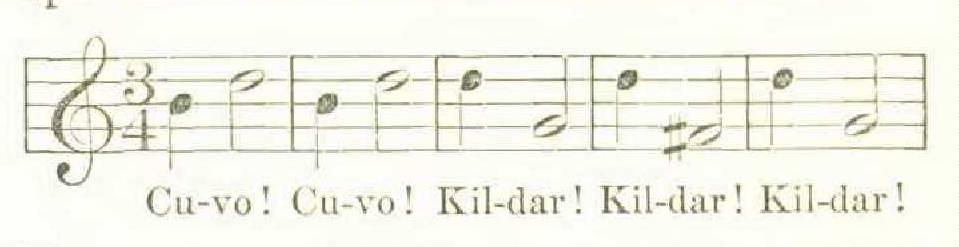
Thus she called her hungry dogs, that fed on human flesh, while the winds were awhirl, and the waning moon was red, and the Big Smoky lay in densest gloom.
The white line of light had yellowed, deepened, grown dull. The furnace needed fuel. Ab suddenly leaned down and threw open the door. The flare of the pulsing coals resuscitated the dim scene and the long, dun-colored shadows. Here in the broad red light were the stolid, meditative faces of the distillers, each with his pipe in his mouth and his hat on his head ; it revealed the dilated eye and unconsciously dramatic gesture of the story-teller, sitting upon a barrel in their midst; the horse was distinct in the background, now dreaming and now lifting an impatient fore-foot, and his gigantic stall-mate, the simulacrum of the mastodon, moved as he moved, but softly, that the echoes might not know, — the immortal echoes, who were here before him, and here still.
And behind all were the great walls of the vault, with its vague apertures leading to unexplored recesses; with many jagged ledges, devoted to shelflike usage, and showing here a jug, and here a shot-pouch, and here a rat — fat and sleek, thanks to the plenteous waste of mash and grain — looking down with a glittering eye, and here a bag of meal, and here a rifle.
Suddenly Amos James broke off. “ Who ’s that?” he exclaimed, and all the echoes were sharply interrogative. There was a galvanic start among the moonshiners. They looked hastily about, — perhaps for the witch, perhaps for the frightful dogs, perhaps expecting the materialization of Mirandy Jane’s raider.
Amos had turned half round, and was staring intently beyond the still. The man lying on the ground had shifted his position ; his soft brown hat was doubled under his head. The red flare showed its long, tawny, tangled hair, of a hue unusual enough to be an identification. His stalwart limbs were stretched out at length ; the hands he thrust above his head were unmanacled; as he moved there was the jingle of spurs.
“ Why, thar be Rick Tyler ! ” exclaimed Amos James.
“ Hev ye jes’ fund that out?” drawled the man on the ground, with a jeering inflection.
“W-w-w-why n’t ye lie low, Rick ? ” demanded Pete aggressively. “ Ef ever thar war a empty cymblin’, it’s yer head. Amos an’ that thar thin-lipped sneak ez called hisself a dep’ty air thick ’n thieves.”
There was no hesitation in Amos James’s character. He leaned forward suddenly, and clutched Pete by the throat, and the old man and Solomon were fain to interfere actively to prevent that doughty member of the family from being throttled on the spot. Pending the interchange of these amenities, Rick Tyler lay motionless on the ground; Ab calmly continued his task of replenishing the fire ; and Ben asked, in a slow monotone, the favor of leaving the furnace door open for a “ spell, whilst I unkiver the kag in the corner, an’ fill the jug, an’ kiver the kag agin, keerful, ’kase I don’t want no rat in mine.”
When Pete, with a scarlet face and starting eyes and a throat full of complicated coughs and gurgles, was torn out of the young miller’s strong bands, old Groundhog Cayce remonstrated : —
“ Lord A’mighty, boys ! Can’t ye set an’ drink yer liquor sociable, ’thout clinchin’ that-a-way ? What did Pete do ter ye, Amos ? ”
“ Nuthin’ ; he dassent,” said the panting Amos.
“Did he hurt yer feelin’s?” asked the old man, with respectful sympathy.
“ Yes, he did,” said Amos, admitting vulnerability in that tender æsthetic organ.
“ Never none — now — koo — koo ! ” coughed Pete. “ He hev got no f-f-ffeelin’s, koo — koo! I hev hearn his own m-mam say so a-many a time.”
“He ’lowed,” said Amos, his black eyes flashing indignantly, his face scarlet, the perspiration thick in his black hair, “ ez I ‘d tell the dep’ty — kase he war toler’ble lively hyar, an’ I got sorter friendly with him when I hed ter sarve on the posse—ez I seen Rick Tyler hyar. Mebbe ye think I want two hunderd dollars — hey ! ” He made a gesture as if to seize again his late antagonist.
“A-koo, koo, koo!” coughed Pete, moving cautiously out of reach.
All the echoes clamored mockingly with the convulsive sound, and thus multiplied they gave a ludicrous suggestion of the whooping-cough.
“ I dunno, Mr. Cayce,” said Amos, with some dignity, addressing the old man, “ what call ye hev got ter consort with them under indictment for murder an’ offenders agin the law. But hevin’ seen Rick Tyler hyar in a friendly way along o’ you-uns, he air ez safe from me ez ef he war under my own roof.”
Rick Tyler drew himself up on his elbow, and turned upon the speaker a face inflamed by sudden passion.
“ Go tell the dep’ty ! ” he screamed. “ I ’ll take no faviors from ye, Amos Jeemes. Kern on ! Arrest me yerse’f!” He rose to his feet, and held out his bruised and scarred hands, smiting them together as if he were again handcuffed. The light fell full on his clothes, tattered by his briery flight, the long dishevelment of his yellow hair, his burning face, and the blazing fury in his brown eyes. “ Kem on! Arrest me yerse’f, — ye air ekal ter it. I kin better bide the law than ter take faviors from you-uns. Kem on ! Arrest me ! ”
Once more he held out his free hands as if for the manacles.
Their angry eyes met. Then, as Amos James still sat silent and motionless on the barrel, Rick Tyler turned, and with a gesture of desperation again flung himself on the ground.
There was a pause. Two of the moonshiners were arranging to decant some liquor into a keg, and were lighting a tallow dip for the purpose. In the dense darkness of the recess where they stood it took on a large and lunar aspect. A rayonnant circle hovered attendant upon it; the shadows about it were densely black, and in the sharp and colorless contrasts the two bending figures of the men handling the keg stood out in peculiar distinctness of pose and gesture. The glare of the fire in the foreground deepened to a dull orange, to a tawny red, even to a dusky brown, in comparison with the pearly, luminous cffect of the candle. The tallow dip was extinguished when the task was complete. Presently the furnace door clashed, the group of distillers disappeared as with a bound, and that long, livid line of pulsating light emitted by the ill-fitting door cleft the gloom like a glittering blade.
“ I dunno ez ye mean ter be sassy in ’special, Amos, faultin’ yer elders, talkin’ ’bout consortin’ with them under indictment,” said old Groundhog Cayce’s voice. “ But I dunno ez ye hev enny call ter sot yerse’f up in jedgmint on my actions.”
“Waal,” said Amos, apologetic, “I never went ter say nuthin’ like faultin’ nohow. Sech ez yer actions I leaves ter you-uns.”
“ Ye mought ez well,” said the elder, unconsciously satiric. “ The Bible ‘lows ez every man air a law unto hisself. An’ I hev fund I gits peace mos’ly in abidin’ by the law ez kems from within. An’ I kin see no jestice in my denyin’ a rifle an’ a lot o’ lead an’ powder ter a half-starvin’ critter ter save his life. Rick war bound ter starve, hid out, ef he hed nuthin’ ter shoot deer an’ wild varmints with, bein’ ez his rifle war tuk by the sher’ff. I knows no law ez lays on me the starvin’ o’ a human. An’ when that boy kem a-cropin’ hyar ter the still this evenin’, he got ez fairspoke a welcome, an’ ez much liquor ez he’d swaller, same ez enny comer on the mounting. I dunno ez he air a offender agin the law, an’ ‘t aint my say-so. I ain’t a jedge, an’ thar ain’t enough o’ me fur a jury.”
This lucid discourse, its emphasis doubled by the iterative echoes, had much slow, impersonal effect as it issued from the darkness. It was to Amos James, accustomed to rural logic, as if reason, pure and simple, had spoken. His heart had its own passionate protest. Not that he disapproved the loan of the rifle, but he distrusted the impulse which prompted it. To find the hunted fugitive here among the distillers added the force of conviction to his suspicions of a rescue and its instigation.
The personal interest which he had in all this annulled for a moment his sense of the becoming, and defied the constraints of etiquette.
“ How ’d Rick Tyler say he got away from the sher’ff, ennyhow ? ” he demanded bluntly.
“He war n’t axed,” said old Groundhog Cayce quietly.
A silence ensued, charged with all the rigors of reproof.
“ An’ I dunno ez ye hev enny call ter know, Amos Jeemes,” cried out Rick, still prone upon the ground. “ That won’t holp the sher’ff none now. Ye’d better be studyin’ ’bout settin’ him on the trail ter ketch me agin.” The line of light from the rift in the furnace door showed a yellow gleam in the blackness where his head lay. Amos James fixed a burning eye upon it.
“ I ‘ll kem thar d’rec’ly an’ tromp the life out’n ye, Rick Tyler. I ‘ll grind yer skull ter pieces with my boot-heel, like ez ef ye war a copperhead.”
“ Laws a massy, boys, sech a quar’lin’, fightin’ batch ez ye be! I fairly gits gagged with my liquor a-listenin’ ter ye, — furgits how ter swaller,” said Groundhog Cayce, suddenly fretful. “ Leave Rick be, Amos Jeemes,” he added, in an authoritative tone. And then, with a slant of his head toward Rick Tyler, lying on the ground, “Hold yer jaw down thar ! ”
And the two young men lapsed into silence.
The spring, rising among the barren rocks, chanted aloud its prescient sylvan song of the woodland ways, and the glancing beam, and the springing trout, and the dream of the drifting leaf, as true of tone and as delicately keyed to the dryadic chorus in the forest without as if the waters that knew but darkness and the cavernous sterilities were already in the liberated joys of the gorge yonder, reflecting the sky, wantoning with the wind, and swirling down the mountain side. The spirits dripped from the worm, the furnace roared, the men’s feet grated upon the rocks as they now and then shifted their position.
“ Waal,”said Amos at last, rising, “I’d better be a-goin’. ’Pears like ez I ve wore out my welcome hyar.”
He stood looking at the line of light, remembering desolately Dorinda’s buoyant, triumphant mood. Its embellishment of her beauty had smitten him with an afflicted sense of her withdrawal from all the prospects of his future. He had thought that he had given up hope, but he began to appreciate, when he found Rick Tyler in intimate refuge with her kindred, how sturdy an organism was that heart of his, and to realize that to reduce it to despair must needs cost many a throe.
“ I hev wore out my welcome, I reckon,” he repeated, dismally.
“ I dunno what ails ye ter say that. Ye hev jes’ got tired o’ comin’ hyar, I reckon,” said old man Cayce. “ Wore out yer welcome, — shucks ! ”
“ Mighty nigh wore me out,” said Pete, remembering to cough.
“ Waal,” said Amos, slightly salved by the protestations of his host, “ I reckon it air time I war a-puttin’ out, ennyhow. Jes’ set that thar furnace door on the jar, Pete, so ’s I kin see ter lay a-holt o’ the beastis.”
Hie door opened, the rod glow flared out, the figures of the moonshiners all reappeared in a semicircle about the still, and as Amos James took the horse’s bridle and led him away from the wall the mastodon vanished, with noiseless tread, into the dim distance of the unmeasured past.
The horse’s hoofs reverberated down the cavernous depths, echoed, reëchoed, multiplied indefinitely. Even after the animal had been led through the tortuous windings of the passage his tramp resounded through the gloom.
X.
The displeasure of his fellows is a slight and ephemeral matter to a man whose mind is fixed on a great essential question, charged with moral gravity and imperishable consequence; whose physical courage is the instinct of his nature, conserved by its active exercise in a life of physical hardship.
Kelsey had forgotten the gander-pulling, the impending election, the excitement of the escape, before he had ridden five miles from the Settlement. He jogged along the valley road, the reins on the horse’s neck, his eyes lifted to the heights. The fullness of day was on their unpeopled summits. Infinity was expressed before the eye. On and on the chain of mountains stretched, with every illusion of mist and color, with every differing grace of distance, with inconceivable measures of vastness. The grave delight in which their presence steeped the senses stirred his heart. They breathed solemnities. They lent wings to the thoughts. They lifted the soul. Could he look at them and doubt that one day he should see God ? He had been near, — oh, surely, He had been near.
Kelsey was comforted as he rode on. Somehow, the mountains had for his ignorant mind some coercive internal evidence of the great truths. In their exalted suggestiveness were congruities: so far from the world were they, — so high above it; so interlinked with the history of all that makes the races of men more than the beasts that perish, that conserves the values of that noble idea, — an immortal soul. On a mountain the ark rested ; on a mountain the cross was planted ; the steeps beheld the glories of the transfiguration; the lofty solitudes heard the prayers of the Christ; and from the heights issued the great sermon instinct with all the moralities of every creed. How often He went up into the mountain !
The thought uplifted Kelsey. The flush of strong feeling touched his cheek. His eyes were fired with that sudden gleam of enthusiasm as remote from earthly impulses as the lightnings of Sinai.
“ An’ I will preach His name ! ” the parson exclaimed, in a tense and thrilling voice. He checked his horse, drew out of his pocket a thumbed old Bible, clumsily turned the leaves and sought for his text.
No other book had he ever read: only that sublime epic, with its deep tendernesses and its mighty portents ; with its subtleties of prophecy in wide and splendid phrase, and their fulfillment in the barren record of the simplest life ; with all the throbbing presentment of martyrdom and doom and death, dominated by the miracle of resurrection and the potency of divinity. Every detail was as clearly pictured to his mind as if, instead of the vast, unstoried stretches of the Great Smoky Mountains, he looked upon the sanctities of the hills of Judæa.
He read as he rode along, — slowly, slowly. A bird’s shadow would flit across the holy page, and then away to the mountain ; the winds of heaven caressed it. Sometimes the pollen of flowering weeds fell upon it; for in the midst of the unfrequented road they often stood in tall rank rows, with a narrow path on either side, trodden by the oxen of the occasional team, while the growth bent elastically under the passing bed of the wagon.
He was almost happy. The clamors of his insistent heart were still. His conscience, his memory, his self-reproach, had loosed their hold. His keen and subtle native intellect stretched its unconscious powers, and discriminated the workings of character, and reviewed the deploying of events, and measured results. He was far away, walking with the disciples.
Suddenly, like an aerolite, he was whirled from high ethereal spaces by the attraction of the earth. A man was peering from between the rails of a fence by the wayside.
“ Kin ye read yer book, pa’son, an’ ride yer beastis all ter wunst ? ” he cried out, with the fervor of admiration.
That tree of knowledge, — ah, the wily serpent! Galilee, — it was thousands of miles away across the deep salt seas.
The parson closed his book with a smile of exultation.
“ The beast don’t hender me none. I kin read ennywhar,” he said, proud of the attainment.
“Waal, sir!” exclaimed the other, one of that class, too numerous in Tennessee, who can neither read nor write. “ Air it the Good Book ? ” he demanded, with a sudden thought.
“It air the Holy Bible,” said the parson, handing him the book.
The man eyed it with reverence. Then, with a gingerly gesture, he gave it back. The parson was looking down at him, all softened and humanized by this unconscious flattery.
“ Waal, pa’son,” said the illiterate admirer of knowledge, with a respectful and subordinate air, “ I hearn ez ye war a-goin’ ter hold fo’th up yander at the meet’n-house at the Notch nex’ Sunday. Air that a true word ? ”
“ I ’lows ter preach thar on the nex’ Lord’s day,” replied the parson.
“ Then,” with the promptness of a sudden resolution, “ I’m a-goin’ ter take the old woman an’ the chil’n an’ wagon up the Big Smoky ter hear the sermon. I ’low ez a man what kin ride a beastis an’ read a book all ter wunst mus’ be a powerful exhorter, an’ mebbe ye ’ll lead us all ter grace.”
The parson said he would be glad to see the family at the meeting-house, and presently jogged off down the road.
One might regard the satisfaction of this simple scene as the due meed of his labors; one might account his pride in his attainments as a harmless human weakness. There have been those of his calling, proud, too, of a finite knowledge, and fain to conserve fame, whose conscience makes no moan, — who care naught for humility, and hardly hope to be genuine.
The flush of pleasure passed in a moment. His face hardened. That fire of a sublimated anger or frenzy touched his eyes. He remembered Peter, the impetuous, and Thomas, the doubter, and the warm generosities of the heart of him whom Jesus loved, and he “ reckoned ” that they would not have left Him standing in the road for the joy of hearing their learning praised. He rebuked himself as caring less for the Holy Book than that his craft could read it. His terrible insight into motives was not dulled by a personal application. Introverted upon his own heart, it was keen, unsparing, insidiously subtle. He saw his pride as if it had been another man’s, except that it had no lenient mediator ; for he was just to other men, even gentle. He took pitiless heed of the pettiness of his vanity ; he detected pleasure that the man by the wayside should come, not for salvation, but to hear the powerful exhorter speak. He saw the instability of his high mood, of the gracious reawaking of faith ; he realized the lapse from the heights of an ecstasy at the lightest touch of temptation.
“ The Lord lifts me up,” he said, “ ter dash me on the groun’! ”
No more in Judæa, in the holy mountains ; no more among the disciples. Drearily along the valley road, glaring and yellow in the sun, the book closed, the inspiration fled, journeyed the ignorant man, who would fain lay hold on a true and perfected sanctity.
He dispatched his errand in the valley,— a secular matter, relating to the exchange of a cow and a calf. The afternoon was waning when he was again upon the slopes of the Big Smoky; for the roads were rough, and he had traveled slowly, always prone to “favor the beastis.” He stopped in front of Cayce’s house, where he saw Dorinda spinning on the porch, and preferred a request for a gourd of water. The old woman heard his voice, and came hastily out with hospitable insistence that he should dismount and “ rest his bones, sence he hed rid fur, an’ tell the news from the Settlemint.” There was a cordial contrast between this warm esteem and his own unkind thoughts, and he suffered himself to be persuaded. He sat under the hop-vines, and replied in monosyllables to the old woman’s animated questions, and gave little news of the excitements at the Settlement which they had not already heard. Dorinda, her wheel awhirl, one hand lifted holding the thread, the other poised in the air to control the motion, her figure thrown back in a fine, alert pose, looked at him with a freshened pity for his downcast spirit, and with intuitive sympathy, He sorrowed not because of the things of this world, she felt. It was some high and spiritual grief, such as might pierce a prophet’s heart. Her eyes, full of the ideality of the sentiment, dwelt upon him reverently.
He marked the look. With his overwhelmed sense of his sins, he was abased under it, and he scourged himself as a hypocrite.
“ Thar air goin’ ter be preachin’ at the meetin’-house Sunday, I hearn,” she observed presently, thinking this topic more meet for his discussion than the “ gaynder-pullin’ ” and the escape, and such mundane matters. The tempered green light fell upon her fair face, adding a delicacy to its creamy tint; her black hair caught a shifting golden flake of sunshine as she moved back and forth ; her red lips were slightly parted. The grasshoppers droned in the leaves an accompaniment to the whir of her wheel. The “ prince’s feathers ” bloomed in great clumsy crimson tufts close by the step. Mirandy Jane, seated on an inverted noggin, listened tamely to the conversation, her wild, uncertain eyes fixed upon the parson’s face ; she dropped them, and turned her head with a shying gesture, if by chance his glance fell upon her.
From this shadowed, leafy recess the world seen through the green hop-vines was all in a great yellow glare.
“ Be you-uns a-goin’ ter hold fo’th,” demanded the old woman, “ or Brother Jake Tobin ? ”
“It air me ez air a-goin’ ter preach,” he said.
“ Then I’m a-comin’,” she declared promptly. “ It do me good ter hear youuns fairly make the sinners spin. Sech a gift o’ speech ye hev got ! I fairly see hell when ye talk o’ thar doom. I see wrath an’ I smell brimstone. Lord be thanked, I hev fund peace! An’
I ’m jes’ a-waitin’ fur the good day ter come when the Lord ’ll rescue me from yearth ! ” She threw herself back in her chair, closing her eyes in a sort of ecstasy, and beating her hands on her knees, her feet tapping in rhythm.
“Though ef ye’ll b’lieve me,” she added, sitting up straight with an appalling suddenness, and opening her eyes,
“ D’rindy thar ain’t convicted yit. Oh, child,” in an enthused tone of reproof,
“ time is short, — time is short! ”
“ Waal,” said Dorinda, speaking more quickly than usual, and holding up her hand to stop the wheel, “ I hev hed no chance sca’cely ter think on salvation, bein’ ez the weavin’ war hendered some — an’ ” — She paused in embarrassment.
“That air a awful word ter say,— puttin’ the Lord ter wait! Why n’t ye speak the truth ter her, pa’son ? Fix her sins on her.”
“ Sometimes,” said the parson abruptly, looking at her as if he saw more or less than was before him, “ I dunno ef I hev enny call ter say a word. I hev preached ter others, an’ I’m like ter be a castaway myself.”
The old woman stared at him in dumb astonishment. But he was rising to take leave, — a simple ceremony. He unhitched the horse at the gate, mounted, and, with a silent nod to the group on the porch, rode slowly away.
Old Mrs. Cayce followed him with curious eyes peering out in the gaps of the hop-vines.
“ D’rindy,” she said, “ that thar Pa’son Kelsey, — we-uns useter call him nuthin’ but Hi,—he’s got suthin’ heavy on his mind. It always ’peared ter me ez he war a mighty cur’ous man ter take up with religion an’ sech. Sech a suddint boy ez he war, — ez good a fighter ez a catamount, an’ always ’mongst the evil, bold men. Them he consorted with till he gin his child morphine by mistake, an’ its mammy quine-iron; an’ she los’ her senses arterward, an’ flunged herse’f off’n the bluff. ’Pears like ter me ez them war judgments on him,— though Em’ly war n’t much loss ; ez triflin’ a chi’ce fur a wife ez a man could make. An’ now he hev got suthin’ on his mind.”
The girl said nothing. She stayed her wheel with one hand, holding the thread with the other, and looked over her shoulder at the receding figure riding slowly along the vista of the forestshadowed road. Then she turned, and fixed her lucent, speculative eyes on her grandmother, who continued: “Calls hisse’f a castaway! Waal, he knows lies’, bein’ a prophet an’ sech. But it air toler’ble comical talk fur a preacher. Brother Jake Tobin kin hardly hold hisself tergether, a-waitin’ fur his sheer o’ the joys o’ the golden shore.”
“ Waal, ’pears like ter me,” said Mirandy Jane, whose mind seemed never far from the culinary achievements to which she had been dedicated, “ ez Brother Jake Tobin sets mo’ store on chicken fixin’s than on grace, an’ he fattens ev’y year.”
“ I hopes,” proceeded the grandmother, disregarding the interruption, and peering out again at the road where the horseman had disappeared, “ ez Hi Kelsey won’t sot hisself ter prophesyin’ evil at the meetin’; ’pears ter me he ought ter be hendered, ef mought be, ’kase the wrath he foresees mos’ly kems ter pass, an I ’m always lookin’ ter see him prophesy the raiders, — though he hev hed the grace ter hold his hand bout’n the still. An’ I hopes he won’t hev nuthin’ ter say ’bout it at the meetin’ Sunday.”
The little log meeting-house at the Notch stood high on a rugged spur of the Great Smoky. Dense forests encompassed it on every hand, obscuring that familiar picture of mountain and cloud and cove. From its rude, glass-
less windows one could look out on no distant vista, save perhaps in the visionary glories of heaven or the climatic discomforts of hell, according to the state of the conscience, or perchance the liver. The sky was aloof and limited. The laurel tangled the aisles of the woods. Sometimes from the hard benches a weary tow-headed brat might rejoice to mark in the monotony the frisking of a squirrel on a bough hard by, or a woodpecker solemnly tapping. The acorns would rattle on the roof, if the wind stirred, as if in punctuation of the discourse. The pines, mustering strong among the oaks, joined their mystic threnody to the sad-voiced quiring within. The firs stretched down long, pendulous, darkling boughs, and filled the air with their balsamic fragrance. Within the house the dull light fell over a few rude benches and a platform with a chair and table, which was used as pulpit. Shadows of many deep, rich tones of brown lurked among the rafters. Here and there a cobweb, woven to the consistence of a fabric, swung in the air. The drone of a blue-bottle, fluttering in and out of the window in a slant of sunshine, might invade the reverent silence, as Brother Jake Tobin turned the leaves to read the chapter. Sometimes there would sound, too, a commotion among the horses without, unharnessed from the wagons and hitched to the trees ; then in more than one of the solemn faces might be descried an anxious perturbation,—not fear because of equine perversities, but because of the idiosyncrasies of callow human nature in the urchins left in charge of the teams. No one ventured to investigate, however, and, with that worldly discomfort contending with the spiritual exaltations they sought to foster, the rows of religionists swayed backward and forward in rhythm to the reader’s voice, rising and falling in long, billowy sweeps of sound, like the ground swell of ocean waves. It was strange, looking upon their faces, and with a knowledge of the limited phases of their existence, their similarity of experience here, where a hundred years might come and go, working no change save that, like the leaves, they fluttered awhile in the outer air with the spurious animation called life, and fell in death, and made way for new bourgeonings like unto themselves, — strange to mark how they differed. Here was a man of a stern, darkly religious conviction, who might either have writhed at the stake or stooped to kindle the flames ; and here was an accountant soul that knew only those keen mercantile motives, — the hope of reward and the fear of hell ; and here was an enthusiast’s eye, touched by the love of God ; and here was an unfinished, hardly humanized face, that it seemed as presumptuous to claim as the exponent of a soul as the faces of the stupid oxen out-of-doors. All were earnest; many wore an expression of excited interest, as the details of the chapter waxed to a climax, like the tense stillness of a metropolitan audience before an unimagined coup de théûtre. The men all sat on one side, chewing their quids ; the women on the other, almost masked by their limp sun-bonnets. The ubiquitous baby — several of him — was there, and more than once babbled aloud and cried out peevishly. Only one, becoming uproarious, was made a public example ; being quietly borne out and deposited in the ox-wagon, at the mercy of the urchins who presided over the teams, while his mother creaked in again on the tips of deprecating, anxious toes, to hear the Word.
Brother Jake Tobin might be accounted in some sort a dramatic reader. He was a tall, burly man, inclining to fatness, with grizzled hair roached back from his face. He cast his light gray eyes upward at the end of every phrase, with a long, resonant “ Ah! ” He smote the table with his hands at emphatic passages; he rolled out denunciatory clauses with a freshened relish which intimated that he considered one of the choicest pleasures of the saved might be to gloat over the unhappy predicament of the damned. He chose for his reading paragraphs that, applied to aught but spiritual enemies and personified sins, might make a civilized man quake for his dearest foe. He paused often and interpolated his own observations, standing a little to the side of the table, and speaking in a conversational tone. " Ain’t that so, my brethren an’ sisters ! But we air saved in the covenant — ah! ” Then, clapping his hands with an ecstatic upward look, — “ I m so happy, I ’m so happy ! ” — he would go on to read with the unction of immediate intention, “ Let death seize them ! Let them go down quick into hell! ”
He wore a brown jeans suit, the vest much creased in the regions of his enhanced portliness, its maker’s philosophy not having taken into due account his susceptibility to “chicken fixin’s.” After concluding the reading he wiped the perspiration from his brow with his red bandanna handkerchief, and placed it around the collar of his unbleached cotton shirt, as he proceeded to the further exertion of “ lining out ” the hymn.
The voices broke forth in those long, lingering cadences that have a melancholy, spiritual, yearning effect, in which the more tutored church music utterly fails. The hymn rose with a solemn jubilance, filling the little house, and surging out into the woods; sounding far across unseen chasms and gorges, and rousing in the unsentient crags an echo with a testimony so sweet, charged with so devout a sentiment, that it seemed as if with this voice the very stones would have cried out, had there been dearth of human homage when Christ rode into Jerusalem.
Then the sudden pause, the failing echo, the sylvan stillness, and the chanting voice lined out another couplet. It was well, perhaps, that this part of the service was so long; the soul might rest on its solemnity, might rise on its aspiration.
It came to an end at last. Another long pause ensued. Kelsey, sitting on the opposite side of the table, his elbow on the back of his chair, his hand shading his eyes, made no movement. Brother Jake Tobin looked hard at him, with an expression which in a worldly man we should pronounce exasperation. He hesitated for a moment in perplexity. There was a faint commotion, implying suppressed excitement in the congregation. Parson Kelsey’s idiosyncrasies were known by more than one to be a thorn in the side of the frankly confiding Brother Jake Tobin.
“ Whenst I hev got him in the pulpit alongside o’ me,” he would say to his cronies, “ I feel ez onlucky an’ weighted ez ef I war a-lookin’ over my let” shoulder at the new moon on a November Friday. I feel ez oncommon ez ef he war a deer, or suthin’, ez hev got no salvation in him. An’ ef he don’t feel the sperit ter pray, he wont pray, an’ I hev got ter surroun’ the throne o’ grace by myse’f. He kin pray ef he hev a mind ter, an’ he do seem ter hev hed a outpourin’ o’ the sperit o’ prophecy ; but he hev made me ’pear mighty comical ’fore the Lord a-many a time, when I hev axed him ter open his mouth an’ he hev kep’ it shut.”
Brother Jake did not venture to address him now. An alternative was open to him. “ Brother Reuben Bates, will ye lead us in prayer?” he said to one of the congregation.
They all knelt down, huddled like sheep in the narrow spaces between the benches, and from among them went up the voice of supplication, that anywhere and anyhow has the commanding dignity of spiritual communion, the fervor of exaltation, and all the moving humility of the finite leaning upon the infinite. Ignorance was annihilated, so far as Brother Reuben Bates’s prayer was concerned. It grasped the fact of immortality, — all worth knowing ! — and humble humanity in its least worthy phase was presented as the intimate inherent principle of the splendid fruitions of eternity.
He had few words, Brother Reuben, and the aspirated “Ah! ” was long drawn often, while he swiftly thought of something else to say. Brother Jake Tobin, after the manner in vogue among them, broke out from time to time with a fervor of assent. “ Yes, my Master ! ” he would exclaim in a wild, ecstatic tone. “Bless the Lord!” “That’s a true word! ” “ I’m so happy ! ”
Always these interpolations came opportunely when Brother Reuben seemed entangled in his primitive rhetoric, and gave him a moment for improvisation. It was doubtless Hi Kelsey’s miserable misfortune that his acute intuition should detect in the reverend tones a vainglorious self-satisfaction, known to no one else, not even to the speaker ; that he should accurately gauge how Brother Jake Tobin secretly piqued himself upon his own gift in prayer, never having known these stuttering halts, never having needed these pious boosts ; that he should be aware, ignorant as he was, of that duality of cerebration by which Brother Jake’s mind was divided between the effect on God, bending down a gracious ear, and the impression of these ecstatic outbursts on the congregation ; that the petty contemptibleness of it should depress him ; that its dissimulations angered him. With the rigor of an upright man, he upbraided himself. He was on his knees: was he praying ? Were these the sincerities of faith. Was this lukewarm inattention the guerdon of the sacrifice of the cross ? His ideal and himself, himself and what he sought to be, — oh, the gulf ! the deep divisions !
He gave his intentions no grace. He conceded naught to human nature. His conscience revolted at a sham. And he was a living, breathing sham — upon his knees.
Ah, let us have a little mercy on ourselves ! Most of us do. For there was Brother Jake Tobin, with a conscience free of offense, happily unobservant of his own complicated mental processes and of the motives of his own human heart, becoming more and more actively assistant as Brother Reuben Bates grew panicky, hesitant, and involved, and kept convulsively on through sheer inability to stop, suggesting epilepsy rather than piety.
It was over at last ; exhausted nature prevailed, and Brother Bates resumed his seat, wiping the perspiration from his brow and raucously clearing his rasped throat.
There was a great scraping of the rough shoes and boots on the floor as the congregation rose, and one or two of the benches were moved backward with a harsh, grating sound. A small boy had gone to sleep during the petition, and remained in his prayerful attitude. Brother Jake Tobin settled himself in his chair as comfortably as might be, tilted it hack on its hind-legs against the wall, and wore the air of having fairly exploited his share of the services and cast off responsibility. Hie congregation composed itself to listen to the sermon.
There was an expectant pause. Kelsey remembered ever after the tumult of emotion with which he stepped forward to the table and opened the book. He turned to the New Testament for his text, — turned the leaves with a familiar hand. Some ennobling phase of that wonderful story which would touch the tender, true affinity of human nature for the higher things, — from this he would preach to-day. And yet, at the same moment, with a contrariety of feeling from which he shrank aghast, there was skulking into his mind all that grewsome company of doubts. In double file they came: fate and free agency, free will and foreordination, infinite mercy and infinite justice, God’s lovingkindness and man’s intolerable misery, redemption and damnation. He had evolved them all from his own unconscious logical faculty, and they pursued him as if he had, in some spiritual necromancy, conjured up a devil, — nay, legions of devils. Perhaps if he had known how they have assaulted the hearts of men in times gone past; how they have been combated and baffled, and yet have risen and pursued again; how, in the scrutiny of science and research, men have paused before their awful presence, analyzed them, philosophized about them, and found them interesting; how others, in the levity of the world, having heard of them, grudge the time to think upon them, — if he had known all this, he might have felt some courage in numbers.
As it was, there was no fight left in him. He closed the book with a sudden impulse. “ My frien’s,” he said, “ I stan’ not hyar ter preach ter-day, but fur confession.”
There was a galvanic start among the congregation, then intense silence.
“ I hev los’ my faith ! ” he cried out, with a poignant despair. “ God ez gin it — ef thar is a God — hev tuk it away. You-uns kin go on. You-uns kin b’lieve. Yer paster b’lieves, an’ he ’ll lead ye ter grace, — leastwise ter a better life. But fur me thar’s the nethermost depths of hell, ef ” — how his faith and his unfaith tried him! — “ ef thar be enny hell. Leastwise — Stop, brother,” — he held up his hand in deprecation, for Parson Tobin had risen at last, with a white, scared face ; nothing like this had ever been heard in all the length and breadth of the Great Smoky Mountains, — “ bear with me a little ; ye ’ll see me hyar no more. Fur me thar is shame, ah ! an’ trial, ah ! an’ doubt, ah ! an’ despair, ah ! The good things o’ life hev not fallen ter me. The good things o’ heaven air denied. My name is ter be a by-word an’ a reproach ’mongst ye. Ye ’ll grieve ez ye hev ever beam the Word from me, ah! Ye’ll be held in derision! An’ I hev hed trials, — none like them ez air comin’, comin’, down the wind. I hev been a man marked fur sorrow, an’ now fur shame.”
He stood erect; he looked bold, youthful. The weight of his secret, lifted now, had been heavier than he knew. In his eyes shone that strange light which was frenzy, or prophecy, or inspiration ; in his voice rang a vibration they had never before heard.
“I will go forth from ’mongst ye,— I that am not of ye. Another shall gird me an’ carry me where I would not. Hell an’ the devil hev preyailed agin me. Pray fur me, bretherin, ez I cannot pray fur myself. Pray that God may yet speak ter me, — speak from out o’ the whurlwind.”
There was a sound upon the air. Was it the rising of the wind? A thrill ran through the congregation. The wild emotion, evoked and suspended in this abrupt pause, showed in pallid excitement on every face. Several of the men rose aimlessly, then turned and sat down again. Brought from the calm monotony of their inner life into this supreme crisis of his, they were struck aghast by the hardly comprehended situations of his spiritual drama enacted before them. And what was that sound on the air ? In the plenitude of their ignorant faith, were they listening for the invoked voice of God?
Kelsey, too, was listening, in anguished suspense.
It was not the voice of God, that man was wont to hear when the earth was young; not the rising of the wind. The peace of the golden sunshine was supreme. Even a tiny cloudlet, anchored in the limited sky, would not sail to-day.
On and on it came. It was the galloping of horse, — the beat of hoofs, individualized presently to the ear, — with that thunderous, swift, impetuous advance that so domineers over the imagination, quickens the pulse, shakes the courage.
It might seem that all the ingenuity of malignity could not have compassed so complete a revenge. The fulfillment of his prophecy entered at the door. All its spiritual significance was annihilated ; it was merged into a prosaic material degradation when the sheriff of the county strode, with jingling spurs, up the aisle, and laid his hand upon the preacher’s shoulder. He wore his impassive official aspect. But his deputy, following hard at his heels, had a grin of facetious triumph upon his thin lips. He had been caught by the nape of the neck, and in a helpless, rodent-like attitude had been slung out of the door by the stalwart man of God, when he and Amos James had ventured to the meeting-house in liquor; and neither he nor the congregation had forgotten the sensation. It was improbable that such high-handed proceedings could be instituted to-day, but the sheriff had taken the precaution to summon the aid of five or six burly fellows, all armed to the teeth. They too came tramping heavily up the aisle. Several wore the reflection of the deputy’s grin; they were the “ bold, bad men,” the prophet’s early associates before “he got religion, an’ sot hisself ter consortin’ with the saints.” The others were sheepish and doubtful, serving on the posse with a protest under the constraining penalties of the law.
The congregation was still with a stunned astonishment. The preacher stood as one petrified, his eyes fixed upon the sheriff’s face. The officer, with a slow, magisterial gesture, took a paper from his breast-pocket, and laid it upon the Bible.
“ Ye kin read, pa’son,” he said. “ Ye kin read the warrant fur yer arrest.”
The deputy laughed, a trifle insolently. He turned, swinging his hat, — he had done the sacred edifice the reverence of removing it, — and surveyed the wide-eyed, wide-mouthed people, leaning forward, standing up, huddled together, as if he had some speculation as to the effect upon them of these unprecedented proceedings.
Kelsey could read nothing. His strong head was in a whirl; he caught at the table, or he might have fallen. The amazement of it, — the shame of it!
“Who does this?” he exclaimed, in sudden realization of the situation. Already self-convicted of the blasphemy of infidelity, he stood in his pulpit in the infinitely ignoble guise of a culprit before the law.
Those fine immaterial issues of faith and unfaith, — where were they ? The torturing fear of futurity, and of a personal devil and a material hell, — how impotent! His honest name, — never a man had borne it that had suffered this shame ; the precious dignity of freedom was riven from him ; the calm securities of his self-respect were shaken forever. He could never forget the degradation of the sheriff’s touch, from which he shrank with so abrupt a gesture that the officer grasped his pistol and every nerve was on the alert. Kelsey was animated at this moment by a pulse as essentially mundane as if he had seen no visions and dreamed no dreams. He had not known how he held himself,— how he cherished those values, so familiar that he had forgotten to be thankful till their possession was a retrospection.
He sought to regain his self-control, He caught up the paper; it quivered in his trembling hands; he strove to read it. “ Rescue ! ” he cried out in a tense voice. “ Rick Tyler ! I never rescued Rick Tyler ! ”
The words broke the long constraint. They were an elucidation, a flash of light. The congregation looked at him with changed eyes, and then looked at each other. Why did he deny ? Were not the words of his prophecy still on the air? Had he not confessed himself a wrong-doer, forsaken of God and bereft of grace. ? His prophecy was matched by the details of his experience. Had he done no wrong he could have foreseen no vengeance.
“ Rick Tyler ain’t wuth it,” said one old man to another, as he spat on the floor.
The woman who had been the wife of the murdered man fell into hysterical screaming at Rick Tyler’s name, and was presently borne out by her friends and lifted into one of the wagons.
“It air jes’ ez well that the sheriff takes Pa’son Kelsey, arter that thar confession o’ his’n,” said one of the darkbrowed men, helping to yoke the oxen. “We could n’t hev kep’ him in the church arter sech words ez his’n, an’ church discipline ain’t a-goin’ ter cast out no sech devil ez he air possessed
by”
Brother Jake Tobin, too, appreciated that the arrest of the preacher in his pulpit was a solution of a difficult question. It was manifestly easier for the majesty of the Slate of Tennessee to deal with him than the little church on the Big Smoky Mountain.
“ Yer sins hev surely fund ye out, Brother Kelsey,” he began, with the air of having washed his hands of all responsibility. “ God would never hev fursook ye, ef ye hed n’t fursook the good cause fust. Ye air ter be cast down, — ye who hev stood high.”
There was a momentary silence.
“Will ye come?” said the sheriff, smiling fixedly, “or had ye ruther be fetched ? ”
The deputy had a pair of handcuffs dangling officiously. They rattled in incongruous contrast with the accustomed sounds of the place.
Kelsey hesitated. Then, after a fierce internal struggle, he submitted meekly, and was led out from among them.
Charles Egbert Craddock.