Crude and Curious Inventions at the Centennial Exhibition
XII.
FURNITURE, SHOES, TOILETTE.
IT would be hardly fair to say that elaborateness and variety of furniture are the measure of civilization, for there are highly civilized communities with simple tastes, and there is barbaric splendor with but little culture. Nevertheless, polish and elegance shown in weapons, utensils, and furniture indicate the dawn of taste, and are the result of leisure.
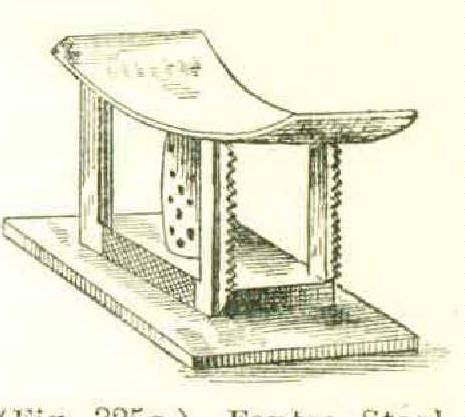
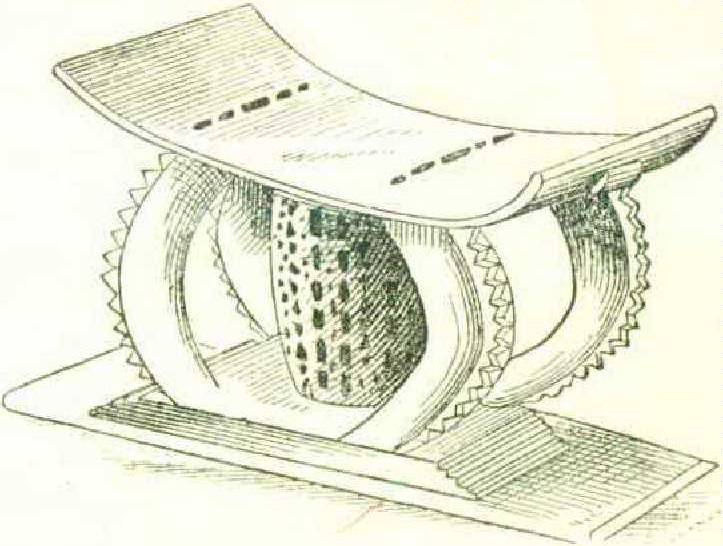
The most leisurely being in the world is perhaps to be found in Africa, but his wants are simple, his tastes undeveloped, and his constructive ability fearfully small. His chairs for important Occasions are fashioned from a solid block of wood by laborious and patient carving. He is not troubled with the need of tables or bedsteads. Of his bowls and spoons we have already spoken. Figure 325a is a native Fantee stool made from a solid block of white wood. Figure 326 is an African chief’s stool from the Gold Coast of Africa; it also is made out of the solid wood, and has curved legs and a perforated central pillar. It is thirteen inches in height, and the seat is twentytwo by eleven inches. The ornamentation is laborious without being ingenious or graceful. The Bongos of the Upper Nile make a stool for women out of goll- tree (Prosopis lanceolata). It is of a chestnutbrown color, and takes a good polish.
The Uaupés of Brazil also make their stools out of a solid block of wood neatly painted and varnished.
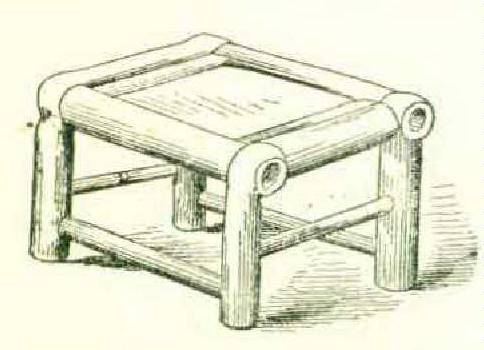
The chair of the Monbuttoos is a bundle of leaf stalks of the raphia palm, sewed together with fine split reeds, and supported by four small carved legs. It is peculiar in having a back, which, however, is not a part of the stool, but a separate erection at the rear. The more ordinary form of Central African stool is of wicker or coiled straw rope, or carved from a block of wood. The Monbuttoos, men and women, sit upon stools; those of the women have but one leg. The Makalolo of the Zambesi have stools with elaborately carved legs. The Bari man always carries his stool with him, slinging it behind him by means of a belt. Although the bamboo is so common in Africa, Madagascar, Australia, Polynesia and elsewhere, and is used for very many purposes in building and for utensils, it is the Chinese notably who make it into furniture. Figure 327 is a Chinese foot-stool of bamboo, and shows clearly the inode of using the ma_ terial for straight and for bent work.
The Chinese chair (Figure 328) is a rather small pattern, as the height of the seat is only twelve inches and of the back twenty inches additional; but it shows well the applications of bamboo. On each side, one piece, cut away at the corners to allow it to bend, forms the frame of the seat. Two others, over which the side frames ar e bent, form the front Chinese Exhibit. and back of the seat frame. The seat itself is made by flattening a section of bamboo by numerous slitti igs from end to end.
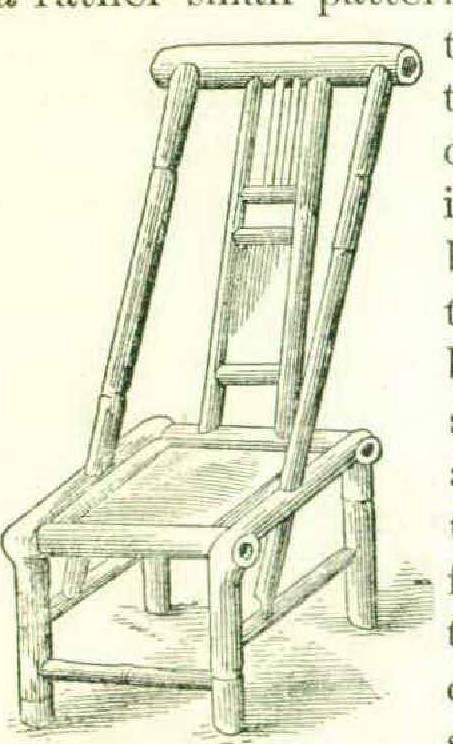
Figure 329 is a Chinese cat - cage shown in the Mineral Annex to the Main Building. The main portion is of whole bamboo of different sizes; the top is of bamboo splits and the parts arc fastened together by pegs of bamboo. The cage is twelve by twelve inches (Fig. 320.) Bamboo Cat-Cage, Chinese Exhibit. and twenty-one inches in height. The baby-cage (Figure 330) would be an acquisition in this country. It is made wholly of bamboo which is smooth a n d round, and not too solid when it is made up. A child could hardly be better off except in its mother’s lap or on the grass. The floor is of Chiplank The upper rounds have loose rings of a larger bamboo, to amuse the child. The cage is two feet high.
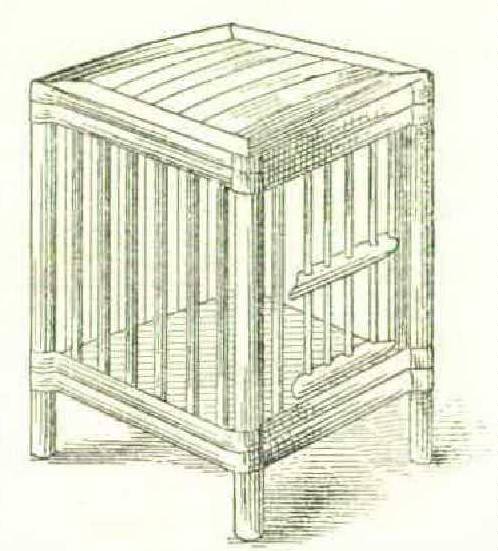
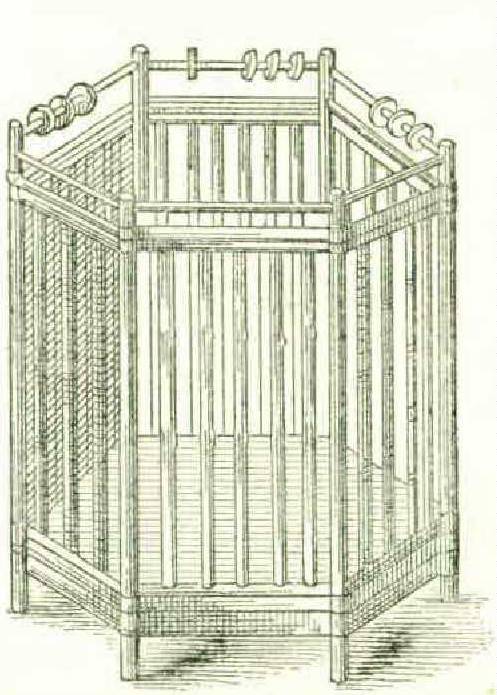
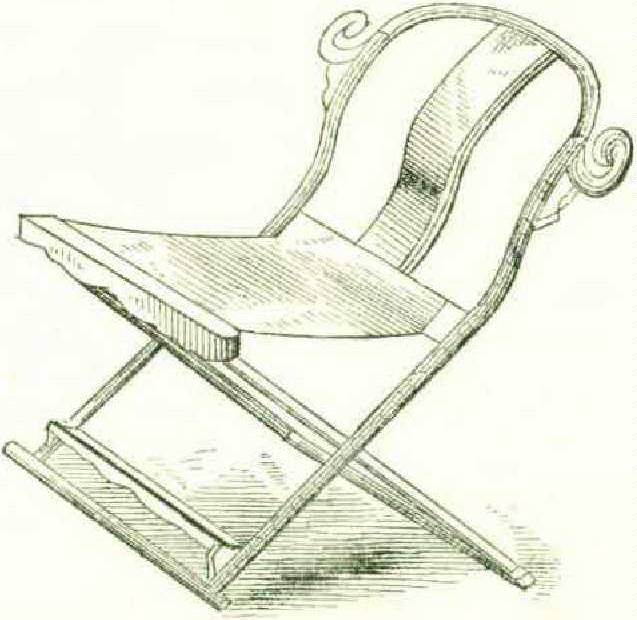
Figure 331 is a veritable camp-chair, for it is stated in the Japanese cataloguc as especially designed to be used by the commander-in-ebief in battle. The wooden part is profusely ornamented, and the seat is of leather.
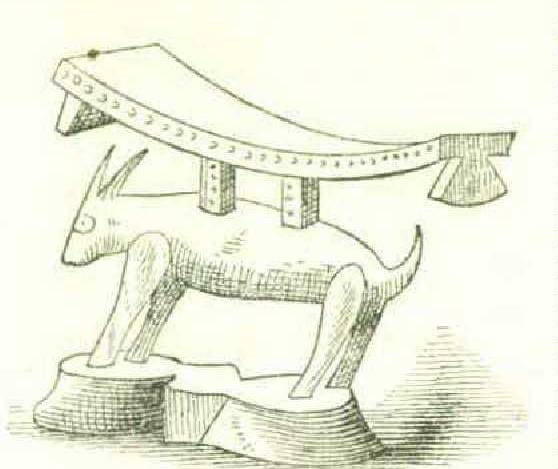
Contrary to the usual habits of Europeans, the natives of Africa, in ancient and recent times, have preferred a headrest of wood to a pillow of feathers. Figure 332 shows a head-rest six inches high, carved by a native of Mozambique. The same collection had several similar specimens from Angola, on the other (Fig. 332.) Head-Stool of Mosideof Africa, zambique. Portuguese ColoPaintings on nies Exhibit. the Egyptian monuments show like contrivances, and some of stone and wood are found in the museums of Cairo, and of Europe and America. The Abyssinians use a headstool to preserve the arrangement of their carefully plaited hair. A cylindrical bar of wood supported on legs is the pillow of the Fijians, Tongans, and Samoans. The carved wooden pillow (mosmnela) is carried suspended from the neck by the people of Zibah on the Zambesi. The Kafir pillow is a headstool cut from a block of the acacia, ft is fifteen inches long and six high. It is usually carved with several legs. The Malays use head-stools of split bamboos. The Chinese have a variety: liead-stools, elastic pillows of bamboo covered with leather, pillows of rattan, blocks with elastic bamboo slats on top, embossed pig - skin cushions stuffed, resembling the Roman pulvina probably. The Siamese are profuse in pillows: not content with using them for the head, they have them for arms, legs, knees, and feet.
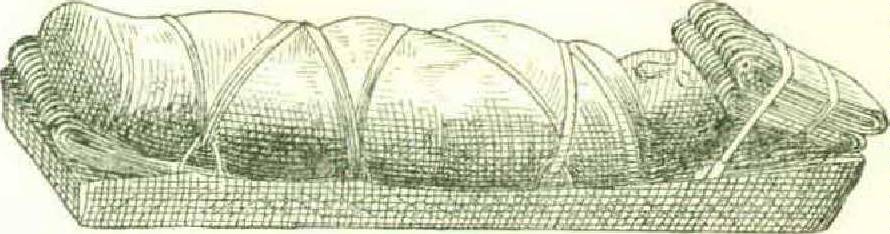
The baby savage is swathed and carried, or is hung up or laid away out of the reach of prowling animals or insects, until he is able to crawl. The rude cradles of the Exhibition were those of the North American Indians. A number of these were shown, principally intended for slinging the infant at the back; but the most peculiar was the cradle of the Chinook or Makah Indians. This is made of cedar bark, the compress and headrest pads being of the same. The compress is to produce the unnaturally retreating forehead so much admired among the flat-heads. Another form of the cradle has a head-board fastened to the upper end of the cradle-hoard, and two strings which pass around the latter to fasten the head-hoard at the desired angle. The pressure is increased daily until a graceful (?) slant is obtained from the nose to the crown.
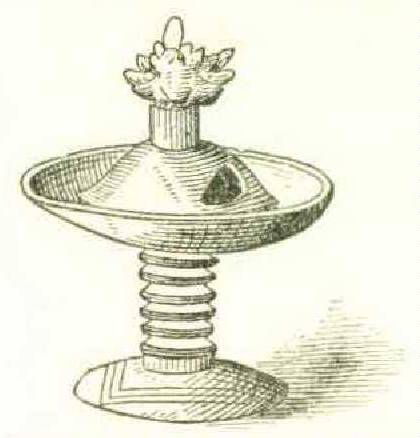
The artificial light of Africa and the tropics generally is a torch; the Burmans use petroleum. They have but little use for anything beside the bonfire to illuminate their night concerts. Wassan on the Gold Coast, however, showed a small black earthenware lamp, rather superior in its shape to most of its surroundings. It is six inches in height, and has a dome-shaped chamber and dish. The former has a hole fur the palm oil and a smaller one for the wick. The clay Exhibit. is heavy and micaceous. Greek and Etruscan domestic and votive lamps, oc what may In: somewhat disrespectfully called the butterboat pattern, were among the few archaic remains exhibited. The classic form seems to have been wide-spread, in ancient Egypt, Etruria, and Rome. Dr. Schliemann found the same in the excavations of Hissarlik. An ancient Egyptian wick - cutter is in the British Museum. The rudest lamp, too crude to be worth presenting, probably, may be found in a pan or Calabash of oil or grease, with a wick over the side or supported by a piece or two of stone to prevent burning the dish, if it be of wood. Such were common in Western cabins within the memory of some of the present generation.
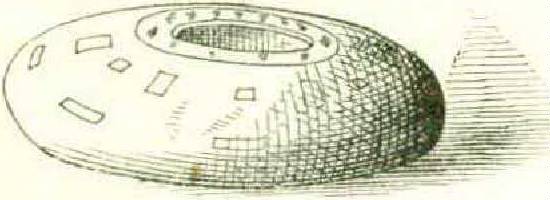
A spittoon was exhibited from Hawaii. It is a carefully turned oblate vessel of wood, inlaid with pieces of human bone.
Sandals and Shoes. Our scheme is not intended to include costume, but there is one subject, that of foot-gear, which may profitably occupy a page or two. Africa, which has furnished so much in every other department of our subject, fails us here: Africa, speaking generally, goes barefoot.
The crudest, forms of foot-gear at the Centennial Exhibition were the sandals of the Spanish peasants. These carry us back at one leap to the times when Pliny wrote and described the customs and products of the Peninsula. Figures 336 and 337 show three specimens from the Spanish exhibit in the Main Building. Figure 336 is a sandal with plaited grass sole and linen counter and toe. The loops for the instep band are on the counter, but the strap was not in place, and we do not make additions. Figure 337: a has counter, toe, and tie of plaited grass, cords and sole of the same material; b, plaited grass soles, a counter of plaited grass with leather straps, and sides of plaited strips of black cloth.
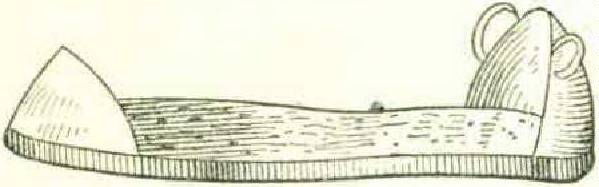
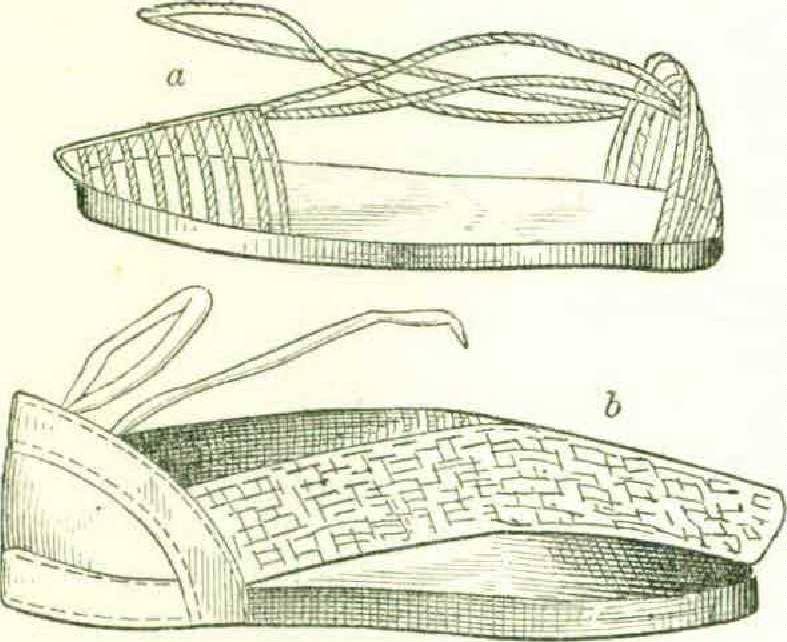
The Roman peasants had sandals (baxa) of plaited willows or rushes; in fact, the common sandals or slippers of the countries bordering on the Mediterranean were of rushes, grass, spartium, or papyrus, according to the prevalence of the different vegetable products. The plaited birch-bark slippers of the Russian peasants were shown in the Agricultural Building.
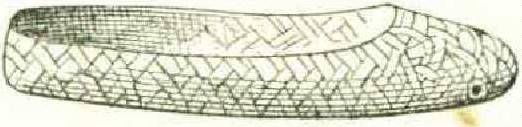
Passing from articles of grass or bark to those of wood and leather, we find the old Roman sandal of the commonest kind (solea), a simple sole of wood with an instep strap, and the sculponea, or sole and thongs of the Roman serf; one form of cothurnus had a sole several inches thick, and was worn by tragic actors to increase their stature. The fulmenta was a threefold sole of cork. In so simple a matter it is not surprising to find the old forms still existing in rude communities. Figure 339 is a sandal of the Gold Coast of Africa, intended for a person of consequence. It has six thicknesses of hide for the sole, sewed through and through with leathern strips. It has an instep strap showily ornamented with metal and beads, and held down in front by a thong which passes between the big toe and the next one.
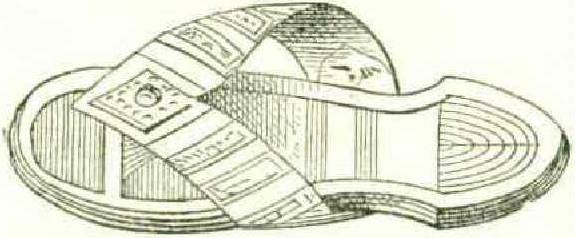
The Hottentot wears a sandal consisting of a sole of leather larger than the. foot and fastened on with thongs which pass around the instep and over and forward between the toes. The sandal of the Malagasy is of raw ox-hide with the hair on. The natives did not understand tanning until it was taught them by the English.
The Apache Indians wear long boots of deer-skin, with stout soles turned up at the toes, the upper ends of the boots being fastened by straps from the loins or turned over the knee; good in a cactus country.
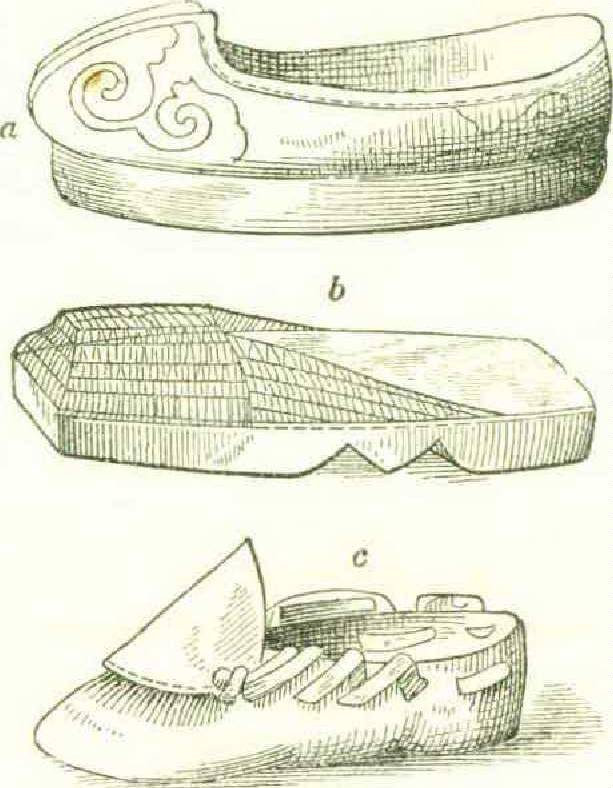
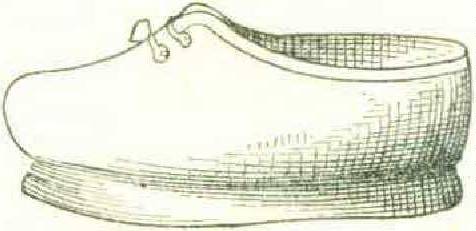
The Chinese have the merit of introducing a new material, — paper. Their shoes have thick paper soles, and are comfortable, though a graceful gait seems to be impossible with such an unbending pad on one’s feet. Figure 340 shows three kinds of shoes exhibited in the Mineral Annex to the Main Building: a is of sheep-skin lined with felt, and with an outer ornamentation of green morocco; the principal thickness of the sole is of layers of paper, with a leathern bottom; b has a thick wooden sole and a pocket for the foot made of twine of cocoa-nut. husk (coir); c. is a raw-hide moccasin without a sole. In front, the leather is gathered as in the American moccasin. The hide is of the natural color. Figure 341 is a shoe of a very thick gray felt, with soles of twelve thicknesses of the same. The Chinese exhibit showed also high boots of various kinds, materials, and patterns; some with high iron studs on the soles.
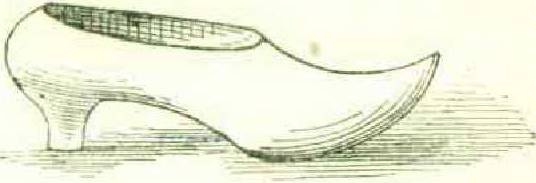
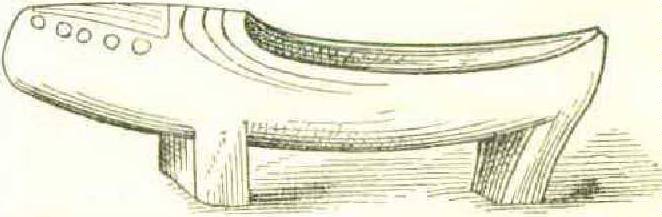
French sabots were not noticed, although for some purposes they are so popular and well fitted; it is a mistake to suppose that they are only common and coarse foot-gear for the peasantry. Spain showed sabots from the Peninsula, and also from her colonies in the Philippine Islands. Figure 342 is a sabot of white wood, probably willow or poplar. The sabot of the Philippines is made of wood, but not from the lack of materials for the usual substitutes in a warm country. The sabot is neatly made, pointed at the toe, and ornamented with carved stripes gayly painted. The wood resembles beech, a very common wood in France, the home of the sabot; it is, however, hut a resemblance. The sabot lias two supports beneath, like the clogs of Turkey which the ladies use in sauntering around the wet iloors of their luxurious baths. The clog and patten with wooden soles are found here and there in Europe and Asia; the patten of the Muscat women has no thong, but is held to the foot by a small peg which stands between the great toe and the next-
Passing from the tropics to the subaretics, from the Philippines to Canada, we find the snow-shoe,— a marvel of lightness and strength. Snow-shoes are not made upon an unvarying plan, but a typical one in the Canadian exhibit is shown in Figure 344. This is three and a half feet long and one foot, wide. The frame is of black ash, and the netting is of twisted deer-sinews laid in throe directions, so as to make a hexagonal mesh of great neatness. The frame has two cross-bars, beneath the forward one of which the toe of the boot is inserted; a buck-skin strap goes over the instep. In walking, the shoe is not raised altogether, but the front end being lifted a little the shoe is dragged over the surface of the snow. Another form has two points and a square opening, which is edged by heavy thongs. The toe of the boot is placed through this, the heel resting on the parallel thongs just behind it, the hollow of the foot resting on the edge thong (binnikibison on which the foot rocks freely. A strap over the instep serves to pull the shoe along, while a strap behind it prevents the foot pulling out backward.

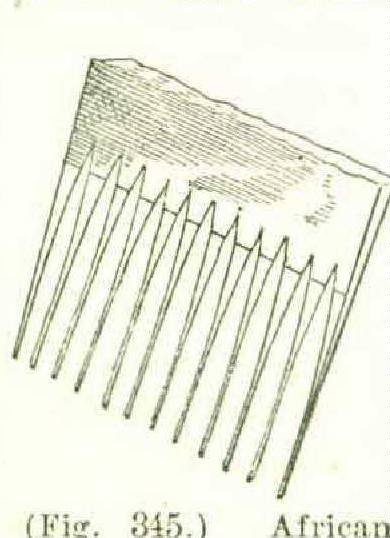
Toilette. We are fortunate in being able to show some combs and a brush of the rudest description. We may begin with Africa, although, indeed, the African specimen is the best of the lot. Figure 345 is a comb of the Gold Coast made of a heavy brown wood, probably rose-wood. The length is five inches. Egyptian combs of the olden time are to be seen in the museums, the toilette being very carefully performed by that cleanly people ; they were accustomed also to wear wigs elaborately plaited and adorned, and even false boards were not unknown. The Persians, too, at a later period, adopted this artificial coiffure. The ringleted heads of hair and beards of the Assyrians suggest the same. Astyages, according to Xenophon (Cyrop. i. 3), had his eyes and face painted, and wore false hair. The. Romans had their combs of box-wool, fine-toothed (demo dente) and large-toothed (rarus pecten). Wigs are yet known in Africa. Sandia, a chief of the Zambesi, wears a wig made of ife fibre (sanseviera) dyed black and of a fine, glossy appearance. The plant ife is allied to the aloe.
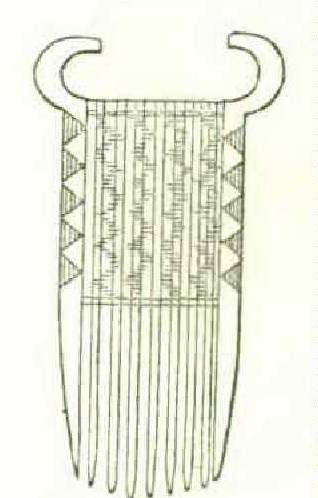
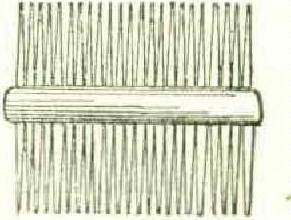
The New Zealand exhibit showed two Maori combs. Figure 346 is called a Karan, and has a single row of teeth. The comb Figure 347 is made of wooden splints with slats lashed across them at mid-length.
The Fijians make combs somewhat like Figure 346. The official insignia of their priests is an oval frontlet of scarlet feathers, and a long-toothed comb made of a number of strips fastened together. These islanders practice most elaborate head - dressing, securing the coiffure with tortoise-shell pins eighteen inches long. They also make immense wigs; red and white being the favorite colors. Some wigs have whiskers and mustache attached. The Samoans let their hair (Fig. Stfi.) Maogrow to large dimensions, ri Comb. New " . Zealand Eslubtll0n remove to it. make wigs, which are stained red and frizzed to an enormous size, and crowned with feathers.
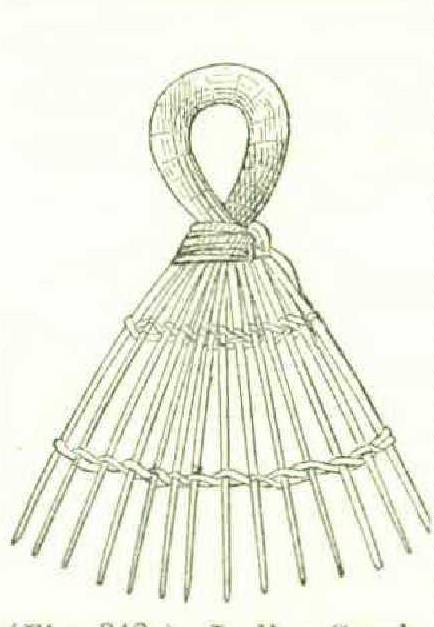
Coming to America we find a comb made of bent maple-wood sticks (Figure 348) hound together at the handle with dressed skin, spread out fan-like, and wattled. Figure 349 is a dolphin’s, jaw comb of the JMMakah ri Comb. New Indians of the Northwest Zealand Exiiibeoast. The poor Fuegian ltof the extreme south uses the same kind of a comb, but not to any great extent. He has more use for head seratchers (Figures 351,352). At a point say about midway between the Makalis and the Fuegians arc found theUaupds of the Amazon. The Uaupe comb is made of palmwood, and ornamented with feathers. The women, of the tribe go entirely naked, and wear few ornaments. The men part the hair carefully, comb it to each side, tie it in a queue behind, and stick the comb on top of the head. They also wear necklaces, and extirpate the beard.

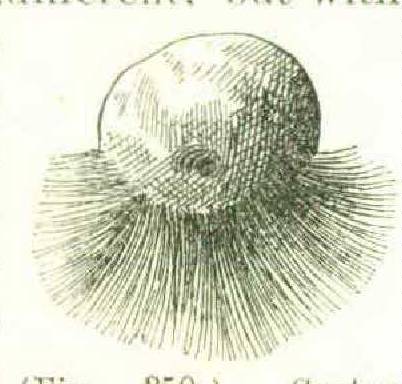
The Exhibition showed a multitude of brushes, (rood and indifferent, but with one exception of the ordinary type. The exception was one from Arizona, made by the Indians of the spinous fruit of a species of cactus, a portion of the spines being removed to permit handling. After this, a chestnut bur. The native brushes of Mexico and New Mexico are bunches of agave fibre or wire-grass. The Roman brushes — not for toilette, however—were bunches of twigs (scopæ) like ihe European birch broom; a smaller one for the hand (scopula) was of line twigs or myrtle, a whisk, in factScldicimmn found a brush-handle thirty-two feet below the surface, in the excavations of Hissarlik; so the brush made with tofts set in a handle is not. a thing of yesterday.
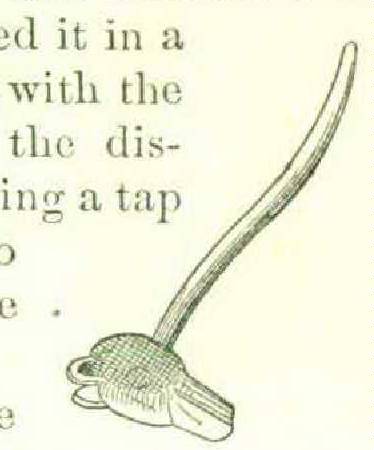
Elaborate or even merely large beads of hair, when the habits are none of the most tidy, involve consequences with which such crude cotnhs and brushes are incompetent to deal. So ingenuity lias been displayed in making head seratchers, capable of penetrating to the seat of disturbance without materially disarranging the head-gear. Figure 351 shows two head scratchers oT walrus ivory obtained from Indians of ihe Northwest coast. They are provided with eyes for suspending, and might have been taken for needles. Figure 352 is an iron head scratoher from the Northwest coast. Jt is made from a bolt, probably picked up on the shore, and carefully shaped into the semblance of a wolf’s head by means of stone implements; a work requiring considerable patience. The legend that comes with this instrument is that the proprietor used it in a double way: searching with the point for the seat of the disturbance and, then giving a tap with the wolf’s nose to execute or disperse the rioters.
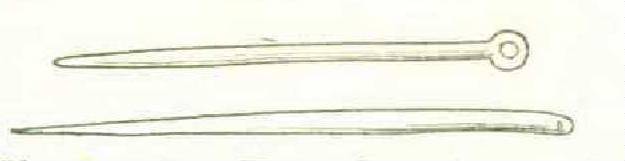
Of the razors of the uncivilized world the Exhibition showed us little: tweezers for extirpating, pumice-stone tor removing; sharp stones or pieces of metal, the latter being a razor proper, however crudely made. The Andamaner uses a piece of the white man’s glass when he can pick it up, the island being now a convict station: in default of that he uses a sharpened shell.
The mirror of the Fijian dandy is a hole chopped in the upper side of a slanting tree, the leaves so arranged that the water drips into it and keeps it full.
The strigil, so commonly used by the Greek athlete and in the Roman baths, is in use among the Kafirs, who are both male and female, most sedulous in greasing their persons and careful in regard to the shine and suppleness of their skins. Their strigils (lebeko) are of bone, wood, ivory, or metal, with a curved edge like a narrow spoon.
The Japanese toilette, appliances include tweezers, brushes, combs, hairnet, cosmetic brushes,, hair-pins, etc. The hair-net of the Australian native is of tendons from the tail of the kangaroo.
The Antis of the Bolivian Alps have a wonderful toilette case: a bag, slung on the shoulder, containing a comb made of the thorns of the Chontci palm; a paint (rocon) for his cheeks; a gemma apple to color his Limbs; a ball of thread ; a bit of wax; two muscle shells to form tweezers for eradicating face hairs; a snail shell doing duty as a snuff-box; a benttube snuff-taker; and any small trifle he may pick up.
We dare not trust ourselves upon the voluminous subject of savage ornament, but may give a few specimens from countries which have already contributed to our collection. Figure 353 is a Hawaiian necklace (Niho palaoa), consisting of a bunch of human - hair braid, with an ivory, hook-shaped, pendent ornament. Figure 354 is an ear pendant made of a shark’s tooth and held to possess great virtue in New Zealand.
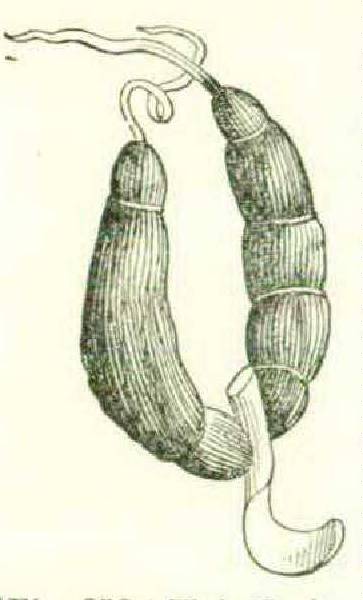
Figure 355 shows the divining bones of a Kafir witch-doctor,Umlambo, who had great influence with his tribe. The pieces of the necklace are the carpal bones of baboons. Among the Zulu Kafirs a necklace of human finger bones has been noticed.
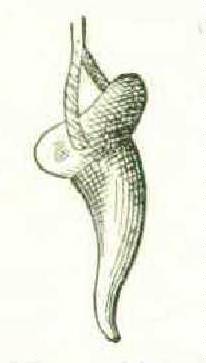
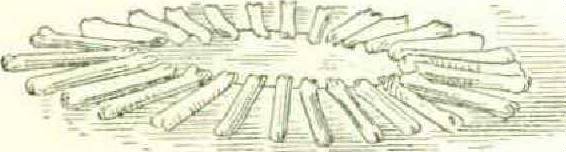
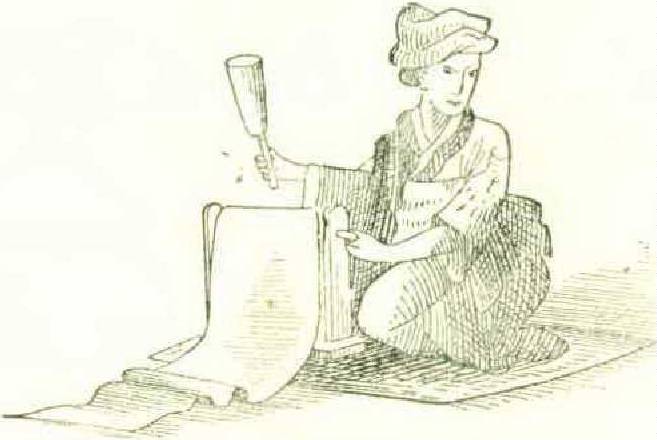
As washing is less important than ornament among savages, we have safely deferred till now a few illustrations, furnished in the Japanese Exhibit, of modes of washing common in the East Indies and Southern Asia generally. The description of the Singhalese by a prisoner in Ceylon, two centuries since, is that “ they use Lye in their washing, setting a Pot over the Fire holding seven or eight Gallons of Water, and lay the foul Cloths on the top; and the steam of the water goes into the Cloths and scalds them. Then they take them and carry them to a River side, and, instead of rubbing them with their hands, slap them against the Rock, and then they become very clean; nor doth this tear the cloths at all as they order it.” The Japanese showed two methods: by mallet and block, and by pestle and mortar. Figures 356 and 357 will be readily understood without a long description. They may also have the Indian Dhobee plan of slapping them on a stone whose flat top is just beneath the surface of the water. The Malagasy method is the same as Figure 356.
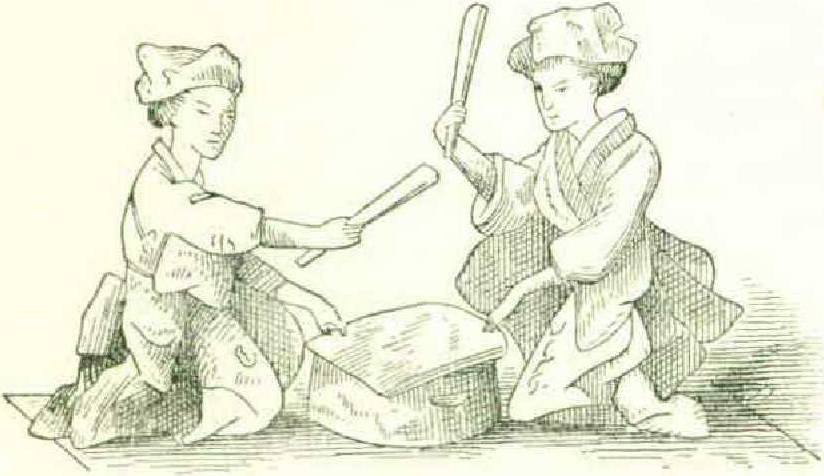
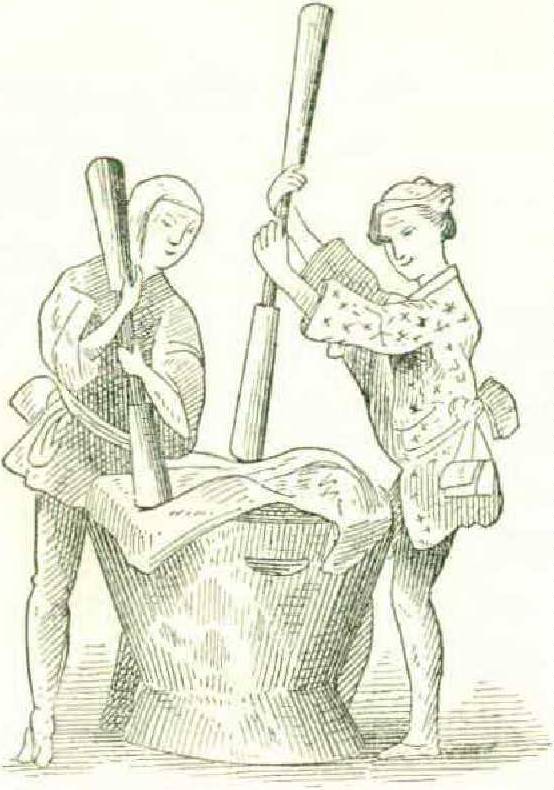
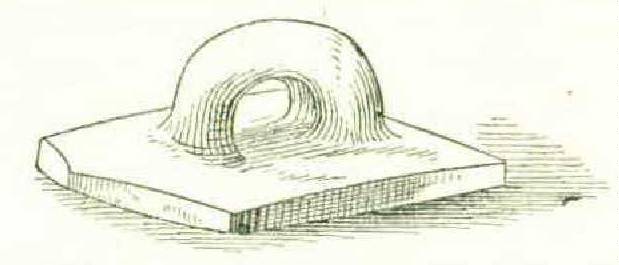
After washing comes ironing, which is done with stone in Peru, with copper in China, and with wood in Japan. Figure 358 is a small smoothing stone from Peru; it is five inches long. The Chinese use a smoothing tool of copper, made hollow and filled with hot embers. The Japanese method is more like mangling or calendering. The fabric is run over a roller and beaten with a mallet. A similar method is adopted in China.
The umbrella, so recent in Europe, is old in Asia especially; in Africa its place was taken in early Egyptian times by a sort of feather brush, which may have operated as a sun-shade, fan, and flybrush. The suggestion of an umbrella is natural enough, the umbrageous leaves of the tropics furnishing them ready to hand. There are also examples which might provoke imitation, the umbrella bird of Brazil, and the nshiego mbottve', an ape of the Gaboon River, in Africa: the former has a dome-shaped crest of feathers, and the latter constructs a roof of leaves over his seat in the tree where he roosts at night,
A captured sailor who lived nearly twenty years in Ceylon two centuries since writes of the natural umbrella in that isle on which the winds are said to “ blow soft: ” “ The Talepol leaves are of great use and benefit to this people, one single Leaf being so broad and large that it will cover some fifteen or twenty men and keep them dry when it rains. The leaf being dryed is very strong, and limber and most wonderfully made for men’s Convenience to carry along with them; for tho this leaf be thus broad when it is open, yet it will close like a Ladies Pan, and then it is no bigger than a man’s arm. It is wonderfully light; they cut them into pieces and carry them in their hands. The whole leaf spread is round almost like a Circle, hut being cut into pieces for use are near like unto a Triangle : they lay them upon their heads as they travel, with the peaked end foremost, which is convenient to make their way through the Boughs and Thickets. When the Sun is vehement hot they use them to shade themselves from the heat. Souldiers all carry them; for beside the benefit of keeping them dry in ease it rain upon the march, these leaves make their Tents to ly under in the Night. A Marvelous Mercy which Almighty God hath bestowed upon this poor and naked People in this Rainy Country.”
The umbrella of Timor is an entire fan-shaped palm leaf, stitched at the fold of each leaflet to prevent splitting. This is opened out and livid sloping over the head, inclining backward in a shower. Many of such obA jects from Java, the Philippines, Trinidad, and other tropical countries were laid on or under benches or against the walls, and were passed unsuspected by casual visitors. In very few eases were attendants ready or able to explain what they had in charge, but the facility for handling was unexpectedly great, and it is a wonder that no more damage was done.
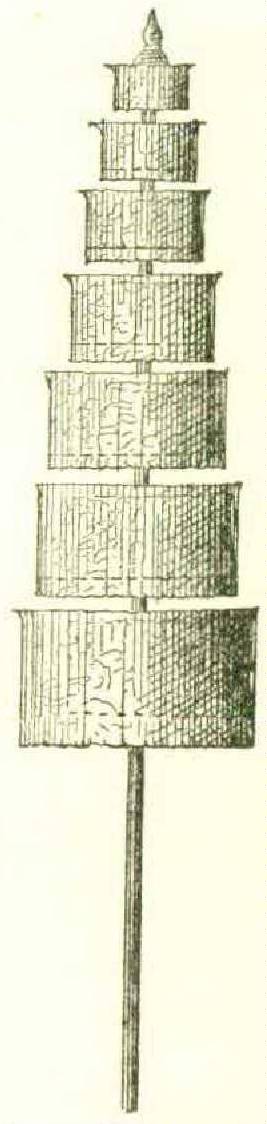
The antiquity of the umbrella in India and elsewhere, and also its regal character, may be gathered from the facts that Vishnu in his fifth incarnation is fabled to have descended (rig. SBO.J ad infernos with an umbrella in his hand, and that the basso-rilievos represent Dionysius (Bacchus) beariking an umbrella when he descends into Hades. The term satrap is said to he derived from ClThatra-pnit (lord of the umbrella), a title of the Mahratta princes of Poonah. A mushroom - shaped umbrella (chatta') is shown on the Buddhist tope Saclii, at Bhilsa in Central India. It is not necessary to insist upon the statement in the Singhalese book Janaeharita, written in Pali, that the umbrella held by Sahampati over Bodisatwayo was forty miles broad.
Edward H. Knight.