The Battles About Atlanta
I.
I. THE AFFAIR OF SYMRNA CAMPGROUND.
IT is difficult to answer the question often asked, “ When did the battle of Atlanta begin ? ”
One could commence an account very properly with Sherman’s spring campaign of 1864, starting with the movements about the first of May; but it is better, perhaps, to skip the battles and combats for sixty days — which include Dalton, Resaca, Adairsville, Kingston, Cassville, Dallas, New Hope Church, Pickett’s Mill, Muddy Creek, Pine Top, and Kenesaw Mountain, wherein we burrowed and flanked, and flanked and burrowed in front of the retreating Johnston till he was ready to cross the Chattahoochee, six miles from Atlanta — and come at once to the several actions which more immediately resulted in driving Johnston’s successor, the famous Hood, from the stronghold of Atlanta.
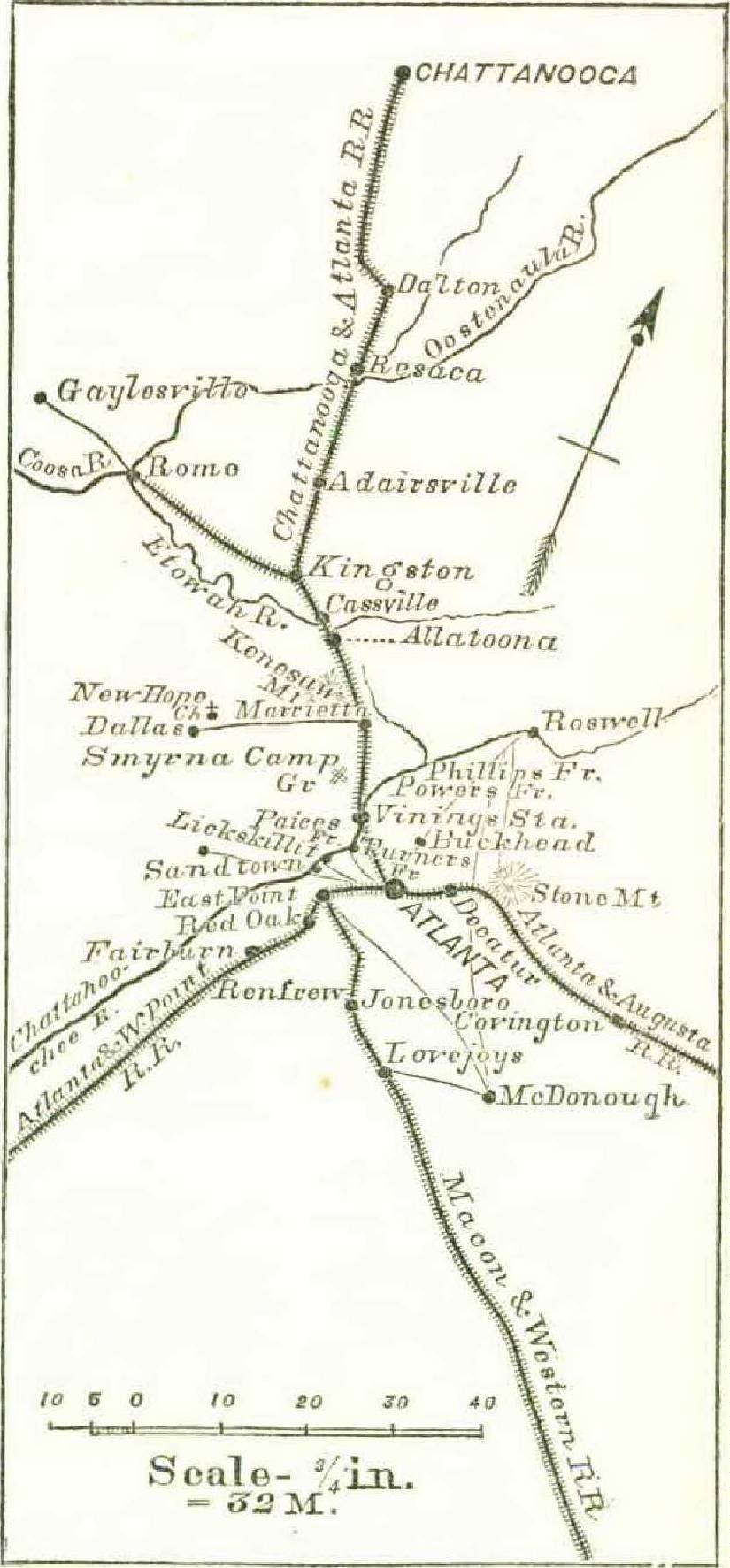
Pursuing the latter course we take the reader to a place called Smyrna CampGround, some six or seven miles above the Atlanta crossing of the Chattahoochee. It was a bright morning, the 4th of July, one year from the close of the battle of Gettysburg, and the anniversary of Pemberton’s surrender of Vicksburg.
Copyright, H O. HOUGHTON & Co. 1876.
(Many of the participators in these battles were standing there side by side.) Generals Sherman and Thomas had encamped with their head-quarters in rear of the fourth corps, which I was at the time commanding. I had stepped over to the front of General Thomas’s tent, and met himself, General Sherman, and several other officers. I was not yet sure just how we were to celebrate the day. Sherman and Thomas seemed to have been having a discussion concerning the situation of affairs. On my arrival the former, turning to me, said, “ Howard, what are you waiting for? Why don’t you go ahead? ”
I replied, “ The enemy is strongly intrenched yonder in the edge of the thick wood; we have come upon his skirmishline.”
“ Oh, nonsense, Howard; he is laughing at you. You ought to move straight ahead. Johnston’s main force must be across the river.”
To this I answered, “ You shall see, general.” Immediately ! directed General Stanley, who commanded a division and was present, to double his skirmishers and move briskly forward, with a view to develop the enemy’s force, and with instructions to assault and carry the skirmish - line of the enemy. The enemy’s outer line, sometimes denominated skirmish and sometimes picket line, was unusually strong, having short, deep trenches, with twenty or more men in each, distributed along the front in places not more than twenty or thirty yards asunder. There was an open grove of shade-trees near us, but between this grove and the enemy’s position lay quite a large open field. Generals Wood and Newton, commanding the other divisions of my corps, were ordered to move their skirmishers in conjunction with Stanley and on his right and left. All was in readiness by eleven A. M.
General Sherman, with an amused and doubtful expression of countenance, repaired with me to the shade - trees. Quickly, at a signal, the men sprang up and crossed that open field at a run. Instantly the hitherto silent Confederates opened their batteries and musketry along the concealed lines, but our men were too quick, and the skirmish trenches were captured and many prisoners taken in them; first on Stanley’s front, then on Newton’s, and then on Wood’s. Our main forces moved up and held the position gained, within short musket-range. This kind of work had been the share of the fourth corps in many an encounter during the past two months, that is, to seize the enemy’s skirmish-lines, extend the rifle-pits, put the batteries under cover at night on or near the line, and then to keep blazing away, actually for the purpose of holding a strong hostile body of men in front of us, thus facilitating Sherman’s flanking operations.
The cannonade in this action was perfectly furious for a time; and the worst, most exposed place on our front was our grove of shade-trees. The general said, as the shot and shell crashed through the trees, that he was satisfied; so then we speedily moved to a safer place of observation.
Those hidden trenches in our front were a kind of outpost to Johnston’s main works, which covered the Atlanta bridge. Referring to the latter, General Sherman remarks in his Memoirs: “ I confess I had not learned beforehand of the existence of this strong place, in the nature of a tête-du-pont, and had counted on striking him [Johnston] an effectual blow in the expected confusion of his crossing the Chattahoochee, a broad and deep river then to his rear.” While General Thomas with the fourth, fourteenth, and twentieth corps was pushing square against these most formidable works, which had been previously constructed by a large force of slaves, General Schofield, with the army of the Ohio, was on his right, and General McPherson, with the army of the Tennessee, was still further beyond and below, opposite Turner’s Ferry. Our lines were also extended in that direction for miles by the cavalry of General Stoneman. Garrard, with a division of cavalry, had been sent northward to cross the Chattahoochee at Roswell’s factory. Our antagonist perceived that both his flanks were virtually turned, and though he could still occupy his magnificent bridge-head and outworks, and make a strong fight against any direct attack, he knew this would be useless, for it would endanger his depots and lines of communication. At last he would have to leave them. My field notes of the 5th say concerning the force in my front: “ During the night the enemy again retreated.” We pressed hard upon his rear guard the next morning, and followed it as far as Vining Station and Paice’s Ferry near that point. This was the place where my chief of staff, Colonel Frank T. Sherman, to his great chagrin, was captured. While reconnoitring he had passed through a gap between my corps and the next on my right, not being aware of the exposure till startled by the enemy’s call upon him to surrender. It was said that for some time the rumor was current in the Confederate camp that our commanderin - chief had been captured. Colonel Sherman, a prompt, bright, hearty man, had been of great assistance to me, and I missed his aid and companionship very much during my remaining connection with the fourth corps. One is never quite reconciled to loss by a capture that could so easily have been prevented.
II. PEACHTREE CREEK: PRELIMINARIES : BATTLE.
It is a little hard to cross a broad river without bridges and with a swift current at any time, but of course very difficult with an enterprising enemy on the adverse bank. General Schofield was moved up to the neighborhood of Power’s Ferry, and I followed in support, sending one division, Newton’s, with Garrard’s cavalry, to secure the crossing at Roswell’s. The remainder of the army made demonstrations and trials of crossing at Paice’s Ferry, pressed against Johnston’s bridge-head, or were put in motion below the Atlanta bridge. The plan, apparently otherwise to Johnston, really was to move the left of the army over first. There was little or no trouble at Roswell’s, and none where we were, at Power’s. As soon as the upper force was well over the river, it moved southward in support of the troops who were next to cross. I sent General T. J. Wood with his division, on the 17th of the month, to sweep along the eastern bank and uncover Paice’s Ferry, so that a bridge might be put across at that point. General Wood always delighted in duty, and enjoyed being trusted with anything that would try his skill or enterprise. Wood’s movement was an important and a delicate one. This was owing to the rugged nature of the country, the want of roads, and the proximity of the enemy’s masses to Paice’s Ferry. It was satisfactorily executed, and without bringing on an engagement. McPherson now, moving from our right to the left, crossed his main force at Roswell’s; Schofield, at the mouth of Soap Creek, above Power’s Ferry; and Thomas, at Power’s and Paice’s ferries. It was on the night of the 16th that Johnston withdrew his last troops from his bridge-head to Atlanta. Therefore our forward movement began in good earnest on the 17th, and continued during the 18th and 19th. Sherman calls this march " a general right wheel ” toward Atlanta. Of course, belonging to Thomas’s command, I moved near the centre, that is, along the Buckhead and Atlanta road, encountering the usual cavalry opposition, road obstructions, and burning of creek bridges. The 18th of July, the day that Joe Johnston was relieved from the command of the Confederates, my column reached Buckhead. The next day, by getting an early start, we had struck the crossing of Peachtree Creek (a stream that has now become of historic importance) before seven A. M., and found some sort of works, logs and trenches, on the other side, with an enemy behind them. Wood’s division touched the creek on the Buckhead road, Stanley’s on the Decatur, and Newton’s between the two. General Thomas now ordered me to cross this creek. Wood, by my direction, crossed, turned the small bridge-head, put the enemy to flight, and held the other bank, supported by Newton. Stanley repaired a bridge which he had partially saved from the flames, and secured his crossing in the usual way, that is, by temporary barricades and embankments constructed a hundred yards in advance of the bridge. All these operations required severe skirmishing; but they are reckoned the preliminaries of a battle.
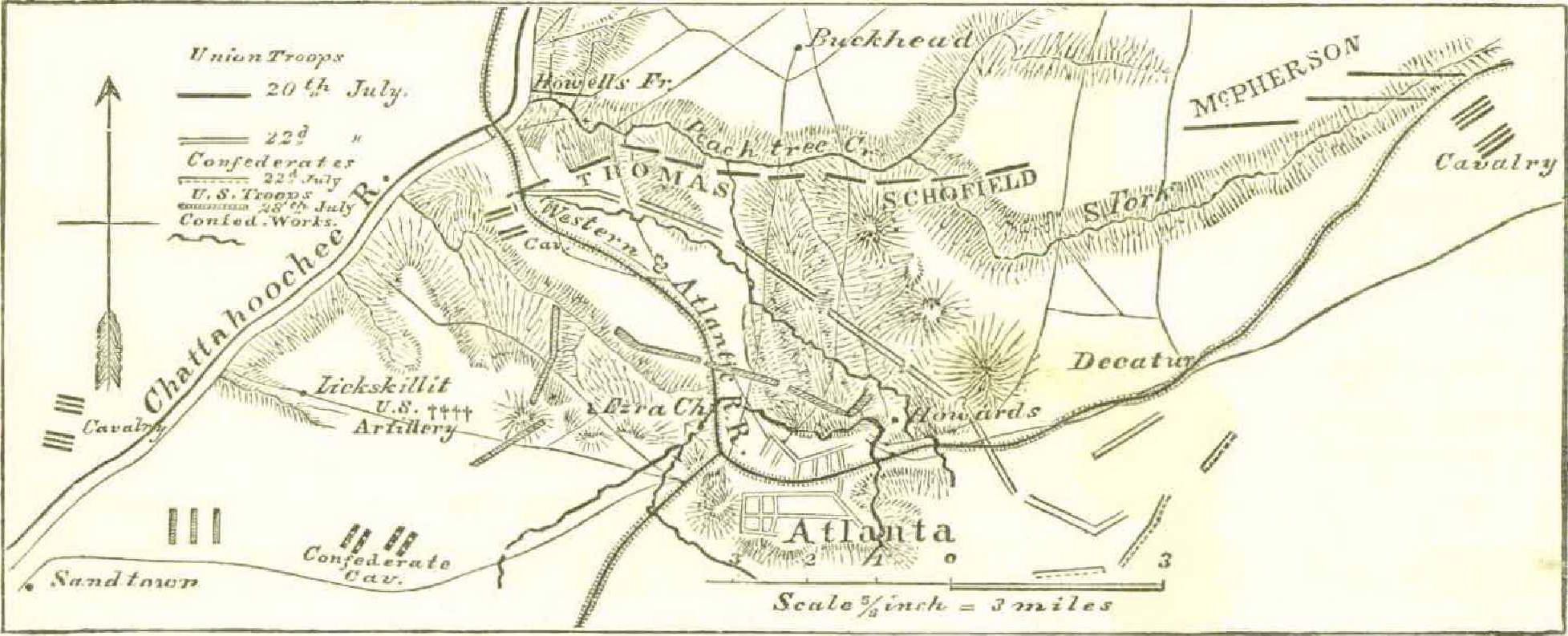
As there appeared to be some conflict in my orders received during the night, I visited General Thomas’s head-quarters at daylight of the 20th. The general then instructed me to push one division forward on the direct Atlanta road, and to move the other two off to the left to the support of General Schofield’s right flank. These instructions, which came from Sherman, now moving in person with Schofield, indicated to us his belief that 1 lood would give battle to his (Sherman’s) left. In fact, the obstinacy of the cavalry in our front and the skirmish and outpost resistance in this quarter were of the sort to lead to such a surmise. Moreover, it would seem Hood’s natural plan to assail the left with vigor in order to save his communications toward Augusta and Savannah, which were already half in McPherson’s possession. I chose Newton’s division for the direct road and work, and the other two, Stanley’s and Wood’s, for the movement to the left. After giving general instructions to General Newton, I was obliged to leave him to cooperate with Hooker’s corps on his immediate right. If the exigencies of the day should require it, he was to go directly to General Thomas for more specific orders. I then accompanied the two divisions. Schofield was on a road a mile distant. As we moved in conjunction with his command, the gap was made wider. When we had reached the enemy in force in our front, there was a break in my line between Wood and Newton of at least two miles. McPherson, it will be remembered, was still further to the left, moving toward Stone Mountain.
Notice now, in brief recapitulation, the general position of Sherman’s troops on the morning of the 20th of July, while moving and just before the battle. They were mostly on the south bank of Peachtree Creek, that is, for troops below the fork of that creek, and on the south bank of the south fork for troops above that point. Palmer’s fourteenth corps, made up of Baird’s, Davis’s, and Johnson’s divisions, were on the right (northwest of the town), near the Atlanta and Chattanooga railroad. Hooker’s corps came next: Williams’s, Geary’s, and Ward’s divisions in order. Then Newton’s of my corps; then a gap of two miles; then Wood’s and Stanley’s. Schofield was next, and McPherson occupied the left, having already reached the Atlanta and Augusta railway. Our cavalry was just then on the extreme flanks, Garrard’s division near McPherson, and the rest beyond the right of the general line.
I did not know till after the war that Joe Johnston, as he was familiarly called, had himself planned the attack, the account of which I am about to relate. I have said that Hood had been put into Johnston’s place. It was done after Jeff Davis’s well-known visit to Atlanta, and was without doubt an expression of his dissatisfaction with the constant retrograde movements of Johnston. The change took place on the 18th, two days before. Hood was well known to McPherson, Schofield, and myself, as we had been cadets with him at West Point. He always had a firm, resolute appearance, rather enjoyed a fight even while a cadet, and was not remarkable for flexibility of mind. He showed no indications of superior genius, but had an honest, manly way with him. Such recollections as these made us anticipate what occurred, that is, hard knocks often repeated as long as he had breath enough left in him to give them. General Sherman speaks of Schofield’s estimate of Hood. I remember that he had mine also, hut I am inclined to think that Sherman anticipated more wariness on Hood’s part, and more manœuvring before battle, than the other generals did. Sherman was hardly ready for a general engagement at Peachtree Creek. Could Hood, like Johnston, have seen straight through hills, knolls, woods, and trackless wilds thickly set with underbrush, and have ascertained just how we were situated, he would have thrown a heavy column into the wide gap between Newton and Wood and put our right into a bad box, leaving the rest well outside of the box. Of course his success would not have been sure (nothing is sure in war), for our heavy left, consisting of two armies and part of another, might have swung around, still turning on Sherman’s “general wheel,” and thus cut off Hood from his moiety in the Atlanta works; so that while he was fighting Thomas desperately (for Thomas never gives up, he always fights desperately, as at the almost hopeless Chickamauga), the rest of us would have been manning the captured trenches at Atlanta. His success would not have been sure, because Thomas was indomitable and Sherman clear-headed and full of expedients, but the issue would have been more problematical.
Atlanta being a city of considerable size, no one is likely to have, before visiting it, a conception of the rough character of the approaches to it. There are no plains about it. The country is rolling and thickly wooded. The undergrowth is dense, with a few openings for cultivation. The creeks cut deep and run crooked. It is just the country to bring on a rough-and-tumble fight between hostile forces, where neither commander can anticipate precisely the place or the time of the conflict.
General John Newton, an engineer officer of mark, had always a vivid knowledge of the possible and probable approaches of an enemy near him, and could not well be surprised. Notwithstanding his orders to advance toward Atlanta, he did not start from the creek till his bridges were well built, nor till Ward of Hooker’s corps had come in sight with his division, to occupy a ridge on the right and close at hand. About one o’clock Newton began his movement, skirmishers in front, to the top of a ridge. Enemy’s skirmishers fall back without much resistance at first, but increase their fire and stubbornness as he advances, showing the presence of a large support behind them. Newton deploys two brigades to the right and left at right angles to the road, moves the third along the road in columns of fours for support, and places a battery of four guns between his two front brigades. This formation, in the shape of the letter T, proved a most fortunate one, as we shall see. Newton’s men covered their front rapidly with rough rail barricades, loose soil being thrown over them.
Hood’s or Johnston’s plan of attack was substantially as follows: to concentrate his strongest column opposite our right flank; to make a lively demonstration in front of Schofield, that is, against our centre (where Sherman was in person) ; also to keep McPherson occupied, at Least with cavalry; all except the attacking force to retire gracefully and seductively till Thomas should be moving into the prepared ground south of the Peachtree Creek; then to deliver battle against Thomas with suddenness and fury.
Hood’s advance extended from and beyond Newton’s left far over to the right, covering one brigade of Palmer, a distance, probably, of little more than a mile. The ground near Newton and Ward was quite open. Geary’s right and Williams’s left, beyond Ward in lower ground, were in thickets and woods. I suspect Hood’s starting was simultaneous throughout his front, though Geary and Newton appear to have been first reached. Newton’s men had hardly placed their piles of rails, and were still carrying fresh supplies while their comrades were covering those in place with earth from the inside, and a new line of skirmishers pushing out from them was creeping cautiously forward, when, of a sudden, the shrill Confederate cry from a host of voices pitched on the highest key rang along the whole front; a fearful yell, not easily described, but once heard never to be forgotten! On the enemies come, in masses rather than lines. They are close upon our men before they are seen. Our skirmishers fire and fall back, coming slowly within the rail piles. Every man gets ready at once. Our ranks are thin, theirs are thick, firm, and rapid. The three minutes before battle are the most trying to men situated as ours are, but they do not move. When all are in line and the battery ready between the brigades, Newton’s words are given, repeated by his officers: “ Commence firing. Fire steady and low.” Instantly the furious rattle and booming begin. And fire draws fire. At first there is little apparent impression. The enemy keeps firing and advancing, with waving banners. Blake’s and Kimball’s brigades on the front are now hard at work. Our men are partially covered. Walker’s Confederates confronting them are not. They fall rapidly; his lines begin to waver, his men hesitate and seek cover. At the same moment another Confederate division turns the flank in the big gap which I have mentioned, and starts for the bridges in Newton’s rear. Bradley’s brigade (Newton’s reserve support) faces this new danger and pours in its fire. Newton has some eight or ten big guns in reserve, two good batteries, and what is more they are just where they are needed. Colonel Goodspeed, the artillery chief, sent them across the bridge on the main road, ready for action south of the creek. These, using canister, are leveled upon the enemy’s flanking division, and as the swift Confederates advance toward the creek they are cut down like grain before the mowers. This battling is carried on under the eye of General Thomas, and probably by his immediate orders, for he is sure to be at the most threatened point at the right time. The enemy approach within one hundred yards of these guns, but no column of men can live to traverse the remaining distance. The hail and smoke increase, confusion begins in front, then a staggering, waving motion, then there is a general break for the rear, seen as the smoke is lifting; then for a time it is like the lull in a storm, firing almost ceasing on both sides. Later, one more attempt is made to turn this flank, but General Thomas has brought up an additional battery and so placed it as to break this advance more quickly than the previous one. Meanwhile Newton’s right as well as his left, so great is the attacking force, is at first completely turned, causing his right brigade to change front toward the west; but quite promptly, just in the nick of time, Ward’s division of the twentieth corps appears on the scene.
You have doubtless often stood on an irregular seashore where there are projecting points of land, rocks of different sizes, and inlets with abrupt banks. You have watched the incoming waters, wave following wave, breaking at the points, thrown into confusion at the rocks, and yet sweeping with inherent momentum within the inlet, to be thrown back by the inflexible banks. So shaped was General Hooker’s front, and so like waves came on Hood’s men, and so did they break against Newton and Geary in the outer front, while masses in ravines and intervals found inlets to surge into, till met and thrown back by Ward, Williams, and R. W. Johnson. All this chafing and surging that was not concealed by the forest and thickets and knolls. General Thomas could see from his post of observation near the creek.
Endeavoring to secure a closer cooperation, at two P. M. Ward’s lines had reached the base of the ridge that Newton, as we have seen, was already fortifying. His (Ward’s) skirmishers were already nearing the crest, when the same Confederate battle cry. fearful and shrill, was heard, and the enemy’s regiments, with their glistening guns and restless flags, rolled out of the opposite wood, three or four hundred paces off. This time the brave skirmishers, instead of retiring and falling into their places behind the solid troops, held their ground by a brisk, rapid fire long enough for General Ward to unfold his lines and get well in motion forward. The brave Ward, fleshy and heavy as he always seemed at rest, now brightened into youthful activity. Following the impulse of a true soldier’s instinct, he did not suffer his men to wait without cover, pale and sick at heart as men are apt to be at such a juueture, but put them at once into rapid motion, ascended the hill, absorbed his skirmishers as he went, and met the Confederate charge with a vigorous counter-charge. An eye witness says, “ So great was the momentum of this counter-charge that several regiments became commingled, the rebels in such cases exhibiting the greatest disorder and submitting to capture without debate.” At some points on Ward’s front the enemy gave way at once and fled. At other points all on both sides went to firing anywhere, as men do when excited, delivering irregular volleys of musketry. Ward had no artillery in action here, yet the destruction of life was very great, and his own losses, as he had no cover, were heavy. He cleared his entire front within a half hour of the commencement of the attack. Upwards of one hundred and fifty wounded, three hundred prisoners, and many battle flags fell into his hands. The enemy’s dead, as usual, he could only roughly estimate.
General Geary (a Marshal Ney in size, deportment, and vigor), always on hand for a battle and sure to be in some exposed position, was this memorable afternoon on a hill quite as far advanced as Newton, making arrangements to intrench his skirmishers. He probably intended to bring hither his main lines. While thus engaged, the cry of battle, already too well known to him, was heard. Part of his line had an open field in front, but his right was in a densely wooded ravine closely set with underbrush. There was still a gap in the woods between him and Williams. Geary’s division, from right to left, was made up of three brigades, commanded by Colonels Jones, Ireland, and Candy; and one battery only was at hand. They had left the bridge-head near the creek, and were fortifying a new position considerably in advance — I should say, just beginning to fortify — when the blow came.
Without skirmishers, without previous warning, in masses with a quick, springy movement, the Confederates came upon Geary up there with his skirmishers. Of these, fifty per cent, of one regiment (all doing skirmish or picket duty), the thirty-third New Jersey, were instantly placed hors du combat. Geary passed quickly to his main infantry and battery force, where his left and centre brigade, by quick, low, and straight firing, held in check the fierce onset; but unfortunately his right brigade and part of Ireland’s were confused by the woods and turned. They changed front as soon as they could, but being too late to hold on they were forced to fall back to the bridge-head of the morning. The contest in this front was not more furious than near Newton and Ward, but it was more evenly balanced than elsewhere. The trees and thickets afterward seemed to have been bruised and broken by some terrific tornado. This part of the fight, obstinate and sanguinary, was kept up till night, when the enemy slowly, reluctantly withdrew.
We have seen that Hood’s troops passed Geary’s flank. It was through a ravine between Geary and Williams. They then seem to have struck Robinson’s brigade of Williams’s division, even while he was in motion by the flank to connect with Geary. This brigade thus placed in the worst condition faced them, and received, to start with, a severe fire, yet wonderful to tell did not give way, but stood (those of course who were not wounded or slain) and returned the fire with increase. After a time Geary’s regiment that had retired was brought up to help; recovering under Robinson’s protection, they were sent, doubtless by General Hooker, to this support. Williams, the division commander, wide awake at the outset, at the first signal — Hood and his men ought to be thanked for their rallying cry, doubtless alarming to recruits, but a grand signal to veterans &emedsh; immediately put into position abundant artillery, arranging it on his hill so as to get an oblique fire upon the enemy in the woods, in Robinson’s and Geary’s front. As the assault rolled along, like an oblique wave against the beach, it touched Williams’s other two brigades, Knipes’s and Rugcr’s, and even broke a little upon Anson McCook’s, of General Palmer’s corps. An officer present, speaking of the battle on this front, which could not have equaled the prolonged contest at other points, says: “ The awful picture of the battle as it raged at this moment, no pencil can paint or pen describe. . . . Wounded men were borne to the rear by scores, the blood streaming from their lacerated flesh, and presenting a sight which at any other time would sicken the heart with horror. ”
This was Hood’s first battle. It was well planned, and as well put into execution as it could be; but the steady, fearless resolve of our veteran soldiers won the day against a spirited and well-sustained attack, so that at dark our troops were masters of the bloody field. Our entire loss was not far from two thousand men, and the enemy’s loss estimated, from the five hundred or six hundred dead and the several hundred prisoners left in our hands, to be in the neighborhood of five thousand. Estimates vary from five to seven of the wounded to one of the killed, but I confess they are not very reliable at such times.
The main success to Sherman was that Hood’s attack, the 20th June, 1864, had failed, and Peachtree Creek was to be inscribed hereafter on our victorious banners.
III. BATTLE OF THE TWENTY-SECOND OF JULY.
There are so many elements to deal with, namely, three small armies and two columns of cavalry, making altogether eight army corps or twenty-four divisions, each constituting a major-general’s command, all operating simultaneously, that it becomes difficult to give a clear account and yet condense within reasonable limits.
On the 20th, Garrard’s cavalry had been relieved from its watch on our left flank, and had gone, by General Sherman’s orders, to burn some bridges and destroy the track and material along the Augusta railroad as far away as Covington. Stoneman, with the remaining cavalry, had not yet replaced Garrard. He was really needed where he was, to protect our line of communications against the enemy’s enterprising raiders. For it may be remembered that what we call “ raiding ” had become about this period of the war a very popular method of petty annoyance to opponents, certainly bothersome and irritating to generals who had nerves. Railroad tracks broken; cars thrown off in transit; small bridges burned; trees, logs, and stones cast into the way; beef-cattle caught and driven off; everything at unexpected times and places, — all these things were chargeable to raiding.
Hood had abandoned the Peachtree Creek defenses after his unsuccessful battle on the night of the 20th, and had apparently drawn everything into the works close around Atlanta. (These works were mainly the ordinary redoubts nicely arranged for heavy guns, and connected by shallow dry ditches sometimes called “ curtains of intrenchment,” with an abundance of obstacles in front, such as abattis, chevaux-de-frise, felled trees and brushwood.) We pressed up during the day on all the roads, marching in the same general order, and coming together so as to close the gap in my corps and to crowd out that portion of the sixteenth corps (Dodge’s) which was with the field-army. Schofield and McPherson, having turned gradually toward Atlanta from the east, had passed Decatur. General J. W. Sprague, with his brigade, was left at Decatur by McPherson, to replace Garrard at that point and protect the trains.
McPherson, following substantially the line of the Augusta railroad, moving in a westerly direction, encountered the enemy’s observing force soon after leaving Decatur, and drove it steadily toward Atlanta. Coining upon the enemy’s abandoned rifle-pits, now in plain sight of the city, he placed the fifteenth corps (Logan’s) in position and brought up the seventeenth on its left. General F. P. Blair, then commanding the seventeenth, gives a detailed account of this movement: “ After marching three or four miles [from Decatur] I struck the road running nearly north and south in front of Cloy’s house. At this point the fourth division, Brigadier - General Gresham’s, discovered the enemy posted half or three quarters of a mile west of Cloy’s road [nearer Atlanta] in a strip of timber, who immediately opened with artillery upon my advance.” . . . Blairdeployed his lines, replied with artillery, and “ drove the enemy full a mile and a quarter to a ridge of hills. At this point my right connected with MajorGeneral Logan [fifteenth corps].”
A bald hill was on the left of this position, from which a sharp-shooter wounded Brigadier-General Gresham, who was not only an able and gallant officer in action, but excellent in council. His loss from the front at this time was much felt. Blair sent another division commander, General Leggett, an order to assault this hill. This order, for some unexplained reason, he did not get on the evening of the 20th, but “with great gallantry carried into effect ” the morning of the 21st. The division moved upon the enemy’s works at a doublequick, capturing forty or fifty prisoners.
The position being important, the enemy attempted to regain this bald hill, but was handsomely repulsed, Gresham’s division having been brought up to assist.
General Giles A. Smith, a clear-headed, self-possessed soldier, who, it will be remembered, became Assistant Postmaster-General after the war, was assigned to the division of Gresham on the latter being disabled by his wound. The ridge terminating in what, since Leggett’s combat for it, has been called Leggett’s Hill, formed the left of the general line. We now had every part of Sherman’s force, except the cavalry, in position facing Atlanta and connected from left to right: McPherson’s command including Blair, Logan, and Dodge (the latter’s force mainly in reserve); Schofield’s, the twenty-third corps (Cox’s), and a few other troops; Thomas’s, the fourth (Howard), twentieth (Hooker), and fourteenth (Palmer); the whole extending around almost a semicircle from Leggett’s Hill, just south of the Atlanta and Augusta railroad, to the south of the Chattanooga and Atlanta railroad.
Now, when Garrard’s cavalry was away from the left, was the opportune time for Hood. During the night of the 21st, leaving a smaller force in the works close around the city, to keep our attention and resist any attempt at assault, he moved Hardee’s and his own corps, now under Stephen D. Lee, by quite a detour, probably of eight or ten miles, to the McDonough and Decatur road, and having by this means gained our unprotected left and rear, he formed lines of assault under cover of the night and the favoring forests.
Through the thick woods, and much impeded by underbrush, the Southern men worked their way forward in lines, skirmishers in front, and sprang upon General Giles A. Smith’s division without warning, precisely as Stonewall Jackson had led his troops, twenty-five thousand strong, to the attack of the right of the eleventh corps at Chancellorsville. A regular battery, some field - hospital material, and some pioneers and soldiers detailed to assist them, were immediately captured, hut General Smith’s veterans sprang over and into the Confederate works, and quickly repelled the first assault. By this time the enemy, from the continuous line of attack, had swept around to Smith’s front so as to come up on the reverse side of the old parapet. Smith’s men sprang back to their first position, and, facing them again, fought hard and drove the enemy back from this quarter. Few troops, with their flank turned in this way by an enveloping force, can ever be kept in position. General Smith and his corps commander, General Blair, were justly proud of this feat of arms, namely, repelling the enemy in two opposite directions with a line in air, gradually withdrawing with a comparatively small loss, and finally making a strong flank for Leggett at the highest point of the hill. While this struggle was going on, Dodge’s command was in motion by a country road running south of west, and was thus, fortunately, well situated as an effective reserve for this sudden emergency. They were marching by the flank, so that on the enemy’s approach through the wood they simply halted and faced to the left, and doubtless surprised Hardee himself by an unexpected vigorous fire well directed into his swinging flank. At the first onset McPherson was with General Sherman, not far from the famous Howard house. Hearing the sharp clangor of musketry not far off, in the direction of his rear and left flank, he mounted immediately, and followed by his aids and orderlies rode rapidly toward the sound of battle. As he neared the seventeenth corps, the noise of artillery and musketry increased so much that he sent off messengers for reënforcements to the fifteenth corps, and elsewhere with information and warning. He in person gave orders to Dodge’s command, and then passed on up the road southward, the route Dodge was following. There was an interval not yet closed in his line of battle, but the woods were thick, and it was doubtless inconceivable to McPherson that his seventeenth corps flank could be so far passed by the enemy as to endanger his passage to his own troops on the front; but so it was; and he there received the fatal shot. It was probably a volley that was fired, as his horse was badly wounded at the same time, and ran back bleeding without him.
General Logan, being next in rank in the army of the Tennessee, was at once assigned by General Sherman to McPherson’s command, for the battle. Besides putting his left into good practical shape, he sent Martin’s brigade of the fifteenth corps to further strengthen the exposed flank. The first cheek by Blair, together with Dodge’s successful counter - charge from his fortunate position, and then the bloody repulse along Blair’s front, only opened the battle. Hardee, followed by Lee, had marched many long miles, and pressed with extreme difficulty through the thick and tangled wilderness. Hood would never give up with merely one effort. Stephen D. Lee was noted for his energy and enterprise, and Hardee was also a thorough soldier. It is not surprising to find this battle renewed again and again at different points after the enemy had successfully gained the rear of the exposed flank. There was sudden charging, rapid firing, and then a counter-charge. Ground was gained and then lost. The woods kept up a continuous roar from eleven A. M. till four P. M. The Confederate Wheeler with his cavalry had made one desperate trial for the wagons at Decatur. Our General Sprague with his infantry brigade assailed, dispersed, and drove off this cavalry, and sent the train into safety behind my position in the line.
During the afternoon, as I found that the battle continued, and as I was under orders not only to keep the force already in my front along the strong line of intrenehments busily employed, but also to bold myself in readiness to go to Logan’s aid if needed, I rode over to General Sherman’s position at the Howard house. He and General Sehofield were there, both mounted and watching the movements of troops which were in plain sight. They were near the right of the fifteenth corps. Just before this time Hood’s men had broken the line of the fifteenth corps at the place which had been weakened by the withdrawal of Martin’s brigade. Lightburn’s brigade, near the break, doubtless too much stretched out, had dropped back considerably, and DeGress’s four - gun battery of choice thirty-two pounders had fallen into the enemy’s possession. The proudest of battery commanders, Captain DeGress, exhibiting much feeling and complaining of his loss, was standing near Sherman. Schofield had caused several cannon to be so located as to give a sweeping fire along the line of works at the interval held by the enemy, and also to bear on the approaches from Atlanta in order to keep back any more Confederates. These cannon were blazing away with a terrific roar, making volumes of smoke. Just then General Charles R. Woods (known in the army as “Susan” Woods; called Susan, in cadet fashion, probably because of his ungirl-like qualities, except perhaps his modesty of deportment, for he was the largest, tallest, stoutest officer on the ground, showing at all times a nerve unconscious of danger), was drawing out his brave division by the flank, in column of fours at right angles to the occupied line of works. He formed this line under cover of the batteries, while they were pouring solid shot and canister into the gap which he wished to regain. As soon as ready, his division moved steadily on till it had swept the lost interval clean of Confederates, regained DeGress’s much coveted battery, and entrapped many prisoners.
General Schofield now suggested to General Sherman that it would be well to follow up the retreating enemy with his command, and thus interpose a corps between Hood’s flanking force and Atlanta, but Sherman thought he would not risk it, and said, “ Let the army of the Tennessee fight it out, this time.” The esprit de corps was much increased by these independent successes, but my judgment would have leaned to Schofield’s suggestion at this crisis, for it seemed the opportune moment to strike a decisive blow. Still, if it had failed of absolute success, it were better not to have undertaken it. Hood finally gave up his attempts and retired into his Atlanta works, carrying with him several guns and many prisoners. He issued confident bulletins, as if he had won a victory; but he really had not, though he had inflicted great injury. We had now fought ourselves into a good position to resist a sally, and were becoming familiar with this rough wilderness around the city. There was great mourning for McPherson, who had been fully trusted by bis command, and much beloved by all who had come into personal contact with him.
We now spent four days in renewing supplies, putting batteries into position, and covering the troops with strong earthworks. Atlanta could be seen plainly from several points, and shells were easily landed by our rifled cannon within the city limits. It was a partial siege, but like that of Yorktown under McClellan, where a complete investment was impossible, it would be a long one to terminate while the enemy’s communication remained intact. On the 24th or 25th, I was reconnoitring with General Sherman along my own front (that of the fourth corps), when he asked me, “ How would you like McPherson’s army to command? ” I remember to have said, “ I have a good corps and am satisfied, and as General Hooker is senior to me in rank he might be deeply offended.” General Sherman said in substance, “ General Thomas and I have considered the subject, and we think you had better be assigned.” I replied again, “ General, Hooker is a good commander, and I believe will be really truer to you than you think.” General Sherman, with a little of his quick impatience when unexpectedly hindered by opposition, said, “ Hooker has not the moral qualities that I want — not those adequate to the command; but if you don’t want promotion, there are plenty who do.” I answered, “ General Sherman, you misunderstand me; I am grateful for your confidence and that of General Thomas, and will undertake anything. ” No more passed between us till the evening of the 26th, which brought to my tent a dispatch from the president, assigning me to the command of the army and department of the Tennessee, that is, to the place made vacant by the death of McPherson. He was in the class before me at West Point. I followed him in the office of quartermaster - sergeant of cadets the third year, also of quartermaster of cadets the fourth year, and was elected to succeed him as president of the Cadets’ Literary Society. Now here again, in the field, Providence made me his successor in the more responsible office. It was at that time a hard place to fill. Some of the warm friends of McPherson thought that I could not satisfactorily hold his place and keep up the confidence of the army. Some of Logan’s friends were ambitious for him to succeed to the posilion, as they thought he had already shown the adequate ability and was not a “ West Point man.” Prejudice against officers from the Potomac existed to some extent. The personal gossip of mischief-makers came in here to make me a great deal of trouble at first, but the steady confidence of the parallel commanders, Thomas and Schofield, and ihe frank, genuine support of General Sherman, who always told objectors and fault-finders to wait and see, added to the true patriotism and observing loyalty of the command, soon gave me the footing I needed.
IV. BATTLE OF EZRA CHAPEL, NEAR ATLANTA.
The army of the Tennessee was already in motion, from our left toward the right of the general line, when at daylight on the 27th of July I joined its head of column, as it was crossing the Buckhead and Atlanta wagon-road. General Sherman, who rode with me as far as the right of Palmer’s line, there indicated the wooded ridge on which he wished me to form. He hoped that I could get hold of Hood’s railroad before he could so extend his intrenchments as to cover and protect it. He thought I had better run my line along the ridge, which was mostly covered thickly with trees, by continuing the usual flank march in column of fours. But as the general did not order me to preserve this formation I asked to vary from it, giving my reasons. I said to him that I anticipated another blow from Hood as I pushed my right flank into the air, and that I would like to unfold by division, that is, by army division, with a view of having each division succeeding the first protect the flank of the one ahead. Sherman said pleasantly, “ I don’t think Hood will trouble you now, but would rather you would deploy in your own way.” General Dodge’s corps took the lead. General Corse, one of his division commanders, who subsequently became distinguished for his indomitable defense of our provision depot at Allatoona Pass, was then in advance, and deployed his line on the ridge not far from Palmer’s right. He got as near as possible to the enemy’s line concealed in the thicket, curving his own and facing it toward Atlanta. General Fuller’s division deployed, passed beyond Corse, and wheeled into line. Succeeding divisions did the same. The long march, the preliminary reconnoissanee in a new place, and the difficulties of the ground in the immediate presence of the enemy consumed the day. so that General Blair’s corps, following Dodge’s, was barely in position at nightfall. I had the fifteenth corps (General Logan’s) in reserve.
This movement was resumed at dawn of the 28th. Logan marched slowly and carefully into position, while Blair and Dodge covered their front as well as possible by rails, and by digging and scooping up of soil with the tin of broken canteens, and bayonets, and with the hands. (It will be remembered that the enemy captured pioneers and tools belonging to these troops, when Hood turned their position at the beginning of the last battle on the 22d of July.) The skirmishers in front of the fifteenth corps were resisted more and more as they advanced eastward; when the last division, General Morgan L. Smith’s, was crowning a ridge in his front. General Sherman and I were together in rear of it, in the neighborhood of the line of battle. The enemy had opened a battery not far off, and what was apparently grape-shot or canister was striking and crashing through the tree-tops over our heads; occasionally there was the explosion of a shell uncomfortably near; and the report reached me that our skirmishers could get ahead no farther. I directed that the front be covered as rapidly as possible with rails and logs. There was an open space but partially cleared of old trees and stumps, and rather a steep slope, just in rear of Logan’s hill. The officers and men worked rapidly in piling up rails and logs. Batteries were brought up so as to be near at hand; reserves were carefully located, and so instructed as to be ready for any emergency. General Sherman, hardly thinking yet that a battle was near at hand, after telling me that Morgan’s division of Palmer’s corps had been sent by him to make a reconnoissanee to Turner’s Ferry, beyond my position, and would soon return as a protection to my right flank, went back to his headquarters near General Thomas’s position, leaving the right to my care. Morgan L. Smith had just located a battery to engage the troublesome one to which I bad referred, placed somewhere in the blind woods in his front, when the well-known piercing yell came to our ears with its continuous, tumultuous, increasing sound.
“Be ready, boys!” passed quickly along the lines as every man dropped into his place, kneeling behind his fragile protection, or lying on his stomach with his head raised and musket in hand, watching through the trees. “Take steady aim, and fire low at the word,”are the orders. In three minutes after the charging cry, glimpses of the on-coming line are seen in the thickets; gleams of bright bayonets, or gun-barrels, or swords flash through to the watching eyes. Then the fire (nobody knows who began it), roar of cannon, rattle of musketry, breaking of trees, running back of a few scared men and officers — very, very few — from the right flank, which is enveloped at the first charge. Logan brightens always after the battle is really joined; be gives all orders clearly, goes back a little for stragglers and drives them with voice, horse, and drawn sabre to duty. The attack burst on the front of Generals Harrow’s, Wood’s, and Morgan L. Smith’s divisions; and, fearing the necessity of support, I sent at once to General Blair to give us all the troops he could spare. In response, four regiments were sent. In less than twenty minutes from the first assault, Captain Gilbreth, of my staff, placed two of these regiments on the right. Lieutenant-Colonel Strong, my inspector-general, led two others, fortunately provided with breech - loading guns, to clear the same flank. Quickly they came into line, and they were quick to commence that fire that never stops till the ammunition is exhausted. Enemies were close up to the right, some on the rails already, some past them, when these fearful weapons swept this part of the field. Hood’s men fell where they were; few got back thence. I had batteries put into position by my chief of artillery, a little to the rear of the right flank, that could sweep every approach and cover easily a quarter of a circle. A slight epaulement was raised in a few minutes, while the guns were already at work. A few words of my report, written while everything was fresh in recollection, bring out the method of this defense: “The position occupied was a very strong one, naturally, to resist a front attack; but I supposed that the enemy had now discovered the right, and would push in a body to hold that point before making his second assault. Therefore, in order to secure my right more substantially, twenty-six pieces of artillery were placed in position in such a way as to sweep the approaches in that direction.”
The attack of Hood, or of his representative, Stephen D. Lee (a classmate of mine at West Point, — he appeared and was recognized by our men, urging on his troops), was renewed again and again during the day. It was as severe a musketry engagement as it was my fortune to see during the war. Our men, being in position, had the advantage. The slight cover of rails and logs was a great protection. They fired low, and ceased firing when the enemy was driven back, thus keeping cool and self-possessed. As I moved along the line to make a better acquaintance with my forces, the men cheered, and their officers said all preferred to fight the battle through without being replaced by others, who were waiting at hand to give them a rest. Logan’s report says Colonel W. W. Belknap brought him reenforcements of two regiments from General Blair, and Lieutenant-Colonel Phillips four regiments from General Dodge. “ These troops were received at a time when I much needed them, and, under the skillful management of the officers who commanded them, acted gallantly until the battle was ended.”
It was necessary to meet Hood’s assaults all along my line with active firing, and having used up all the reserves that I cared to spare from Blair and Dodge for the fifteenth corps front, and finding that the enemy’s assaults exhibited singular pertinacity, I feared that by continually throwing in fresh troops he might at last succeed in breaking our line, as he had done on the 22d, at one point. For these reasons I asked General Sherman to send me at least a brigade.
At first Sherman replied, “ Morgan’s division will be back in time, and will come in on your right flank.” But Morgan, delayed by the enemy’s cavalry, did not appear. Toward night I sent my brother, Lieutenant-Colonel Charles H. Howard, then on my staff, to represent the facts to the general. He sent me a brigade immediately. I learned, I think it was through Colonel Howard on his return from Sherman, that those men who had given way at the first onset had fled as far as Sherman’s headquarters, and that an officer had headed them in the retreat, and had said to the general, “ Everything is lost; the troops are missing McPherson; if you don’t at once take care of that flank you will be defeated!” Sherman simply asked, “ Is General Howard there? ” “ Yes.” “ Then I shall wait for his report.”
It is difficult to fight any battle without suffering from at least a few stragglers and croakers. Approaching the battle line during the progress of an engagement, the nearer you come to the actual front, the cooler and steadier you find the men. This was my first trial with these troops, and I was delighted with their conduct. Our losses were in the neighborhood of six hundred. In a letter to General Sherman, dated July 29th (the next day after the battle), 1 reported the enemy’s dead at six hundred and forty-two. Between one and two hundred more bodies were subsequently found, and two hundred prisoners taken. As it was presumed that many others were removed, as well as the wounded, our officers estimated Hood’s loss in this battle at upwards of five thousand all told.
I meditated sweeping the field after the last repulse, and making a bold push for Atlanta, but the troops were tired, Morgan’s division was still held back, and it was near night, so that I contented myself with the old game, namely, “ strengthening the skirmishers and pushing them out.” This was done as Lee drew his defeated men within the Atlanta works, and opened on our advance with his musketry and artillery reserves. Thus ended Hood’s third attempt to defeat Sherman and drive him from Atlanta.
V. AN INTERIM OF SMALL COMBATS: CHANGES OF OFFICERS.
From this battle to the 26th of August the enemy stood on the defensive, and “our command,” in the words of Blair, “ was occupied in making approaches, digging rifle pits, and erecting batteries, being subjected day and night to a galling fire of artillery and musketry.” During these operations of pressing up closer and closer to the enemy’s lines, putting our batteries in place within forty or fifty yards of his, a man could not put up a hand without drawing fire. The heads of the men were protected by a large piece of timber laid upon the embankment, which the soldiers named “ the top log.” General Dodge was one day reconnoitring under this cover, when a ball struck his head and gave him a serious and painful wound, and he retired from the field. General S. E. G. Ransom succeeded him, a young man, very able and very handsome, like his father, who fell in the Mexican war. Before the close of the campaign he, too, gave up his life.
General Lightburn was also disabled by a wound, and General Hazen, at my request, succeeded to his division. General Osterhaus, returning from a leave of absence, took General Charles R. Wood’s division of the fifteenth corps, and General Wood passed to the third division, seventeenth corps. By lengthening the fourth and twentieth corps fronts, the fourteenth was drawn out and passed beyond me. Schofield with his command moved from the left to the right. A little trouble arose concerning seniority, during this movement. General Hooker took offense at my assignment, apparently because he was senior to me, and thought that he should have been chosen. He probably forgot that he had previously done substantially the same thing as Sherman, that is, he let a junior general command a corps while his senior was commanding a division.
General Palmer now took offense because General Schofield (really a junior, but acting senior because commanding an army under the president’s assignment.) was placed by General Sherman in charge of a combined movement to strike the enemy’s communications. Palmer was thus put under Schofield’s command. He gave up his own command and went home. General Jeff. C. Davis (now so well known to the country) succeeded to Palmer’s corps.
O. O. Howard.