The Sanitary Drainage of Houses and Towns
DR. BOWDITCH says, “ All filth is absolute poison,”
it should be the first purpose of town sewerage to remove the unclean refuse of life rapidly beyond the limit of danger; the second, to prevent it from doing harm during its passage; and the third, to regulate its final disposal.
The channel through which the removal is effected — the sewer — whether large or small, must conform to certain conditions, or it had better never have been built: —
a. It must be perfectly tight from one end to the other, so that all matters entering it shall securely be carried to its outlet, not a particle of impurity leaking through into the soil.
b. It must have a continuous fall from the head to the outlet., in order that its contents may “keep moving,” so that there shall be no halting to putrefy by the way, and no depositing of silt that would endanger the channel.
c. It. must be perfectly ventilated, so that the poisonous gases that necessarily arise from the decomposition of matters carried along in water, or adhering to the sides of the conduit, shall be diluted with fresh air, and shall have such means of escape as will prevent them from forcing their way into houses through the traps of house drains.
d. It must be provided with means for inspection, and, where necessary, for flushing.
e. Its size and form must be so adjusted to its work that the usual dry-weather flow shall keep it free from silt and organic deposits.
A sewer that is deficient in anyone of these particulars is an unsafe neighbor to any inhabited house, and a fair subject for indictment as a dangerous nuisance. Frequently, when the systematic sewerage of a town is undertaken, there comes up the question of private drains, which have been built by individual enterprise and are really the property of private owners; but owing to this complication, and to the fact that they are thought to be good enough for temporary purposes, they are often left to the last.
This is entirely wrong. So far as circumstances will permit, the first action of the authorities should be to stop all connection of house drains with these sewers. The next should be to stop all connection of house drains with private cesspools. This may seem to those who have not considered the subject like an extreme statement; but all who have studied the evidence as to the means of propagation of infectious diseases will recognize its justice. The health of the community would really be less endangered if the offensive matters sought to be got rid of were allowed to flow, in the full light of day, in roadside gutters, than it now is by their introduction into the soil from which the water of house wells proceeds, and by the accumulation of putrefying masses in unventilated and leaky caverns, whence the poisonous gases sure to be produced find their way through the drains into our houses, or into their immediate vicinity. In the open air, their offensiveness would make us avoid them, and their poisonous emanations would be dissipated in the atmosphere. In the cess-pool and in a leaky sewer (which is but an elongated cess-pool) they too often find only one means of escape — through the drains into houses.
It is an almost invariable rule, in this country, to hold the question of sewerage in abeyance until after a public water supply has been provided. This is in every way unwise. It is a sufficient tax upon the soil of any ordinary village to receive its household wastes and subject them to a slow process of oxidation, so as to keep them, even under the most favorable circumstances, from doing great harm; but when the volume of these wastes is enormously increased by the liberal use of water from public works running free in every house, the case becomes at once serious. The soil is oversaturated. not only with water, but with water containing the most threatening elements of danger.
On the other hand, no system of sewerage arranged to accommodate an abundant water supply should be introduced until enough water is provided to secure the thorough cleansing of the drains.
Both branches of the work should be carried out at once, so that the over-saturation of the ground and the danger of sedimentary deposits in the sewer may alike be avoided. Where the introduction of water is not contemplated, the local authorities of towns and villages should regard it as their most important duty to provide and maintain sufficient and absolutely impervious sewers wherever these are needed.
Nor is the simple foul-water sewerage enough, save where the soil is so dry as to be free from such sources of malaria as do not depend on the wastes of human life. Malaria is a poison in the atmosphere which is recognized only by its effects on health. It often accompanies foul-smelling gases, but it is not necessarily heralded by any form of appeal to the senses, unless it be in the way of nervous headaches and a general feeling of debility.
Its presence is often marked by a disturbance of sleep, uneasiness, lassitude, and digestive irregularity. Sir Thomas Watson, who has made one of the best statements of the case, says, —
“ For producing malaria it appears to be requisite that there should be a surface capable of absorbing moisture, and that this surface should be flooded or soaked with water and then dried; the higher the temperature and the quicker the drying process, the more plentiful and the more virulent the poison that is evolved. ”
If malaria come from cryptogams, then drainage may prevent the germination of these, just as it prevents the germination of the seeds of the cat-tail flag.
The districts soaked by hill-waiters about Rome were malarious for many centuries. Tarquin, by a system of deep subterranean drainage, collected this stagnant water and turned it into the Tiber. The lands became at once healthy, and were occupied by a large population. After the Gothic invasion the drains were neglected, became obstructed, and so they still continue; and for hundreds of years these once fertile and populous districts have remained almost uninhabitable.
In addition to the frequent examples of sanitary drainage in Europe, and conspicuously in England, there are some instances in our own country which are sufficiently striking.
The town of Batavia, in New York, became at one time so malarious that it was almost threatened with destruction. It was decided to drain some saturated lands near the town. The first work was carried on by subscription, but the agricultural profit demonstrated was enough to induce land-owners to continue it at their own expense. The malaria was immediately mitigated, and for the past twenty years the town has been practically free from it.
Shawneetown, in Indiana, was formerly exceedingly unhealthy. One seventh of the men engaged in building the railroad there died of malarious disease. The draining of the surface water by a ditch (which at one point had to be cut to a depth of forty feet) removed the cause of the difficulty, and the town has remained healthy ever since.
Embryo towns and paper cities —their surface being obstructed by partly finished roads, and the land being withdrawn from cultivation and left to the care of no one in particular — are often much more unhealthy than their sites would have been had the same population planted itself in the open fields.
Stagnant pools on which cryptogams grow are frequent sources of disease. Most surface ponds have their areas contracted in summer by evaporation, and their newly-exposed, foul margins are quite sure to poison the atmosphere.
The increase of population in malarious districts always exerts an especially bad influence, because the organic wastes of human life accumulate in the soil and aggravate its insalubrity.
Closely allied to the malarious influences of saturated soils (especially in densely built districts) are those which attend the escape of sewer gas. The pernicious action of this gas is especially felt in the higher districts of sewered towns. As a rule, sewer air finds its escape in the higher-lying districts, and often conveys the germs of diseases originating in the lower and poorer parts of the town.
The Medical Officer of Glasgow says: “ It has been conclusively shown that houses presumed to be beyond suspicion of any possible danger from this cause — houses in which the most skillful engineers and architects have, as they believed, exhausted the resources of modern science—have been exposed in a high degree to the diseases arising from air in contact with the products of decomposition in the sewers. And this for a very obvious reason. Such houses are usually built on high levels, where the drains have a very rapid fall.”
Thon says that in Cassel, in the higher part of the town, which one would suppose the healthiest, typhoid fever was brought into houses by sewer gas which rose to them by reason of its lightness. In Oxford, in 1850, cholera, by the same action, appeared in several houses in the higher and healthier parts of the town.
In Berlin, in 1866, in those parts of the city where there were no sewers or water-closets, the deaths amounted to 0.37 per cent, of the population, while in the Louisenstadt, where sewers and water-closets were in general use, the deaths reached 4.85 per cent. Owing to errors in the construction of the sewers of Croydon (England), their early use was followed by a violent outbreak of typhoid fever, which attacked no less than eleven per cent. of the population.
The evidence is almost universal, that wherever sewerage works are badly executed, and where proper precautions against the invasion of houses by sewer gas are not taken, typhoid fever and diseases of the bowels are quite sure to be increased in intensity, and to appear in parts of the town which, before sewerage was undertaken, were comparatively healthy.
In 1856 there was an epidemic of typhoid fever in Windsor, England. Four hundred and forty persons, or five per cent. of the whole population, were attacked, and thirty-nine died. The disease affected the rich quite as much as the poor, but it confined itself entirely to houses that were in communication with a certain defective town drain. Windsor Castle had its own drain, and its inmates were entirely untouched; in the town, places only a block apart suffered severely or escaped entirely according as they were in communication with the town drain or with the castle drain.
It should be understood that sewage matters, though offensive, are not dangerous until two or three days after their production. The great point sought to be gained in the water system of sewerage, and that which constitutes its chief claim to confidence, is the instant removal of all organic refuse, everything being carried entirely away from the vicinity of the town before decomposition can have begun. Any plan not effecting this is entirely inadequate, and, on sanitary grounds, objectionable.
In many towns where there is no water supply, a rude system of sewerage is adopted, with the precaution of prohibiting water-closet connections. This is really hardly a precaution at all. Investigations made in towns where the earth and ash systems prevail, as in many of the large manufacturing towns of the north of England, show that the ordinary contents of the public sewers are in all respects not less foul and offensive, and probably little less dangerous, than are the contents of those which receive all of the ordure of the town with a copious flow of water. That is to say, the kitchen wastes and house slops when mixed with the wash of the streets constitute so prolific a source of offensive sewer gases that the night-soil is not especially marked, save as a specific vehicle for the spreading of epidemics.
It is not the least benefit of the water supply in towns and villages that it sooner or later compels proper attention to the sewerage question; for a liberal supply of water running free of cost in every house soon leads to a great increase in the amount of water used and allowed to run to waste, and the result is that the people are awakened to the only argument by which average communities are at all affected, — the argument of life and death, — and are compelled, often in spite of themselves, to adopt more complete sewerage. It would show a wiser forethought, and lead to ultimate economy, if our towns would at once, on agitating the question of the introduction of water, couple with the scheme a plan of complete sewerage. It is a very ostrich-like blindness which hopes to escape the sure consequence of the beginning of the work. If it is undertaken at all, the double expense is inevitable, and it had better be honestly acknowledged and sufficiently provided for at the outset, especially as it is in every way better that the two operations should proceed simultaneously.
If the supply of water is ten gallons per head per day, the quantity of sewage to be removed will be about one hundred pounds daily for each person, of which the closet flow will constitute about one third. This assumes that the use of the water-closet is universal, that vaults are entirely done away with, and that the water is employed for all domestic requirements.
Nearly the most important item in connection with the arrangement of a plan for sewerage, and one in which professional experience is especially important, is the regulation of the sizes of the different main drains and laterals. This involves a consideration of the amount of sewage proper; the customary rain-fall of the district; the grade or inclination of the surface, as indicating the rapidity with which storm waters will find their way to the entrances of the sewers; and the extent to which, in order to avoid the flooding of cellars and other injury during copious rains, it is advisable to increase the sizes of the conduits beyond what is needed for ordinary use.
It is doubtful whether even large cities can really afford, in arranging their sewerage, to provide for the underground removal of the water of heavy rains, and certainly in smaller towns and villages it would be far cheaper to pay for repairing whatever damage might be caused by occasional heavy floods in the streets, or to provide for the removal of the water of these storms by surface gutters, than to make the size of the whole system of sewerage adequate for such work. Not only this, but sewers large enough to accommodate the water of very heavy storms would usually be too large for perfect cleansing with their daily flow, and would require expensive flushing appliances, which with smaller pipes would not be needed. In country towns it would not generally be wise to provide for removing through the pipes the flow of a heavier storm than one quarter inch per hour. Gutters are much cheaper than sewers, and there is usually no objection to their being depended on to remove the surplus water of sudden showers.
It is not unusual to provide in cities for a rain-fall of one inch per hour, and to assume that one half of this will reach the sewer within the hour. Even this is far more than is necessary, if any other provision can be made for exceptional storms. For example: In Providence, one hundred and eighty-five storms were recorded in twenty-six years. Of these, one hundred and fifty-eight were of one half inch or less, and one hundred and thirty-one were of one fourth inch or less. One half inch per hour equals thirty and one fourth cubic feet per minute per acre.
In Brooklyn, it is estimated that, aside from rain, the sewage equals one and one fourth times the water supply, or fifty million gallons per day, the half of which running off between nine A. M. and five P. M. gives 3,125,000 gallons per hour, escaping during eight hours. This, from twelve hundred acres, gives two hundred and sixty gallons or thirty-three cubic feet per acre per hour, being less than one hundredth of an inch in depth over the whole area.
It is a safe rule to estimate all sewage except rain-fall at eight cubic feet per head of population per day. Of this, one half will be discharged between nine A. M. and five P. M., equal to a flow of five hundred cubic feet per hour for each thousand of the population.
Sewers choke and overflow during heavy storms mainly because they are too large for the work they are ordinarily called on to perform. If a sewer is so small that its usual flow is concentrated to a sufficient depth to carry before it any ordinary obstruction, it will keep itself clean. But if, as is almost always the case where the engineer lacks experience or where he defers to the ignorance of the local authorities, it is so large that its ordinary How is hardly more than a film, with no power even to remove sand, we may be quite sure that its refuse solid matters will gradually accumulate until they leave, near the crown of the arch, only the space needed for
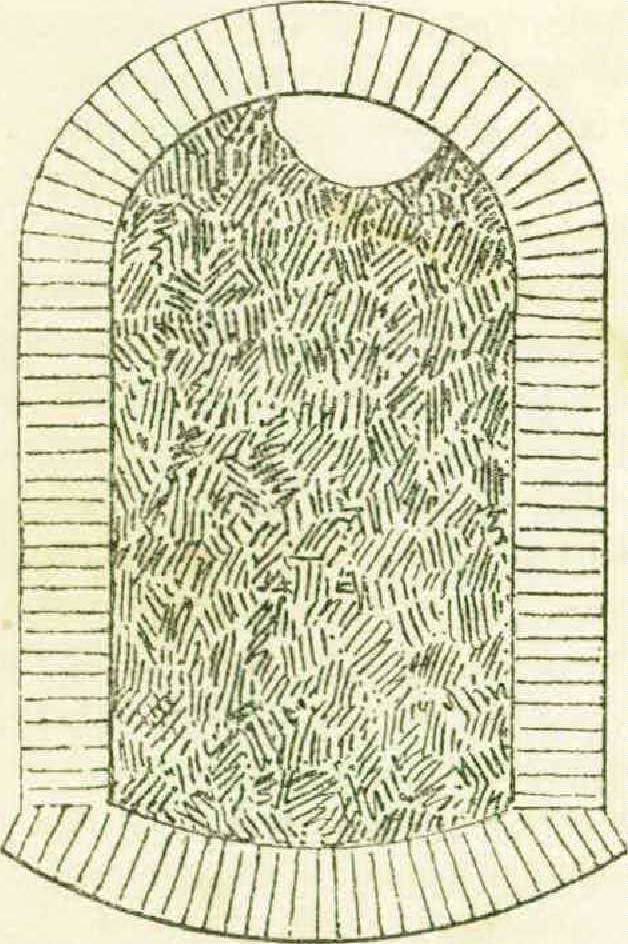
the smallest constant stream. And, in order to make room for a rain-fall flow, the whole sewer will have to be cleared by the costly and offensive process of removal by manual labor. A smaller sewer would have been kept clear by its own flow.
The shallower and broader the stream, the more the friction against the bottom and sides and the greater the retarding of velocity. A brick will stand unmoved in a shallow stream of water running sluggishly through a fifteen-inch drain, while if the same stream were concentrated into a five - inch drain it would have so much greater depth, force, and velocity, that the brick would be entirely covered and swept away.
The passion for too large pipes seems to be an almost universal one. The feeling is that it is best to make the conduit “ big enough anyhow,” and as a result, nearly every drain that is laid, in town or country, is so much larger than is needful that the cost of keeping it clean is often the most serious item of cost connected with it.
One principle is very apt to be disregarded in regulating the sizes of sewers: that is, that after water has once fairly entered a smooth conduit having a fall or inclination towards its outlet, the rapidity of the flow is constantly accelerated up to a certain point, and the faster the stream runs the smaller it becomes; consequently, although the sewer may be quite full at its upper end, the increasing velocity soon reduces the size of the stream, and gives room for more water. It is found possible, in practice, to make constant additions to the volume of water flowing through a sewer by means of inlets entering at short intervals, and the aggregate area of the inlets is thus increased to very many times the area of the sewer itself. Where a proper inclination can be obtained, a pipe eighteen inches in diameter makes an ample sewer for a population of ten thousand.
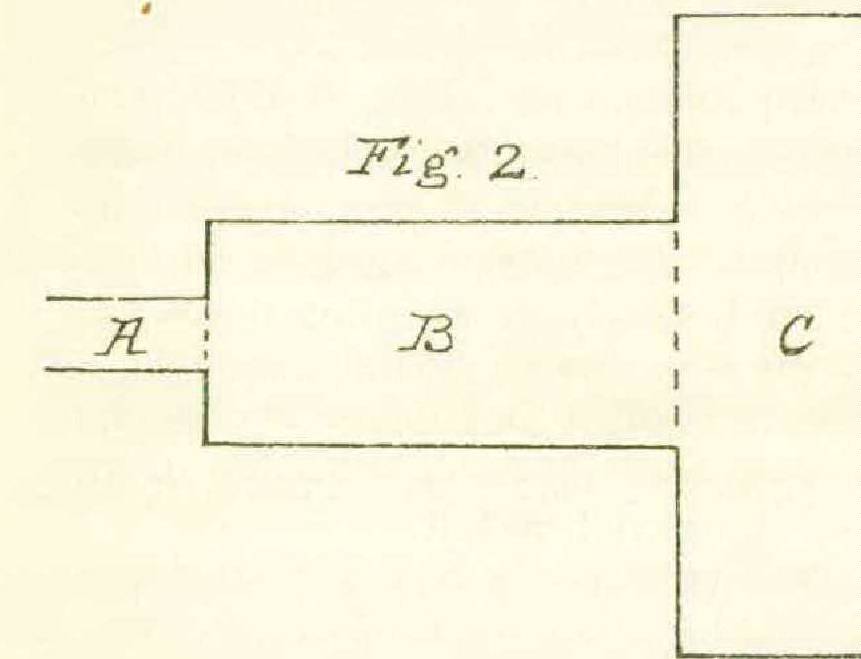
It was formerly the custom with architects and engineers to enlarge the area of any main pipe or sewer in proportion to the sectional area of each subsidiary drain delivering into it. But this is no longer done, since it has become known that additions to the stream increase its velocity, so that there is no increase of its sectional area. For example, the addition of eight junctions, each three inches in diameter to a main line of four-inch pipe, did not increase the sectional area of its flow, but made the flow only more rapid and cleansing. Ranger thus illustrates the average architect’s method of draining a house and court. The reason for making B so large is to prevent its choking, an effect that its extra size is quite sure to produce.
The main sewer in Upper George Street, in London, is five and one half feet high and three and one half feet wide. In the bottom of this sewer there was laid a twelve-inch pipe five hundred and sixty feet long. A head-wall or dam was built at the upper end of this, so that all the sewage had to pass through the pipe. The whole area drained was about forty-four acres (built area). The velocity of the water in the pipe was found to be four and. one half times greater than on the bed of the old sewer. The pipe contained no deposit, and during rains stones could be heard rattling. through it. The force of water issuing from the pipe kept the bottom of the old sewer perfectly clean for about twelve feet below its mouth. From this point bricks and stones began to be deposited, and farther on sand, mud, and other refuse, to the depth of several inches. In one trial a quantity of sand, bricks, stones, mud, etc., was put into the head of the pipe; the whole of this was passed clear through the pipe, and much of it was deposited on the bottom of the old sewer some distance from its end. The pipe was rarely observed to be more than half full at its head. It was found that the sum of the cross sections of the house drains delivering to this half-full twelve-inch pipe was equal to a circle thirty feet in diameter.
Another experiment was made with a sewer in Earl Street, which took the drainage from twelve hundred averagesized London houses, the area occupied being forty-three acres of paved or covered surface. It was three feet wide and had a sectional area of fifteen feet, with an average fall of one in one hundred and eighteen. The solid deposit from the twelve hundred houses accumulated to the amount of six thousand cubic feet per month (two hundred and twenty-two cart-loads). A fifteen-inch pipe placed in this sewer, with an inclination of one in one hundred and fifty-three, kept perfectly clear of deposit. The average flow from each house was about fifty-one gallons per day, and, apart from rain-fall, the twelve hundred houses would have been drained by a five-inch pipe. It was estimated that at that time (about twenty-five years ago) the mere house drainage of the whole of London might he discharged through a sewer three feet in diameter; yet there is probably not a village of five thousand inhabitants in the United States whose magnates would be satisfied with a sewer of much less size for their own purposes; and a single hotel in Saratoga has secured future trouble in the way of the accumulation of raw material for the production of poisonous sewer gas, by laying a drain for its own uses thirty inches in diameter.
Rats and vermin live and breed in large sewers, never in small pipes.
A fifteen-inch sewer was formerly considered the smallest size admissible for the drainage of a “ mansion.” Such a sewer, with a fall of one in one hundred and twenty, or one inch in ten feet, would drain nearly two hundred of the largest city houses; and a nine-inch drain with the same inclination would remove the house - drainage and storm water from twenty such houses.
A curious example of the capacity of small pipes was furnished in a case where a six-inch pipe was laid for the drainage of one detached house. One after another, as new houses were built, new drains were connected with this same pipe, until, after a time, it was found to be clean and in perfect action, though carrying all the drainage of one hundred and fifty houses. In a second instance a workman by mistake used for the drainage of a large block of houses a pipe which the architect had intended for a single house, and it was found to work perfectly.
It may be taken as a rule that, with even a slight fall, a well - constructed eighteen-inch pipe sewer is ample for the drainage of an ordinary village area containing seven or eight hundred houses. In one instance a sewer of this size, having a fall of one in one thousand, accumulated but little deposit, and this was always removed by storms. In Tottenham (London) a main sewer of nine-inch pipe, widening to twelve-inch and afterward to eighteen-inch, and having a fall of one in one thousand and sixty-two, drained an area containing sixteen hundred houses. Its ordinary current was two and one half miles per hour, and brickbats introduced into it were carried to the outlet. During ordinary continued rains it was not more than half full half a mile from the outlet, and at the outlet the stream was only two and three fourths inches deep.
During the preparation of these papers the Sewer Commissioners of Saratoga (the writer being employed as their consulting engineer) have completed a main sewer more than two miles long, for the removal of the entire sewage, rain-fall, and spring-water drainage of that village. The experience with this work affords so pertinent an illustration of the principles here advanced that it seems worth while to refer to it. The village is large and scattered, has an abundant water supply, is so inclined that during showers its storm waters concentrate rapidly, and has, aside from its regular population, five or six enormous hotels, entertaining, when full, about as many thousand guests. The village brook itself, being mainly supplied by spring water flowing from various points over a wide district, is always a considerable stream. As it flowed through its old channel — a conduit with rough, loosely-laid stone side-walls, and with a more or less irregular bottom — its sectional area was about five feet. During heavy rains it was sometimes thrice this.
From the very beginning of the work we encountered the most violent opposition on the part of many citizens, who believed that the sewer contemplated (circular, three feet in diameter) would be entirely inadequate, not only for the removal of the water of heavy rains, hut even for the drainage of the hotels alone, or the carrying of the storm waters alone; and throughout its construction this main sewer has been derided as a “ cat hole.” We were constantly reminded that one hotel had a main drain eighteen inches in diameter, and another a drain two and one half feet in diameter, and that it was madness, with these drains as our guide, to attempt to accomplish the whole work with a three-foot sewer; especially as our fall was said to be slight, one foot in four hundred feet.
On the 9th of July, 1875, the connections were made with all of the hotels; the village brook itself was turned into the sewer at its head, and its insufficiency was to be demonstrated. After every available source of water had been drained, the depth of flow in the upper part of the sewer was six and one half inches. Nearer the outlet, where the water had acquired its maximum velocity, it was only four and one half inches. As this was not sufficient to wash out the few loose boards carelessly left by the workmen who had done the final pointing of the joints, a hydrant was turned on at the upper end of the sewer, with a full head, and it had the effect only of raising the flow one inch at the upper end and less than half an inch at the lower end of the sewer. On the 10th there fell a violent thunder-shower, flooding the street gutters until the water ran to the top of the curb-stones, and when this flood had reached the catch-basins and the open brook that discharged into the head of the sewer, its only effect was to raise the flow, at the highest point, less than two inches, justifying my original opinion that, a two-foot sewer would have been more than adequate for all that was required of it. On the 30th day of August the entire village brook, with its tributaries and its many springs, was turned into the three-foot sewer, near the waterworks, about one half mile beyond the outskirts of the village. The effect of this addition was to increase the depth of flow in the sewer from about six inches to nine inches, and to increase the velocity of its stream from one hundred and fifty feet per minute to one hundred and eighty-five feet per minute. I can excuse my course in recommending so large a sewer as one of three feet, only by the fact that in the state of public opinion then it would have been entirely impossible to secure the making of anything smaller. Before the introduction of the brook I examined the outlet of the Grand Union Hotel, which had then about eight hundred and fifty guests and four hundred and fifty servants, or about thirteen hundred inmates in all. There can hardly be fewer than one hundred water-closets in the house, and the use of water in this hotel seems to be in every way as copious as possible. The hour of examination was ten in the morning, at which time, as, the landlord supposes, the largest flow is running. By the most careful measurement and estimate that I could make, the amount of sewage then flowing from that hotel measured four and one half inches in sectional area, and might have all been discharged by a two and one half inch pipe.
The pipe sewer has been so long in successful use that there is no further question of its value. Even ten years ago, fifty miles of such pipe were made per week in Great Britain alone.
Accuracy in form and joints, and smoothness of surface, are very important. A perfectly round pipe, accurately laid at the joints, will deliver, under the same circumstances, fifty per cent, more water than one of distorted form or with ill-fitting joints.
Any roughness of surface, as in even the best made cement pipes, tends to catch hair and lint and thus to form nuclei for accumulating obstructions, sometimes so hard that they can be removed only by forcible mechanical means.
With a well-constructed system of pipe sewers, not too large for the work required of them, of good form and surface, with perfect joints, with only curved junctions, and with a well regulated even if slight fall, every particle of the sewage of the town may be delivered at the outlet, far away from the built-up districts, long before any decomposition of the refuse matter has set in; though occasional flushing may be necessary to cleanse the sides of the pipes from slimy matters adhering to them.
In New York, the cost of flushing and cleansing sixty miles of pipe sewers was found to he only fifty dollars per year.
The material of the pipe, should be a hard, vitreous substance, not porous, since this would lead to the absorption of the impure contents of the drain, would have less actual strength to resist pressure, would be more affected by frost or by the formation of crystals in connection with certain chemical combinations, or would be more susceptible to the chemical action of the constituents of the sewage. The best pipe known in our market is the Scotch; but some American work is very nearly as good.
Sewer pipes should be salt-glazed, as this requires them to be subjected to a much more intense heat than is needed for slip-glazing, and thus secures a harder material.
Pipes having a socket at one end should be furnished with a gasket before being cemented, in order that no cement may be pressed through into the bore of the sewer, to cause a disturbance of the flow. Where there is danger of the penetration of roots, as near elm-trees, the sewer should be bedded in a sufficient thickness of concrete to prevent the entrance of rootlets, which are sure to find and to penetrate the smallest aperture. An entrance once effected, a mass of fibres soon forms, sufficient to retard or entirely to arrest the flow.
A chief argument in favor of the use of pipes rather than brick sewers lies in their greater essential cleanliness. Brick sewers are always offensive, even though small, because their porous walls are more or less permeated by the filth of their contents. If (as is almost always the case) they are too large, there will be the additional annoyance of accumulations of refuse as foul and dangerous as the contents of any cess-pool, producing poisonous gases which are free to travel through the sewer and all its branches.
The first question to be considered in arranging the plan for the sewerage of a town or village is that of an outlet, at which the foul sewage of the streets and houses may be delivered without danger of polluting water-courses or destroying their fish, or of silting up harbors or navigable streams; and without forming within dangerous proximity to the town a deposit of offensive sewage matters which might constitute a source of annoyance or of insalubrity.
In all cases where this part of the problem presents difficulties, it should be considered whether a separate direction or a shorter outfall may not be given to the storm-water drainage, allowing the sewers to deliver at their main outlet only the ordinary drainage of houses and the street-wash of very slight rains. The cases are frequent where the removal of the sewage proper may be best and most economically secured by artificial pumping; though, in the majority of instances, it will be practicable, by the use of intercepting sewers, to deliver by natural outfall the drainage of all except the very lowest portions of the town. It is in the adjustment of this part of the work that the experience and judgment of the engineer in charge will be the most severely tested: in all matters of construction, ventilation, house connections, etc., certain rules and explicit directions can be applied, but the arrangement of the outlet varies with nearly every new undertaking, and with reference to this branch of the subject it is possible here to give only general indications.
It would often be practicable to take the small ordinary flow of public sewers to a remote point, when the cost of providing such an outlet for storm water would be so great as to make it impracticable. In such cases there may be carried from the point of outlet to the distant point of discharge the smallest pipe that will accommodate the usual flow, so arranged that whenever, as during storms, the volume is increased beyond the capacity of this pipe, it shall overflow and be carried directly into the stream or harbor at hand. At such times the amount of water in the sewage will so dilute it that no bad effect need be apprehended.
The great danger in nearly all the towns of our Atlantic seaboard lies in the fact that they discharge some of their most important sewers below high-water mark, so that at each rise of tide not only is the flow at these points cheeked, and foul silt allowed to collect in the stilled water, but the closing of the vent at this end of the sewer and the rise of water within it, whether by the action of the tide or through the accumulation of the flow from above, brings a pressure to bear upon the contained air and forces it to escape at the higher points; so that the state of the tide is often made perceptible by the forcing of water traps a mile or more distant from the outlet.
Outlets, especially of large sewers, exposed to strong winds, are likewise very objectionable, the pressure of the wind forcing the tainted air to find vent too often through badly trapped drains leading into occupied houses.
Where necessary to secure a constant flow of sewage, pumping should always be resorted to. With coal at nine dollars per ton, the cost of lifting thirty thousand gallons ten feet high with a twenty-five horse-power engine would not exceed seventy-five cents, while with a larger engine and a larger flow the relative cost would be much less. It was estimated that to lift the whole sewage and rain-fall from a low-lying district in London, occupying four thousand acres, to a height of thirty-one feet would cost about five cents per annum per head of population. Whatever the cost of pumping, it may be made in level districts to do away with any outlay for cleansing or flashing sewers, which without pumping must have been laid nearly level.
There are few cases yet in this country where it is necessary to discharge the sewage of a town into a stream from which other towns receive their water supply, though the towns along the Schuylkill River still stand in this relation to the city of Philadelphia. The time is probably not very distant when this question will become here, as it now is in England, a very serious one.
Tidal estuaries and bays receiving the drainage of a town are sure to have those parts of their bottoms and sides which are alternately covered and exposed by the changing tides fouled with organic matter, and to become thereby seriously offensive.
Recent sewage floats in water. After maceration it sinks in still water and in currents having a less velocity than one hundred and seventy feet per minute. Its specific gravity is 1.325.
The condition of Newtown Creek, Wallabout Bay, and the Gowanus Canal and Bay, near Brooklyn, are examples of the subsidence of sewage in eddies and slack water.
Tides may be made extremely useful in the flushing of sewers in level lowlands, but care should be taken to carry the outlet to a point where the inconvenience from subsidence will be reduced to the minimum.
All sewers must at least be vented, and for perfect security all ought to be well ventilated. It is of the first importance to provide openings for the escape of the contained air and gases when these are compressed, either by a wind blowing into the outlet or by the increase of the quantity of water in the sewer from the rise of the tide or from heavy rain-fall. Unless such precaution is taken, house traps will surely be forced and sewer gas will surely escape into dwellings. It is, however, hardly less important that there should be such a free circulation of air through the sewer as will prevent the formation of those poisonous, mephitic gases which are especially generated in the absence of a sufficient supply of oxygen.
Latham says that unventilated sewers are far more dangerous than steam-engines without safety-valves. They contain in their air some quality that is pestilential and dangerous to health, and this can he disposed of or neutralized only by giving the air of the sewer a free communication with the atmosphere. Typhoid fever is said rarely to be absent from towns with unventilated sewers. The constantly changing pressure upon the confined air within these conduits acts in connection with the draughts of chimneys and the force of winds to cause the bubbling of house traps, accompanied with an entrance of more or less of the sewer emanations.
When the sewerage works of Croydon were nearly completed, and the town was visited by an epidemic of typhoid fever, the mortality rose from 18.53 per thousand to 28.57 per thousand. Although it is probable that the only matters decomposing in the sewer were such as adhered to the pipes (which were well flushed), there were frequent outbreaks of fever until 1866. Diseases: which had formerly made their haunts in the lower parts of the town traveled by means of the sewers and infected the higher districts. In 1866 the sewers were systematically ventilated, and since that time there have been no periodical outbreaks of fever, and, with a doubled population, “ the rate of mortality rarely exceeds eighteen in the thousand, which is a standard of health unparalleled in the history of sanitary science for a district having so large a population.”
The principle of the ventilation of a sewer is practically the same as that adopted by builders for the prevention of dry-rot. The fungi which cause this rot in timber cannot produce their germs in a current of air, and if a sufficient number of ventilating openings are made, communicating with each other, the action of the wind from one side or the other will cause a sufficient current. So in a sewer, a continuous movement of the air in one direction or the other carries away and dilutes sewer gases, and if they contain germs of organic disease capable of infecting the human blood, these are believed to be destroyed by oxidation or otherwise.
A safe sewer always has a current of air passing through it, and if it contains sewage matters at all, these also must be in constant motion. On this incessant movement of the air and the liquid must we rely for our only security. A solution of sugar in water, remaining stagnant, and protected from a free circulation of air, will enter into a vinous fermentation. If well ventilated and agitated, no such fermentation takes place. The excrement of a typhoid patient, continually agitated in contact with fresh air and a fair admixture of water, passes through a series of complete chemical changes, with no injurious product; but if allowed to remain stagnant, if not freely exposed to the air, or if it gain access to human circulation before a certain oxidation, it will, like a ferment, reproduce itself, and give rise to the conditions under which it was itself produced. Motion and aeration are therefore needed to prevent infection, which is sure to be generated when typhoid evacuations are confined and stagnant. Unventilated and badly-constructed sewers are sure agents for the propagation of the disease.
The resulting gases of sewer decomposition are the vehicle or medium for the conveyance of infection, and from their lightness they give rise to a rapid diffusion owing to the eagerness with which they seek means of escape at the higher parts of the sewer system, that is, in house drains, soil pipes, etc. It may not be possible entirely to prevent the development of the poison in even the best arranged sewer, but it is possible, by a free admission of air, to supply the oxygen which will take away its sting and render it, harmless. Sewers which have large and frequent openings at the street surface, and through which the liquid contents have a constant flow, may give forth offensive smells, but, if they have proper attention, sanitary evils do not often result.
Sewer gas, when largely diluted on its escape (at frequent intervals) into the air of the street, is probably nearly or quite innoxious, but when it forces its way into the limited atmosphere of a closed living-room, the poison, or the germs of disease accompanying it, may work their fatal effects.
Sulphuretted hydrogen is found in all sewers in which the sewage itself or the mucous matters adhering to the pipe assume a certain degree of putridity. This gas is extremely poisonous; so much so that one part of the gas to two hundred and fifty parts of atmospheric air will kill a horse. At one half this intensity it will kill a dog. A rabbit was killed by having its body immersed in a bag of it, although its head was not inclosed and it could breathe pure air freely.
One of the most frequent sources of pressure upon the air within a sewer is the increase of temperature arising from the hot water escaping from kitchens and baths. The repeated expansions and contractions caused by the admission of hot and cold water produce a constant effect on all water traps connecting with unventilated sewers. With ventilation, the breathing in and out, as the air of the sewer contracts or expands, does not affect the water traps, because an easier passage is found through the ventilators.
The constantly changing volume of water in many sewers, as has been before stated, exerts a powerful influence on the confined air. As the water rises it reduces the air space, and if it reduces this to one half, it brings to bear upon the air a pressure equal to a column of water thirty-four feet in height, and this pressure is relieved by a forcing out of air through the most available channel,—the channel where there is the least resistance; if there is no other vent, a sufficient number of water traps must be forced to allow the pressure to become reduced. It being reduced, and the water falling again to a lower level, a vacuum is created which must be supplied by air forcing the traps in a reverse direction, and in either case the forced trap may remain open for the free passage of foul air until another use fills it with water. In the ebb and flow, too, a part of the perimeter of the sewer is made alternately wet and dry, with an accompanying production of vapor and gas.
As the chief domestic use of sewers is between morning and noon, and as at this time the most hot water passes into them, the pressure on the air in the sewer is during this period increased both by an elevation of the temperature and by a reduction of the air space. Then, from about noon until the next morning, the quantity of the flow decreases, the air-space increases, the temperature falls, and more air must be admitted to supply the partial vacuum created. Such fluctuations are constantly occurring, accompanied with a drawing in and forcing out of air, for which ample passage must be made independently of the water traps of houses, or sewer gas will surely enter them. Where proper air vents are provided, this ebb and flow of the sewer may be increased, with great advantage in the matter of ventilation, by artificial flushing arrangements which will allow the water to be dammed back and released at frequent intervals.
The movement of the air in and out of the sewer is also affected by barometric changes.
Where proper ventilation is furnished there will be an advantage in exposing the outlets of sewers to the direct action of the wind, but where there is not sufficient vent for escape, such outlets should, as has been stated, always be screened against strong currents of air.
Numerous experiments have been made with tall chimneys and fires, having for their purpose the creation of a strong draught from the sewer, but these have never worked satisfactorily, and are in no case to be recommended, being both expensive and troublesome. By reason of the causes constantly at work tending to the increase and decrease of the pressure of the air in the sewer, this variation may safely be depended on to furnish all needed ventilation, if only sufficient openings are provided from which air can pass in and out at frequent intervals.
Ventilation by rain-water pipes from the eaves of houses has often been recommended, but experience has shown that it is unsatisfactory, not only because it frequently discharges sewer gas near the windows of sleeping-rooms, but because at the time when ventilation is most needed these pipes are not available; either being filled with a rush of water or else having such a rapid downward current as to move the air toward the sewer rather than away from it, or because, from the position at which rain water inlets are often introduced into sewers, these are entirely closed when there is a large amount of sewage flowing, — as during heavy rains, when ventilation is especially demanded.
This system was adopted during the early days of the Croydon work, and was rigorously pursued. In 1860 such ventilation was compulsory in all cases. The mortality was very much increased until a better system was adopted in 1866, when the death-rate fell again to its old standard.
In Hints on House Drainage, by Dr. Carpenter, of Croydon, we are told, with reference to fatal epidemics of typhoid fever, that the illness dated from two distinct times, at both of which, with a high temperature and a stifling atmosphere, there was a heavy fall of rain. “ I do not mean to assert that each case commenced immediately after the rain-fall, but in upwards of twenty fatal cases into the history of which I examined, the commencement curiously ran up to two distinct dates, and of many slighter cases the patients stated that they had not felt well about the same periods.” One case occurred in his own house. The water-pipe ventilators being closed by the rain water, and the air in the sewers being compressed by the increased volume of the flow, the gas forced the water trap of his soil pipe and escaped into his tank room, where the upper end of the ventilator was used as an overflow pipe for the cistern. This air ascended to a room occupied by two persons, both of whom were attacked with typhoid fever. There were no other cases in the house.
After all the experiments that have been tried with shafts, furnaces, mechanical blowers, steam jets, electricity, etc., the most experienced engineers have settled upon more frequent ventilation, by means of man-holes and lampholes opening at the centres of streets, as in all respects the best and safest. If these openings are sufficiently frequent, there is such an easy and thorough circulation of air in the sewer that the concentration of poisonous or of offensive gases is prevented, and their escape into the open air takes place at a point where they will be more diluted before reaching the sidewalks or the houses than if withdrawn by any other means yet devised. By the use of the excellent charcoal ventilators described below, so arranged as to give free vent at their openings, all practical danger or objection may be obviated.
The great safety, however, lies in the dilution of the gases by the free admission of air, and by their escape, when they escape at all, into the open air as far as possible from the house line. The effect of dilution is fully shown in fever hospitals: formerly, the mortality among both patients and attendants was frightful to contemplate; but now, although the ventilation is often far from complete, the condition of the patients themselves is much improved, and contagion is almost done away with; so much so that if an attendant contracts the disease it is taken as clear evidence that there has not been a sufficient dilution of the exhalations from the patients, or, in other words, that the ventilation has been imperfect.
The absorbing and disinfecting power of charcoal fully sustains its popular reputation. Latham quotes the following from Professor Musprat: “ The absorbing powers of charcoal are so great that some have doubted whether it is really a disinfectant. This opinion has probably arisen from imperfect views of its modus operandi, since it not only imbibes and destroys all offensive exhalations and oxidizes many of the products of decomposition, but there is scarcely a reasonable ground of doubt remaining that it does really possess the property of a true disinfectant, acting by destroying those lethal compounds upon which infection depends.”
Strictly speaking, the charcoal is simply an apparatus by which a natural process is carried on in an intensified form. It has the two important qualities of condensing upon the surfaces of its inner particles eight or ten times its volume of oxygen, and of attracting to itself all manner of other gases. It is not necessary that sewer gas be brought into direct contact with it by external pressure. By the operation of the law of the diffusion of gases, the impurities of the air next to the charcoal being absorbed, remoter impurities flow to this space and are in turn taken up, until the contents of a close room may be entirely purified by a small dish of charcoal. The oxygen that consumes or burns up the organic matter is speedily replaced from the atmosphere, and the constant efficiency of the apparatus is thus maintained.
The clogging of the pores of the charcoal with dust, or their saturation with water, prevents this action, and charcoal that has become wet or foul must be dried or burned in a retort before it becomes again perfect in its action. If charcoal ventilators are so situated as to keep dry and free from dust, they will not require changing or reburning more often than once a year.
The efficiency of even a small quantity of charcoal will be understood when we remember Liebig’s statement, that a cubic inch of beech-wood charcoal contains a surface of interior particles equal to one hundred square feet.
The capital adaptation of charcoal to use in sewer ventilators is further shown by the fact that it absorbs gases contained in or accompanied by the vapor of water (as they always escape from the sewer) much more readily than those which are dry.
All manner of chemicals used for disinfecting sewer gas are objectionable, from their unpleasant odor, their own injurious character, the constant attention their use demands, and their expense ; nothing has yet been discovered that can at all compare with the simple use of wood charcoal.
Several forms of charcoal ventilators have been devised. The best of them seems to be that of Mr. Baldwin Latham, which is a type of the class, all of which work on essentially the same
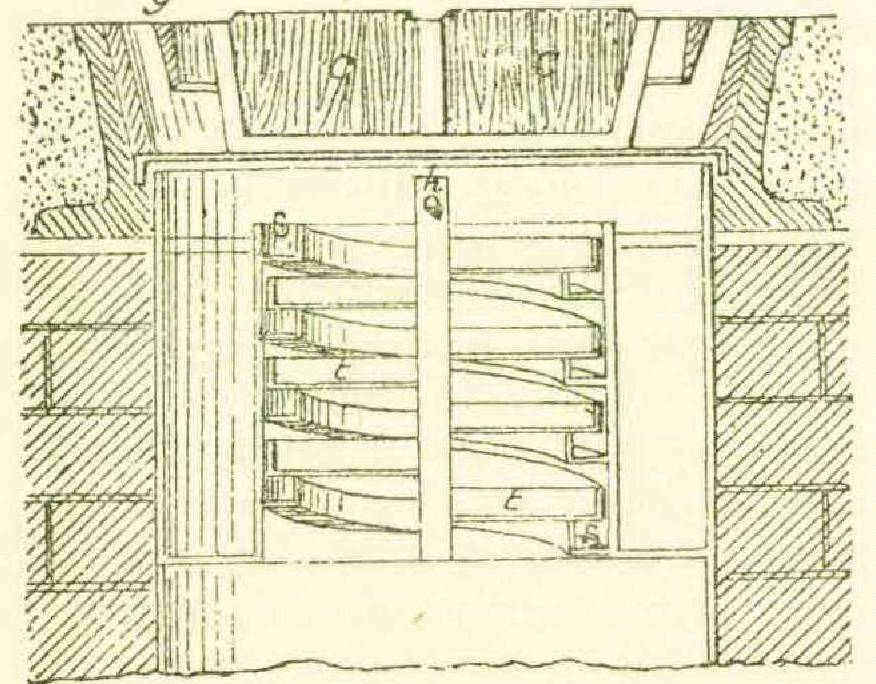
principle. It is illustrated in the accompanying diagrams. The central cover, C, which is of wood, protects the charcoal from rain or water used in sprinkling the streets; g is a grating outside of the closed part, through which the air escapes from the sewer or is drawn into it. Under this grating is a dirt-box surrounding the ventilator and intended to catch dirt falling through the grating. There is an overflow (S) arranged to carry to the sewer all water reaching the dirt - boxes. The spiral tray t is made of galvanized wire-cloth and is filled with charcoal; it is screwed into the ventilator over the spiral trough S by means of the handle h.
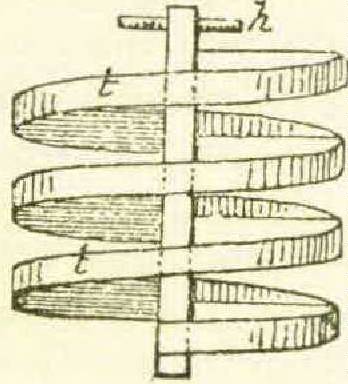
The arrangement of this disinfector is such that all air escaping from the sewer must pass either through the charcoal or through the spiral passage between layers of charcoal. If the layers become so obstructed by dust that a free passage through them is not afforded for the air, there is still an easy vent through the spiral open spaces. The charcoal is thoroughly protected against dirt and wet, and will remain effective for a long time, and the arrangement is such that there can be no interruption of the working by the accumulations in the dirt-boxes, nor by the overflow of the water escaping from them. The sewer gas is all brought into close contact with charcoal, and has no possible means for escape except through the protected channels intended for it. The spiral tray should be filled with charcoal broken to about the size of marbles, and if care is taken in screening out its finer dust, it will afford a very permeable passage for gas. The dirt-box can be easily taken out and dumped, and readily replaced.
Ventilators should be closer together in the lower and filthier parts of a town than on higher lands or steeper inclines.
Mr. Latham thinks that they should never be more than two hundred yards apart. He advises renewing the charcoal once a month. Five hundred and sixty-two sets of his apparatus were used in Croydon. Their total cost, including labor, new charcoal, fuel for reburning, etc., made a charge of less than one dollar and twenty-five cents per annum for each. The charcoal is reburned in iron retorts having small pipes to carry away the escaping gases.
The usefulness of the charcoal ventilators is demonstrated by the fact that in Croydon the written complaints of smells from certain sewers coincided with the absence of the trays (taken out for repairs), and the cause of the complaint was removed by replacing them.
On steep grades, where there would be a tendency for the air of the sewer to be drawn toward the ventilators on the highest land, discharging at this point an amount of gas that should be distributed along the whole street, it is therefore well to place a light hanging valve in front of each outlet into a manhole. Such a valve will not obstruct the flow of the sewage, while it will prevent the air below from finding its way up the drain, compelling it to escape at its own ventilator.
Where ventilators are used not in connection with man-holes, they should rise, not from the crown of the sewer itself, but from a recess or chamber carried up to the height of a foot or more. Into this recess the sewer air will naturally rise instead of passing on up the line, as it would be likely to do were there only a small ventilator-opening to arrest it.
With a free ventilation through the soil pipes at every house, there is an immense preponderance of area in favor of the vertical escapes, and these are frequently so placed that they become sufficiently heated to create a strong upward current. In a district containing a population of fifty thousand there would probably be ten thousand of these vertical openings, with a combined area equal to from twenty to forty times the area of the sewer at its mouth, so that their action would result more or less generally in the drawing in of air at the street openings; a fact which is sufficiently proved in Croydon, by the accumulation of dust in dry weather in the charcoal-baskets with which the ventilators are furnished. Where the orifice is a continuous exit, — that is, where there is no inward draught of air, — the charcoal remains black in spite of dusty
streets.
Concerning the rate of fall necessary for the removal of ordinary road silt from sewers, Adams gives the following table of inclination for pipes of different sizes running half full ; based on careful calculations and practical trials in connection with the sewerage works of the city of Brooklyn.
For 6-inch pipes a grade of 1 in 60
“ 9 " " " " 1" 90
“ 12" " " " 1" 200
“ 15 " " " " 1" 250
“ 18 " " " " 1" 300
“ 24 " " " " 1" 400
“ 30 " " " " 1" 500
“ 36 " " " " 1" 600
“ 42 " " " " 1" 700
“ 48 " " " " 1" 800
When the direction changes, the friction is increased, and the fall must be increased to compensate for this.
When the lay of the land permits it, the most rapid fall should be given at the upper end of the sewer, where the quantity of water is least, and where the greatest velocity is consequently needed to secure a cleansing flow.
The object of giving an inclination or fall to the sewer is to secure the velocity necessary for the removal of such solid matters as may exist in the sewage, but if the amount of water flowing is proportionate to the size of the conduit, sewers of different sizes give the same velocity at different inclinations: for instance, a ten-foot sewer with a fall of two feet per mile, a five-foot sewer with a fall of four feet per mile, a two-foot sewer with a fall of ten feet per mile, and a onefoot sewer with a fall of twenty feet per mile, will have the same velocity, provided they are filled in proportion to their capacity; but the ten-foot sewer will require one hundred times as much sewage as will the one-foot sewer, and unless it carries a volume of water proportioned to its capacity, the velocity of its stream will he correspondingly lessened. It becomes, therefore, especially important that the size of the conduit be adjusted to the volume of the stream, this being as important as the rate of inclination in securing a cleansing flow, and being so little understood that it cannot be too much emphasized in any attempt to bring the mechanism of sewerage works to the notice of the general public.
The character of the junctions of main and tributary sewers has much influence on their capacity. It has been found that when equal quantities of water were running in two sewers, each in a direct line, at a rate of ninety seconds, if their junction was at right angles their discharge was effected only in one hundred and forty seconds, while if it met with a gentle curve the discharge was effected in one hundred seconds.
In one recorded instance, a pipe, having been gorged by reason of a right-angled junction, which kept the velocity of its flow down to one hundred and twentytwo feet per minute, had its flow increased to two hundred and eight feet per minute and the difficulty entirely removed by making the junction on a curve of sixty feet radius. The same objection holds with right-angled junctions falling vertically into the sewer. In this case, as in the other, the inlet should be on a curved line; but vertical junctions are usually objectionable.
Frequent junctions are of great advantage. Experiment has shown that, with a pipe having a fall of one in sixty, its capacity, with junctions at frequent intervals, is more than three times what it would be if flowing only from a full head at the upper end of the pipe. In sewers of larger sizes the capacity is increased more than eight times.
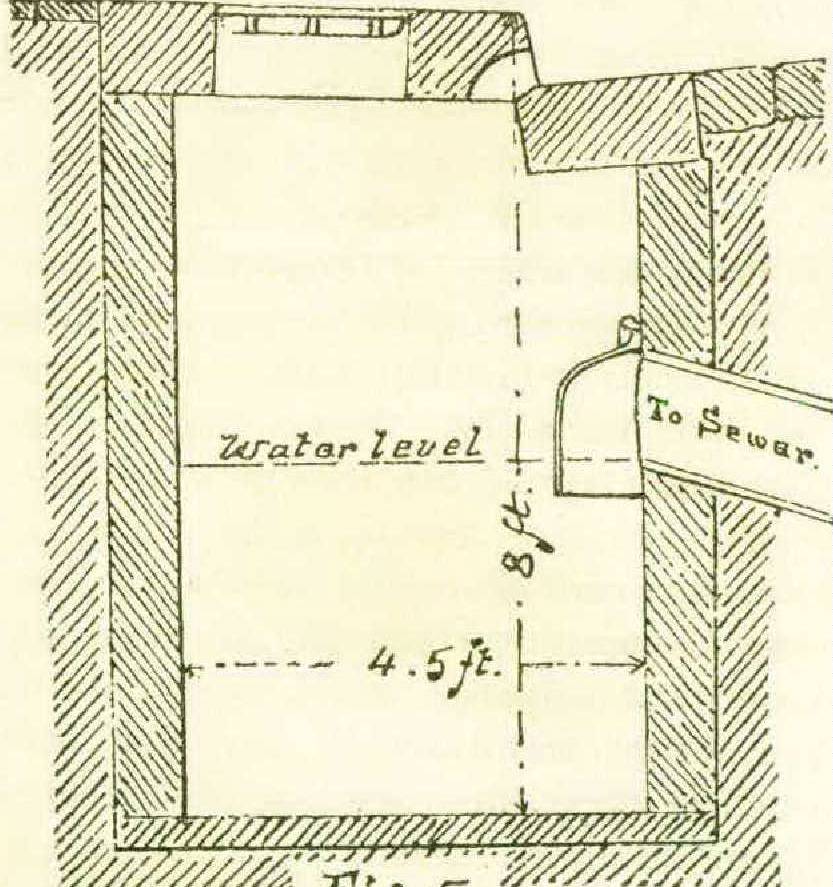
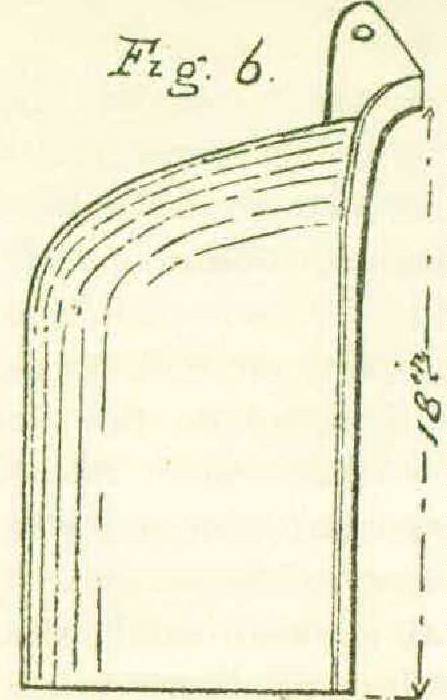
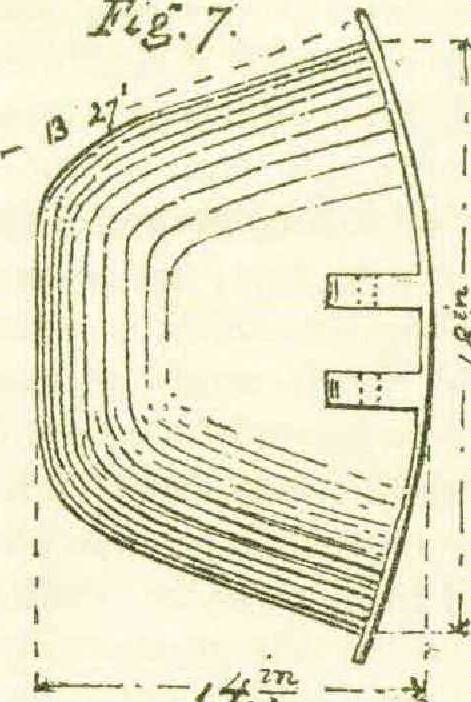
Various devices have been adopted to secure the admission of surface water from street gutters to the sewer without allowing the escape of sewer gas. These are usually arranged with a deep recess below the outlet for the accumulation of sand and silt washed from the roadway, and with some form of water trap. Their construction in our northern climate should have careful reference to a severe action of the frost, and no plan that has come under my notice seems so well adapted for this as one used by Mr. Shedd, the engineer of the sewerage in the city of Providence, the arrangement of which is shown in the accompanying diagrams. The trap for sealing the outlet is made of castiron, hinged with a copper bolt. It is firmly attached to the side of the basin with cement, and, if disturbed by frost, is simply torn loose from the brick-work, and can be easily cemented to its place in the spring.
All sewers should bo provided with man-holes for ventilation and for service during examination ; and pipe drains should have, between the man-holes, and at every point where the vertical or horizontal direction of the sewer is changed, lamp-holes, at the bottom of which lanterns may be suspended which will enable the line to be examined from the nearest man-hole. The removal of all such obstructions accumulating in pipe drains as cannot be washed out by flushing is effected by various instruments attached to jointed rods, like chimneysweep tools, which serve as handles, enabling them to be used even at a distance of several hundred feet.
It was formerly supposed that with pipe sewers not too large for the amount of liquid they were to carry, there would be no necessity for flushing, and so far as sedimentary deposits are concerned this is usually true; but a slimy coating often forms on the wall of the pipe and enters into decomposition, generating objectionable sewer gases. For this reason, all pipes used for house - drainage only should be so arranged that they can be occasionally flushed out with a good flow of fresh water; but where rain-fall is admitted from roadways and from the roofs of houses, additional flushing will not generally be needed, except during epidemics, or in dry, hot seasons. At such times there is always a great advantage in frequent flushing, and occasional disinfection.
It cannot be too often reiterated that the great purpose of modern water sewerage is to remove immediately, entirely beyond the occupied portions of a town, all manner of domestic waste and filth before it has time to enter into decomposition; thus preventing an accumulation of dangerous matter, and obviating the necessity for employing men in the unwholesome work of hand-cleansing of cess - pools and of sewers of deposit, which all sewers are when materially too large for the work they have to perform.
The public sewer or drain may properly afford an outlet to the land drainage of private property, but before reaching the public drain this should pass through at least two rods of sub-main drain laid under the direction of the public engineer, and trapped as he may direct for the exclusion of silt or refuse. This submain should deliver its water into the public drain as nearly as possible in the direction of the flow of the latter, so that the streams may run together without confusion, and the danger from eddies be obviated. Drains from houses and all private establishments should be connected with the sewer under similar official regulation.
It is a frequent practice with engineers to admit house drains at a very low point in the wall of the sewer, where they will ordinarily be entirely submerged. This renders such connections inoperative as a means for ventilating the sewer, and the ventilation of the soil pipes of houses so connected will consequently be of no avail as a part of the public system of ventilation. If the drain has no ingress for air at its lower end, the ventilation of the soil pipe itself will be much less complete; the pent-up gases arising from the decomposition of the contained organic matters may escape, but there will be little of the needed circulation of air in the pipe. With a free sweep of air from below, this decomposition would not take place in a pent - up condition, but would be carried on with a full supply of constantly changing atmosphere. Under these circumstances the ventilation of the street sewer would have to depend upon its street openings alone. In a perfect system these should even play a somewhat secondary part, acting more as a means for the inlet of fresh air to supply the higher ventilators than as a means of escape for the air of the sewer itself.
The question of cost should be taken into very early consideration, and it will not be slight; but pari passu there should be a due estimate of the benefits to accrue. These are not of such a character that they can be very readily calculated in dollars and cents, but there are few cases, in towns of five thousand inhabitants and over, where their importance will not be very fully appreciated.
The construction of a proper system of sewerage is at best expensive, but it may be much more cheaply done if taken in hand at once and carried on systematically until the whole is complete, than if done piecemeal, here and there, as property-holders may elect, which is the general custom in America. I do not know that the English method of paying for the cost by distributing principal and interest over a period of years has been adopted with us, but it seems the most just and the least oppressive. It is more fair to posterity, without bearing heavily on the present generation, than payment by interest-bearing bonds to be redeemed twenty or thirty years hence.
Latham, in his inaugural address as President of the Society of Engineers, made a calculation of the cost and value of the water-works and sewerage of the town of Croydon, as follows: —
Cost: purchase of land (for sewage utilization), £50,000; water-works, £70,000; sewers, irrigation works, baths, abattoirs, and general improvements, £75,000. Total, £195,000. The money savings during thirteen years since the completion of the work, he estimates to have been: 2439 funerals, which would have cost £12,195; 60,975 cases of sickness prevented, £60,975; value of the labor for six and one half years of 1317 adult persons whose lives were extended, £l66,930. Total, £240,100. He says, “Although it has been attempted to put a money value on human life, we individually feel that life is priceless, and we may look to the 2439 persons saved from the jaws of death in this single town as the living testimony of the great value of sanitary works.”
It is well known to physicians that their chances of success in the treatment of disease are very much reduced with persons living in unhealthy places.
The cost of sewerage works is often made unnecessarily great with the idea that it is the duty of the public to furnish an outlet for factories, slaughterhouses, and all manner of establishments which are carried on for individual profit, and in which the cost of removing the resultant refuse is fairly chargeable on the business rather than on the public purse.
So far as the community is concerned, it should be compelled to construct sewers only for the removal of such waste matters as are incident to the daily life of all classes of the population. If breweries, chemical works, and other manufactories producing a large amount of liquid waste, are to be provided with a means of outlet, this should be done entirely at their own charge; their profit and convenience should not be advanced at the cost of every member of the community. And more than this, the wastes of factories being often pernicious, not only on reaching the outlet of the sewer, but by the generation of gases within them which may pervade all their ramifications, it is a serious question whether such establishments should not be compelled to secure independent outlets at their own expense, or at least to render their wastes innoxious before discharging them into the public drain; paying even then an extra sewer-rate proportionate to the extra service they require.
The sanitary authority of every town should have entire control over the sewers, with power to decide what shall be admitted to them and what excluded, and to levy an additional tax in all cases where an undue use is made of the public convenience.
In the limited space of a magazine article it would be out of place to go very largely into the question of the economical use of the organic wastes of the house or town. The utilitarian question, important though it is, is but secondary. At the same time, as an accessory, the matter of economy is very important, and in every perfect system of sanitary improvement the arrangements must be such that there shall be a complete utilization of all the valuable constituents of the wastes of domestic life; and practically our arrangements should be so nearly perfect that nothing shall be lost that can be economically saved.
In our climate, sewage irrigation cannot be carried on in winter, but it may be made very useful during the growing (and sickly) season.
In sewage irrigation the amount of land appropriated should not be less than one acre to one hundred and fifty of population, and should lie not more than a mile from the town. The same land should not receive sewage two days in succession, and each area should have occasional periods of rest for a whole growing season.
If the land is of a very retentive character, even if well underdrained, it would be better to allow an acre to one hundred of population.
Bailey Denton objects to the disposal of large volumes of sewage by sub-irrigation, but where the ground is covered with vegetation, and where the flow is evenly and intermittently distributed in that part of the soil occupied by roots, especially if not in too close proximity to wells, it must be, under many circumstances, the best system.
Under favorable conditions, the utilization of the manurial matter contained in sewers is more easy by the system of irrigation than by any other in general use. .
Where the earth-closet is used, and where there is no system of sewers for the removal of liquid wastes, some provision must necessarily be made for disposing of slop water before it can generate dangerous products of decomposition. This may be best effected in many cases by the use of some device like Field’s flush tank (described in the preceding paper), in connection with the subirrigation of the lawn or garden.
The " general conclusions ” of the English Board of Health, after a thorough investigation of the whole subject of sewerage, were as follows: —
1. That no population living amidst aerial impurities arising from putrid emanations from cess-pools, drains, or sewers of deposit, can be healthy or free from attacks of devastating epidemics.
2. That as a primary condition to salubrity no ordure or refuse can be permitted to remain beneath or near habitations, and by no other means can remedial operations be so conveniently, economically, inoffensively, and quickly effected as by the removal of all such refuse dissolved or suspended in water.
3. That the general use of large brick sewers has resulted from ignorance or neglect; such sewers being wasteful in construction and repair, and costly through inefficient efforts to keep them free from deposits.
4. That brick and stone house drains are “false in principle and wasteful in the cleansing, construction, and repair. . . . That house drains and sewers, properly constructed of vitrified pipe, detain and accumulate no deposit, emit no offensive smells, and require no additional supplies of water to keep them clear.”
5. That an artificial fall may be cheaply and economically obtained by steam pumping, and that the cost of the whole system to each house is much less than the cost to that house of removing its refuse by hand.
6. All offensive smells proceeding from any works intended for house or town drainage indicate the fact of the detention and decomposition of ordure, and afford decisive evidence of malconstruction or of ignorant or defective arrangement.
George E. Waring Jr.