The Human Wheel, Its Spokes and Felloes
THE starting-point of this paper was a desire to call attention to certain remarkable AMERICAN INVENTIONS, especially to one class of mechanical contrivances, which, at the present time, assumes a vast importance and interests great multitudes. The limbs of our friends and countrymen are a part of the melancholy harvest which War is sweeping down with Dahlgren’s mowing-machine and the patent reapers of Springfield and Hartford. The admirable contrivances of an American inventor, prized as they were in ordinary times, have risen into the character of great national blessings since the necessity for them lias become so widely felt. While the weapons that have gone from Mr. Colt’s armories have been carrying death to friend and foe, the beneficent and ingenious inventions of MR. PALMER have been repairing the losses inflicted by the implements of war.
The study of the artificial limbs which owe their perfection to his skill and long - continued labor has led us a little beyond its first object, and finds its natural prelude in some remarks on the natural limbs and their movements. Accident directed our attention, while engaged with this subject, to the efforts of another ingenious American to render the use of our lower extremities easier by shaping their artificial coverings more in accordance with their true form than is done by the empirical cordwainer, and thus Dr. Plumer must submit to the coupling of some mention of his praiseworthy efforts in the same pages with the striking achievements of his more aspiring compatriot.
We should not tell the whole truth, if we did not own that we have for a long time been lying in wait for a chance to say something about the mechanism of walking, because we thought we could add something to what is known about it from a new source, accessible only within the last few years, and never, so far as we know, employed for its elucidation, namely, the instantaneous photograph.
The two accomplishments common to all mankind are walking and talking. Simple as they seem, they are yet acquired with vast labor, and very rarely understood in any clear way by those who practise them with perfect ease and unconscious skill.
Talking seems the hardest to comprehend. Yet it has been clearly explained and successfully imitated by artificial contrivances. We know that the moist membranous edges of a narrow crevice (the glottis) vibrate as the reed of a clarionet vibrates, and thus produce the human bleat. We narrow or widen or check or stop the flow of this sound by the lips, the tongue, the teeth, and thus articulate, or break into joints, the even current of sound. The sound varies with the degree and kind of interruption, as the “ babble ” of the brook with the shape and size of its impediments,— pebbles, or rocks, or dams. .To whisper is to articulate without bleating, or vocalizing ; to coo as babies do is to bleat or vocalize without articulating. Machines are easily made that bleat not unlike human beings. A bit of India-rubber tube tied round a piece of glass tube is one of the simplest voice - uttering contrivances. To make a machine that articulates is not so easy ; but we remember Maelzel’s wooden children, which said, “ Pa-pa ” and “ Ma-ma ”; and more elaborate and successful speaking machines have, we believe, been since constructed.
But no man has been able to make a figure that can walk. Of all the automata imitating men or animals moving, there is not one in which the legs are the true sources of motion. So said the Webers1 more than twenty years ago, and it is as true now as then. These authors, after a profound experimental and mathematical investigation of the mechanism of animal locomotion, recognize the fact that our knowledge is not yet advanced enough to hope to succeed in making real walking machines. But they conceive that the time may come hereafter when colossal figures will be constructed whose giant strides will not be arrested by the obstacles which are impassable to wheeled conveyances.
We wish to give our readers as clear an idea as possible of that wonderful art of balanced vertical progression which they have practised, as M. Jourdain talked prose, for so many years, without knowing what a marvellous accomplishment they had mastered. We shall have to begin with a few simple anatomical data.
The foot is arched both longitudinally and transversely, so as to give it elasticity, and thus break the sudden shock when the weight of the body is thrown upon it. The ankle-joint is a loose hinge, and the great muscles of the calf can straighten the foot out so far that practised dancers walk on the tips of their toes. The knee is another hingejoint, which allows the leg to bend freely, but not to be carried beyond a straight line in the other direction. Its further forward movement is checked by two very powerful cords in the interior of the joint, which cross each other like the letter X, and are hence called the crucial ligaments. The upper ends of the thighbones are almost globes, which are received into the deep cup - like cavities of the haunch-bones. They are tied to these last so loosely, that, if their ligaments alone held them, they would be half out of their sockets in many positions of the lower limbs. But here comes in a simple and admirable contrivance. The smooth, rounded head of the thighbone, moist with glairy fluid, fits so perfectly into the smooth, rounded cavity which receives it, that it holds firmly by suction, or atmospheric pressure. It takes a hard pull to draw it out after all the ligaments are cut, and then it comes with a smack like a tight cork from a bottle. Holding in this way by the close apposition of two polished surfaces, the lower extremity swings freely forward and backward like a pendulum, if we give it a chance, as is shown by standing on a chair upon the other limb, and moving the pendent one out of the vertical line. The force with which it swings depends upon its weight, and this is much greater than we might at first suppose; for our limbs not only carry themselves, but our bodies also, with a sense of lightness rather than of weight, when we are in good condition. Accident sometimes makes us aware how heavy our limbs are. An officer, whose arm was shattered by a ball in one of our late battles, told us that the dead weight of the helpless member seemed to drag him down to the earth; he could hardly carry it; it “ weighed a ton,” to his feeling, as he said.
In ordinary walking, a man’s lower extremity swings essentially by its own weight, requiring little muscular effort to help it. So heavy a body easily overcomes all impediments from clothing, even in the sex least favored in its costume. But if a man’s legs are pendulums, then a short man’s legs will swing quicker than a tall man’s, and he will take more steps to a minute, other things being equal. Thus there is a natural rhythm to a man’s walk, depending on the length of his legs, which beat more or less rapidly as they are longer or shorter, like metronomes differently adjusted, or the pendulums of different time-keepers. Commodore Nutt is to M. Bilim in this respect as a little, fastticking mantel-clock is to an old-fashioned, solemn-clicking, upright time-piece.
The mathematical formulæ in which the Messrs. Weber embody their results would hardly be instructive to most of our readers. The figures of their Atlas would serve our purpose better, had we not the means of coming nearer to the truth than even their careful studies enabled them to do. We have selected a number of instantaneous stereoscopic views of the streets and public places of Paris and of New York, each of them showing numerous walking figures, among which some may be found in every stage of the complex act we are studying. Mr. Darley has had the kindness to leave his higher tasks to transfer several of these to our pages, so that the reader may be sure that he looks upon an exact copy of real human individuals in the act of walking.
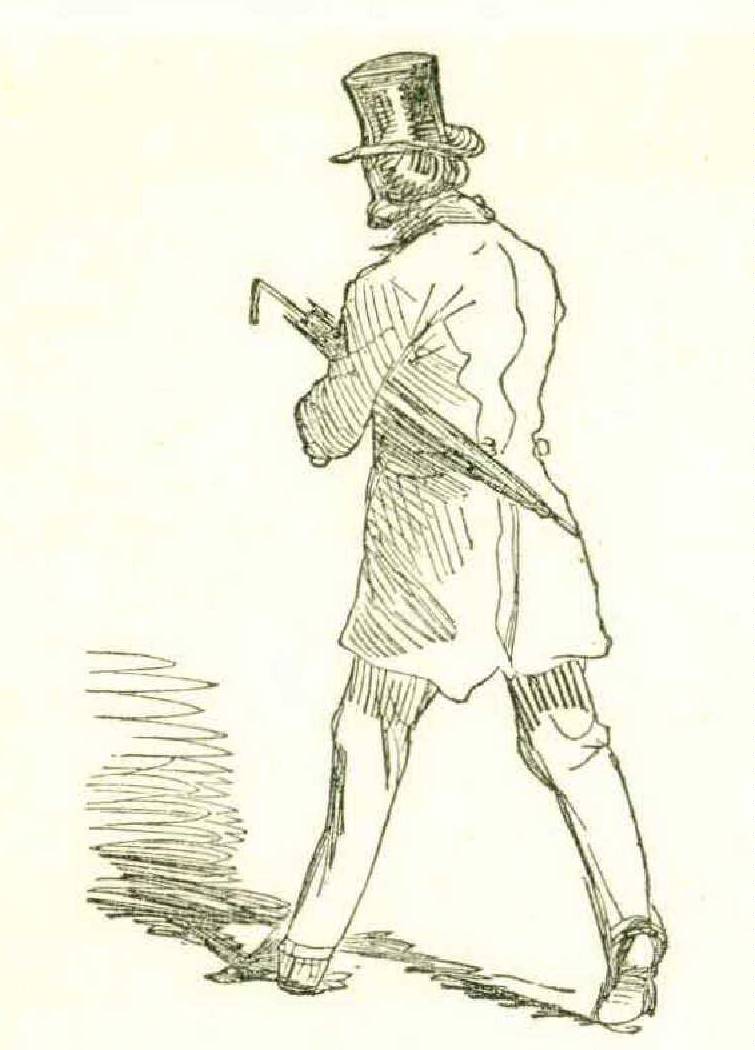
The first subject is caught with his legs stretched in a stride, the remarkable length of which arrests our attention. The sole of the right foot is almost vertical. By the action of the muscles of the calf it has rolled off from the ground like a portion of the tire of a wheel, the heel rising first, and thus the body, already advancing with all its acquired velocity, and inclined forward, has been pushed along, and, as it were, tipped over, so as to fall upon the other foot, now ready to receive its weight.
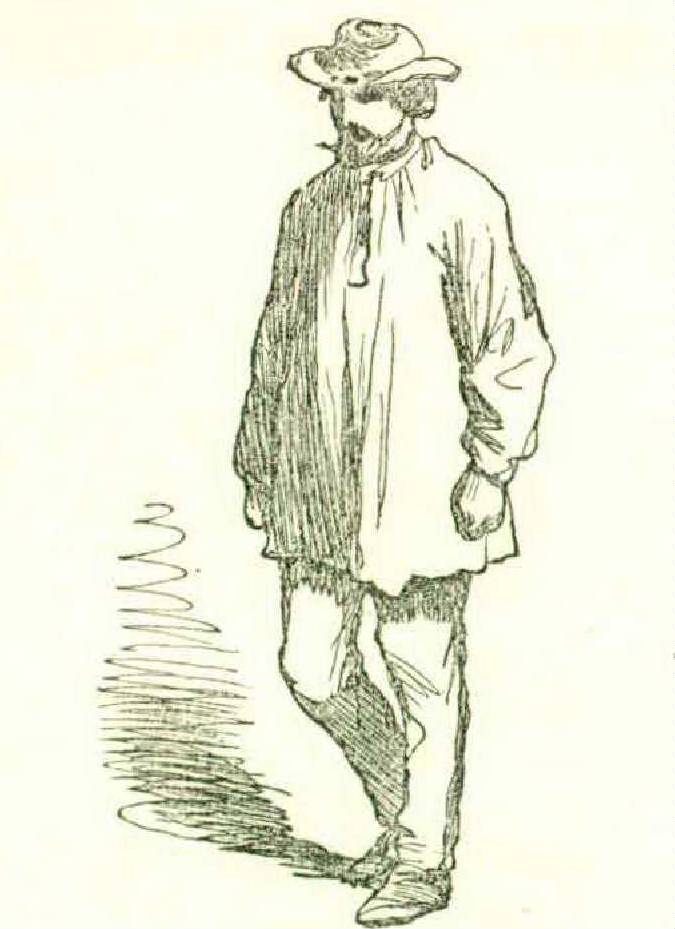
In the second figure, the right leg is bending at the knee, so as to lift the foot from the ground, in order that it may swing forward.
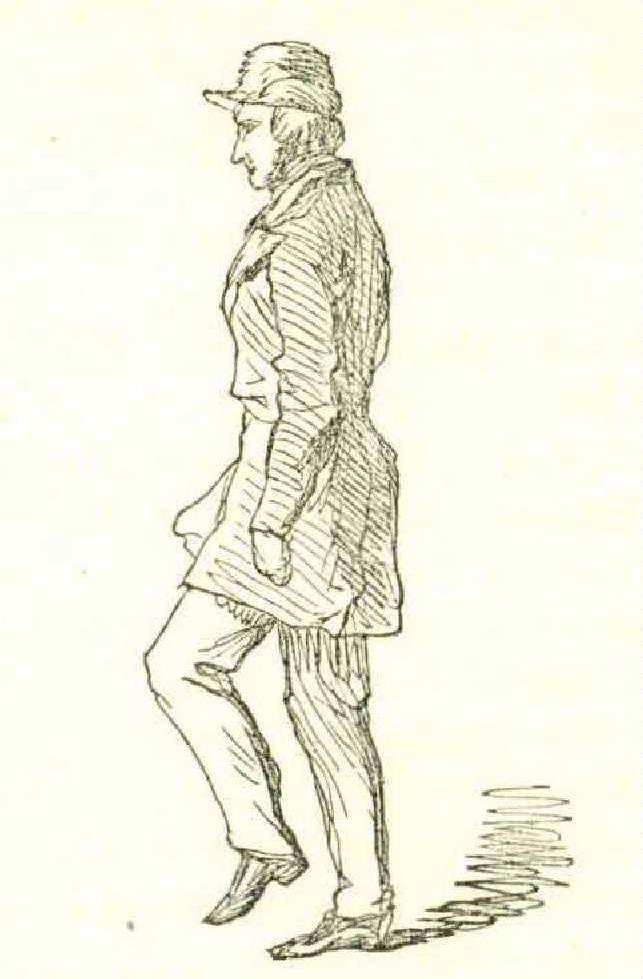
The next stage of movement is shown in the left leg of figure 3. This leg is seen suspended in air, a little beyond the middle of the arc through which it swings, and before it has straightened itself, which it will presently do, as shown in the next figure.
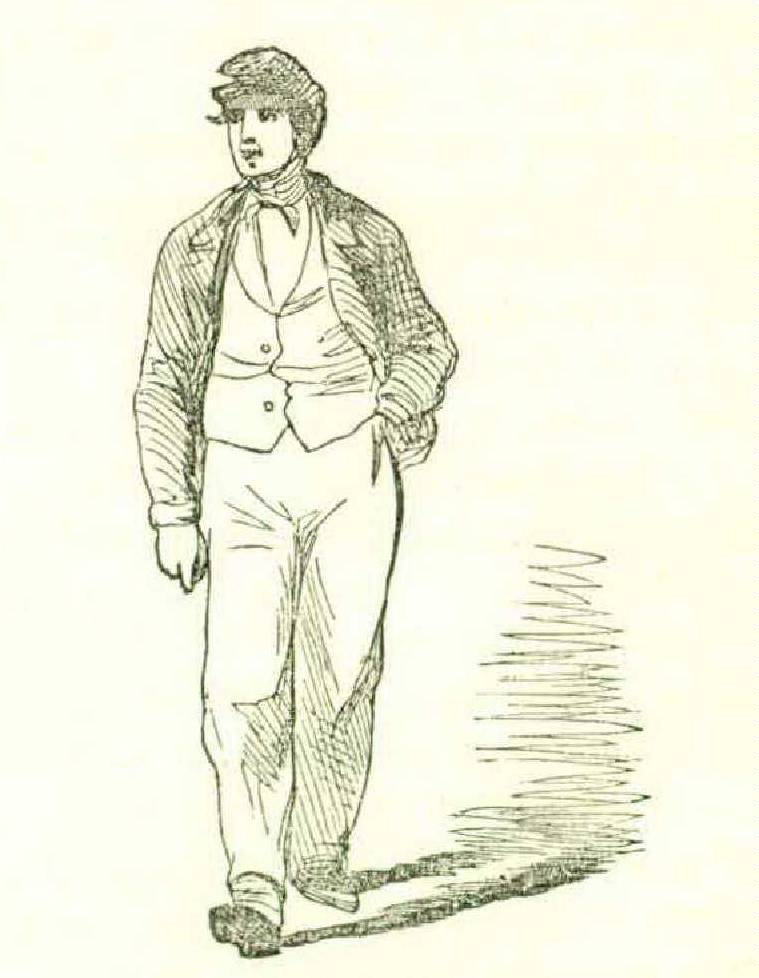
The foot has now swung forward, and, tending to swing back again, the limb being straightened, and the body tipped forward, the heel strikes the ground. The angle which the sole of the foot forms with the ground increases with the length of the stride : and as this last surprised us, so the extent of this angle astonishes us in many of the figures, in this among the rest.
The heel strikes the ground with great force, as the wear of our boots and shoes in that part shows us. But the projecting heel of the human foot is the arm of a lever, having the ankle-joint as its fulcrum, and, as it strikes the ground, brings the sole of the foot down flat upon it, as shown in figure 1. At the same time the weight of the limb and body is thrown upon the foot, by the joint effect of muscular action and acquired velocity, and the other foot is now ready to rise from the ground and repeat the process we have traced in its fellow.
No artist would have dared to draw a walking figure in attitudes like some of these. The swinging limb is so much shortened that the toe never by any accident scrapes the ground, if this is tolerably even. In cases of partial paralysis, the scraping of the toe, as the patient walks, is one of the characteristic marks of imperfect muscular action.
Walking, then, is a perpetual falling with a perpetual self-recovery. It is a most complex, violent, and perilous operation, which we divest of its extreme danger only by continual practice from a very early period of life. We find how complex it is when we attempt to analyze it, and we see that we never understood it thoroughly until the time of the instantaneous photograph. We learn how violent it is, when we walk against a post or a door in the dark. We discover how dangerous it is, when we slip or trip and Come down, perhaps breaking or dislocating our limbs, or overlook the last step of a flight of stairs, and discover with what headlong violence we have been hurling ourselves forward.
Two curious facts are easily proved. First, a man is shorter when he is walking than when at rest. We have found a very simple way of showing this by having a rod or yardstick placed horizontally, so as to touch the top of the head forcibly, as we stand under it. In walking rapidly beneath it, even if the eyes are shut, to avoid involuntary stooping, the top of the head will not even graze the rod. The other fact is, that one side of a man always tends to outwalk the other, so that no person can walk far in a straight line, if he is blindfolded.
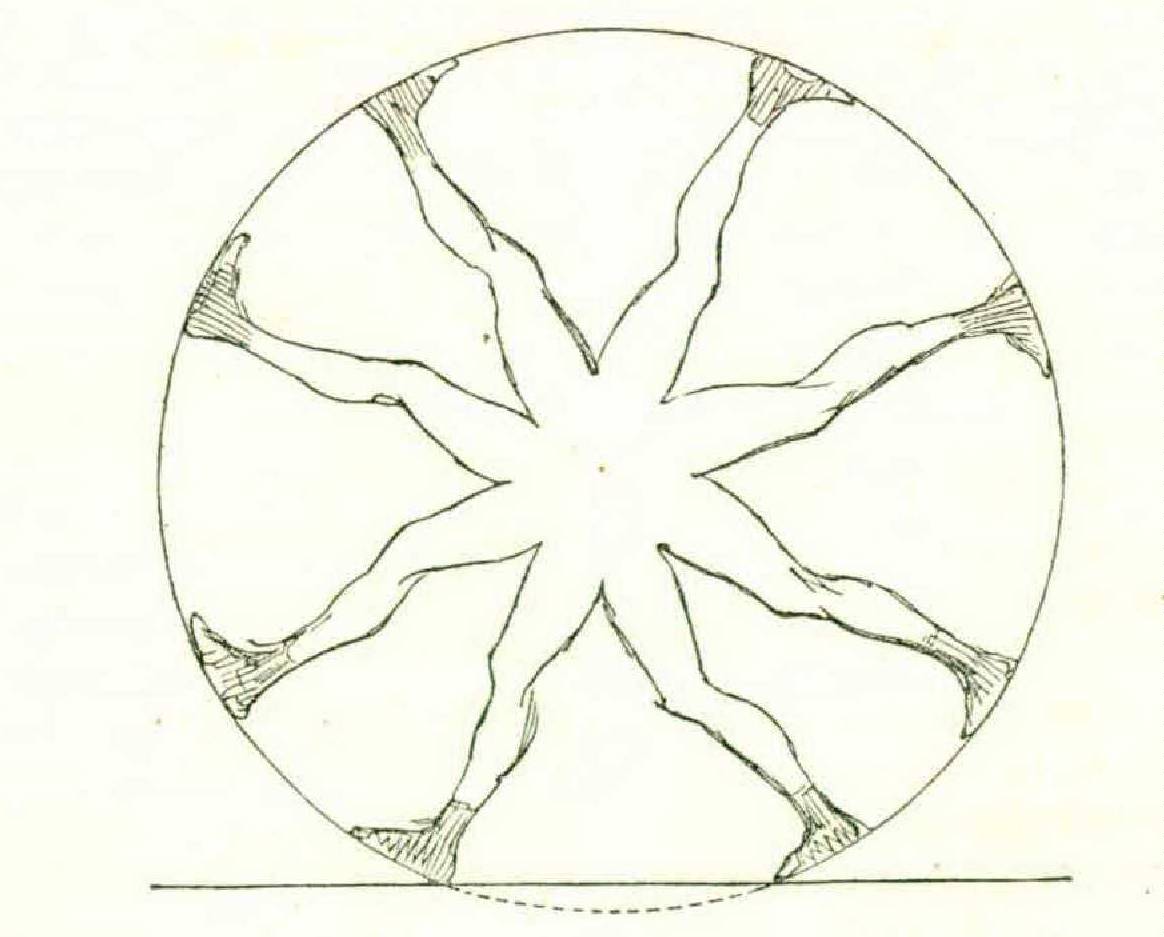
The somewhat singular illustration at the head of our article carries out an idea which has only been partially alluded to by others. Man is a wheel, with two spokes, has legs, and two fragments of a tire, his feet. He rolls successively on each of these fragments from the heel to the toe. If he had spokes enough, he would go round and round as the boys do when they " make a wheel ” with their four limbs for its spokes. But having only two available for ordinary locomotion, each of these has to be taken up as soon as it has been used, and carried forward to be used again, and so alternately with the pair. The peculiarity of bipedwalking is, that the centre of gravity is shifted from one leg to the other, and the one not employed can shorten itself so as to swing forward, passing by that which supports the body.
This is just what no automaton can do. Many of our readers have, however, seen a young lady in the shop-windows, or entertained her in their own nurseries, who professes to be this hitherto impossible walking automaton, and who calls herself by the Homeric-sounding epithet Autoperipatetikos. The golden-booted legs of this young lady remind us of Miss Kilmansegg, while their size assures us that she is not in any way related to Cinderella. On being wound up, as if she were a piece of machinery, and placed on a level surface, she proceeds to toddle off, taking very short steps like a child, holding herself very stiff and straight, with a little lifting at each step, and all this with a mighty inward whirring and buzzing of the enginery which constitutes her muscular system.
An autopsy of one of her family who fell into our hands reveals the secret springs of her action. Wishing to spare her as a member of the defenceless sex, it pains us to say, that, ingenious as her counterfeit walking is, she is an impostor. Worse than this, — with all our reverence for her brazen crinoline, duty compels us to reveal a fact concerning her which will shock the feelings of those who have watched the stately rigidity of decorum with which she moves in the presence of admiring multitudes. She is a quadruped! Inside of her great golden boots, which represent one pair ot feet, is another smaller pair, which move freely through these hollow casings.
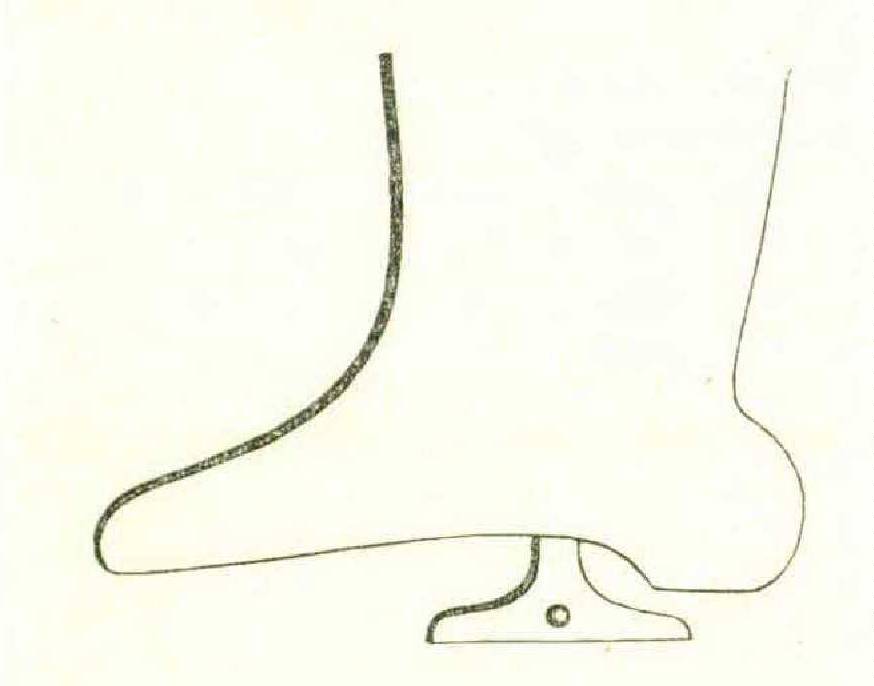
Four cams or eccentric wheels impart motion to her four supports, by which she is carried forward, always resting on two of them,—the boot of one side, and the foot of the other. Her movement, then, is not walking; it is not skating, which it seems to resemble ; it is more like that of a person walking with two crutches besides his two legs. The machinery is simple enough : a strong spiral spring, three or four cog-wheels and pinions, a fly to regulate the motion as in a musical box, and the cams before mentioned. As a toy, it or she is very taking to grown people as well as children. It is a literal fact, that the police requested one of our dealers to remove Miss Autoperipatetikos from his window, because the crowd she drew obstructed the sidewalk.
We see by our analysis of the process, and by the difficulty of imitating it, that walking is a much more delicate, perilous, complicated operation than we should suppose, and well worth studying in a practical point of view, to see what can be done to make it easier and safer. Two Americans have applied themselves to this task : one laboring for those who possess their lower limbs and want to use them to advantage, the other for such as have had the misfortune to lose one or both of them.
Dr. J. C. Plumer, formerly of Portland, now of Boston, has devoted himself to the study of the foot, and to the construction of a last upon which a boot or shoe can be moulded which shall be adapted to its form and accommodated to its action.
Most persons know something of the cruel injustice to which the feet are subjected, and the extraordinary distortions and diseases to which they are liable in consequence. The foot’s fingers are the slaves in the republic of the body. Their black leathern integument is only the mask of their servile condition. They bear the burdens, while the hands, their white masters, handle the money and wear the rings. They are crowded promiscuously in narrow prisons, while each of the hand’s fingers claims its separate apartment, leading from the antechamber, in the dainty glove. As a natural consequence of all this, their faculties are cramped, they grow into ignoble shapes, they become callous by long abuse, and all their natural gifts are crushed and trodden out of them.
Dr. Plumer is the Garrison of these oppressed members of the body corporeal, He comes to break their chains, to lift their bowed figures, to strengthen their weakness, to restore them to the dignity of digits. To do this, he begins whereevery sensible man would, by contemplating the natural foot as it appears in infancy, unspoiled as yet by social corruptions, in adults fortunate enough to have escaped these destructive influences, in the grim skeleton aspect divested of its outward disguises. We will give the reader two views of the latter kind, illustrating the longitudinal and transverse arches before spoken of.
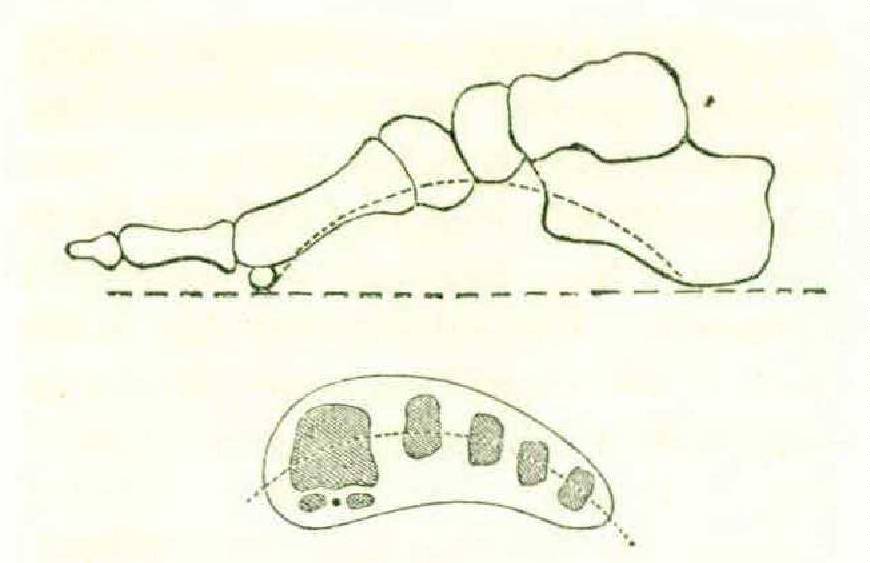
A man who walks on natural surfaces, with his feet unprotected by any artificial defences, calls the action of these arches into full play at every step. The longitudinal arch is the most strikingly marked of the two. In some races and in certain individuals it is much developed, so as to give the high instep which is prized as an evidence of good blood. The Arab says that a stream of water can flow under his foot without touching its sole. Under the conditions supposed, of a naked foot on a natural surface, the arches of the foot will commonly maintain their integrity, and give the noble savage or the barefooted Scotch lassie the elasticity of gait which we admire in the children of Nature.
But as a large portion of mankind tread on artificial hard surfaces, especially pavements, their feet are subjected to a very unnatural amount of wear and tear. How great this is the inhabitants of cities are apt to forget. After passing some months in the country, we have repeatedly found ourselves terribly lamed and shaken by our first walk on the pavement. A party of city-folk who landed on a beach upon Cape Cod complained greatly to one of the natives accompanying them of the difficulty of walking through the deep sand. “ Ah,” he answered, “it’s nothing to the trouble I have walking on your city-sidewalks.” To save the feet from the effects of violent percussion and uneven surfaces, they must be protected by thick soles, and thick soles require strong upperleather. When the foot is wedged into one of these casings, a new boot, a struggle begins between them, which ends in a compromise. The foot becomes more or less compressed or deformed, and the boot more or less stretched at the points where the counter-pressure takes place.
On the part of the foot, the effects of this warfare are liable to show themselves in thickening and inflammation of the integuments, in displacement of the toes, and occasionally in the breaking down of the transverse or longitudinal arches. On the part of the boot or shoe, there is a gradual accommodation which in time fits it to the foot almost as if it had been moulded upon it, so that a little before it is worn out it is invaluable, like other blessings brightening before they take their flight.
Now Mr. Plumer’s improvements proceed from two series of data. First, certain theoretical inferences from the facts above named. Finding the arches liable to break down, he supports the transverse arch by making the inner surface of the sole corresponding to it convex instead of concave transversely; he makes the middle portion of the sole convex again in both directions to support the longitudinal arch, and for the same reason extends the heel of the boot or shoe forward, so as to support the anterior portion of the heel of the foot. Secondly, Mr. Plumer takes an old shoe that has done good service, and studies the reliefs and hollows which the foot has shaped on the inner surface of its sole. Comparing the empirical results of this examination with those based on the anatomical data above given, and finding a general coincidence in them, he constructs his last in accordance with their joint teachings. Theoretically, Mr. Plumer is on somewhat dangerous ground. If the arches of the foot are made to yield like elliptical springs, why support them ? But we subject them to such unnatural conditions by pressure from above over the instep, by adding high heels to our boots and shoes, by taking away all yielding qualities from the soil on which we tread, that very probably they may want artificial support as much as the soles of the feet want artificial protection. If, now, we find that an old, easy shoe has worked the inside surface of its sole into convexities which support the arches, we are safe in imitating that at any rate. We shall have a new shoe with some, at least, of the virtues of the old one.
This all sounds very well, and the next question is, whether it works well. We cannot but remember the coat made for Mr. Gulliver by the Laputan tailors, which, though projected from the most refined geometrical data and the most profound calculations, he found to be the worst fit he ever put on his back. We must ask those who have eaten the pudding how it tastes, and those who have worn the shoe how it wears. We have no satisfactory experience of our own, having only within a week or two, by mere accident, stumbled into a pair of Plumerian boots, and being thus led to look into a matter which seemed akin to the main subject of this paper. But the author of " Views Afoot,” who ought to be a sovereign authority on all that interests pedestrians, confirms from his own experience the favorable opinions expressed by several of our most eminent physicians, from an examination of the principles of construction. We are informed that the Piumer last has been recently adopted lor the use of the army. We add our own humble belief that Dr. Plumer deserves well of mankind for applying sound anatomical principles to the construction of coverings for the feet, and for contriving a last serving as a model for a boot or shoe which is adapted to the form of the foot from the first, instead of having to be broken in by a painful series of limping excursions, too often accompanied by impatient and even profane utterances.
It is not two years since the sight of a person who had lost one of his lower limbs was an infrequent occurrence. Now, alas ! there are few of us who have not a cripple among our friends, if not in our own families. A mechanical art which provided for an occasional and exceptional want has become a great and active branch of industry. War unmakes legs, and human skill must supply their places as it best may.
Our common idea of a wooden leg is realized in the “ peg” of the Greenwich pensioner. This humble contrivance has done excellent service in its time, and may serve a good purpose still in some cases. A plain working-man, who has outlived his courting-days and need not sacrifice much to personal appearance, may find an honest, old-fashioned wooden leg, cheap, lasting, requiring no repairs, the best thing for his purpose. In higher social positions, and at an age when appearances are realities, in the condition of the Marquis of Anglesea, for instance, it becomes important to provide the cripple with a limb which shall be presentable in polite society, where misfortunes of a certain obtrusiveness may be pitied, but are never tolerated under the chandeliers.
The leg invented by Mr. Potts, and bearing the name of the “ Anglesea leg,” was long famous, and doubtless merited the reputation it acquired as superior to its predecessors. But legs cannot remain stationary while the march of improvement goes on around them, and they, too, have moved onward with the stride of progress.
A boy of ten years old, living in a New-Hampshire village, had one of his legs crushed so as to require amputation. The little fellow was furnished with a “ peg,” and stumped round upon it for ten years. We can imagine what he suffered as he grew into adolescence under the cross of this unsightly appendage. He was of comely aspect, tall, well-shaped, with well-marked, regular features. But just at the period when personal graces are most valued, when a good presence is a blank check on the Bank of Fortune, with Nature’s signature at the bottom, he found himself made hideous by this fearful - looking counterfeit of a limb. It announced him at the threshold he reached with beating heart by a thump more energetic than the palpitation in his breast. It identified him as far as the eye of jealousy could see his moving figure. The “peg” became intolerable, and he unstrapped it and threw himself on the tender mercies of the crutch.
But the crutch is at best an instrument of torture. It presses upon a great bundle of nerves ; it distorts the figure; it stamps a character of its own upon the whole organism ; it is even accused of distempering the mind itself.
This young man, whose name was “ B. FRAKK. PALMER,” (the abbreviations probably implying the name of a distinguished Boston philosopher of the last century, whose visit to Philadelphia is still remembered in that city,) set himself at work to contrive a limb which should take the place of the one he had lost, fulfilling its functions and counterfeiting its aspect so far as possible. The result was the “ Palmer leg,” one of the most unquestionable triumphs of American ingenuity. Its victorious march has been unimpeded by any serious obstacle since it first stepped into public notice. The inventor was introduced by the late Dr. John C. Warren, in 1846, to the Massachusetts General Hospital, which institution he has for many years supplied with his artificial limbs. He received medals from the American Institute, the Massachusetts Charitable Association, and the Great Exhibition in New York, and obtained an honorary mention from the Royal Commissioners of the World’s Exhibition in London, — being the only maker of legs so distinguished. These are only a few of fifty honorary awards he has received at various times. The famous surgeons of London, the Société de Chirurgie of Paris, and the most celebrated practitioners of the United States have given him their hearty recommendations. So lately as last August, that shrewd and skilful surgeon, Dr. Henry J. Bigelow, who is as cautious in handling his epithets as he is bold in using the implements of his art, Strongly advised Surgeon-General Hammond to adopt the Palmer leg, which, after a dozen years’ experience, he had found none to equal. We sec it announced that the Board of Surgeons appointed by the Surgeon-General to select the best arm and leg to be procured by the Government for its crippled soldiers chose that of Mr. Palmer, and that Dr. Hammond approved their selection.
We have thought it proper to show that Mr. Palmer’s invention did not stand in need of our commendation. Its merits, as we have seen, are conceded by the tribunals best fitted to judge, and we are therefore justified in selecting it as an illustration of American mechanical skill.
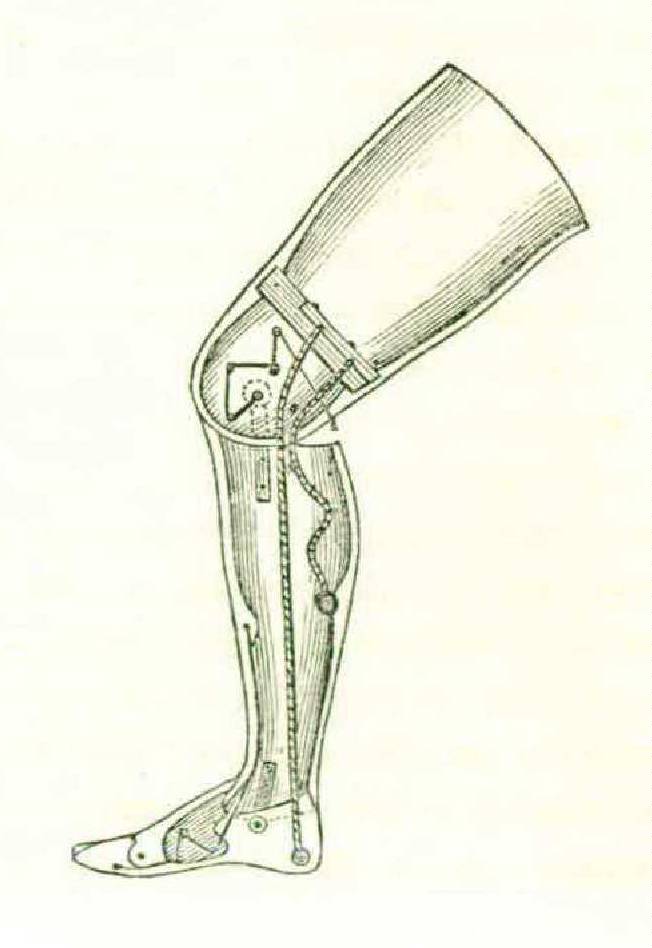
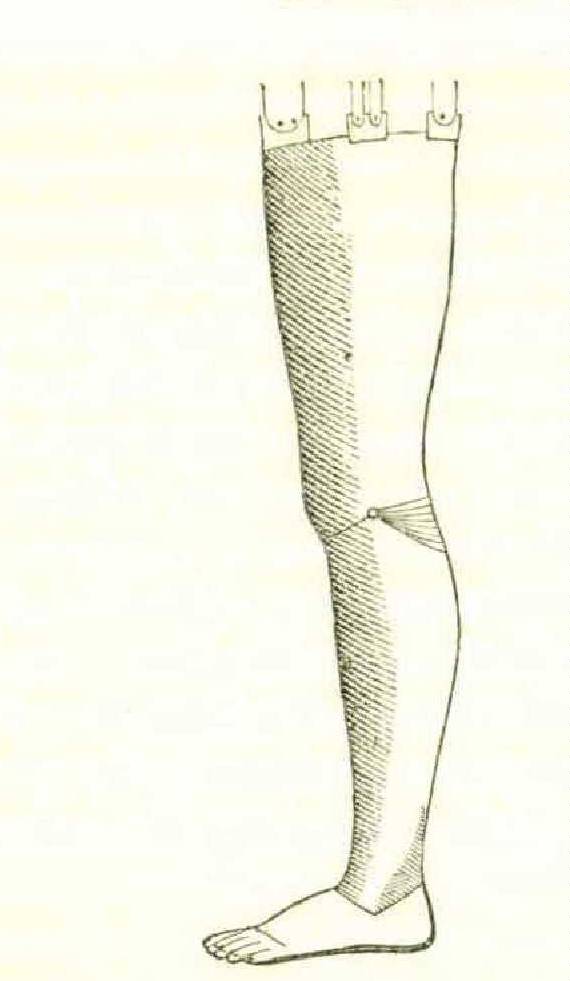
We give three views of the Palmer leg : an inside view when extended, a second when flexed, a third as it appears externally.
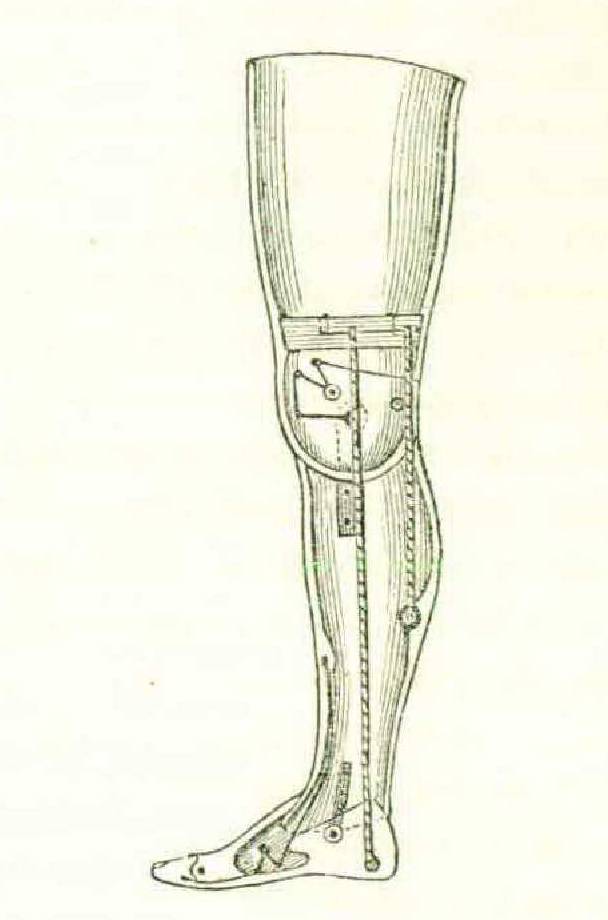
The Committee on Science and the Arts of the Franklin Institute of Pennsylvania thus stated the peculiarities of Mr. Palmer’s invention : —
“ First. An ingenious arrangement of springs and cords in the in side of the limb, by which, when the wearer is in the erect position, the limb is extended, and the foot flexed so as to present a natural appearance.
“ Second. By a second arrangement of cords and springs in the inside of the limb, the foot and toes are gradually and easily extended, when the heel is placed in contact with the ground. In consequence of this arrangement, the limping gait, and the unpleasant noise made by the sudden stroke of the ball of the foot upon the ground in walking, which are so obvious in the ordinary leg, are avoided.
“ Third. By a peculiar arrangement of the knee-joint, it is rendered little liable to wear, and all lateral or rotary motion is avoided. It is hardly necessary to remark that any such motion is undesirable in an artificial leg, as it renders its support unstable.”
Before reporting some of the facts which we have seen, or learned by personal inquiry, we must, be allowed, for the sake of convenience, to exercise the privilege granted to all philosophical students, of enlarging the nomenclature applicable to the subject of which we are treating.
Man, according to the Sphinx, is successively a quadruped, a biped, and a triped. But circumstances may change his natural conditions. If he loses a leg, he becomes a uniped. If he loses both his legs, he becomes a nulliped. If art replaces the loss of one limb with a factitious substitute, he becomes a ligniped, or, if we wish to be very precise, a unibigniped; two wooden legs entitle him to be called a biligniped. Our terminology being accepted, we are ready to proceed.
To make ourselves more familiar with the working of the invention we are considering, we have visited Mr. Palmer’s establishments in Philadelphia and Boston. The distinguished “ Surgeon-Artist ” is a man of fine person, as we have said. But if he has any personal vanity, it does not betray itself with regard to that portion of his organism which Nature furnished him. There is some reason to think that Mr. Palmer is a little ashamed of the lower limb which he brought into the world with him. At least, if he follows the common rule and puts that which he considers his best foot foremost, he evidently awards the preference to that which was born of his brain over the one which he owes to his mother. He walks as well as many do who have their natural limbs, though not so well as some of his own patients. He puts his vegetable leg through many of the movements which would seem to demand the contractile animal fibre. He goes up and down stairs with very tolerable ease and despatch. Only when he comes to stand upon the human limb, we begin to find that it is not in all respects equal to the divine one. For a certain number of seconds he can poise himself upon it.; but Mr. Palmer, if he indulges in verse, would hardly fill the Horatian complement of lines in that attitude. In his anteroom were unipeds in different stages of their second learning to walk as lignipeds. At first they move with a good deal of awkwardness, but gradually the wooden limb seems to become, as it were, penetrated by the nerves, and the intelligence to run downwards until it reaches the last joint of the member.
Mr. Palmer, as we have incidentally mentioned, has a branch establishment in Boston, to which also we have paid a visit, in order to learn some of the details of the manufacture to which we had not attended in our pleasant interview with the inventor. The antechamber here, too, was the nursery of immature lignipeds, ready to exhibit their growing accomplishments to the inquiring stranger. It almost seems as if the artificial leg were the scholar, rather than the person who wears it. The man does well enough, but the leg is stupid until practice has taught it just what is expected from its various parts.
The polite Boston partner, who, if he were in want of a customer, would almost persuade a man with two good legs to provide himself with a third, carried us to the back part of the building, where legs are organized.
The willow, which furnishes the charcoal for the gunpowder that blows off limbs, is the wood chosen to supply the loss it has helped to occasion. It is light, strong, does not warp or “ check ” so much as many other woods, and is, as the workmen say, healthy, that is, not irritating to the parts with which it is in contact. Whether the salicine it may contain enters the pores and invigorates the system may be a question for those who remember the drugs in the Sultan’s bat-handle and the remarkable cure they wrought. This wood is kept in a dryhouse with as much care as that intended for the manufacture of pianos. It is thoroughly steamed also, before using.
The wood comes in rudely shaped blocks, as lasts are sent to the factory, seeming to have been coarsely hewed out of the log. The shaping, as we found to our surprise, is all done by hand. We had expected to see great lathes, worked by steam-power, taking in a rough stick and turning out a finished limb. But it is shaped very much as a sculptor finishes his marble, with an eye to artistic effect,—not so much in the view of the stranger, who does not look upon its naked loveliness, as in that of the wearer, who is seduced by its harmonious outlines into its purchase, and solaced with the consciousness that he carries so much beauty and symmetry about with him. The hollowing-out of the interior is done by wicked-looking blades and scoops at the end of long stems, suggesting the thought of dentists’ instruments as they might have been in the days of the giants. The joints are most carefully made, more particularly at the knee, where a strong bolt of steel passes through the solid wood. Windows, oblong openings, are left in the sides of the limb, to insure a good supply of air to the extremity of the mutilated limb. Many persons are not aware that all parts of the surface breathe just as the lungs breathe, exhaling carbonic acid as well as water, and taking in more or less oxygen.
One of the workmen, a pleasant-looking young fellow, was himself, we were told, a ligniped. We begged him to give us a specimen of his walking. He arose and walked rather slowly across the room and back. “ Once more,” we said, not feeling quite sure which was Nature’s leg and which Mr. Palmer’s. So he walked up and down the room again, until we had satisfied ourselves which was the leg of willow and which that of flesh and bone. It is not, perhaps, to the credit of our eyes or observing powers, but it is a fact, that we deliberately selected the wrong leg. No victim of the thimblerigger’s trickery was ever more completely taken in than we were by the contrivance of the ingenious Surgeon-Artist.
Our freely expressed admiration led to the telling of wonderful stories about the doings of persons with artificial legs. One individual was mentioned who skated particularly well; another who danced with zeal and perseverance ; and a third who must needs swim in his leg, which brought on a dropsical affection of the limb, — to which kind of complaint the willow has, of course, a constitutional tendency, — and for which it had to come to the infirmary where the diseases that wood is heir to are treated.
But the most wonderful monuments of the great restorer’s skill are the patients who have lost both legs, — nullipeds, as presented to Mr. Palmer, bilignipeds, as they walk forth again before the admiring world, balanced upon their two new-born members. We have before us delineations of six of these hybrids between the animal and vegetable world. One of them was employed at a railwaystation near this (Atlantic) city, where he was often seen by a member of our own household, whose testimony we are in the habit of considering superior in veracity to the naked truth as commonly delivered. He walked about, we are assured, a little slowly and stiffly, but in a way that hardly attracted attention.
The inventor of the leg has not been contented to stop there. He has worked for years upon the construction of an artificial arm, and has at length succeeded in arranging a mechanism, which, if it cannot serve a pianist or violinist, is yet equal to holding the reins in driving, receiving fees for professional services, and similar easy labors. Where Mr. Palmer means to stop in supplying bodily losses it would be premature to say. We suppose the accidents happening occasionally from the use of the guillotine are beyond his skill, and spare our readers the lively remark suggested by the contrary hypothesis.
It is one of the signs of our advancing American civilization, that the arts which preserve and restore the personal advantages necessary or favorable to cultivated social life should have reached such perfection among us. American dentists have achieved a reputation which has sent them into the palaces of Europe to open the mouths of sovereigns and princes as freely as the jockeys look into those of horses and colts. Bad teeth, too common among us, help to breed good dentists, no doubt; but besides this there is an absolute demand for a certain comeliness of person throughout all the decent classes of our society. It is the same standard of propriety in appearances which lays us open to the reproach of caring too much for dress. If the national ear for music is not so acute as that of some other peoples, the national eye for the harmonies of form and color is better than we often find in older communities. We have a right to claim that our sculptors and painters prove so much as this for us. American taste was offended, outraged, by the odious “peg” which the Old-World soldier or beggar was proud to show. We owe the well-shaped, intelligent, docile limb, the half-reasoning willow of Mr. Palmer, to the same sense of beauty and fitness which moulded the soft outlines of the Indian Girl and the White Captive in the studio of his namesake at Albany.
As we wean ourselves from the Old World, and become more and more nationalized in our great struggle for existence as a free people, we shall carry this aptness for the production of beautiful forms more and more into common life, which demands first what is necessary and then what is pleasing. It is but a step from the painter’s canvas to the weaver’s loom, and the pictures which are leaving the easel to-day will show themselves in the patterns that sweep the untidy sidewalks to-morrow. The same plastic power which is showing itself in the triumphs of American sculpture will reach the forms of our household-utensils. The beans of Beverly shall yet be baked in vases that Etruria might have envied, and the clay pipe of the Americanized Milesian shall be a thing of beauty as well as a joy forever. We are already pushing the plastic arts farther than many persons have suspected. There is a small town not far from Us where a million dollars’ worth of gold is annually beaten into ornaments for the breasts, the fingers, the ears, the necks of women. Many a lady supposes she is buying Parisian adornments, when Attleborough could say to her proudly, like Cornelia, “These are my jewels.” The workmen of this little town not only meet the tastes of the less fastidious classes, to whom all that glisters is gold, but they shape the purest metal into artistic and effective patterns. When the Koh-i-noor — the Mountain of Light—was to be fashioned, it was found to be almost as formidable a task as that of Xerxes, when he undertook to hew Mount Athos to the shape of man. The great crystal was sent to Holland, as the only place where it could be properly cut. We have lately seen a brilliant which, if not a mountain of light, was yet a very respectable mound of radiance, valued at some ten or twelve thousand dollars, cut in this virgin settlement, and exposed in one of our shopwindows to tempt our frugal villagers.
Monsieur Trousseau, Professor in the Medical School of Paris, delivered a discursive lecture not long ago, in which he soared from the region of drugs, his wellknown special province, into the thin atmosphere of æsthetics. It is the influence that surrounds his fortunate fellow-citizens, he declares, which alone preserves their intellectual supremacy. If a Parisian milliner, he says, remove to New York, she will so degenerate in the course of a couple of years that the squaw of a Choctaw chief would be ashamed to wear one of her bonnets.
Listen, O Parisian cockney, pecking among the brood most plethoric with conceit, of all the coop-fed citizens who tread the pavements of earth’s manychimneyed towns! America has made implements of husbandry which out-mow and out-reap the world. She has contrived man-slaying engines which kill people faster than any others. She has modelled the wave-slicing clipper which outsails all your argosies and armadas. She has revolutionized naval warfare once by the steamboat. She has revolutionized it a second time by planting towers of iron on the elephantine backs of the waves. She has invented the sewing-machine to save the dainty fingers of your virtuous grisettes from uncongenial toil, so that Fifine and Frétillon may have more leisure for self-development. She has taught you a whole new system of labor in her machinery for making watches and rifles. She has bestowed upon you and all the world an anodyne which enables you to cut arms and legs off without hurting the patien t; and when his leg is off, she has given you a true artist’s limb for your cripple to walk upon, instead of the peg on which he has stumped from the days of Guy do Chauliac to those of M. Nelaton. She has been contriving well-shaped boots and shoes for the very people who, if they were your countrymen, would be clumping about in wooden sabots. In works of scientific industry, hardly to be looked for among so new a people she has distanced your best artificers. The microscopes made at Canastota, in the backwoods of New York, look in vain for their rivals in Paris, and must challenge the best workmanship of London before they can be approached in excellence. The great eye that stares into the celestial spaces from its workshop in Cambridge dives deeper through their clouds of silvery dust than any instrument mounted in your observatory in face of the Luxembourg. Our artisans produce no Gobelin tapestries or Sèvres porcelain as yet; but when your mobs have looted the Tuileries, our shopkeepers have bought up enough specimens to serve them as patterns by-and-by.
All this is something for a nation which has hardly pulled up the stumps out of its city market-places. It is sad to reflect that milliners, like Burgundy, are spoiled by transportation to the headquarters of American fashion. But as the best bonnet of the Empress’s own artist would be exploded with yells a couple of seasons after the time when it was the rage, the Icarian professor’s flight into the regions of rhetoric has not led him to any very logical resting-place from which he can look down on the aesthetic possibilities of New York or other Western cities emerging from the semi-barbarous state.
We are not proud, of course, of any of the mechanical triumphs we have won ; they are well enough, and show —to borrow the words of a distinguished American, whom, during his too brief career, we held unrivalled by any experimenter in the Old World for the depth as well as the daring of his investigations— that some things can be done as well as others.
Our specialty is of somewhat larger scope. We profess to make men and women out of human beings better than any of the joint-stock companies called dynasties have done or can do it. We profess to make citizens out of men, — not citoyens, but persons educated to question all privileges asserted by others, and claim all rights belonging to themselves, — the only way in which the infinitely most important party to the compact between the governed and governing can avoid being cheated out of the best rights inherent in human nature, as an experience the world has seen almost enough of has proved. We are in trouble just now, on account of a neglected hereditary melanosis, as Monsieur Trousseau might call it. When we recover from the social and political convulsion it has produced, and eliminate the materies morbi, — and both these events are only matters of time, — perhaps we shall have leisure to breed our own milliners. If not, there will probably be refugees enough from the Old World, who have learned the fashions in courts, and will be glad to turn their knowledge to a profitable use for the benefit of their republican patronesses in New York and Boston.
We have run away from our subject farther than we intended at starting; but an essay on legs could hardly avoid the rambling tendency which naturally belongs to these organs.
- Traite de la. Mėchaniqut des Organes de la Locomotion. Translated from the German in the Encyclopėdie Anatomique. Paris, 1843.↩