Have Accommodations Become an Unfair Advantage in Higher Education?
Readers respond to “Accommodation Nation”
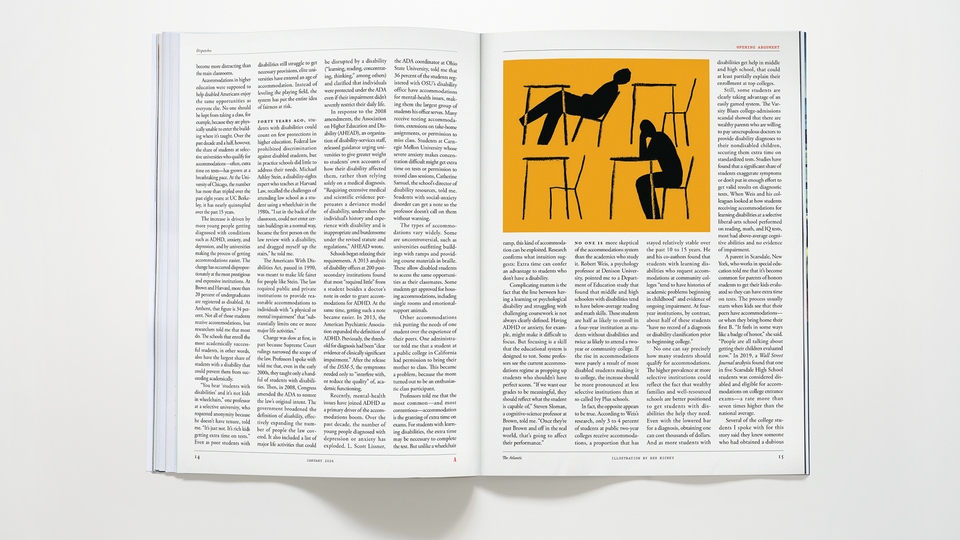
Accommodation Nation
In the January 2026 issue, Rose Horowitch reported on American colleges’ extra-time-on-tests problem.

Explore the May 2026 Issue
Check out more from this issue and find your next story to read.
As a teacher and an administrator with more than 40 years of experience providing special-education services in public schools, I have watched the evolution of awareness and support that Rose Horowitch describes. The Americans With Disabilities Act was meant to level the playing field by removing obstacles to publicly funded services for anyone identified as disabled. It was not enacted to provide advantages. But that has begun to change.
The root of the abuses, I think, is in the language of the law. The vagueness of crucial terms allows for easy manipulation of the eligibility process. The determination of a disability has become more subjective. Compassionate educators and invested parents can easily over-identify disabilities. I have seen students who perform extremely well on psychoeducational assessments and meet or exceed all grade-level standards put on an accommodation plan based on mild distractibility or slow written output.
Thanks to the ADA, many students who need support are seeing futures that otherwise would not have been possible. Yet the disproportionate number of “disabled” but high-achieving students at secondary schools reflects the pressure that students and their anxious parents feel to find any edge in a society where young adults face shrinking opportunities for gainful employment, secure incomes, and stable communities. These circumstances have turned a well-intentioned law into a ticket for advantages.
Patty Bell
Deerfield, Mass.
I recently graduated from law school in Canada, where the accommodations framework is very similar to that of the United States. I can confirm that the issue is quietly but frequently discussed among students. Because many law schools apply a curved grading system, students without time-based accommodations sometimes feel that attaining an A is virtually impossible. Numerous students conveyed to me a sense of disillusionment: No matter how diligently they prepare, they may still receive a B+ simply because the A-range grades have been taken by those who had twice the time to complete the assessment.
In response, some of my peers sought accommodations themselves—sometimes out of legitimate need, but sometimes because of the competitive pressure created by the system. This situation warrants careful reexamination. Short of eliminating accommodations—which would be contrary to human-rights principles and entirely inappropriate—the most constructive solution may be to reconsider the role of time limits in assessments altogether. Providing all students with a reasonable and uniform timeframe in which to demonstrate their knowledge, without excessive time pressure, may help restore both fairness and clarity in evaluation.
David Kantrovitz
Maple, Ontario, Canada
I am a former college disability-services professional who worked for more than 24 years in both two- and four-year institutions. Before entering the field professionally, I myself was a student who used accommodations in the early and mid-1990s. Although it is absolutely correct that the 2008 ADA amendments, the expanded assessment guidance, and the dramatic rise in ADHD, anxiety, and depression diagnoses among young people have all contributed to the increase in students receiving accommodations, so, too, has the corporatization of higher education.
Today, universities treat their students as customers. Rising tuition costs have forced administrators to adopt a customer-service model, which in turn has heightened pressure on staff to keep students and their families satisfied. Academic accommodations are often folded into the model, and disability-services providers are encouraged to waive or dilute documentation standards. This can improve access for students who lack financial resources, but my experience has been that the students who benefit the most are those with means. Demanding parents expect institutions to remove every obstacle to their children’s ideal college experience. This environment makes it extremely difficult for disability-services professionals to apply consistent standards or to make thoughtful, evidence-based decisions about which academic adjustments are genuinely warranted and which are simply desired.
Chris Kinney
Crozet, Va.
I was born with optic atrophy and am just blind enough to be designated “legally blind.” In 1961, I was completing a master’s degree at the University of Chicago; I needed only to pass a language exam to graduate. These exams were given in a huge room in an old stone building with little windows up near high ceilings. I didn’t have enough light to read. I failed. I went from one office to another requesting permission to take the test again with a lamp. No one seemed to have the authority to grant my “outrageous” request. I finally found a dean who laughed with me at the absurdity. He arranged for me to retake the exam with a good reading lamp. I thanked him. I took the exam again, and I passed.
Naomi Woronov
New York, N.Y.
I am a professor at a nonselective public university who attended an elite university with accommodations for both physical and learning disabilities. I have students who would really benefit from accommodations but do not seek them. Many of these students have been raised in households and communities that stigmatize disability or seeking help.
The Americans With Disabilities Act exists in an inequitable context—so of course economic inequality can hamper its application. But making accommodations harder to obtain is the wrong solution. Perhaps we ought to consider a more radical approach: rethinking pedagogies to be more inclusive so that accommodations are rendered moot. Unless the learning objective of a course is specifically to do something quickly, wouldn’t it be better if everyone had the time and means to demonstrate their mastery of a new concept or skill? We don’t lower academic rigor by making accommodations universal—we give students the ability to fully demonstrate what they’ve learned.
Miranda Worthen
Professor, San José State University
San José, Calif.
Why not allow extended time for all students? In a world where AI encourages quick fixes and discourages independent thinking, aren’t critical and deep thinking exactly what we want to cultivate at a university? My guess is that most students will not stay one minute more than they have to in an exam room.
Julie F. Skolnick
Potomac, Md.
Rose Horowitch replies:
Thank you for engaging with my article so thoughtfully. A perfect structure would allow accommodations for every student who needs them while preventing students who don’t from gaining an unfair advantage. But I understand that the same factors that allow more privileged students to access accommodations—wealth, cultural capital—can prevent others from getting the support they need. The suggestion to remove time limits is an interesting one. Some professors I spoke with said that they, too, favored this solution—they didn’t see any pedagogical need for their students to complete tests in a certain amount of time. The idea would create new demands at universities for physical space and proctors, but it could be worth exploring.
Behind the Cover
In this month’s cover story, “I Found It: The Best Free Restaurant Bread in America,” Caity Weaver travels across the country to determine which establishment—from strip-mall chains to upscale brasseries—offers its customers the greatest complimentary bread. Armed with more than 500 nominations, Weaver eventually crowned just one loaf champion. To accompany the story, we gathered 18 of the breads Weaver sampled for a photo shoot. On the cover are slices of a rustic country loaf from the three-Michelin-star Joël Robuchon at the MGM Grand in Las Vegas. (This is not the best free restaurant bread in America.)
— Bifen Xu, Senior Photo Editor

Corrections:
“The Women of Avenger Field” (April) stated that Patricia Perry moved two hours southeast to study political science at UC Berkeley and that she arrived in Sweetwater, Texas, on July 5, 1943. In fact, she moved two hours southwest, and she began training in Sweetwater on that date. The article also included a quote attributed to a base commander that was in fact a quote from another source paraphrasing his remarks, and used an incorrect verb tense in a quote from Pete Hegseth. “The Secrets of Indigenous Art” (March) stated that a traveling exhibition of Native abstraction was organized by Jeffrey Gibson. In fact, it was co-organized by Gibson and Jenelle Porter. “How America Got So Sick” (March) implied that tuberculosis was among the diseases covered by the national vaccine schedule for which cases are surging. In fact, the United States does not routinely vaccinate for tuberculosis.
This article appears in the May 2026 print edition with the headline “The Commons.”