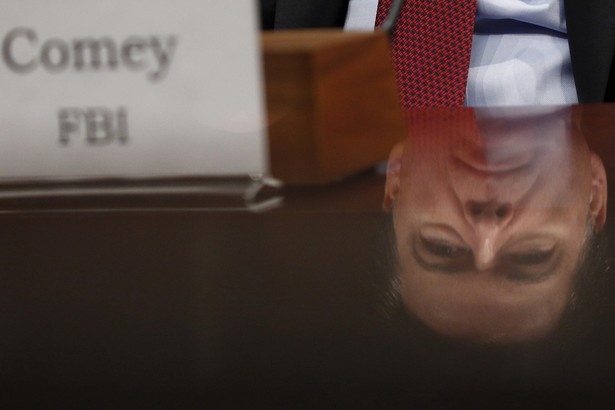
Comey testifies at a world wide threat hearing on Capitol Hill in Washington.
Kevin Lamarque / Reuters
On Tuesday, President Donald Trump fired James Comey, director of the FBI. Although Comey had been widely criticized for his handling of investigations related to the 2016 election, his dismissal was a shock to many observers, because he was overseeing an investigation into Russian interference in the election and whether any members of the Trump administration were involved. We're liveblogging the aftermath of the dismissal below; here are some highlights from our ongoing coverage:
The Senate Intelligence Committee Subpoenas Michael Flynn
Senate Intelligence Committee Chairman Richard Burr and Mike Warner, the committee’s vice chair, address reporters at a press conference on March 29. (Aaron P. Bernstein / Reuters)
The Senate Intelligence Committee formally issued a subpoena Wednesday to Michael Flynn, President Trump’s former national-security adviser, for “documents relevant to the Committee’s investigation into Russian interference with the 2016 election.” In a press release announcing the subpoena, Richard Burr, the committee’s Republican chairman, and Mark Warner, its Democratic ranking member, said they had originally requested the documents in an April 28 letter but Flynn declined to offer them voluntarily.
The subpoena is among the most advanced steps yet in either congressional investigation into Russian electoral interference. While the committee indicated it was the natural outcome of Flynn’s refusal to cooperate, it also sends a signal that the committee’s work will go forward despite FBI Director James Comey’s controversial ouster on Tuesday. NBC News reported that it’s the first of its kind from the Senate Intelligence Committee since the 9/11 attacks investigation and the first subpoena for documents from the committee since the Church Committee in the 1970s, which investigated U.S. intelligence-community abuses.
Was Comey Fired After Asking for More Resources in the Russian Meddling Investigation?
Gary Cameron / Reuters
The Department of Justice is denying reports that former FBI Director James Comey was fired just days after he asked for more resources to investigate alleged connections between the Trump administration and Russian election meddling.
The New York Timesfirst reported the news Wednesday morning, saying Comey met with Deputy Attorney General Rod Rosenstein last week, according to three anonymous sources. Rosenstein is the top official in charge of the investigation, because Attorney General Jeff Sessions recused himself after it was learned he failed to disclose meetings with the Russian ambassador. Rosenstein also wrote the memo recommending Comey’s dismissal.
Whether or not Comey asked for more resources and then found himself without a job a few days later is important because it bolsters the narrative that the Trump administration is seeking to undermine the investigation into Russia’s alleged election meddling. In a terse response to The Atlantic, when asked if the reports were true, DOJ spokesman Ian Prior said, “totally false.”
The Times reported that Comey briefed members of Congress after his meeting with Rosenstein, and told them he was frustrated by the lack of personnel and money provided to his agency for the investigation. He said he hoped to speed up the investigation, but in order to do so he needed more resources.
At a press briefing Wednesday afternoon, White House Deputy Press Secretary Sarah Huckabee Sanders said Comey’s dismissal had nothing to do with the investigation into Russia. She said Rosenstein and Sessions both told Trump they had concerns about Comey, and that Trump asked them to “put those concerns in writing.” Not long after, Trump fired Comey.
In Full Hockey Gear, Putin Responds to Comey's Firing
Reuters
While President Donald Trump met with Russian Foreign Minister Sergei Lavrov Wednesday morning at the White House, President Vladimir Putin was back in Russia preparing for a hockey game. As he was about to take the ice, CBS News stopped Putin at the rink’s entryway. Putin greeted reporter Elizabeth Palmer with a smirk. Dressed in hockey pads and a jersey, through a translator, Putin played off Comey’s dismissal as a purely domestic issue. Here’s a transcription of the quick conversation, and below it the video.
“Sir,” Palmer said, “how will the firing of James Comey affect U.S.-Russia relations?
“There will be no effect,” Putin replied. “Your question looks very funny for me. Don't be angry with me. We have nothing to do with that. President Trump is acting in accordance with his competence, in accordance with his law and constitution. What about us? Why we?”
“You see,” Putin told Palmer, “I am going to play hockey with the hockey fans. And I invite you to do the same.”
According to Russian media, Putin only learned to ice skate six years ago. He finished the game with seven points.
The Republicans Who Find Trump's Timing Suspicious
Jonathan Ernst / Reuters
Democrats say James Comey’s firing comes conveniently as the investigation into Russia’s alleged interference in the presidential election ramps up. And while there are plenty of conservatives who’ve rushed to support Trump’s decision, as my colleague Russell Berman notes, some Republicans have also called the timing suspicious. Arizona Senator John McCain, who has long been a critic of Trump, said he was “disappointed” in the decision. McCain acknowledged that the “president does have that constitutional authority. But I can’t help but think that this is not a good thing for America.”
Tennessee Senator Bob Corker said it was important the investigation be free of political interference, and that Comey’s “removal at this particular time will raise questions.” Nebraska Senator Ben Sasse, who is also chairman of the Judiciary Committee’s Oversight Subcommittee, said the “timing of this firing is very troubling.” And North Carolina Senate Intelligence Chairman Richard Burr also said he was “troubled by the timing and reasoning” of Comey’s dismissal.
Dir. Comey has been more forthcoming w/ information than any FBI Director I can recall in my tenure on the congressional intel committees.
Other Congressional Republicans who are skeptical of Trump’s decision include Michigan Representative Justin Amash, who called part of Trump’s dismissal letter to Comey “bizarre,” because the president thanked the FBI director for assuring him on three occasions that he was not being investigated. Arizona Senator Jeff Flake tweeted Tuesday night that he’d “spent the last several hours trying to find an acceptable rationale for the timing of Comey's firing. I just can't do it.”
Why is Donald Trump breaking bread with the “enemy of the people”?
Even in the best of times, the annual White House Correspondents’ Dinner is an awkward and ethically fraught affair. Journalists spend the evening partying with the president and administration officials whom they’re supposed to cover rigorously and skeptically. I’ve been to the dinner several times over the years. It’s typically crowded and a little chaotic, and the ratio of non-journalists to journalists is about 10 to 1. The evening is promoted as a celebration of journalism and the First Amendment, but it has always been a bit of an embarrassment.
These aren’t the best of times for White House correspondents or, for that matter, the First Amendment. And this year’s gala figures to be even more awkward and embarrassing than usual.
The people we were died at the exact moment our child did.
This article was featured in the One Story to Read Today newsletter. Sign up for it here.
My husband, David, hates Valentine’s Day. He once called it “New Year’s Eve with nuclear weapons.” I pretend not to care. Still, when the day passes entirely unremarked on, a woman can’t help but feel overlooked.
On Valentine’s Day 2024, David found a way out. He booked a speech on February 14 that required traveling from our home in Washington, D.C., to Toronto. I couldn’t object—he was getting paid. Anyway, I had my own plans: an “anti–Valentine’s Day” dinner hosted by one of the foreign embassies.
As I got ready, I called our oldest daughter, Miranda. She answered from her Brooklyn bathroom, getting ready for her own party. She propped her phone up beside her sink and laughed when I told her about her father’s strategic Valentine’s Day escape.
For the richest men on Earth, everything is free and nothing matters.
At the end of Paul Thomas Anderson’s 2007 movie, There Will Be Blood, Daniel Day-Lewis’s oil-baron character, old now and richer than Croesus, beats Paul Dano’s preacher to death with a bowling pin. Dano’s Eli Sunday, a nemesis of Day-Lewis’s Daniel Plainview during his seminal, wealth-building years, has come to sell Plainview the oil-rich land that he once coveted. But Plainview doesn’t need the land anymore, because—as he explains in one of the most famous monologues in modern cinema—he has sucked out all the oil hidden beneath it from an adjoining property, like a milkshake.
Desperate for money, Eli begs for a loan. Instead, Plainview chases him around a bowling alley and murders him with great enthusiasm. Once it’s over, a butler comes to see what all the noise was about. “I’m finished,” Plainview yells.
Kash Patel has alarmed colleagues with episodes of excessive drinking and unexplained absences.
This article was featured in the One Story to Read Today newsletter. Sign up for it here.
On Friday, April 10, as FBI Director Kash Patel was preparing to leave work for the weekend, he struggled to log on to an internal computer system. He quickly became convinced that he had been locked out, and he panicked, frantically calling aides and allies to announce that he had been fired by the White House, according to nine people familiar with his outreach. Two of these people described his behavior as a “freak-out.”
Patel oversees an agency that employs roughly 38,000 people, including many who are trained to investigate and verify information that can be presented under oath in a court of law. News of his emotional outburst ricocheted through the bureau, prompting chatter among officials and, in some corners of the building, expressions of relief. The White House fielded calls from the bureau and from members of Congress asking who was now in charge of the FBI.
The administration has downplayed the importance of the text messages inadvertently sent to The Atlantic’s editor in chief.
So, about that Signal chat.
On Monday, shortly after we published a story about a massive Trump-administration security breach, a reporter asked the secretary of defense, Pete Hegseth, why he had shared plans about a forthcoming attack on Yemen on the Signal messaging app. He answered, “Nobody was texting war plans. And that’s all I have to say about that.”
This article was featured in the One Story to Read Today newsletter. Sign up for it here.
At a Senate hearing yesterday, the director of national intelligence, Tulsi Gabbard, and the director of the Central Intelligence Agency, John Ratcliffe, were both asked about the Signal chat, to which Jeffrey Goldberg, the editor in chief of The Atlantic, was inadvertently invited by National Security Adviser Michael Waltz. “There was no classified material that was shared in that Signal group,” Gabbard told members of the Senate Intelligence Committee.
More families who can afford it are hiring a house manager, a kind of “chief of staff for the home.”
Here is the promise of a house manager. Hire one, and soon someone else could be doing your laundry, washing your dishes, prepping your meals, and completing those Amazon returns you’ve been meaning to make. They could reorganize the utensil drawer, notice if your kid is outgrowing their shoes and order more, take your car to the repair shop, and be at home to meet the plumber. If your child needs food for a class party, a house manager could make the dish and drop it off; if that child also has a pet lizard, a house manager could buy the crickets to feed it.
House managers are not a nanny or a house cleaner. They’re a “chief of staff for the home,” a “personal assistant for Mom,” and “a clone of myself,” according to the more than a dozen people I spoke with who have either hired one or work as one. They are, in effect, what might have once been called a housekeeper—a person who helps oversee a household’s basic functioning. Middle- and upper-class families used to more commonly employ this kind of position (the title “house manager” dates back to at least the 1830s), but it has become rare enough that a couple of people I spoke with thought they may have come up with the term.
Montana Democrats thought they found a novel way to win control of the U.S. Senate—until the party faithful started fighting back.
Jason Boeshore, a grain-elevator manager on the eastern plains of Montana, fired off a rocket this month to the private Signal chat he shares with the 23 other members of the state Democratic Party executive board. He demanded that leaders make clear in newspapers across the state that the Democratic Party would support only Democratic candidates in the fall elections. The response was swift and not to his liking. Shannon O’Brien, the chair of the party, wrote that her staff, not the board, would set the messaging strategy. Then she addressed the unspoken concerns at the heart of Boeshore’s request. “Listen if ANY of you EVER find yourselves questioning my intentions, please call me,” O’Brien wrote. “I will continue to move forward to get Democrats elected. There’s no hidden agenda.”
U.S. national-security leaders included me in a group chat about upcoming military strikes in Yemen. I didn’t think it could be real. Then the bombs started falling.
The world found out shortly before 2 p.m. eastern time on March 15 that the United States was bombing Houthi targets across Yemen.
I, however, knew two hours before the first bombs exploded that the attack might be coming. The reason I knew this is that Pete Hegseth, the secretary of defense, had texted me the war plan at 11:44 a.m. The plan included precise information about weapons packages, targets, and timing.
This is going to require some explaining.
This article was featured in the One Story to Read Today newsletter. Sign up for it here.
The story technically begins shortly after the Hamas invasion of southern Israel, in October 2023. The Houthis—an Iran-backed terrorist organization whose motto is “God is great, death to America, death to Israel, curse on the Jews, victory to Islam”—soon launched attacks on Israel and on international shipping, creating havoc for global trade. Throughout 2024, the Biden administration was ineffective in countering these Houthi attacks; the incoming Trump administration promised a tougher response.
The phrase is even more complicated than it appears.
Earlier this month, a staff writer for The Free Press, Olivia Reingold, asked the Democratic Senate candidate Abdul El-Sayed from Michigan a question: “Does Israel have a right to exist as a Jewish state?”
El-Sayed replied with his own question: “What do you mean by a ‘Jewish state’?” When Reingold went silent, before beginning to stutter out a response, El-Sayed continued, “If you can’t define the question, I’m not going to answer your question.”
A lot of labels and terms get thrown around in arguments over the Israeli-Palestinian conflict, words such as Zionist or anti-Zionist and one state or two states. These terms are not always well defined, and they mean different things to different factions—so it’s important, when discussing such matters, to know what people actually mean.
Lori Chavez-DeRemer was supposed to take the GOP in a more worker-friendly direction. Instead she joins a group of dismissed administration officials.
This is an edition of The Atlantic Daily, a newsletter that guides you through the biggest stories of the day, helps you discover new ideas, and recommends the best in culture. Sign up for it here.
When Lori Chavez-DeRemer was nominated, she had a chance to be a pathbreaking secretary of labor, supposedly tasked with shepherding the Republican Party in a more worker-friendly direction. Instead, she turned out to be a typical Trump Cabinet member: disempowered and disgraced. Now she has added dismissed to that list.
Chavez-DeRemer’s departure was announced yesterday evening in an X post from White House Communications Director Steven Cheung, who said she would “take a position in the private sector.” He said that Keith Sonderling, the deputy secretary, will be acting secretary.