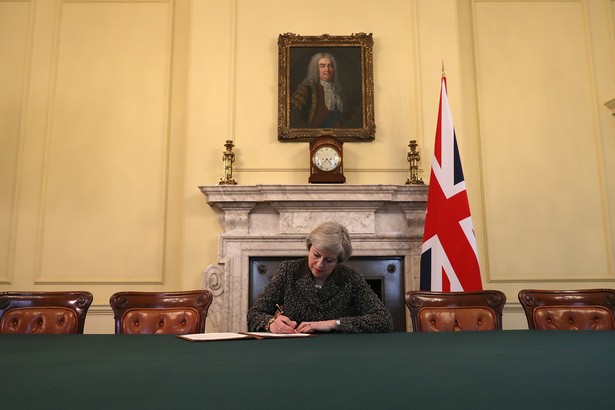
—The U.K. government has invoked Article 50 of the EU charter, triggering the mechanism by which it can begin formal talks on its separation from the European Union. More here
—Iraqi troops, backed by U.S. and allied forces, are trying to wrest Mosul back from ISIS.
—The Nobel Academy says Bob Dylan, who skipped the award ceremony in December, will pick up his prize this weekend. More here
—We’re tracking the news stories of the day below. All updates are in Eastern Daylight Time (GMT -4).
Bridget Anne Kelly, former deputy chief of staff to New Jersey Governor Chris Christie, arrives Wednesday for her sentencing at the Federal Courthouse in Newark, New Jersey. (Lucas Jackson / Reuters)
U.S. District Judge Susan Wigenton sentenced Bill Baroni and Bridget Anne Kelly, two former top associates of Governor Chris Christie, to prison time for their role in the “Bridgegate” scandal. Baroni, the former deputy executive director of the Port Authority of New York and New Jersey, received 24 months, along with a year of probation, 500 hours of community service, fines and restitution. Kelly, Christie’s deputy chief of staff, was sentenced to 18 months in prison. A jury in Newark, New Jersey, found them guilty last November of all charges. As I wrote at the time:
Baroni … and Kelly were indicted [in 2015] on nine counts of conspiracy and fraud in connection with the scheme in 2013 to close lanes on a section of the George Washington Bridge in Fort Lee, New Jersey, over the refusal of its Democratic mayor to endorse Christie, a Republican, for re-election. …
Federal prosecutors’ main witness in the six-week trial was David Wildstein, a Christie appointee to the Port Authority who admitted to masterminding the plan. The jury also heard testimony from more than 30 other witnesses, including Baroni and Kelly. Federal prosecutors alleged Christie was aware of the actions of his aides.
Christie, a close associate of President Trump, consistently denied any knowledge or involvement in the lane closures, and hasn’t been charged with any wrongdoing.
Kelly and Baroni will remain free while they appeal their convictions.
Iraqi Forces Battle ISIS in Mosul as Concerns Over Civilian Casualties Persist
(Khalid Al Mousily / Reuters)
Iraqi forces are battling ISIS militants in western Mosul, Iraq’s second-largest city that was captured by the Islamic State in 2014. Here’s more from Reuters today on the state of the fighting: “The close-quarters fighting is focused on the Old City surrounding the [ al-Nuri] mosque where Islamic State leader Abu Bakr al-Baghdadi proclaimed a caliphate nearly three years ago across territory controlled by the group in both Iraq and Syria.” Thousands of civilians are trapped in the city, and as the fighting rages, their position is fraught. Indeed, as we reported yesterday, the Pentagon is investigating the March 17 coalition airstrike in Mosul that may have led to the collapse of buildings with at least 160 people inside. “It is very possible that Daesh blew up that building to blame it on the coalition in order to cause a delay in the offensive into Mosul and cause a delay in the use of coalition airstrikes,” General Mark A. Milley, the U.S. army chief of staff, told reporters Monday in Baghdad. “And it is possible the coalition airstrike did it.” But Lieutenant General Stephen Townsend, the senior coalition commander in Iraq, said: “My initial assessment is that we probably had a role in these casualties.”
Bob Dylan to Accept Nobel Prize This Weekend, Swedish Academy Says
(Robert Galbraith / Reuters)
Bob Dylan will accept his Nobel Prize for Literature this weekend, a member of the Swedish Academy, the body that awards the prize, has said in a blog entry. The academy announced last October that Dylan had won the prize “for having created new poetic expressions within the great American song tradition.” But the famously reclusive singer did not acknowledge the award or indicate whether he would accept it until two weeks after the announcement, telling a British newspaper he would attend the ceremony “if it’s all possible.” Ultimately, he did not—but he did send a speech in which he said the prize “is something I never could have imagined or seen coming.” Which brings us to today’s blog post by Sara Danius, the permanent secretary of the Swedish Academy. She said:
The good news is that the Swedish Academy and Bob Dylan have decided to meet this weekend. The Academy will then hand over Dylan’s Nobel diploma and the Nobel medal, and congratulate him on the Nobel Prize in Literature. The setting will be small and intimate, and no media will be present; only Bob Dylan and members of the Academy will attend, all according to Dylan’s wishes.
Tim Barrow, the U.K.'s permanent representative to the European Union, arrives Wednesday at EU Council headquarters in Brussels to formally trigger Article 50 of the Lisbon Treaty. (Yves Herman / Reuters)
The U.K.’s envoy to the European Union has hand-delivered a letter from Prime Minister Theresa May to the office of European Council president in Brussels, invoking Article 50 of the Lisbon Treaty and formally beginning the process of talks over the U.K.’s separation from the European Union. The move comes nine months after Britons voted 52 percent to 48 percent to leave the EU, a decision that shocked the political establishment, and sparked a rancorous debate in the U.K. on what a future U.K.-EU relationship should look like. It’s the nature of that relationship that talks between the U.K. and the EU will focus on. The process will take two years, during which time the U.K. remains a full member of the bloc. Those who campaigned to keep the U.K. in the EU want a future relationship to be similar to the one the country enjoyed with full EU membership, but the main sticking point, access to the EU single market, depends on the free movement of the EU’s citizens across the bloc—an aspect of membership deeply unpopular in the U.K. Linda Kintsler wrote yesterday about what happens next. Read it here.
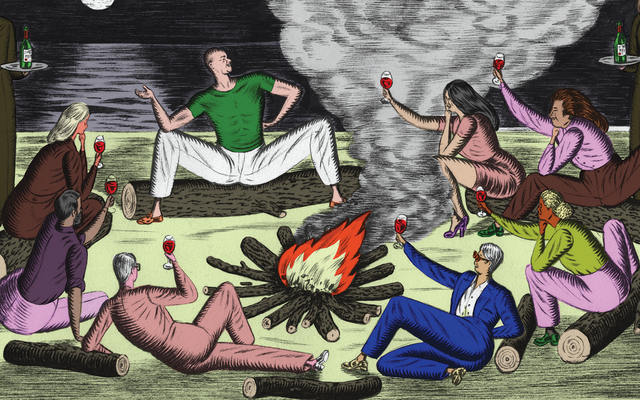
For the richest men on Earth, everything is free and nothing matters.
At the end of Paul Thomas Anderson’s 2007 movie, There Will Be Blood, Daniel Day-Lewis’s oil-baron character, old now and richer than Croesus, beats Paul Dano’s preacher to death with a bowling pin. Dano’s Eli Sunday, a nemesis of Day-Lewis’s Daniel Plainview during his seminal, wealth-building years, has come to sell Plainview the oil-rich land that he once coveted. But Plainview doesn’t need the land anymore, because—as he explains in one of the most famous monologues in modern cinema—he has sucked out all the oil hidden beneath it from an adjoining property, like a milkshake.
Desperate for money, Eli begs for a loan. Instead, Plainview chases him around a bowling alley and murders him with great enthusiasm. Once it’s over, a butler comes to see what all the noise was about. “I’m finished,” Plainview yells.
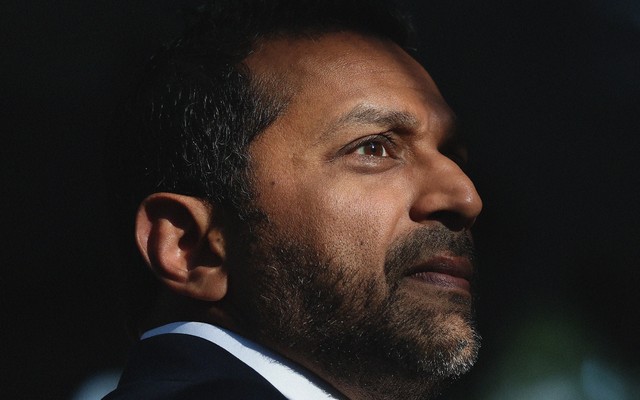
Kash Patel has alarmed colleagues with episodes of excessive drinking and unexplained absences.
This article was featured in the One Story to Read Today newsletter. Sign up for it here.
On Friday, April 10, as FBI Director Kash Patel was preparing to leave work for the weekend, he struggled to log on to an internal computer system. He quickly became convinced that he had been locked out, and he panicked, frantically calling aides and allies to announce that he had been fired by the White House, according to nine people familiar with his outreach. Two of these people described his behavior as a “freak-out.”
Patel oversees an agency that employs roughly 38,000 people, including many who are trained to investigate and verify information that can be presented under oath in a court of law. News of his emotional outburst ricocheted through the bureau, prompting chatter among officials and, in some corners of the building, expressions of relief. The White House fielded calls from the bureau and from members of Congress asking who was now in charge of the FBI.
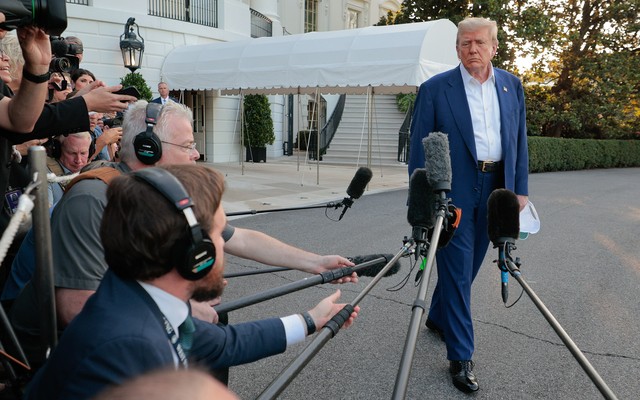
Why is Donald Trump breaking bread with the “enemy of the people”?
Even in the best of times, the annual White House Correspondents’ Dinner is an awkward and ethically fraught affair. Journalists spend the evening partying with the president and administration officials whom they’re supposed to cover rigorously and skeptically. I’ve been to the dinner several times over the years. It’s typically crowded and a little chaotic, and the ratio of non-journalists to journalists is about 10 to 1. The evening is promoted as a celebration of journalism and the First Amendment, but it has always been a bit of an embarrassment.
These aren’t the best of times for White House correspondents or, for that matter, the First Amendment. And this year’s gala figures to be even more awkward and embarrassing than usual.
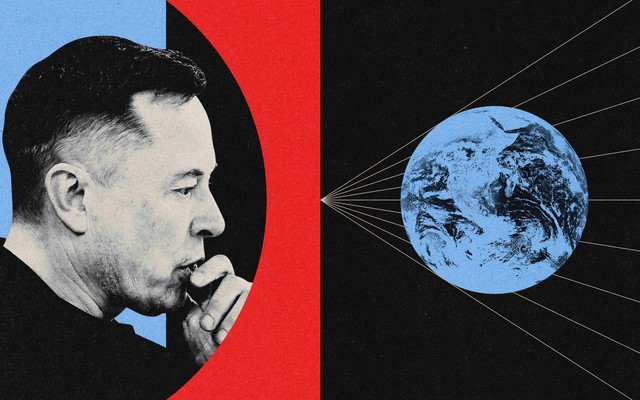
The world’s richest man is accruing more power than ever before.
If Elon Musk gets his way, space will soon look very different. Through his ownership of SpaceX, the world’s richest man already operates most of the roughly 14,000 active satellites that are orbiting Earth. Now his rocket company is asking the government for permission to launch up to 1 million more. It’s part of Musk’s plan to build data centers in space that can harness the power of the sun for AI. “You’re power-constrained on Earth,” Musk said last month. “Space has the advantage that it’s always sunny.”
Musk has a lot riding on these orbital data centers. To help finance them, he is set to take SpaceX public as early as June, at a reported valuation of $2 trillion. Musk has claimed that data centers in space can “enable self-growing bases on the moon, an entire civilization on Mars, and ultimately expansion to the universe.” It’s all classic Musk, who has a habit of making big promises that he can’t always keep. Data centers in space are an untested technology, and it’s not clear if they’d actually work. (Neither Musk nor SpaceX responded to a request for comment.)
The “disappearing scientists” story is, in its way, a remarkable achievement.
The mystery of the missing scientists began with a Silver Alert. In late February, a retired Air Force major general named Neil McCasland left his house in New Mexico for a walk and never returned. Rumors spread on social media that the elderly former astronautical engineer had been abducted or killed. Forget Nancy Guthrie, they said. Here was a guy who used to run a “UFO-linked” lab. Here was a guy with knowledge of “America’s deepest, darkest secrets.” So where was this guy?
McCasland’s wife did her best with a post on Facebook to address what she called the “misinformation circulating about Neil and his disappearance,” but wild notions only multiplied. Dots were added, then connected: Another scientist—an advanced-materials researcher at NASA’s Jet Propulsion Laboratory (JPL) named Monica Reza—had disappeared while hiking near Los Angeles in June 2025. A physicist at MIT had been murdered in December. “What is going on seems to be an enemy action,” Walter Kirn, the novelist and podcast contrarian, said last month.
The people we were died at the exact moment our child did.
This article was featured in the One Story to Read Today newsletter. Sign up for it here.
My husband, David, hates Valentine’s Day. He once called it “New Year’s Eve with nuclear weapons.” I pretend not to care. Still, when the day passes entirely unremarked on, a woman can’t help but feel overlooked.
On Valentine’s Day 2024, David found a way out. He booked a speech on February 14 that required traveling from our home in Washington, D.C., to Toronto. I couldn’t object—he was getting paid. Anyway, I had my own plans: an “anti–Valentine’s Day” dinner hosted by one of the foreign embassies.
As I got ready, I called our oldest daughter, Miranda. She answered from her Brooklyn bathroom, getting ready for her own party. She propped her phone up beside her sink and laughed when I told her about her father’s strategic Valentine’s Day escape.
Montana Democrats thought they found a novel way to win control of the U.S. Senate—until the party faithful started fighting back.
Jason Boeshore, a grain-elevator manager on the eastern plains of Montana, fired off a rocket this month to the private Signal chat he shares with the 23 other members of the state Democratic Party executive board. He demanded that leaders make clear in newspapers across the state that the Democratic Party would support only Democratic candidates in the fall elections. The response was swift and not to his liking. Shannon O’Brien, the chair of the party, wrote that her staff, not the board, would set the messaging strategy. Then she addressed the unspoken concerns at the heart of Boeshore’s request. “Listen if ANY of you EVER find yourselves questioning my intentions, please call me,” O’Brien wrote. “I will continue to move forward to get Democrats elected. There’s no hidden agenda.”
More families who can afford it are hiring a house manager, a kind of “chief of staff for the home.”
Here is the promise of a house manager. Hire one, and soon someone else could be doing your laundry, washing your dishes, prepping your meals, and completing those Amazon returns you’ve been meaning to make. They could reorganize the utensil drawer, notice if your kid is outgrowing their shoes and order more, take your car to the repair shop, and be at home to meet the plumber. If your child needs food for a class party, a house manager could make the dish and drop it off; if that child also has a pet lizard, a house manager could buy the crickets to feed it.
House managers are not a nanny or a house cleaner. They’re a “chief of staff for the home,” a “personal assistant for Mom,” and “a clone of myself,” according to the more than a dozen people I spoke with who have either hired one or work as one. They are, in effect, what might have once been called a housekeeper—a person who helps oversee a household’s basic functioning. Middle- and upper-class families used to more commonly employ this kind of position (the title “house manager” dates back to at least the 1830s), but it has become rare enough that a couple of people I spoke with thought they may have come up with the term.
With the rise of screen culture, all the world has stage fright.
The beta-blocker propranolol has been a mainstay of American medicine since the 1960s, when it was regularly prescribed as a first-line defense against hypertension, arrhythmia, and other cardiovascular problems. Recent years, though, have seen a boom in the medication’s prescription rates—in part because as the drug regulates the heart, it also settles the nerves. Off-label, propranolol is used to calm the assorted storms of stage fright: the sweaty palms, the belly churn, the racing heart. Even professional performers have publicly alluded to using it. Robert Downey Jr., accepting an award at the 2024 Golden Globes, said casually, “I took a beta-blocker, so this is going to be a breeze.” Last fall, a People magazine headline asked, “Why Is Everyone Suddenly Taking the Decades-Old Chill Pill Propranolol?”
The phrase is even more complicated than it appears.
Earlier this month, a staff writer for The Free Press, Olivia Reingold, asked the Democratic Senate candidate Abdul El-Sayed from Michigan a question: “Does Israel have a right to exist as a Jewish state?”
El-Sayed replied with his own question: “What do you mean by a ‘Jewish state’?” When Reingold went silent, before beginning to stutter out a response, El-Sayed continued, “If you can’t define the question, I’m not going to answer your question.”
A lot of labels and terms get thrown around in arguments over the Israeli-Palestinian conflict, words such as Zionist or anti-Zionist and one state or two states. These terms are not always well defined, and they mean different things to different factions—so it’s important, when discussing such matters, to know what people actually mean.