—Police say five people, including the alleged assailant, were killed in a terrorist attack in London. Forty others were injured. More here
—At Wednesday’s hearing, Democratic senators adopted a new strategy to press Supreme Court nominee Neil Gorsuch on abortion and campaign finance. More here
—House Intelligence Chairman Devin Nunes turned quite a few heads on Capitol Hill when he announced he’s learned that the Intelligence Community “incidentally collected information about U.S. citizens involved in the Trump transition.” More here
—We’re tracking the news stories of the day below. All updates are in Eastern Standard Time (GMT -5).
House Intelligence Chairman Devin Nunes turned quite a few heads on Capitol Hill Wednesday when he announced he’s learned that the Intelligence Community “incidentally collected information about U.S. citizens involved in the Trump transition.” He said he received this information through an unnamed source. The vague statement from the congressman and Trump ally did note that the intelligence was gathered legally and that there was no evidence of wiretapping at Trump Tower. But the news does throw a lifeline to President Trump after weeks of alleging his predecessor “wiretapped” him. As my colleague David A. Graham writes:
Nunes’s vague statements raised a host of questions, and his decision to announce them publicly and then go to the White House to brief President Trump, having not informed Democrats on the committee about his new findings, cast a pall of politics over the proceedings.
Trump said felt “somewhat vindicated” by the announcement, as former intelligence officials and Democrats on the Hill said the statement from Nunes was inappropriate.
Possible U.S. Airstrike Kills 33 Civilians in Syria
Ammar Abdullah / Reuters
A possible U.S. airstrike killed 33 civilians in Syria, a monitoring group said Wednesday. The Syrian Observatory for Human Rights, a London-based network trusted by many news organizations, said the U.S.-led coalition airstrike hit a school in northern Syria in a region controlled by ISIS. The school, located in the town of Mansoura, some 15 miles southwest of Raqqa, was being used as a shelter for displaced families from Raqqa, Aleppo, and Homs. Only two people survived the airstrike. U.S. officials have not confirmed whether the airstrike took place. U.S. military personnel were in the area that day airlifting around 500 U.S.-trained Syrian fighters. Fighting remains intense the northern city of Raqqa, the last ISIS stronghold and self-declared capital.
A file photo of the Palace of Westminister in central London on January 9, 2002. (Russell Boyce / Reuters)
The U.K. Parliament was placed under lockdown Wednesday after reports emerged of gunfire outside Westminster Palace in central London, according to local media. Details about what exactly happened are not yet known.
This story is developing. For more updates, follow our live blog here.
More Allegations About Manafort's Russia Links, But Trump's Former Campaign Manager Rejects Them
(Carlo Allegri / Reuters)
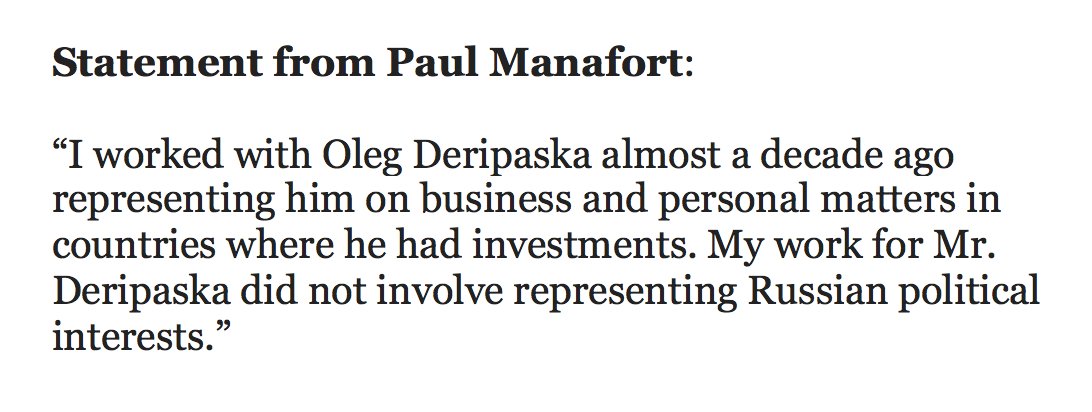
Paul Manafort, who was chair of Donald Trump’s presidential campaign, worked secretly a decade ago for Oleg Deripaska, a Russian billionaire, to further Russian President Vladimir Putin’s interests, the Associated Press is reporting this morning, citing documents that laid out Manafort’s plan to hurt opponents of Russia across the former Soviet Union. For this work, the AP adds, Manafort received a $10 million annual contract beginning in 2006. Manafort and the Trump White House have repeatedly denied that Manafort, who previously worked for Ukraine’s pro-Moscow president, worked to further Russian government interests. Manafort’s repeated that assertion today in response to the AP’s story, acknowledging he worked for Deripaska, but noting his “work did not involve representing Russian political interests.” Here’s more from the AP: “Manafort proposed in a confidential strategy plan as early as June 2005 that he would influence politics, business dealings and news coverage inside the United States, Europe and the former Soviet republics to benefit the Putin government, even as U.S.-Russia relations under Republican President George W. Bush grew worse. … Manafort and Deripaska maintained a business relationship until at least 2009, according to one person familiar with the work.” The allegations come a day after Serhiy Leshchenko, a Ukrainian lawmaker, said he had evidence Manafort tried to hide about $750,000 as payment in 2009 from a pro-Russia political party in Ukraine; at the time, Manafort was an adviser to Viktor Yanukovych, the Ukrainian president who was close to Moscow. Manafort called that claim “baseless.” On Monday, FBI Director James Comey told lawmakers the bureau was “investigating the Russian government's efforts to interfere in the 2016 presidential election,” including “the nature of any links between individuals associated with the Trump campaign and the Russian government, and whether there was any coordination between the campaign and Russia’s efforts.”
Judge Gorsuch Prepares for the Third Day of His Confirmation Hearings
(Joshua Roberts / Reuters)
Judge Neil Gorsuch will face questions for the third day from lawmakers on the Senate Judiciary Committee, a day after he went before the panel and defended the independence of the judiciary, but refused to be drawn into more controversial issues such as abortion rights and gun control. As my colleague Matt Ford wrote last night, “attempts by the Democratic senators … to reveal new dimensions of Gorsuch’s ideological beliefs were largely unsuccessful.” Gorsuch is President Trump’s nominee to fill the position on the U.S. Supreme Court made vacant by the death last year of Justice Antonin Scalia. Democrats were angered that President Obama’s nominee for the position, Judge Merrick Garland, was not given a hearing by Republicans, who control the Senate. The fourth and final day of the hearings are scheduled for Thursday. Despite some public opposition from Democrats and their supporters, Gorsuch, a widely respected jurist, is expected to be easily confirmed by the Senate.
For the richest men on Earth, everything is free and nothing matters.
At the end of Paul Thomas Anderson’s 2007 movie, There Will Be Blood, Daniel Day-Lewis’s oil-baron character, old now and richer than Croesus, beats Paul Dano’s preacher to death with a bowling pin. Dano’s Eli Sunday, a nemesis of Day-Lewis’s Daniel Plainview during his seminal, wealth-building years, has come to sell Plainview the oil-rich land that he once coveted. But Plainview doesn’t need the land anymore, because—as he explains in one of the most famous monologues in modern cinema—he has sucked out all the oil hidden beneath it from an adjoining property, like a milkshake.
Desperate for money, Eli begs for a loan. Instead, Plainview chases him around a bowling alley and murders him with great enthusiasm. Once it’s over, a butler comes to see what all the noise was about. “I’m finished,” Plainview yells.
Kash Patel has alarmed colleagues with episodes of excessive drinking and unexplained absences.
This article was featured in the One Story to Read Today newsletter. Sign up for it here.
On Friday, April 10, as FBI Director Kash Patel was preparing to leave work for the weekend, he struggled to log on to an internal computer system. He quickly became convinced that he had been locked out, and he panicked, frantically calling aides and allies to announce that he had been fired by the White House, according to nine people familiar with his outreach. Two of these people described his behavior as a “freak-out.”
Patel oversees an agency that employs roughly 38,000 people, including many who are trained to investigate and verify information that can be presented under oath in a court of law. News of his emotional outburst ricocheted through the bureau, prompting chatter among officials and, in some corners of the building, expressions of relief. The White House fielded calls from the bureau and from members of Congress asking who was now in charge of the FBI.
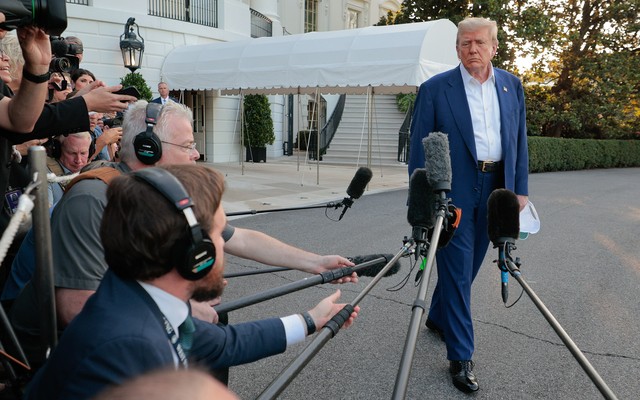
Why is Donald Trump breaking bread with the “enemy of the people”?
Even in the best of times, the annual White House Correspondents’ Dinner is an awkward and ethically fraught affair. Journalists spend the evening partying with the president and administration officials whom they’re supposed to cover rigorously and skeptically. I’ve been to the dinner several times over the years. It’s typically crowded and a little chaotic, and the ratio of non-journalists to journalists is about 10 to 1. The evening is promoted as a celebration of journalism and the First Amendment, but it has always been a bit of an embarrassment.
These aren’t the best of times for White House correspondents or, for that matter, the First Amendment. And this year’s gala figures to be even more awkward and embarrassing than usual.
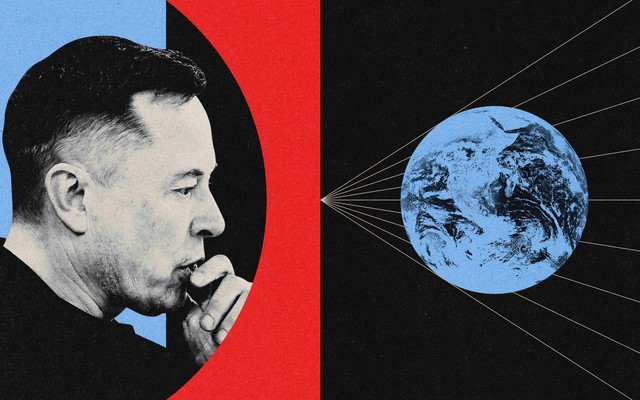
The world’s richest man is accruing more power than ever before.
If Elon Musk gets his way, space will soon look very different. Through his ownership of SpaceX, the world’s richest man already operates most of the roughly 14,000 active satellites that are orbiting Earth. Now his rocket company is asking the government for permission to launch up to 1 million more. It’s part of Musk’s plan to build data centers in space that can harness the power of the sun for AI. “You’re power-constrained on Earth,” Musk said last month. “Space has the advantage that it’s always sunny.”
Musk has a lot riding on these orbital data centers. To help finance them, he is set to take SpaceX public as early as June, at a reported valuation of $2 trillion. Musk has claimed that data centers in space can “enable self-growing bases on the moon, an entire civilization on Mars, and ultimately expansion to the universe.” It’s all classic Musk, who has a habit of making big promises that he can’t always keep. Data centers in space are an untested technology, and it’s not clear if they’d actually work. (Neither Musk nor SpaceX responded to a request for comment.)
The “disappearing scientists” story is, in its way, a remarkable achievement.
The mystery of the missing scientists began with a Silver Alert. In late February, a retired Air Force major general named Neil McCasland left his house in New Mexico for a walk and never returned. Rumors spread on social media that the elderly former astronautical engineer had been abducted or killed. Forget Nancy Guthrie, they said. Here was a guy who used to run a “UFO-linked” lab. Here was a guy with knowledge of “America’s deepest, darkest secrets.” So where was this guy?
McCasland’s wife did her best with a post on Facebook to address what she called the “misinformation circulating about Neil and his disappearance,” but wild notions only multiplied. Dots were added, then connected: Another scientist—an advanced-materials researcher at NASA’s Jet Propulsion Laboratory (JPL) named Monica Reza—had disappeared while hiking near Los Angeles in June 2025. A physicist at MIT had been murdered in December. “What is going on seems to be an enemy action,” Walter Kirn, the novelist and podcast contrarian, said last month.
The people we were died at the exact moment our child did.
This article was featured in the One Story to Read Today newsletter. Sign up for it here.
My husband, David, hates Valentine’s Day. He once called it “New Year’s Eve with nuclear weapons.” I pretend not to care. Still, when the day passes entirely unremarked on, a woman can’t help but feel overlooked.
On Valentine’s Day 2024, David found a way out. He booked a speech on February 14 that required traveling from our home in Washington, D.C., to Toronto. I couldn’t object—he was getting paid. Anyway, I had my own plans: an “anti–Valentine’s Day” dinner hosted by one of the foreign embassies.
As I got ready, I called our oldest daughter, Miranda. She answered from her Brooklyn bathroom, getting ready for her own party. She propped her phone up beside her sink and laughed when I told her about her father’s strategic Valentine’s Day escape.
Montana Democrats thought they found a novel way to win control of the U.S. Senate—until the party faithful started fighting back.
Jason Boeshore, a grain-elevator manager on the eastern plains of Montana, fired off a rocket this month to the private Signal chat he shares with the 23 other members of the state Democratic Party executive board. He demanded that leaders make clear in newspapers across the state that the Democratic Party would support only Democratic candidates in the fall elections. The response was swift and not to his liking. Shannon O’Brien, the chair of the party, wrote that her staff, not the board, would set the messaging strategy. Then she addressed the unspoken concerns at the heart of Boeshore’s request. “Listen if ANY of you EVER find yourselves questioning my intentions, please call me,” O’Brien wrote. “I will continue to move forward to get Democrats elected. There’s no hidden agenda.”
More families who can afford it are hiring a house manager, a kind of “chief of staff for the home.”
Here is the promise of a house manager. Hire one, and soon someone else could be doing your laundry, washing your dishes, prepping your meals, and completing those Amazon returns you’ve been meaning to make. They could reorganize the utensil drawer, notice if your kid is outgrowing their shoes and order more, take your car to the repair shop, and be at home to meet the plumber. If your child needs food for a class party, a house manager could make the dish and drop it off; if that child also has a pet lizard, a house manager could buy the crickets to feed it.
House managers are not a nanny or a house cleaner. They’re a “chief of staff for the home,” a “personal assistant for Mom,” and “a clone of myself,” according to the more than a dozen people I spoke with who have either hired one or work as one. They are, in effect, what might have once been called a housekeeper—a person who helps oversee a household’s basic functioning. Middle- and upper-class families used to more commonly employ this kind of position (the title “house manager” dates back to at least the 1830s), but it has become rare enough that a couple of people I spoke with thought they may have come up with the term.
With the rise of screen culture, all the world has stage fright.
The beta-blocker propranolol has been a mainstay of American medicine since the 1960s, when it was regularly prescribed as a first-line defense against hypertension, arrhythmia, and other cardiovascular problems. Recent years, though, have seen a boom in the medication’s prescription rates—in part because as the drug regulates the heart, it also settles the nerves. Off-label, propranolol is used to calm the assorted storms of stage fright: the sweaty palms, the belly churn, the racing heart. Even professional performers have publicly alluded to using it. Robert Downey Jr., accepting an award at the 2024 Golden Globes, said casually, “I took a beta-blocker, so this is going to be a breeze.” Last fall, a People magazine headline asked, “Why Is Everyone Suddenly Taking the Decades-Old Chill Pill Propranolol?”
The phrase is even more complicated than it appears.
Earlier this month, a staff writer for The Free Press, Olivia Reingold, asked the Democratic Senate candidate Abdul El-Sayed from Michigan a question: “Does Israel have a right to exist as a Jewish state?”
El-Sayed replied with his own question: “What do you mean by a ‘Jewish state’?” When Reingold went silent, before beginning to stutter out a response, El-Sayed continued, “If you can’t define the question, I’m not going to answer your question.”
A lot of labels and terms get thrown around in arguments over the Israeli-Palestinian conflict, words such as Zionist or anti-Zionist and one state or two states. These terms are not always well defined, and they mean different things to different factions—so it’s important, when discussing such matters, to know what people actually mean.