—Five people are dead and 37 were injured after someone opened fire at the Fort Lauderdale-Hollywood International Airport. More here
—An unclassified assessment released Friday by the U.S. intelligence community says Russian President Vladimir “Putin and the Russian Government aspired to help President-elect Trump’s election chances when possible by discrediting Secretary Clinton and publicly contrasting her unfavorably to him.” More here
—We’re live-blogging the news stories of the day below. All updates are in Eastern Standard Time (GMT -5).
Just hours after he received an intelligence briefing on the influence of Russian hacking on the U.S. presidential election, Donald Trump refuses to say that Russia was responsible. Instead, he’s blaming the Democratic National Committee for allowing themselves to get hacked.
Gross negligence by the Democratic National Committee allowed hacking to take place.The Republican National Committee had strong defense!
WikiLeaks Wants to Create a Database of Verified Twitter Users' Hacked Information
Axel Schmidt / Reuters
WikiLeaks is considering making an online database of verified Twitter accounts that would include sensitive personal information, the hacking organization said Friday. The group published hacked Democratic National Committee emails. Russian hackers are suspected of leaking the emails in an attempt to sway the U.S. presidential election. In this proposed database, WikiLeaks would provide information on a user’s family, job, finances, political party membership, and housing status. In a follow-up tweet, the group, which is led by Julian Assange, asked its online following for guidance on additional hacking.
We are looking for clear discrete (father/shareholding/party membership) variables that can be put into our AI software. Other suggestions?
Such a database could be dangerous and used for political retribution to the group’s opponents in media, politics, or other organizations. In a statement, Twitter warned, “Posting another person’s private and confidential information is a violation of the Twitter Rules.”
Turkey dismissed an additional 6,000 public workers Friday, as the country continues its crackdown in the months after a failed coup last July. Among the workers are 2,700 police officers, 1,700 justice ministry officials, 838 health ministry officials, and 630 academics who leaders believe played a role in the coup or have ties to Fethullah Gulen, a Muslim cleric who President Recep Tayyip Erdogan believes orchestrated the putsch. Gulen, who lived in self-exile in Pennsylvania, has denied any role. The Turkish parliament voted this week to extend the country’s state of emergency by another three months, which allows the government to usurp rights and freedoms. Turkey has already suspended or dismissed 120,000 public workers, and jailed 41,000. Meanwhile, the Turkish people are still reeling from a New Year’s Day attack at an Istanbul nightclub that killed 39 people, for which ISIS claimed responsibility, and a carb bomb explosion that killed two people in Izmir on Thursday, which has been blamed on the Kurdistan Workers’ Party.
The Four Suspects in the Chicago Live-Streamed Beating Appear in Court
Reuters
A Chicago judge on Friday denied bail for the four suspects accused of beating a mentally disabled man and streaming it on Facebook Live, telling them: “Where was your sense of decency?" The four are charged with hate crimes, aggravated kidnapping, and battery, among other charges. Video of the attack that was live-streamed online shows four black suspects assault the victim, who is white, and shout, “fuck white people” as they hit him. The suspects appeared in court Friday before Cook County Associate Judge Maria Kuriakos Ciesil, who listened to prosecutors say one of the suspects had demanded $300 from the victim's mother, and that the suspects forced the man to kiss the floor, drink toilet water, and stuffed a sock into his mouth. Authorities say the victim suffers from schizophrenia and attention deficit disorder.
Intelligence Assessment Says Russia 'Aspired to Help' Trump in Election
(Sputnik Photo Agency / Reuters)
An unclassified assessment released Friday by the U.S. intelligence community says Russian President Vladimir “Putin and the Russian Government aspired to help President-elect Trump’s election chances when possible by discrediting Secretary Clinton and publicly contrasting her unfavorably to him.” The report, which can be found here, was released the same day President-elect Donald Trump received his own intelligence briefing on the Russian activities during the election. Trump, in a statement, said the hacking by “Russia, China, other countries, outside groups, and people” had no “effect on the outcome of the election.” Russia has denied it tried to interfere in the election.
It’s finally official: Donald Trump has won the presidential election.
Media outlets announced Trump’s victory weeks ago in November. But Congress counted and certified the Electoral College votes on Friday, a time-honored tradition that takes place only after electors have formally cast their votes. Along the way, Trump’s opponents hoped in vain the results of the election might be overturned. A small group of electors attempted to instigate an Electoral College revolt aimed at keeping Trump out of the White House, but that effort ultimately failed. The Electoral College formally selected Trump as the winner of the election in December.
And there were a few failed attempts at resistance on Friday. USA Todayreports:
Several Democratic House members raised formal objections to the Electoral College results, but they did not have the backing of any senators — a requirement for being considered. Vice President Biden, who presided over the session, repeatedly slammed the gavel on debate, saying the objections could not be entertained.
"It is over," Biden said as Republicans applauded.
Congress officially certified the election of Mike Pence to become vice president on Friday as well. Trump’s inauguration as the 45th president of the United States will take place on January 20th in Washington, D.C. The final electoral college vote tally certified by Congress stands at 304 votes for Trump to 227 votes for Hillary Clinton.
UPDATE: 5 Dead in Fort Lauderdale Airport Shooting
People stand on the tarmac after shots were fired at the Fort Lauderdale-Hollywood International Airport on Friday, January 6, 2017. (AP)
Five people are dead and eight taken to hospital after at least one gunman opened fire at the Fort Lauderdale-Hollywood International Airport. A gunman is in custody, the Broward County Sheriff’s Office said. The airport said there was “an ongoing incident in Terminal 2, Baggage Claim.” Here’s our live-blog of the shooting.
Tilikum, the Orca That Inspired the Documentary 'Blackfish,' Dies
AP
Tilikum, the SeaWorld orca that was the subject of the documentary Blackfish, died Friday of a persistent lung infection, SeaWorld announced. Tilikum’s role in the 2013 documentary and his life story triggered an anti-captivity backlash against SeaWorld that is still being felt. He was captured from the waters near Iceland when he was young, and transferred to SeaWorld Orlando in 1992. He became one of the park’s largest whales at six tons, and gained a reputation for being dangerous after a man who had snuck into the park for a swim in his tank was found dead, and again in 2010 after he was blamed for battering and drowning orca-trainer Dawn Brancheau. After these incidents, SeaWorld kept Tilikum separate from other orcas, though he was made to perform for paying customers practically until his death. The story of Tilikum’s life told by Blackfish resonated so profoundly with people that SeaWorld is still trying to recover from the image it painted of whale captivity. The marine tourist park has suffered financially, hired a new chief executive officer, and announced last year it would phase out its orca program.
Japan Recalls Envoy to South Korea Over Statue of Comfort Woman
A statue outside the Japanese consulate in Busan, South Korea represents women forced to work in Japanese military brothels during World War II. (Reuters)
Japan temporarily recalled Yasumasa Nagamine, its ambassador to South Korea, Friday in protest of a statue commemorating Korean women forced to work in Japanese military brothels during World War II. It’s estimated that between 20,000 to 200,000 women—commonly known as “comfort women”—were forced to serve as sex slaves for Japanese soldiers during that period. Japan called for an immediate removal of the statue, which was displayed last week by a civic group outside its consulate in the South Korean city of Busan, and announced it would also suspend on-going talks with South Korea on resuming a bilateral currency-swap agreement. South Korea expressed “strong regret” over Japan’s decision. A similar statue was placed outside the Japanese Embassy in Seoul in 2011; it too was criticized by the Japanese. The issue continues to be one of the thorniest between the two countries despite an accord reached in December 2015, in which Japan offered a formal apology and agreed to pay about $8.3 million to establish a fund for surviving “comfort women.”
Next week Norway will become the first country in the world to drop its FM radio network. The move is widely unpopular in Norway, but is being closely watched by other European nations. FM will be replaced by digital audio broadcasting (DAB), which is said to have clearer sound and signal, and is already being broadcast in Norway. DAB also allows for eight times as many stations as FM for the same cost. The problem is that more than 2 million cars in Norway don’t have DAB receivers, nor do many homes. The devices are also more expensive. Only 17 percent of Norwegians support the switch, while the rest are undecided. All FM broadcasts are scheduled to shut off by the end of the year. Switzerland plans to make the switch to DAB in 2020. Britain and Denmark have also said they’ll drop FM, though neither has set a firm deadline.
U.S. Adds 156,000 Jobs in December; Jobless Rate at 4.7 Percent
The U.S. economy added 156,000 jobs last month, the U.S. Department of Labor announced Friday, and the unemployment rate ticked up slightly to 4.7 percent. Economists had expected the economy to add about 175,000 jobs. The slight increase of the jobless rate was attributed to a more people in the labor force. Wage rose 2.9 percent from December 2015. The report, the last of President Obama’s tenure, shows an economy on solid footing as President-elect Donald Trump prepares to enter the White House. Bloombergadds: “The latest payrolls tally brought the advance for 2016 to 2.16 million, after a gain of about 2.7 million in 2015. The streak of gains above 2 million is the longest since 1999, when Bill Clinton was president.” Full report here.
Russia Withdraws Aircraft Carrier From Syria as Part of Partial Drawdown
Admiral Kuznetsov, the aircraft carrier (Ho New / Reuters)
Russia announced Friday it was beginning a gradual drawdown of its military presence in Syria, starting with the departure of Admiral Kuznetsov, the aircraft carrier. The announcement comes just days after Russia and Turkey announced a ceasefire between forces loyal to Syrian President Bashar al-Assad and rebels opposed to his rule. Assad, bolstered by military support from Russia, Iran, and Hezbollah, the Shia militant group from Lebanon, recaptured eastern Aleppo, the last major rebel stronghold, last month. The Syrian leader is now more firmly in charge of the country than at any point since the civil war began. The ceasefire announced by Russia and Turkey is largely holding, though it is fragile.
Thirteen thousand miles. Infinite contenders. One beautiful loaf.
This article was featured in the One Story to Read Today newsletter. Sign up for it here.
Here is the promise you and I must cling to across the thousands of words that follow: At some point within this text, I will reveal to you what—after 555 responses, 13,000 miles of travel, and months of monomaniacal research—I have determined to be the best free restaurant bread in America. I will not attempt to slither to the moral high ground, arguing that best is a meaningless measure, or insisting that all bread is dear in its own way. Even if you attempt to betray me—for instance, by merely scanning the text that follows for the phrase Here it is: the best free restaurant bread in America—I will uphold my end of the bargain.
The president is on a losing streak, and even some of his aides are dismayed by his choices.
This article was featured in the One Story to Read Today newsletter. Sign up for it here.
You’ve heard the joke: The White House is going to start talking about the Epstein files to distract from how badly the Iran war is going.
Except that this reverse “Wag the dog” is based on bizarre truth: First Lady Melania Trump did bring the disgraced financier up, unprompted, late last week in an effort to distance herself from the scandal (in a move that, predictably, only shifted it back into the spotlight once again). Meanwhile, as negotiations with Iran stumble forward, the Strait of Hormuz is still in Tehran’s hands and now President Trump has authorized a risky naval blockade that will likely send prices soaring further. Moreover, Trump’s poll numbers have continued to fall, Republicans worry that both houses of Congress could be lost in November, and the president threw away a remarkable amount of geopolitical capital trying to support his now-defeated illiberal buddy Viktor Orbán of Hungary. Oh, and Trump deeply offended adherents of the world’s two largest religions in one week’s time.
The car industry says it has an answer for drivers wary of going electric.
Two hours into a road trip in my Tesla, I start to get twitchy. By that point, the battery in my 2019 Model 3 has dipped to an uncomfortably low percentage. If I can’t reach the next plug, I’m in trouble. This is the kind of problem that Ram’s electric pickup truck—the first of a new breed of EV to arrive in the United States—is intended to solve. When the range starts to dwindle, the truck automatically fires up a hidden gas engine that refills the giant battery. The “electric” vehicle keeps on chugging down the highway, hour after hour; pit stops are once again decided by the need for bathroom breaks rather than battery range.
The Ram 1500 REV, set to debut later this year, is what’s called an “extended-range electric vehicle,” or EREV. In essence, it is an electric vehicle that burns gas. There’s nothing revolutionary about a half-gas, half-electric car, of course. Hybrids have been a mainstay in the United States since the Toyota Prius broke through two decades ago, and automakers have released more efficient plug-in hybrids—allowing drivers to charge up for about 30 miles of electric driving, just enough to accomplish daily errands without fossil fuels. An extended-range EV is a different kind of beast. The engine burns gasoline for the sole purpose of replenishing the battery—it never actually pushes the wheels. In the Ram, the battery can run for about 150 miles of electric driving, and the whole setup delivers enough range to travel nearly 700 miles between stops.
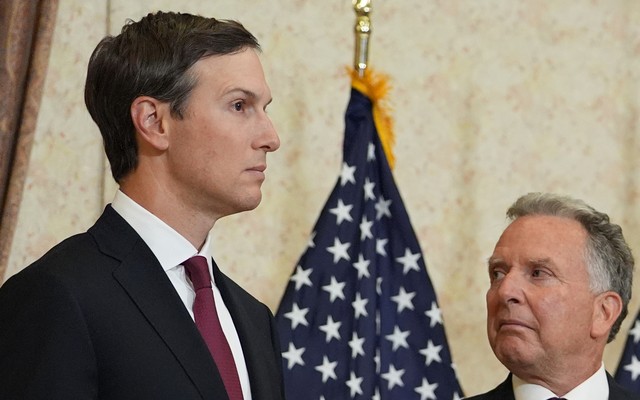
Is the president’s son-in-law carrying out the public’s business or pursuing his own private interests?
In 2021, shortly after he left his role as a senior White House adviser, Jared Kushner let it be known that he had loved his job but disliked the scrutiny and disclosure that came with being a top U.S. government official. He set up a private-equity firm and took a $2 billion investment from a Saudi fund led by Crown Prince Mohammed bin Salman. He proclaimed that he was embracing private life. “I’m an investor now,” Kushner said in a 2024 interview. If President Trump “calls you on November whatever and says, ‘I’d like you to come back to D.C.,’ you say, ‘Thanks, but I’m good’?” the interviewer, Dan Primack of Axios, pressed. “Yes,” Kushner responded.
But Kushner did come back. Two days before the United States and Israel attacked Iran this past February, he was in Geneva in a negotiation of the highest possible stakes. Over the weekend, he traveled with Vice President Vance to Islamabad to participate in failed peace talks with Iran. Without title or remit or any kind of official designation—only “presidential son-in-law”—Kushner has in the first 14 months of the second Trump administration sat down with world leaders including Vladimir Putin, Benjamin Netanyahu, and Volodymyr Zelensky, along with Saudis and multiple other actors from the Middle East.
The president’s attempts to interfere with the midterms demand vigilance, but a recent flimsy gambit is an argument against despair.
This is an edition of The Atlantic Daily, a newsletter that guides you through the biggest stories of the day, helps you discover new ideas, and recommends the best in culture. Sign up for it here.
Anxiety among election officials and experts had been building for months before Donald Trump issued his latest executive order purporting to ensure election integrity late last month. When the actual text emerged, the reaction wasn’t relief exactly—but a definite sense that things could have been much worse.
Americans have many reasons to be worried about whether the midterm elections will be free and fair. As I laid out in a cover story last fall, the president’s plan to subvert the 2026 election is multifaceted and already in swing. But last month’s order and the dismissive reaction it’s received from experts—along with this weekend’s decisive defeat of Hungarian Prime Minister Viktor Orbán, which shows how the competitive-authoritarian playbook that Trump has imitated can be beaten—also point to the reasons to resist doomerism.
A minimally speaking autistic man just wrote a best-selling book. Or did he?
On a recent morning at Rockefeller Center, NBC employees strolled through the crowd with copies of Upward Bound, the latest book-club pick from the Today show co-host Jenna Bush Hager. “It’s deeply heartfelt and moving,” Hager said, after holding up the debut novel from the 28-year-old Woody Brown, “and the reason it’s so authentic is that the author understands autism firsthand.”
That understanding is indeed profound. Brown’s autism is such that he can barely speak, and he communicates mostly by pointing to letters, one by one, on a laminated board. This is also how his novel, which is already a New York Times best seller, came to be. In the recorded interview that followed Hager’s introduction, Brown’s mother, Mary, sat beside him, holding the letter board and reading his tapped-out messages.
On many recent nights, Donald Trump has been posting obsessively on his Truth Social site into the wee hours. The president, of course, has never been one for a solid night’s sleep—or restrained and temperate commentary on social media—but his emotional state seems to be fraying: This weekend, he attacked Pope Leo XIV, presented himself as Jesus Christ, and then jabbed at his phone until dawn.
Judging from those posts, the commander in chief is in distress. No one can say for sure what is causing the president’s bizarre behavior. Perhaps Trump’s narcissistic insistence that he is always successful in everything he undertakes is feeling the sting and strain of multiple public failures, including the collapse of his campaign to dislodge the Iranian regime, plummeting approval ratings, the decline of the U.S. economy, and, on Sunday, the crushing defeat of one of his favorite fellow authoritarians, Hungary’s Viktor Orbán.
Former U.S. Deputy National Security Adviser Matt Pottinger on the U.S.-Iran cease-fire, Trump’s Hormuz blockade, and China’s reaction to the Iran war. Plus: A seismic election in Hungary, and Labyrinths, by Jorge Luis Borges.
In this week’s episode of The David Frum Show, The Atlantic’s David Frum opens with his reaction to the recent election in Hungary and the defeat of Viktor Orbán. David counters Orbán defenders who claim that this loss proves Orbán was never a threat. Antidemocratic leaders often face institutional constraints, and it was those institutional constraints that compelled Orbán to accept a defeat after years of abuse of power.
Then, David is joined by former U.S. Deputy National Security Adviser Matt Pottinger to discuss the current state of President Trump’s war in Iran. David and Pottinger talk about the recent failed negotiations between the two sides in Pakistan, the blockade of the Strait of Hormuz, and what could happen next. They also discuss how the Iran war is viewed in China and how it has been a financial gain for Russia.
Hungary offers lessons in defeating right-wing populists.
To the outside world, Hungarian Prime Minister Viktor Orbán began his rule as a pariah—an obstreperous, often lone dissenter from European Union policies, especially over migration. Then he became a prophet to new-style “national conservatives”—the anti-immigration, anti-elite right-wing movement that has reshaped the politics of the West. After resoundingly losing national elections held on April 12, Orbán has become a parable for how populism can be defeated.
His political demise was hardly inevitable. It had to be shrewdly engineered by politicians and voters who put aside their ideological differences to defeat him. In politics, there is no natural law of self-correction.
From 2010 until now, Orbán and his Fidesz party transformed Hungary into a new kind of state, which he proudly proclaimed as an “illiberal democracy.” He and his allies rewrote the constitution to entrench his power, centralizing control over civil society and countervailing institutions such as courts and universities. Péter Magyar, the presumptive next prime minister, triumphed against a tilted electoral system—gerrymandered districts, government influence over traditional media and even over the country’s billboards—designed to keep Fidesz in power. Magyar understood that such a regime does not simply collapse under the weight of its own contradictions and mismanagement.
If you are anything like me, you have spent a lot of time over the past few weeks opening letters, finding receipts, requesting PDFs, scanning documents, and going through your credit-card statements line by line. It’s tax season. And in the United States, taxes are a DIY affair.
This is the case even though Washington could probably do your taxes for you. If you earn a salary or an hourly wage, the Internal Revenue Service already knows how much money you make. It likely knows how much you owe or how big your refund should be too. Nine in 10 households take the standard deduction, making their liability easy to glean from payroll and banking data.
Yet Uncle Sam demands that Americans fire up TurboTax, head to a storefront preparer, hire an accountant, or sit down with a sharp pencil and a strong cup of coffee to get their taxes done each spring. The average filer spends 13 hours on their 1040—a time tax that many of our wealthy peer countries have reduced to a couple of minutes, if that. Prepopulated documents and return-free systems are common everywhere but here. Sweden lets residents file by text. Canada prefills paperwork. Japan sends households a document summarizing their tax contributions. If everything looks copacetic, many workers get to do a blissful nothing. Denmark, Estonia, Spain, and Norway have similarly simple processes.