LinkedIn hacker indicted, hackers cause worldwide Internet outages, European experimental Mars lander may have exploded in crash landing, and more from across the United States and around the world.
—A federal grand jury indicted a Russian man for the 2012 hack of LinkedIn, where 117 million passwords were stolen. More here
—Domain name server company Dyn said hackers targeted them three times Friday with a distributed denial of service attack, causing internet outages across the globe. More here
—The European Space Agency (ESA) said Friday its experimental Mars lander, Schiaparelli, may have exploded in a crash landing on the planet’s surface. More here
—We’re live-blogging the news stories of the day below. All updates are in Eastern Daylight Time (GMT -4).
Russian Man Indicted for Hacking 117 Million LinkedIn Passwords
Eric Risberg / AP
A federal grand jury indicted a Russian man this week in connection with hacking LinkedIn and stealing 117 million passwords.
Czech police arrested Yevgeniy Aleksandrovich Nikulin, 29, Wednesday in Prague. Nikulin allegedly hacked LinkedIn in March 2012. Prosecutors also alleged Nikulin hacked social media site Formspring and file sharing site Dropbox. He now faces nine criminal counts after his Thursday indictment.
In court papers, federal agents aren't clear about what exactly Nikulin stole -- or how he planned to profit from their sale online. But the government claims Nikulin worked with at least two others in the attempt to make the business deals.
His arrest is the latest chapter in growing cyber tensions between the U.S. and Russia. While there is no indication that these hacks were sanctioned by the Russian government, federal authorities have pinned other hacks on the Kremlin.
NFL Kicker Placed on Paid Leave After Abuse Revelation
(Matt Rourke / AP)
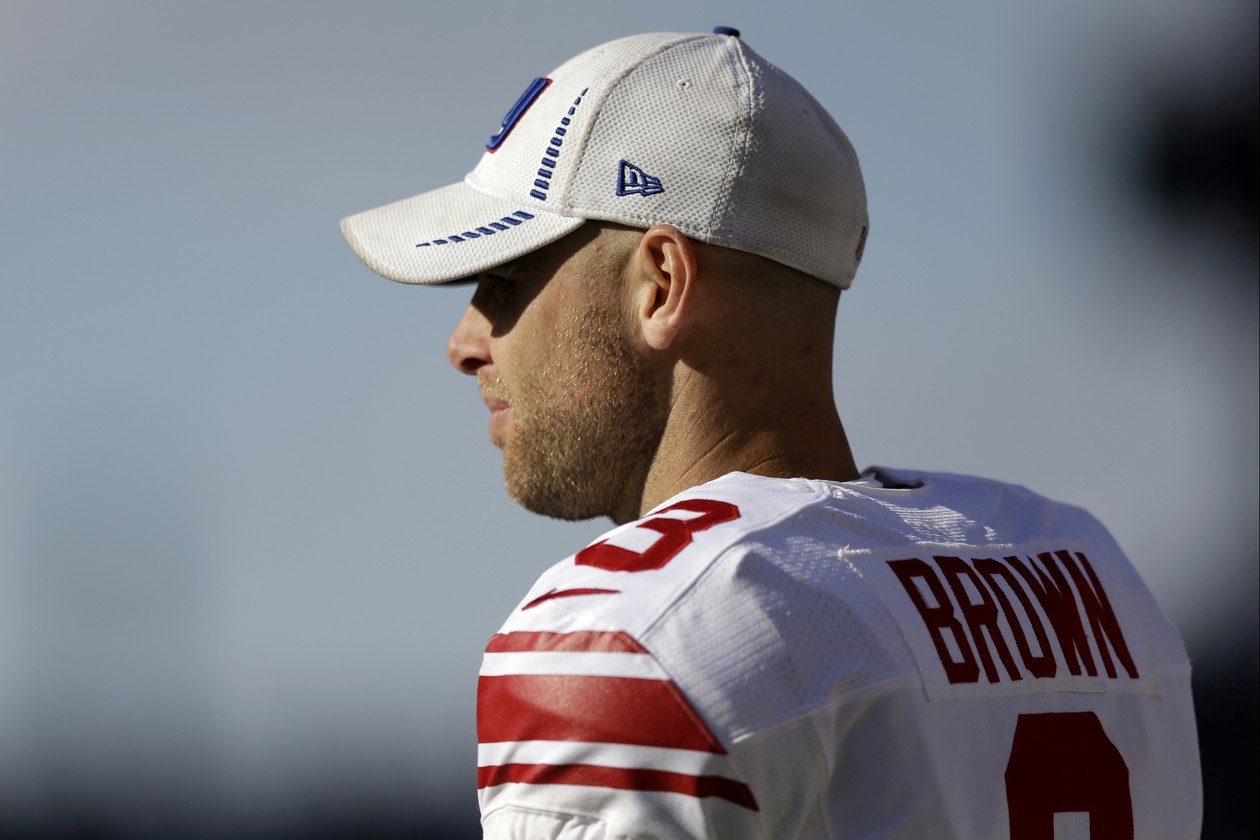
Josh Brown, the New York Giants kicker who admitted to domestic abuse against his then-wife, has been placed on paid leave by the NFL.
While the league investigates these recent revelations, the NFL put Brown on the commissioner’s exempt list, ESPN reports. Brown cannot play or attend games but, with the team’s permission, he is allowed to work out and receive treatment at the team’s facility. A player may be on the exempt list indefinitely.
In a letter sent Friday, Adolpho Birch, a senior vice president for the NFL, told Brown the league will investigate documents released earlier this week from the King County Sheriff’s Office in Washington, which revealed a history of domestic violence and details surrounding a 2015 arrest.
In those documents, Brown referred to himself as a “physically, mentally, emotionally and verbally... repulsive man.” In one entry, he said that he viewed himself as “God” and his then-wife, Molly, as “my slave.”
Brown’s tenure with the Giants is likely over, and it’s unclear if any teams will sign him in the future. The Giants signed another kicker, Robbie Gould, to fill the current void left by Brown.
In the meantime, Giants head coach Ben McAdoo offered his support to Brown, saying Friday, “We’re not going to turn our back on Josh.”
Facebook says it’s relaxing its rules on explicit posts after feedback from our community and partners.
Joel Kaplan, Facebook’s vice president of global public policy, and Justin Osofsky, the company’s vice president of global operations and media partnerships, wrote in a blog post that in “the weeks ahead, we’re going to begin allowing more items that people find newsworthy, significant, or important to the public interest—even if they might otherwise violate our standards.”
The move follows two recent controversies about posts that Facebook pulled because they apparently violated its Community Standards. One of those posts was Nick Ut’s iconic, Pulitzer Prize-winning black-and-white photograph of a naked girl, wailing in pain in the aftermath of a napalm attack during the Vietnam War. Then this week, a video posted by the Swedish Cancer Society to promote breast-cancer awareness didn’t make it past Facebook’s censors. The company apologized and reversed itself in both cases.
Canada’s Prospects of a Trade Deal With the EU Appear Dead
Canada's International Trade Minister Chrystia Freeland (Chris Wattie / Reuters)
Chrystia Freeland, Canada’s trade minister, walked out of talks Friday in Belgium, declaring the European Union incapable of ratifying a long-discussed trans-Atlantic free-trade deal.
All 28 EU governments support the Comprehensive Economic and Trade Agreement (CETA), but the agreement was held up because one of Belgium’s five subdivisions has not signed off. Without French-speaking Wallonia’s affirmation, Belgium cannot give assent to CETA. Walloon lawmakers are concerned that CETA, and a stalled plan for a similar deal with the United States, risk degrading consumer, labor, and environmental protections, while granting excessive power to multinational corporations. But supporters say the agreement could increase trade by 20 percent.
“Canada has worked, and I personally have worked, very hard,” Freeland, who was a visibly distraught after the talks, said. “But it is now evident to me, evident to Canada, that the European Union is incapable of reaching an agreement.”
CETA was set to be signed at an EU-Canada summit next Thursday in the presence of Canadian Prime Minister Justin Trudeau.
This issue could serve as an ominous forecast for future EU economic deals, including with the UK, which voted over the summer to leave the bloc and is still unsure about the shape of trade relations with it.
Chemical Spill at Kansas Food Plant Sends 54 to Hospital
The fog in the air is believed to contain chemicals from the spill (Reuters)
Updated at 4:06 p.m. ET
A chemical spill Friday at an Atchison, Kansas, food-processing plant sent a thick fog into the air and a chlorine-like smell, spurring evacuations and warnings from emergency officials.
Fifty-four people have been admitted to Atchison Hospital for upper-respiratory discomfort, including one into the intensive-care unit, TC Roberts, the hospital’s marketing and public relations director, said in an interview. Two of the women were pregnant and being monitored, Roberts said. The hospital was following poison-control protocol.
The spill occurred at 8:02 a.m. at MGP Ingredients, a food-and-alcohol plant, Atchison City Manager Trey Cocking said. Citing city officials, the Kansas CIty Star reports the reaction was caused after two chemicals were inadvertently mixed together.
The Kansas Department of Transportation confirmed that the two chemicals were sodium hypochlorite—a salt-based chemical mainly used for bleaching—and sulphuric acid, according to public-affairs manager, Kimberly Qualls. Exposure to sodium hypochlorite can cause upper respiratory issues due to the corrosive effects of chlorine. The city would not confirm which chemicals were mixed.
Atchison city officials said shortly before 11 a.m. that the situation was under control and all-clear was being given.
Shortly after the spill, Atchison County emergency officials urged people to stay out of town.
Residents of Atchison who live north of the plant were being told to stay inside with their doors and windows shut.
Atchison is located in northeast Kansas, about 40 miles from Kansas City.
Images from social media showed a thick gray plume clouding the air.
Images of Schiaparelli’s expected landing site taken on October 20, 2016, by the Mars Reconnaissance Orbiter (European Space Agency)
The European Space Agency (ESA) said Friday its experimental Mars lander, Schiaparelli, may have exploded in a crash landing on the planet’s surface.
“Estimates are that Schiaparelli dropped from a height of between 2 and 4 kilometres, therefore impacting at a considerable speed, greater than 300 km/h,” the ESA said in a statement. “It is also possible that the lander exploded on impact, as its thruster propellant tanks were likely still full. These preliminary interpretations will be refined following further analysis.”
As my colleague Marina Koren previously reported, Schiaparelli was scheduled to touch down on the red planet Wednesday after a seven-month journey. The mission, conducted jointly between the ESA and Russian space agency Roscosmos, lost contact with the lander shortly after it began its descent. Now, the ESA believes the lander suffered issues during the last 50 seconds of its descent through Mars’s atmosphere, prompting the possible crash.
The Wall Street Journal is offering buyouts to “a substantial number of employees,” Gerard Baker, its editor in chief, told the newspaper’s staff in a memo Friday.
As I told you earlier this week, we have begun an extensive review of operations as part of a broader transformation program. There will be, unfortunately, an impact on news department staff in this process. In order to limit the number of involuntary layoffs, we will be offering all news employees around the world - management and non-management - the option to elect to take an enhanced voluntary severance benefit. The terms are described in the attached FAQ.
We are seeking a substantial number of employees to elect this benefit, but we reserve the right to reject a volunteer based on business considerations. Employees will be required to sign a separation agreement and release of claims in a form provided by the Company in exchange for the accompanying severance benefits.
I regret of course the need for such a move and I appreciate deeply the dedication all of you continue to show through challenging times. Thanks to your hard work, the news department continues to produce world-class journalism every day and I'm confident this process is the right one to set us on the right footing for renewed growth in the years ahead.
Sydney Ember, The New York Times’s media reporter, pointed out on Twitter that the FAQ section of the memo says “there are no current plans for future buyouts.”
Earlier this week, the newspaper reported that Dow Jones & Co., the Journal’s parent company, “launched a broader review of operations to cut costs in response to a significant decline in print advertising.” More:
The memo didn’t lay out specifics, but people familiar with the situation said one element of the plan involves combining the “Business & Tech” and “Money & Investing” sections. That would be aimed at reducing production costs, and wouldn’t signal a cutback in coverage in those core areas, one of the people said.
The newspaper’s report quoted unnamed sources as saying the revamp “could include a reduction of head count.”
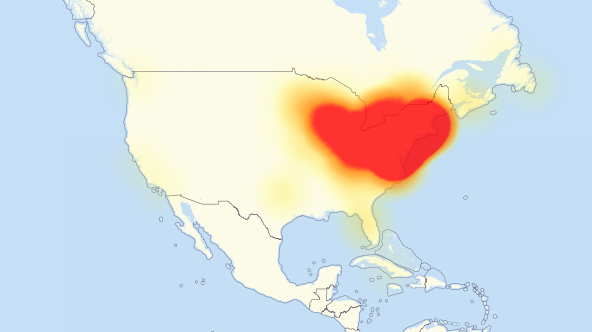
Looks like whoever launched this morning’s attack on the internet is at it again, shutting down access to Twitter, Reddit, Netflix, and other sites. Around noon ET, domain name server company Dyn said hackers had once again targeted them with a distributed denial of service attack, flooding their servers with nonsense and hampering their ability to properly direct internet traffic.
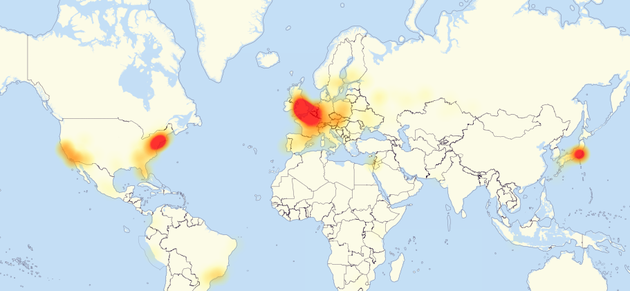
This time, the U.S. reports of outages appear more closely centered on the northeast states, with sizable gridlock also seen in Japan, the U.K., and France, according to downdetector.com.
Police officers demonstrate on the Champs-Élysées in Paris, France (Michel Euler / AP)
Hundreds of police officers marched in Paris and other French cities Thursday for the fourth night of protests against their working conditions, Agence France-Presse reports.
The officers, who say they are ill-equipped to defend themselves on the job, protested against an increasing workload, bureaucracy, and outdated equipment. They also called on the government to implement fixed minimum sentences for attacks against officers. The demonstrations follow several attacks on police in recent months, including a Molotov cocktail thrown on a patrol car and the killing of a French officer and his partner in June by a man who pledged allegiance to ISIS .
The demonstrations come amid a nationwide state of emergency—which has been in place since last November’s attacks—and will likely play a role in the country’s presidential election in six months. Many of the presidential candidates have used the opportunity to criticize President François Hollande, including Alain Juppé, the center-right candidate, and Marine Le Pen, the far-right candidate.
In a statement to police Friday, Bernard Cazeneuve, the French interior minister, said: “You are asking for respect, we owe you that. You are asking for resources, we’ll give you them. You are asking for support, you’ve earned it.”
AT&T Reportedly Is in Talks to Acquire Time Warner
(Brendan McDermid / Reuters)
AT&T is in advanced talks to buy Time Warner and a deal could be announced as early as this weekend, Bloombergand theWall Street Journal report.
The merger would unite AT&T’s portfolio of wireless, broadband, and satellite-TV services with Time Warner’s vast entertainment empire, which includes CNN, HBO, TNT, and TBS.
AT&T and Time Warner representatives declined to comment.
There Is Nothing Funny About Exploding Samsung Galaxy Note 7 Sticky Bombs
Submitted to Reddit by Haku111
It seems Samsung has little sense of humor when it comes to its combustible Galaxy Note 7 cellphone. The company recalled the Note 7 last month because its lithium-ion batteries can burst into flames. It’s banned by some airlines, and become the butt of a presidential wisecrack. But the joke Samsung didn’t find funny was made this week by video-game enthusiasts.
A gamer who uses the screen name HitmanNiko wrote a code that players can download—called a “mod”—for Grand Theft Auto V that replaces sticky bombs with Samsung’s pyrotechnics-friendly cellphone. Gamers then posted videos to YouTube of their digital character using the phone to blow up people, cars, and helicopters.
Some owners of those YouTube accounts then received copyright-infringement notices, and their videos were removed. One U.S. gamer, who goes by the screen name DoctorGTA, said in a YouTube video his livestream account was suspended after he got an infringement notice from Samsung Electronics America Inc.
So far, Samsung has done a bad job of damage control. This latest move to silence jibes from gamers seems only to have raised more notice that Samsung produced millions of phones that can potentially catch fire.
Here's an example of the sticky-bomb Samsung videos (fast forward to 45 seconds):
America’s Latest Whiskey Rebellion May Be Coming to an End
(Bruce Schreiner / AP)
Jim Beam workers in Kentucky, on strike for the past six days to protest long work hours, were offered a new contract Thursday that includes a company pledge to hire more workers, according to the Associated Press.
About 250 union workers are scheduled to vote on the new contract Friday, the United Food and Commercial Workers Union said.
Workers walked out last Saturday from distilleries at Clermont and Boston, Kentucky, over working hours. Jim Beam workers said they were often forced to work 60-80 hours per week in order to meet the demands of the global bourbon boom.
Clarkson Hine, a company spokesman, said Thursday the company was encouraged by the tentative deal reached with union leaders.
Bourbon, Kentucky’s golden commodity, is a $3 billion a year industry. Ninety-five percent of the world’s bourbon is produced in the state.
Jim Beam is owned by Suntory Holdings Ltd., the Japanese beverage giant. Suntory bought the classic American whisky brand for $16 billion in 2014. In the first six months of 2016, Suntory’s alcohol profits rose 24 percent due to the popularity of its American spirit sales.
Smoke rises from a building in Kirkuk, Iraq, where two ISIS militants are believed to be holed up Friday. (Rudaw TV / AP)
ISIS fighters attacked the Iraqi city of Kirkuk Friday, killing at least 19 people, even as Iraqi forces were closing in on Mosul, the group’s last major stronghold in Iraq.
The battle in Kirkuk appears to be ongoing, and there are various versions of what’s exactly happening there. The BBC reported that ISIS fighters attacked government buildings, killing at least six police officers. They also targeted a power station that’s under construction and killed 13 workers. Twelve ISIS fighters were also reportedly killed. Images on social media posted by a Kurdish news site showed Kirkuk residents had hanged at least one suspected ISIS fighter.
The attack is a reminder that while ISIS is losing territory in Iraq and neighboring Syria, it still remains a force to be reckoned with in the region. The attack in Kirkuk comes as Iraqi forces, Kurdish Peshmerga, and their allies—backed by U.S. airstrikes—are trying to retake Mosul, which is about 100 miles northwest of Kirkuk.
About 5,000 ISIS fighters are reportedly still in Mosul, the group’s last major stronghold in Iraq, along with 1.5 million people.
Double-Oh No: Pierce Brosnan Wants Out of Indian Ad Campaign
John Salangsang / AP
Pierce Brosnan, the former James Bond star, endorsed what he thought was breath-freshening, tooth-whitening mint. He appeared in Indian newspapers, with his lush beard and arched eyebrow, holding a tin of Pan Bahar. A minute-long TV commercial shows the former 007 cooly waltzing into a fancy hotel, disarming men, women, and a pack of ninjas with his good looks—and a can of Pan Bahar.
But Brosnan is upset now because Pan Bahar is associated in India with addictive forms of chewing tobacco. Those products, which are made from a mixture of nuts, seeds, herbs, spices, and tobacco, are used by millions of Indians and have been linked to cancer. Pan Bahar’s manufacturer, Ashok & Co., told the BBC the public has misconceived their product and there’s neither nicotine or tobacco in it.
In a statement to People magazine, Brosnan said: “As a man who has spent decades championing women’s healthcare and environmental protection, I was distressed to learn of Pan Bahar’s unauthorized and deceptive use of my image to endorse their range of pan masala products. I would never have entered into an agreement to promote a product in India that is dangerous to one’s health.”
Brosnan demanded the company remove his image from all of the company’s products. Here’s a video of the commercial:
Update 9:45 a.m. ET: Dyn, a large domain name service company, reports that it was attacked by a distributed denial-of-service attack around 7 a.m. ET, shutting down access to a number of popular internet sites. As of 9:20 a.m. ET, it had restored service to normal.
Dyn is one of several companies that essentially maintains a master list of websites, translating “CNN.com” into the string of numbers that actually directs readers to the news network’s servers. It appears they were flooded with targeted traffic by an unknown party with the intention of shutting down access to these sites.
Our original post below:
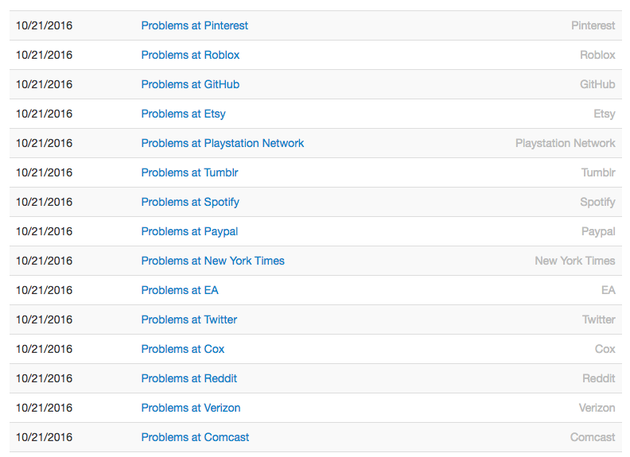
If your internet connection seems slow this morning—especially if you live in the U.S. Northeast—you’re not imagining it. Internet-monitoring service downrightnow.com says Twitter is experiencing a serious outage, and crowd-sourced downdetector.com reports trouble at a slew of popular sites, including CNN, Amazon, Netflix, and Reddit.
Hillary Clinton, the Democratic presidential nominee, and Donald Trump, her GOP rival, paused their contentious campaign for the presidency for an evening of what was supposed to be light-hearted ribbing and self-effacing humor.
But as my colleague Megan Garber noted, the evening at the Alfred E. Smith Memorial Foundation Dinner was going according to plan “until Trump decided it was time to tease his opponent a little more sharply.” Trump’s remarks, she said, “went full stream-of-consciousness [and] on the attack.” The crowd, at various points in the night, gasped, booed, booed some more, and then some.
South Africa Says It's Leaving the International Criminal Court
South Africa’s failure to arrest Sudanese President Omar al-Bashir prompted criticism. (Mike Hutchings / Reuters)
South Africa said Friday it notified the UN on October 19 that it is leaving The Hague-based International Criminal Court.
Michael Masutha, the justice minister, said at a news conference South Africa didn’t want to carry out the ICC’s arrest warrants, which would lead to “regime change.” Masutha said the government would introduce legislation in parliament to withdraw the country from the ICC.
Last year, the government didn’t arrest Sudanese President Omar al-Bashir, who was in the country despite an ICC warrant against him for his alleged actions in the Darfur region. A South African court criticized the government for that failure.
Human-rights groups condemned Friday’s announcement, and experts predict it will trigger similar decisions by other African nations, many of which believe the ICC is biased against African leaders. The UN declined to comment.
The president is on a losing streak, and even some of his aides are dismayed by his choices.
This article was featured in the One Story to Read Today newsletter. Sign up for it here.
You’ve heard the joke: The White House is going to start talking about the Epstein files to distract from how badly the Iran war is going.
Except that this reverse “Wag the dog” is based on bizarre truth: First Lady Melania Trump did bring the disgraced financier up, unprompted, late last week in an effort to distance herself from the scandal (in a move that, predictably, only shifted it back into the spotlight once again). Meanwhile, as negotiations with Iran stumble forward, the Strait of Hormuz is still in Tehran’s hands and now President Trump has authorized a risky naval blockade that will likely send prices soaring further. Moreover, Trump’s poll numbers have continued to fall, Republicans worry that both houses of Congress could be lost in November, and the president threw away a remarkable amount of geopolitical capital trying to support his now-defeated illiberal buddy Viktor Orbán of Hungary. Oh, and Trump deeply offended adherents of the world’s two largest religions in one week’s time.
The car industry says it has an answer for drivers wary of going electric.
Two hours into a road trip in my Tesla, I start to get twitchy. By that point, the battery in my 2019 Model 3 has dipped to an uncomfortably low percentage. If I can’t reach the next plug, I’m in trouble. This is the kind of problem that Ram’s electric pickup truck—the first of a new breed of EV to arrive in the United States—is intended to solve. When the range starts to dwindle, the truck automatically fires up a hidden gas engine that refills the giant battery. The “electric” vehicle keeps on chugging down the highway, hour after hour; pit stops are once again decided by the need for bathroom breaks rather than battery range.
The Ram 1500 REV, set to debut later this year, is what’s called an “extended-range electric vehicle,” or EREV. In essence, it is an electric vehicle that burns gas. There’s nothing revolutionary about a half-gas, half-electric car, of course. Hybrids have been a mainstay in the United States since the Toyota Prius broke through two decades ago, and automakers have released more efficient plug-in hybrids—allowing drivers to charge up for about 30 miles of electric driving, just enough to accomplish daily errands without fossil fuels. An extended-range EV is a different kind of beast. The engine burns gasoline for the sole purpose of replenishing the battery—it never actually pushes the wheels. In the Ram, the battery can run for about 150 miles of electric driving, and the whole setup delivers enough range to travel nearly 700 miles between stops.
A minimally speaking autistic man just wrote a best-selling book. Or did he?
On a recent morning at Rockefeller Center, NBC employees strolled through the crowd with copies of Upward Bound, the latest book-club pick from the Today show co-host Jenna Bush Hager. “It’s deeply heartfelt and moving,” Hager said, after holding up the debut novel from the 28-year-old Woody Brown, “and the reason it’s so authentic is that the author understands autism firsthand.”
That understanding is indeed profound. Brown’s autism is such that he can barely speak, and he communicates mostly by pointing to letters, one by one, on a laminated board. This is also how his novel, which is already a New York Times best seller, came to be. In the recorded interview that followed Hager’s introduction, Brown’s mother, Mary, sat beside him, holding the letter board and reading his tapped-out messages.
Thirteen thousand miles. Infinite contenders. One beautiful loaf.
This article was featured in the One Story to Read Today newsletter. Sign up for it here.
Here is the promise you and I must cling to across the thousands of words that follow: At some point within this text, I will reveal to you what—after 555 responses, 13,000 miles of travel, and months of monomaniacal research—I have determined to be the best free restaurant bread in America. I will not attempt to slither to the moral high ground, arguing that best is a meaningless measure, or insisting that all bread is dear in its own way. Even if you attempt to betray me—for instance, by merely scanning the text that follows for the phrase Here it is: the best free restaurant bread in America—I will uphold my end of the bargain.
The president’s attempts to interfere with the midterms demand vigilance, but a recent flimsy gambit is an argument against despair.
This is an edition of The Atlantic Daily, a newsletter that guides you through the biggest stories of the day, helps you discover new ideas, and recommends the best in culture. Sign up for it here.
Anxiety among election officials and experts had been building for months before Donald Trump issued his latest executive order purporting to ensure election integrity late last month. When the actual text emerged, the reaction wasn’t relief exactly—but a definite sense that things could have been much worse.
Americans have many reasons to be worried about whether the midterm elections will be free and fair. As I laid out in a cover story last fall, the president’s plan to subvert the 2026 election is multifaceted and already in swing. But last month’s order and the dismissive reaction it’s received from experts—along with this weekend’s decisive defeat of Hungarian Prime Minister Viktor Orbán, which shows how the competitive-authoritarian playbook that Trump has imitated can be beaten—also point to the reasons to resist doomerism.
Is the president’s son-in-law carrying out the public’s business or pursuing his own private interests?
In 2021, shortly after he left his role as a senior White House adviser, Jared Kushner let it be known that he had loved his job but disliked the scrutiny and disclosure that came with being a top U.S. government official. He set up a private-equity firm and took a $2 billion investment from a Saudi fund led by Crown Prince Mohammed bin Salman. He proclaimed that he was embracing private life. “I’m an investor now,” Kushner said in a 2024 interview. If President Trump “calls you on November whatever and says, ‘I’d like you to come back to D.C.,’ you say, ‘Thanks, but I’m good’?” the interviewer, Dan Primack of Axios, pressed. “Yes,” Kushner responded.
But Kushner did come back. Two days before the United States and Israel attacked Iran this past February, he was in Geneva in a negotiation of the highest possible stakes. Over the weekend, he traveled with Vice President Vance to Islamabad to participate in failed peace talks with Iran. Without title or remit or any kind of official designation—only “presidential son-in-law”—Kushner has in the first 14 months of the second Trump administration sat down with world leaders including Vladimir Putin, Benjamin Netanyahu, and Volodymyr Zelensky, along with Saudis and multiple other actors from the Middle East.
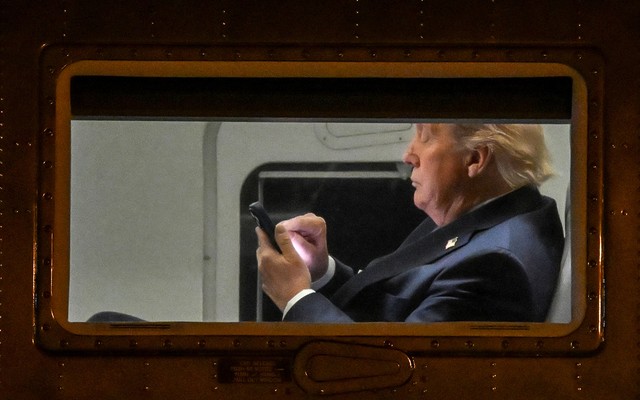
On many recent nights, Donald Trump has been posting obsessively on his Truth Social site into the wee hours. The president, of course, has never been one for a solid night’s sleep—or restrained and temperate commentary on social media—but his emotional state seems to be fraying: This weekend, he attacked Pope Leo XIV, presented himself as Jesus Christ, and then jabbed at his phone until dawn.
Judging from those posts, the commander in chief is in distress. No one can say for sure what is causing the president’s bizarre behavior. Perhaps Trump’s narcissistic insistence that he is always successful in everything he undertakes is feeling the sting and strain of multiple public failures, including the collapse of his campaign to dislodge the Iranian regime, plummeting approval ratings, the decline of the U.S. economy, and, on Sunday, the crushing defeat of one of his favorite fellow authoritarians, Hungary’s Viktor Orbán.
Former U.S. Deputy National Security Adviser Matt Pottinger on the U.S.-Iran cease-fire, Trump’s Hormuz blockade, and China’s reaction to the Iran war. Plus: A seismic election in Hungary, and Labyrinths, by Jorge Luis Borges.
In this week’s episode of The David Frum Show, The Atlantic’s David Frum opens with his reaction to the recent election in Hungary and the defeat of Viktor Orbán. David counters Orbán defenders who claim that this loss proves Orbán was never a threat. Antidemocratic leaders often face institutional constraints, and it was those institutional constraints that compelled Orbán to accept a defeat after years of abuse of power.
Then, David is joined by former U.S. Deputy National Security Adviser Matt Pottinger to discuss the current state of President Trump’s war in Iran. David and Pottinger talk about the recent failed negotiations between the two sides in Pakistan, the blockade of the Strait of Hormuz, and what could happen next. They also discuss how the Iran war is viewed in China and how it has been a financial gain for Russia.
If you are anything like me, you have spent a lot of time over the past few weeks opening letters, finding receipts, requesting PDFs, scanning documents, and going through your credit-card statements line by line. It’s tax season. And in the United States, taxes are a DIY affair.
This is the case even though Washington could probably do your taxes for you. If you earn a salary or an hourly wage, the Internal Revenue Service already knows how much money you make. It likely knows how much you owe or how big your refund should be too. Nine in 10 households take the standard deduction, making their liability easy to glean from payroll and banking data.
Yet Uncle Sam demands that Americans fire up TurboTax, head to a storefront preparer, hire an accountant, or sit down with a sharp pencil and a strong cup of coffee to get their taxes done each spring. The average filer spends 13 hours on their 1040—a time tax that many of our wealthy peer countries have reduced to a couple of minutes, if that. Prepopulated documents and return-free systems are common everywhere but here. Sweden lets residents file by text. Canada prefills paperwork. Japan sends households a document summarizing their tax contributions. If everything looks copacetic, many workers get to do a blissful nothing. Denmark, Estonia, Spain, and Norway have similarly simple processes.
This article was featured in the One Story to Read Today newsletter. Sign up for it here.
Some people in the Epstein files are monstrously gross. Some are moderately gross. Some are situationally, aspirationally, or cosmetically gross. And it is also quite possible that some may be no grosser than you.
The files run to nearly 3.5 million pages. I’ve lost hours to the search bar, feeding it boldface names and receiving, almost unfailingly, a bright pellet of righteousness in return. Jeffrey Epstein’s correspondents who were most interested in sex were generally careful to be euphemistic about it—they were not waiting with excitement for an “underage girl” but for “my surprise” or a “gift.” Most of the others weren’t careful about anything. They preened. They flattered. They abased themselves before a man they must have known wasn’t what he presented himself to be—but whose private jet was very real.