


Go to this issue's Table of Contents.
M A R C H 2 0 0 0
 ES, continuity. She was their designated kaddish, their living memorial candle, the third generation. And now she was a Christian. This was tragic -- tragic! How could it have happened? Who could ever have foreseen such an outcome? It was beyond human imagining. They had thrown everything they had into that girl. She had always been the ideal apprentice and prot�g�e. She was, as Maurice used to say in his speeches, the spitting image of his mother, Shprintza Chaya Messer the guerrilla fighter, shot down by the Nazis during the roundup in Wieliczka while she screamed at the top of her lungs, "Fight, Yidalech, fight!"
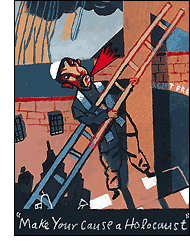 To this day people still talked about Nechama's bat-mitzvah speech -- how she had turned to address the ghost of the Vilna girl with whom she had insisted on being twinned with the words "Rosa, my sister, you were cruelly cut down by the Nazis during the Holocaust. You never had a bat mitzvah. Today I give back to you what was so wrongfully taken away -- because today I am you." Arlene, with her naive American Oh-say-can-you-see attitude, had called this gruesome, morbid, a form of child abuse, and had walked out of the sanctuary, but everyone else felt spiritually uplifted and morally renewed by Nechama's words, and wept contentedly. And who could forget the Holocaust assemblies that Nechama had organized in high school, at which either Maurice or Blanche gave testimony? Once even Norman, as the ambassador of the second generation, addressed the teenagers, with their yellow paper stars for Jews pinned to their Nine Inch Nails T-shirts, their pink triangles for homosexuals, black triangles for Gypsies. Especially, who could forget Nechama's original dance composition, presented each year, "Requiem for the Absent," with the flowing, twisting scarves and the arms reaching poignantly toward the heavens? She had always been so proud of her family, those Holocaust relics who would have mortified your average adolescent, and had even invited her grandparents and her father to accompany her to Poland for the March of the Living, with thousands of other Jewish girls and boys from all over the world -- but she was in a class apart. She was a Holocaust princess. And she wasn't ashamed of the VIP treatment that she received because of her family's position in the Holocaust hierarchy, and she wasn't embarrassed to walk at a slower pace alongside the old folks for the three-kilometer march from Auschwitz to the actual killing center in Birkenau, with its remains of gas chambers and crematoria, and ash and powdered bone underfoot. She had turned to them and said -- they would never forget it -- "I see them, I hear them, I feel them. The dead are walking beside us." And then, in her essay for her college application, she had written, "The one thing about me that you may or may not have learned so far from this application is that I am, in the most positive and constructive sense, a Holocaust nut. What this means is that I am totally obsessed by the Holocaust, the murder of six million of my people, and am determined to do everything in my power to make sure that these dead shall not have died in vain." "Beautiful, beautiful," Maurice had declared, "like the Star Spangled Banana!" She was rejected by Princeton, even though she was legacy, because deep down they were, as Maurice put it, "a bunch of anti-Semitten and shtinkers." So she went to Brown.
With such Holocaust credentials, who would ever have predicted that she would turn her back on her people and become, of all things, a nun? Convent and continuity -- these were two concepts that definitely did not go together. They did not mix well. They were not a natural couple. The idea of a nun was very foreign to Jewish thinking. Among Jews every girl got married one way or another, every girl had children, and if one didn't -- well, that just never happened. Who ever heard of such a thing? Ever since she was a little girl, she had talked so movingly about how she would have at least twelve children to help make up for the millions who had been murdered -- hurled alive into flaming pits, shot, gassed, their heads bashed against stone walls. She was going to be a baby machine for Jewish continuity. She was a pretty girl, everyone remarked -- a little full, maybe. "Zaftig," Maurice said. "Baby fat," Blanche said. Her favorite food, according to family lore, was marzipan, and even that preference was regarded as a sign of her superiority. It was so European, so Old World -- what ordinary American Mars Bars kid knows from marzipan? The boys who were attracted to her were usually considerably older, usually foreigners. One of the family's favorite stories was about how she had stayed out very late one night, and when she finally came home, at five in the morning, her excuse to her worried parents was that this Salvadoran guy named Salvador had asked her out, and she didn't want to hurt his feelings, so she had to explain to him that she could never date a non-Jew because of the Holocaust -- it was nothing personal, but her duty was to replace the six million. And then, of course, she had to tell him the whole history of the Holocaust, so that he'd understand where she was coming from -- starting with Hitler's rise to power, in 1933, and continuing to the end of World War II, in 1945, which took a long time. Which was why she was so late. She hoped they weren't mad. "So what did Salvador say?" Norman had asked, obviously not mad at all, obviously gratified. "Oh, he said, 'I only asked you out for a cup of coffee. I didn't ask you to marry me.' But that's not the point."
And she never did date a non-Jew, so far as they knew. In any case, soon after she entered college, her romantic life became a mystery to them, off limits as a subject. She did, it is true, bring home a number of gentile boys, but this was "purely platonic," as she put it -- "We're just friends." She knew them in connection with her activities to end the persecution of Christians throughout the world. "A Christian Holocaust is going on as we speak," she declared at dinner in the presence of one of these guests, "and as a Jew who could have been turned into a lampshade, I cannot in good conscience remain a silent bystander." She brought home a Chinese graduate student who described how he had been beaten and tortured because of his membership in an underground church. She brought home a Sudanese lab technician whose family members had been burned or sold into slavery for practicing their faith. As they narrated their stories at the table, she listened raptly, her eyes moist, her mouth slightly open, even though she had surely heard them before. "Any guy who wants her will have to show torture marks," Arlene said. "What for is she foolin' with the Christians?" Maurice complained to Norman. "Where you think Hitler got all his big ideas from about the Jews, tell me that. And the Pope, you should excuse me, His Holiness, where was he during the war -- playing pinochle?" "They're trying to hijack the Holocaust," Norman wailed. "Christians are not -- I repeat, not! -- acceptable Holocaust material. This is where we draw the line."
They tried to wean her from this new fixation by offering her a partnership in their business -- complete control of the Women's Holocaust portfolio: abortion, sexual harassment, female genital mutilation, rape, the whole gamut -- but she wasn't buying. "The Christians are the new Jews," she said. "Christians have a right to a Holocaust too. Since when do Jews have a monopoly? That's the problem with Jews. They never share." So they broke down after all and offered to take on the Christian Holocaust as part of their business, however alien and distasteful it was to them -- to have her create and head up, in fact, a new department devoted entirely to this area. "Forget it," she said. "You guys are too compromised and politicized for me. You'd sell out the victims for the first embassy dinner invitation."
 HE last time any member of the family had seen her was a few days after she called to say that she would be entering the Carmelite convent near Auschwitz as a postulant, and because it was a contemplative, enclosed, "hermit" order, she would not be available much afterward for visitors. She insisted that though she would soon become a novice and then eventually take vows, she would always consider herself to be a Jewish nun. They should keep that in mind. They were not losing her. They should not despair. The family decided that Arlene would go alone to see her. She accepted the mission despite her frequently voiced resolve never to set foot in that "huge cemetery called Poland -- it's no place for a live Jew; this back-to-the-shtetl nostalgia is obscene; these grand tours of the death camps are grotesque." The day after Nechama called, Arlene flew to Warsaw.
When Nechama had converted to Catholicism, she had told them that it was a necessary step toward the fulfillment of her "vocation" but they should know and understand that, like the first Christians, she remained also a Jew. "What you mean?" Maurice had demanded. "Are you with us or against us? Are you a goy or a Jew? You can't have it both ways. You can't have your kishke and eat it also!" Norman wanted to know if this was some kind of Jews-for-Jesus deal, but no, she said, it was in the best tradition of the early Church fathers. Norman then made the hopeful point to the family that nowadays maybe you could be both a Christian and a Jew, just as you could, as everyone knew, be both a Buddhist and a Jew -- "a Jew-Bude" it was called, something pareve, nothing to get excited about, neither milk nor meat.
Even so, her conversion was a devastating blow, though not entirely unexpected, given her increasing immersion in the Christian Holocaust. After college she had worked full time for the cause at its Washington headquarters, and then had set out on what she called her "pilgrimage," her "crusade," to bear witness to the persecution firsthand at the actual sites throughout the world, and to offer comfort and strength to the oppressed. She had been kicked out of Pakistan for agitation and promoting disorder. In Ethiopia she had been arrested, and major string-pulling had been required to spring her, which, fortunately, her family was able to manage discreetly, thanks to its position in the world and its fancy connections in high places ("A little schmear here, a little kvetch there," as Maurice recounted with satisfaction). As it became clearer and clearer to them that she was heading toward conversion, Norman had tried to make the case to her that she was far more useful to the Christian Holocaust as a Jew, that her Jewishness was an extremely effective media hook. It piqued people's curiosity -- what was a nice Jewish girl like her doing in a place like this? It made her far more interesting and, let's face it, bizarre, especially as she was so Jewishly identified, with her family so prominent in Holocaust circles, bringing even greater attention and visibility to the cause. "Besides," Norman added deliberately, "you don't have to be Christian to love the Christian Holocaust. When I do the Whale Holocaust, do I become a whale? Think about it, Nechama'le. Think again, baby."
From contacts in Poland they knew almost immediately when Nechama had arrived there. She began a slow circuit of the main extermination camps, stopping for a few days at each one to fast and pray -- first Treblinka, then Chelmno, Sobib�r, Majdanek, Belzec, until she came, finally, to Auschwitz-Birkenau. She called home to say that she had lit a memorial candle in front of the Carmelite convent for a "blessed Jewish nun," Saint Edith Stein ("Sister Teresa Benedicta of the Cross," Nechama called her), who was martyred in the gas chambers there. "Oy vey," Maurice had said. "She's talkin' about that convert Edit' Shtein? I'm not feelin' so good!" In another telephone conversation she had made the comment that traditional Judaism provides no real outlet for a woman's spirituality. "I mean, suppose a Jewish woman wants to dedicate her whole heart and soul and all of her strength to loving God and to prayer. Where is there a Jewish convent for that? Does Judaism even acknowledge the existence of a woman's spirituality in any context other than home and family?" She took a room in Oswiecim to be near the nuns. "They're such holy, holy women, it's humbling and uplifting, both at once. How could anyone ever accuse them of trying to Christianize Auschwitz? It's just ridiculous. Everything they do they do out of love."
Nechama arranged to have Arlene meet her at the large cross near the now-abandoned old convent, the building in which, during the Holocaust, the canisters of Zyklon B gas with which the Jews were asphyxiated had been stored, just at the edge of the death camp. She was already there, praying on her knees, when Arlene's car drove up. Arlene asked the driver to wait for her; she had no intention whatsoever of visiting the camp. After she finished with Nechama, she would go directly back to Krak�w. She would be in Warsaw by evening. She would be on a plane flying out of this cursed country the next morning. As she approached the cross with her daughter kneeling before it, she could see two nuns in full habit posted in the distance. Nechama herself was wearing an unfamiliar sort of rough garment -- probably some sort of nun's training outfit, Arlene thought.
Nechama heard Arlene approaching, and with her back still turned she signaled with her thumb and index finger rounded into a circle -- a gesture she had picked up during a teen trip to Israel -- for her mother to wait a few seconds more as she finished her devotions. Then, after placing her lips directly on the wood of the cross and kissing it passionately, she rose to her feet. "Mommy," she cried, and she ran to embrace her mother. Arlene shocked herself by breaking down in racking sobs that swept over her like a flash storm. Her mascara streaked down her cheeks.
"I'm sorry, I'm sorry," she kept on repeating.
"What are you sorry about? Go on, cry. Crying is good for you -- it cleanses the spirit. There's nothing to be ashamed of."
"I'm sorry for letting them screw you up," Arlene sputtered into the coarse cloth of Nechama's garment. She had not planned to begin this way, but she could not stop herself now. "I'm sorry for not fighting harder to keep them from poisoning you with their Holocaust craziness. I should have fought them like a lioness protecting her cub. They crippled you, crippled you, they destroyed any chance you might have had to lead a normal life -- and I did nothing to prevent it."
"Mom?" Nechama pushed Arlene to arm's length. "Two things, Mom. Number one, I'm not screwed up, and number two, the Holocaust, believe it or not, is the best thing that has ever happened to me. It has made me what I am today. I'm proud of what I am. I'm doing vital, redemptive work. I'm bringing healing to the world. Do you understand? I don't want you to pathologize me -- okay, Mom? I'm not a sicko."
Wiping her eyes with a tissue that she held clutched in her fist, Arlene now took the time to look closely at her daughter. Nechama's face, framed by a kerchief that concealed all of her thick, curly hair, her best feature, was exposed and clear -- no makeup, and no sign either of the acne that had distressed her well into her twenties. So convents are good for the complexion, Arlene concluded bitterly. Instead of contact lenses she was wearing glasses with translucent pale-pink plastic frames. The expression in her eyes was serene and benevolent -- too placid, Arlene thought; she looked drugged, brainwashed, dead to life. A faint moustache lay over her top lip; in her new life of poverty, chastity, and obedience, in her tight schedule between Lauds and Compline, there was no place for the facial bleaching that Arlene had taught her as part of the beauty regimen of every dark-haired woman. Around her neck was a daunting cross made from some base metal. The womanly fullness of her barren hips bore down earthward against her skirts, pulled down inevitably by gravity whether they fulfilled their biological function or not, Arlene could see. She had put on a little weight -- not that it mattered anymore. At least she was getting enough to eat.
Nechama quickly sensed her mother's appraising eye, and for a moment she was seized by a familiar irritation that she recognized from those times in the past when her mother had rated her appearance down to the last fraction of an ounce and had registered mute disappointment. By an act of will Nechama shook off this feeling, which she considered unworthy and a vanity.
"You look nice," Arlene finally said. She avoided Nechama's eyes, gazing up instead at the twenty-six-foot wooden cross looming behind them. "So this is the famous cross that the Jews and the Poles are beating up on each other about."
"Yes -- isn't it silly?" Nechama said. "I guess I'll just never understand what Jews have against a cross."
The Crusades. The Inquisition. Pogroms. Blood libels. The Holocaust. If she can't figure out what we have against the cross, Arlene thought, especially when it is planted right in this spot, where a million Jews were gassed and burned, then she has strayed a long, long way from home. She has gone very far indeed. She is lost to us.
"I mean," Nechama went on, "what everyone has to realize now, if we're ever going to get beyond this, is that each Jew who was murdered in the Holocaust is another Christ crucified on the cross. When I pray to Him, I pray to each one of them. I pray every day to each of the six million Christs."
Suffering and salvation. Martyrdom and redemption. This was not a language that Arlene recognized. The cross cast its long dark shadow over them and onto the blood-soaked ground beyond. The afternoon was passing. Arlene adjusted the strap of the stylish black-leather bag on her shoulder and glanced toward the waiting car. More than anything else in the world now, she wanted to get away from here, from this madness that bred more madness, from this alien sacred imagery that justified unspeakable atrocities. She wanted ordinariness, dailiness, routine -- plans, schedules, menus, lists, programs, things, material goods. "Do you need anything, Nechama?" Arlene asked. "I mean, before I go -- like underwear, vitamins, toiletries? Tell me what you need, and I'll see that you get it."
"Oh, I don't need anything anymore. I'm finished with needing things," Nechama said, breaking her mother's heart. "We live very simply here. Other people have needs. They send us long lists of what they need, and we pray for them. That's what we do. I can pray for you, too, Mommy. Tell me what you need."
What did she need? She needed to think and see clearly. She needed to remember everything she had forgotten -- or she would soon lose faith that she had ever existed at all. "I need to have you back with me," Arlene said quietly, in the voice she would use when she lay down in bed beside her daughter at night, to ease the child into sleep.
Nechama smiled rapturously. "We'll pray for you," she said, and her glance moved from her mother and the cross above them to encompass her whole world, the two nuns motionless in the distance, and the million dead inside the camp who never rested.
Tova Reich is the author of the novels Mara (1978), Master of the Return (1988), and The Jewish War (1995).
Illustrations by John Howard.
Copyright © 2000 by The Atlantic Monthly Company. All rights reserved.
The Atlantic Monthly; March 2000; The Third Generation - 00.03 (Part Three);
Volume 285, No. 3; page 87-98.