


Return to this issue's Table of Contents.
M A R C H 2 0 0 0
 AYBE we should've come with one of those deprogramming fellas," Maurice was now saying. "Maybe we should've climbed the wall from the convent like that crazy rabbi -- what's his name? -- when it used to be in the other building where they used to keep the gas in the war. Maybe we should've kidnapped her from the schwesters. "
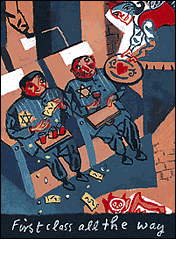 Norman shook his head. "Bad idea, Pop." He swallowed portentously before elaborating. "It would have been disastrous for Polish-Jewish relations, a nightmare for Catholic-Jewish relations, not to mention curtains for business relations."
"Nu. Anyway, you have to be a younger man for that kind of monkey business, climbing walls. You know what I mean? And you're not so young anymore, Normie, ha ha, and I'm not in such good shape -- like your mama says, svelte. I'm not so svelte like I used to be when I was a leader from the partisans and fought against the Nazis in the woods."
Norman had to catch his breath and squeeze the bridge of his nose to stem the keen rush of longing for his daughter that swept over him at that moment, as Maurice recited the familiar refrain in exactly those words about having been a partisan leader who fought the Nazis in the woods. It was a private joke between Norman and Nechama. They would mouth those exact words every time Maurice uttered them, flawlessly imitating his grimaces and gestures, mouth them behind the old man's back at gatherings with friends and family or even at the public speeches that he regularly gave in synagogues, community centers, and schools about his career as a resistance fighter, which he always began with the sentence "I'm here to debunk the myth that the Jews went like sheep to the shlaughter." Norman and Nechama would mouth this sentence, too, in fits of choking, mute hilarity. It was a harmless father-daughter ritual that had started when she was about eighteen or nineteen years old, after Maurice had given his standard talk, at Nechama's invitation, in her college's Jewish students' center, opening, as usual, with that sentence about the sheep-to-the-slaughter myth, and ending, as usual, by snapping smartly to attention when they played the Partisans' Hymn, "Never Say That You Have Reached the Final Road."
In a moment alone with Nechama during the reception following Maurice's talk, the two of them facing each other with their clear-plastic wineglasses filled with sparkling cider, as if playing a couple just introduced at a social gathering, Norman casually mentioned -- in another context entirely, he forgot what -- that of course nobody really knew exactly what Maurice Messer had done during the Holocaust except that he had hidden in the woods all day and stolen chickens at night. No shame in that, of course, under the circumstances. "You just gotta face it, kiddo," Norman went on, in the grip of something beyond his control, "he never shot in the woods -- he shat in the woods!"
"You mean Grandpa wasn't really a partisan leader who fought the Nazis?" The child seemed genuinely shocked.
Norman raised an eyebrow. His daughter was not being ironic. Maybe he had gone too far this time. Maybe she really was an innocent; maybe she was just too fragile for this kind of realpolitik. Incredibly, it looked as if she truly hadn't fathomed until that moment that her grandfather's story was just an innocuous piece of self-promoting fiction. But when, after a long pause to absorb the new information, she mischievously blurted out, "Okay, Dad, I won't be the one to tell the Holocaust deniers that it's all made up," he breathed again with relief, impressed by how quickly she had caught on, how alert she was to where her interests lay and her loyalties belonged, how sophisticated she was in accepting human weakness as another amusing fact of life.
"Look," Norman intoned, "it's not as if he didn't really suffer. You think it's easy being considered a victim all the time, having people feel sorry for you -- especially if you're a macho type like Grandpa? Who's going to be hurt by an old man's little screenplay starring himself as the big hero? Tell me that, please." He slowed down emphatically now to make way for the flourish. "The Holocaust market is not about to collapse due to one old man's inflations, trust me. Those loonies who say the whole thing never happened should not take comfort."
Should not take comfort, he had said -- not take nechama. Anyway, it was from that time on, as he recalled it, that they engaged in their tradition of delicious mockery, all in affectionate fun, whenever Maurice warmed up and delivered his partisan spiel. It had evolved into their own personal father-daughter thing. And it was the memory of this innocent conspiratorial bonding with his child that took possession of him now and overcame him.
 U, Normie," Maurice was saying. "Yes or no? Why you not talkin'? You remember that hoo-hah with the schwesters at the convent with that crazy rabbi, like your mama calls him?"
Maurice, whenever possible, liked to quote his wife, to whom he gallantly conceded a superior mastery of English idiom and pronunciation, and whom he regarded as a nearly oracular source of common sense. For example, whenever the subject came up of that rabbi who had caused an international incident with his protest against the presence of a Catholic convent at Auschwitz, where a million Jews had been gassed -- the very same convent in which, in a more acceptable location ordained by the Pope himself, their granddaughter Nechama was now a nun praying for the salvation of the souls of the Jewish dead -- Blanche would open her eyes wide and exclaim, "But, darling, he's crazy!" In consequence, Maurice never failed, when referring to that event at the old Carmelite convent, to include the epithet "that crazy rabbi" -- as if the rabbi's mental state were a genuine clinical diagnosis, because Blanche, with her peerless common sense, had declared it to be so. Common sense, in Maurice's opinion, was an exceedingly desirable quality in a woman, and there was a time when he had advised Norman to put it at the top of his list of qualities in choosing a mate. To which Blanche would always remark coyly, "When they tell you a girl has common sense, that's a code for not so ay-yay-yay -- in other words, not so pretty." "Common sense together with pretty," Maurice would then chime in with alacrity, "just like mine Blanchie."
They discussed everything, he and Blanche, even the subjects they did not discuss. They discussed but did not discuss, for instance, their shared sense of the limitations of their Norman's capabilities. It was not an understanding that they cared to seal in words. But around the time they sold their ladies'-undergarments company, Messers' Foundations, from which they had made a more than comfortable living, the Holocaust had become fashionable, more fashionable even than padded brassieres and spandex girdles. At first the two of them had booked up their retirement by becoming leaders in the survivor community and popular lecturers on the oral-testimony circuit. The Holocaust was hot, no question about it. Blanche then urged Maurice to start the consulting business, Holocaust Connections, Inc., and to take Norman in as an equal partner. "Make Your Cause a Holocaust," as their smart-aleck Norman packaged it; he was just too much. It would be first and second generation working and playing together, an ideal setup, a perfect outlet for their Norman, the original futzer and putzer, as they lovingly called him, whose jobs until then, they agreed, had been totally beneath him, totally unsatisfactory and unchallenging. Now Norman could hang around all day long, talking creatively with clients on the telephone, holding forth with all his brilliant opinions, cracking his wicked jokes, writing an article now and then for a Jewish newspaper, traveling and schmoozing in diplomatic channels and the corridors of power with all the other politicians and insiders -- the best possible use of his considerable gifts and talents. Unspoken was their shared sense that Norman needed their help, that fundamentally he was a weak person, that he could never manage on his own. Never mind that he had gone to Princeton University -- Princeton, Shminceton! -- where he had even taken part in a sit-in in the president's office for three days and nights, though his mother had marched right into the middle of that nonstop orgy to personally hand him his allergy medicine. Never mind that he had a law degree from Rutgers, where they trained poor schlemiels to become a bunch of creepers and crawlers. Never mind that he was an adult, to all appearances a grown man, with a social-worker wife and a beautiful but moody daughter. They knew in their hearts that if the war broke out tomorrow, their Norman would never make it. Without saying it out loud, they recognized that, unlike themselves, Norman would not have survived.
 URVIVAL -- that was the bottom line. You couldn't argue with it. It was the fact on the ground that separated the living from the dead. That was the lesson they had struggled to drum into their Norman: first you survive, then you worry about such niceties as morality and feelings. When someone tells you he's going to kill you, you pay attention, you take him seriously, you believe him. You wake up earlier the next morning and you kill him. If you survive, you win. If you don't survive, you lose. If you lose, you're nothing. What is Rule No. 1 for survival? Never trust anyone. Suspect everyone. Take it as a given that the other guy is out to destroy you, and eat him alive before he gets the chance. Why had they survived? Luck, they always said. It was luck. But they didn't believe it for a minute. It was the accepted thing to say, so as not to insult the memory of the ones who hadn't survived, the ones who were now piles of gray ash and crushed bone that people stepped on. The real truth, they knew, was that they had survived because they were stronger, better -- fitter. Look at the survivors today, the ones who had staggered out of the camps like the living dead. They were your classic greenhorns, eternal immigrants, afraid to offend by harping on the Holocaust -- why make a federal case of it? -- a bunch of nobodies until they had their consciousness raised by the survivor elite, by Blanche and Maurice's circle, the ones who survived with style, the fearless ones. "Me? I'm never afraid!" Maurice always said. It was his motto. Now, thanks to them, the Holocaust was a household word. They built monuments and museums. They were millionaires, big shots, movers and shakers. They ran the country. Survival of the fittest. Blanche had once read in a magazine that cancer cells were the fittest form of life, because they ate everything else up, they spread, they reproduced, they survived, they won. Maybe this wasn't such a wonderful example; maybe this didn't reflect so nicely on her and Maurice and the rest -- to be compared to cancer. Cancer was bad, but in this world if you survive, you win, and if you win, you're good.
They were a formidable team, Blanche and Maurice Messer, a fierce couple, and proud of it. For their fortieth wedding anniversary Norman and Arlene had given them a plaque engraved with the words "Don't Mess With the Messers," which they hung in "Holocaust Central," their den off the living room, right above the composition that Nechama had written when she was eight years old, in third grade. The topic was "My Hero"; Nechama had chosen Maurice.
Grandpa had a gun in World War II. He killed bad Germans with the gun. He was a Germ killer. He saved the Jewish people. He loved the gun. He kissed the gun goodnight every night. He slept with the gun. After the war they gave Grandpa a ride on a tank. He was holding the gun. Then they took the gun away. Grandpa was sad. He cried because he missed his gun. So he married Grandma.The teacher gave her only a "Fair" for this effort, but Blanche said, "What does she know? It's not by accident that she's a teacher," and she hung the composition, expensively framed, on the wall. "I'm the gun," she asserted defiantly. Maurice also didn't care much for this composition. "What for is she telling the ganze velt this partisan story? It's private, just for family." "What are you worrying about, Maurie?" Blanche said. "Every survivor is a partisan. Survival is resistance." "Don't be so paranoid, Pop," Norman said. "It's safe to come out of the closet now." Then, swallowing deliberately and pausing pregnantly, he added, "Ziggy and Manny and Feivel and Yankel, and everyone else who was with you in the woods in those days, they're all dead by now, may they rest in peace -- and quiet."
Again, it was a question of survival, this time the survival of the Jewish people in an age of assimilation and intermarriage and the mixed-blessing decline of anti-Semitism in America -- another Holocaust, frankly, even more dangerous in its way because it was insidious, underground. Blanche and Maurice would do anything to ensure Jewish survival. No effort or sacrifice was too great, and, as they knew very well, nothing could compare to the Holocaust for bagging a straying Jew; it was the best seller, it was the top of the line, it got the customer every time. Why did God give us the Holocaust? For one reason only: to drive home the lesson that once a Jew, always a Jew. You could try to blend in and fade out, you could try to mix and match, but it was all useless, hopeless. There was no place to hide, no way to run. Hitler would find you wherever you were and flush you out like a cockroach.
And what could be more effective in sending this message loud and clear than a partisan leader and his wife -- herself a survivor of three death camps, maybe four, depending on how you counted -- telling their story over and over again until they were blue in the face, pounding in nonstop, day and night, the lessons of the Holocaust. Whatever it took to beat in the message, even if it meant pushing themselves into the limelight in crude ways that ran thoroughly counter to their refined nature, even if it meant giving the misleading impression that they were exploiting the dead, they would do it, not for personal fame and glory, God forbid, but for the cause, because this was their mission. This was why they had been chosen. This was the reason they had survived. They were the first generation, the eyewitnesses. Norman was the connecting link. Nechama was continuity.
(The online version of this article appears in three parts. Click here to go to part one or part three.)
Tova Reich is the author of the novels Mara (1978), Master of the Return (1988), and The Jewish War (1995).
Illustrations by John Howard.
Copyright © 2000 by The Atlantic Monthly Company. All rights reserved.
The Atlantic Monthly; March 2000; The Third Generation - 00.03 (Part Two);
Volume 285, No. 3; page 87-98.