Tom Lake
by Ann Patchett
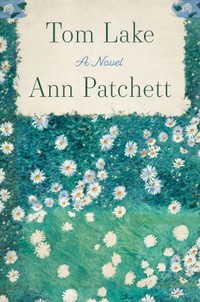
I had a strange question while reading Patchett’s latest: Are novelists allowed to write stories about people who are this happy? Lara, the book’s narrator, lives contentedly on her cherry farm in North Michigan with her kind husband and three doting daughters, all merrily trapped together during the pandemic. To kill time while they pick cherries in the orchard, Lara tells them the story of her great, youthful, summer-long love affair with a rakish man, Peter Duke, who would go on to become a very famous actor (the character put me in mind of Ethan Hawke or Robert Downey Jr.). The daughters hang on her every word. The story itself has the sweetness and tartness of cherries, taking place mostly at a summer-stock-theater company called Tom’s Lake where Lara and Peter meet and fall in love as she herself decides whether or not to continue her almost-accidental career as an actress. But this nostalgia trip contains no regrets. As Lara emphasizes in one of many similar refrains, the life she went on to live is all she has “ever wanted in the world.” — Gal Beckerman
Tom Lake
by Ann Patchett
Daughter of the Dragon: Anna May Wong’s Rendezvous With American History
by Yunte Huang
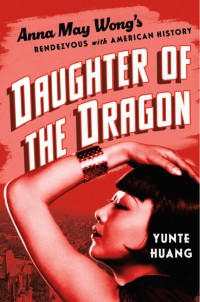
Daughter of the Dragon is a vivid and heartbreaking biography of the 20th-century Hollywood actress Anna May Wong, and Huang’s third book about a Chinese American icon’s “rendezvous with American history.” Wong grew up movie-obsessed in a Chinese immigrant family in Los Angeles. When she began to act professionally in the 1920s, she struggled to land leading roles: Anti-miscegenation laws meant that she couldn’t kiss a white man on-screen, and she was passed over for top jobs in favor of white actors in yellowface. Though Wong eventually became a bona fide celebrity, she was frequently forced into stereotypical parts—the tragic “Madame Butterfly,” the conniving “Dragon Lady.” (When blamed for perpetuating racist tropes, she responded that “when a person is trying to get established in a profession, he can’t choose parts. He has to take what is offered.”) Wong occupies a singular place in both Hollywood history and the history of Asian Americans in the 20th century; as Huang puts it, her existence was determined by “simultaneous repulsion and desire.” Through detailing her resilience in the face of these challenges, Huang tells an essential story about the tenuous place of Asians in America. — Maya Chung
Daughter of the Dragon: Anna May Wong’s Rendezvous With American History
by Yunte Huang
Family Lore
by Elizabeth Acevedo
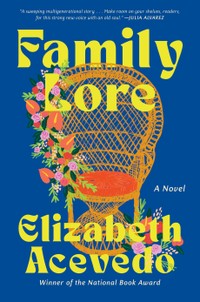
Many of the most pivotal scenes across Acevedo’s poetry and fiction take place near, or in, a kitchen. In Family Lore, her first novel for adults, the question of whether to serve pork takes on the weight of sacrament as a group of Dominican women reluctantly plans the menu for a still-living sister’s upcoming wake. Flor, one of four sisters, can predict the exact day of someone’s death. At the outset of the book, she announces that she’ll be holding a living wake for herself, and the decision rattles her sprawling family. Much of Acevedo’s work revolves around the primal emotions family can evoke—need, disappointment, belonging, connection. Her latest offering is her most impressive emotional excavation yet, a decade-spanning epic that sees Acevedo deftly stretching out into the new space afforded by a shift in audience. Vividly rendered and deliciously complex, Family Lore will stick with you long after you leave Flor’s table. — Hannah Giorgis
Family Lore
by Elizabeth Acevedo
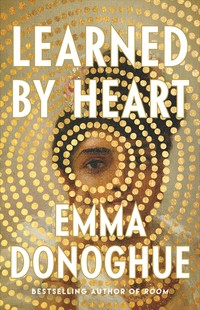
Learned by Heart
by Emma Donoghue
At a 19th-century York boarding school for young ladies, Eliza Raine, the daughter of an English father and an Indian mother, studies French, geography, and how to be a wife. Since leaving Madras for Britain, she’s felt she has something to prove; her parents weren’t legally married, and her social standing has suffered as a result. In class, she is focused, working hard to memorize and recite lessons. But her new roommate, Anne Lister, doesn’t have to try at all—she’s effortlessly brilliant. And that’s not the only reason she stands out. Learned by Heart is the culmination of Donoghue’s long obsession with Lister, the real-life 19th-century figure whose exhaustive, coded diaries, which describe her many affairs with other women, inspired the television show Gentleman Jack. Lister, as she makes classmates call her, is an oddity—she walks with a masculine swagger and is constantly breaking rules—and Eliza is fascinated. In close quarters, the two build a tentative romance. Donoghue’s affection for the savvy, strange Lister is obvious, and the author makes her teenage couple’s partnership both deeply serious and wonderfully naive. But the reader knows from the first page that their infatuation won’t last, and the novel is ultimately a tender, sad account of first love. — Emma Sarappo
Learned by Heart
by Emma Donoghue