

Return to the March 1999 A&E
Preview Cover
|
Arts & Entertainment Preview - March 1999

B Y B O B B L U M E N T H A
L & C H A R L E S M.
Y O U N G

Mixed Metal

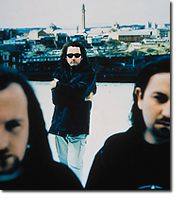 | Vietnam Inc.
|
In classical music and jazz, musicians establish a theme and then feel obligated to play a variation on it every time around. In rock-and-roll, musicians find a riff they like and play it exactly the same way for as long as they feel like it. In metal, musicians find a riff they like and play it twice as long as anyone else feels like it. In industrial, musicians have their computers play the riff until next Tuesday. Vietnam Inc., a band from Manchester, England, has aptly titled its debut album
Full Metal Racket (Mercury). Indeed, it is full, it is metal, and what a racket. If these musicians had gone for full disclosure, as opposed to Stanley Kubrick allusions, they might also have added the terms "techno" and "industrial" to the title. Like their label brethren Rammstein, for whom Vietnam Inc. has done remixes, they are both relentless and precise, both terrifying and exhilarating, and their computers hammer away at their riffs until next Tuesday. They're really good riffs, though, enhanced considerably if you crank your stereo to neighbors-call-the-police volume, pound nails in your head, and watch C-Span. It's hard to tell what Vietnam Inc. is for or against just by listening to the lyrics, but its members seem to have especially intense feelings about "obsessional love" and how it distorts the personality while bestowing a large percentage of the adrenaline that fuels this music. They express distaste for fundamentalists in "Born Again." In "We Love You" they taunt the audience, a cathartic ritual held over from their punk beginnings, but if you happen to have punk roots yourself, there's nothing better than getting properly taunted. Watch for their tour and get properly taunted in person.
--C.M.Y.
Deep in the Heart of Texas
 | The Damnations TX
|
The Damnations TX have made quite a stir in Austin with their live show and one locally released album. Now the rest of the country can hear why on Half Mad Moon (Watermelon/Sire), their major-label debut. Bright country rock with respect for the proper traditions, the album varies widely in mood from track to track, yet retains a satisfying continuity. Actually, the most satisfying thing here is the band's bracing energy, which is presented in a very pure and concise instrumental environment. No hiding behind walls of guitar wash from big amplifiers. Indeed, one of the best songs, "Black Widow," tells the story of the Damnations' favorite amplifier getting stolen -- a moment of exquisite despair in the life of all too many musicians, but rarely documented. Led by a pair of half-sisters, Amy Boone and Deborah Kelly, The Damnations TX harmonize gloriously as they document their sense of loss, and not just of stolen equipment. The opening song, "Things I Once Adored," tells the story of lost love leading to lost everything else, and "No Sign of Water" uses some bleak imagery of the Old West to speculate on the harsh meaning of it all. If harmonies aren't for making the harsh meaning of it all a little more tolerable, what are they for?
--C.M.Y.
Swing Shift
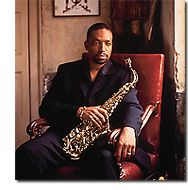 | Donald Harrison
|
Commercial touches on jazz albums usually produce either the blandness of soporific smooth jazz or the arena-rock assaults of overamplified fusion. Donald Harrison has a different idea of how to plough populist ground with his alto saxophone. He calls his concept Nouveau Swing, which places his fluent, often acerbic horn in an atmosphere of contemporary dance beats. Free to Be (Impulse!), Harrison's second effort in the style, is an infectious program on which salsa, second-line, hip-hop, reggae, and swing are blended into rhythmic stews that allow the saxophonist to dart and slide without in any way diminishing the cleverness or lyrical content of his ideas. The foundation might be funk on his cover of the Meters' hit "Cissy Strut," or in the more reflective atmosphere of "Smooth Sailing," though Harrison ultimately layers the rhythmic activity to create new conjunctions of source grooves. He is better prepared to practice this style than most, having grown up in New Orleans and apprenticed with the jazz master Art Blakey and the Latin-music giant Eddie Palmieri. Star sidemen, including Palmieri, lend frisky support on a few tracks; most of the album is energized by Harrison's own young and promising band, featuring Andrew Adair on piano, Reuben Rogers on bass, and John Lamkin on drums. They've all absorbed the obvious yet rarely practiced notion at the heart of Nouveau Swing -- that just as improvisers ought to learn song lyrics, as the tenor saxophonist Lester Young advised, a player who wants to make listeners move should know the dance steps.
--B.B.
Bob Blumenthal is a jazz critic for The Boston
Globe.
Charles M. Young reviews popular music for Playboy, Musician, and
other publications.
Go to ...
 
Copyright © 1999 by The
Atlantic Monthly Company. All rights reserved.
|