
Return to the October 1998 A&E Preview Cover
|
Arts & Entertainment Preview - October 1998


B Y B O B B L U M E N T H A L & C H A R L E S M. Y O U N G

Twenty-First Century Blues

 On the continuum of clean to dirty blues, R. L. Burnside plays way over on the dirty side. "Grunge blues" would not be too strong a term for a sound that fermented in Mississippi nightclubs where a performer had to make people dance even if he had only a cheap guitar and an amp that distorted for all the wrong reasons. To inspire dancing, the musician must groove, and that has always been Burnside's great strength in a unique style that owes more to John Lee Hooker than to B. B. King. On Come On In (Fat Possum/Epitaph) the producer Tom Rothrock takes Burnside's groove into the next millennium with a techno remix that starts with hypnotic raw material and goes to very, very, very hypnotic trance dance that still sounds like raw material. That's raw material. That grooves. Seem redundant? Well, that's the point. Burnside, who is seventy-one years old, has always believed that if you have a good riff, you should play it for a good long time. And Rothrock believes that after you play it for a good long time, you should play it some more, add some psychedelic sampling, and put it over a relentless drum track. Who would have thought at this late date that somebody could record another version of "Rollin', Tumblin'" that sounds fresh? This is something new in the blues that's truly new under the sun.
--C.M.Y.
On the continuum of clean to dirty blues, R. L. Burnside plays way over on the dirty side. "Grunge blues" would not be too strong a term for a sound that fermented in Mississippi nightclubs where a performer had to make people dance even if he had only a cheap guitar and an amp that distorted for all the wrong reasons. To inspire dancing, the musician must groove, and that has always been Burnside's great strength in a unique style that owes more to John Lee Hooker than to B. B. King. On Come On In (Fat Possum/Epitaph) the producer Tom Rothrock takes Burnside's groove into the next millennium with a techno remix that starts with hypnotic raw material and goes to very, very, very hypnotic trance dance that still sounds like raw material. That's raw material. That grooves. Seem redundant? Well, that's the point. Burnside, who is seventy-one years old, has always believed that if you have a good riff, you should play it for a good long time. And Rothrock believes that after you play it for a good long time, you should play it some more, add some psychedelic sampling, and put it over a relentless drum track. Who would have thought at this late date that somebody could record another version of "Rollin', Tumblin'" that sounds fresh? This is something new in the blues that's truly new under the sun.
--C.M.Y.
Ware In The World
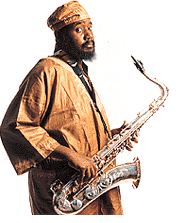 | David S. Ware
|
For his initial foray as the creative consultant to Columbia Records' jazz division, Branford Marsalis has chosen to present the unapologetically avant-garde David S. Ware Quartet. This decision is guaranteed to generate slim sales and told-you-so claims that free music is a misguided indulgence. Yet Ware's Go See the World is no monochromatic rant, and may persuade the open-minded that extreme techniques and rhythms have a place in the jazz landscape. Ware is a leather-lunged tenor saxophonist who cut his professional teeth with the innovator Cecil Taylor in the seventies. For nearly a decade he has led his own quartet, which has been prominent in creating a bridge between jazz's freedom wing and alternative rock's head-banging contingent, and which on previous albums often sacrificed nuance for a sustained roar. Go See the World contains the greater variety Ware has displayed in recent years, and can serve as an entry point to his oft-treacherous sonic terrain. The African vamp on "Mikuro's Blues" connects Ware's combustible style to the music of the late John Coltrane, and a lengthy inspection of "The Way We Were" makes the bathetic Streisand ballad spread wings like a condor. Even the pounding assaults of "Lexicon" and "Estheticmetric" are effectively sustained and resolved, thanks to the attentive interplay of the quartet. Susie Ibarra, who joined two years ago, has a precise touch on drums along with the requisite snap; the pianist Matthew Shipp and the bassist William Parker, both charter members and each a leading new-music light in his own right, find ways to parry Ware's energy with motifs and melodic commentary that help to shape and translate the emotional abstractions. --B.B.
Psychedelic Singles
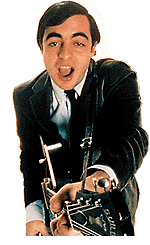 | Barry Tashian
of The Remains
|
In 1972 Elektra released Nuggets: Original Artyfacts from the First Psychedelic Era, 1965-1968, and it sent a shock of recognition through thoughtful rock fans everywhere. It documented something that no one had thought to document before: white teenage boys discovering the Beatles, the blues, electric instruments (particularly the fuzz box), and LSD. Now Rhino has borrowed the title and the concept for a four-CD boxed set, expanding the original twenty-seven songs to 118. A smidgen short of definitive, Nuggets presents an explosion of creativity that is still reverberating in the vital remnants of punk and grunge and metal. These are the bands that saw the Beatles on Ed Sullivan and thought, "I can do that." For the most part they couldn't. They didn't have the talent. But they made something come together for one song that was perfect. Three decades later, especially for men whose childhood touched the sixties, these songs are just about as exhilarating as music gets. Women may have a problem with the Mick Jagger-inspired sneering about treacherous babes who talk too much. If so, they can skip to the next cut for an outrageously surreal rendition of somebody's first acid trip. One might quibble with a few of the song selections (three by The Chocolate Watch Band and one by The Beau Brummels feels disproportionate), but The Electric Prunes, Human Beinz, Syndicate of Sound, The Remains, The Sonics, Shadows of Knight, The Music Machine, and the rest all deserve their place in music history right next to one another. Question for the ages: What was The Elastik Band thinking when it recorded "Spazz"? --C.M.Y.
Bob Blumenthal is a jazz critic for The Boston Globe.
Charles M. Young reviews popular music for Playboy, Musician, and other publications.
Go to ...
 
Copyright © 1998 by The Atlantic Monthly Company. All rights reserved.
|