
Return to the October 1998 A&E Preview Cover
|
Arts & Entertainment Preview - October 1998


B Y N A N C Y D A L V A & J O H N I S T E L

Moving Violations

 | How I Learned to Drive
|
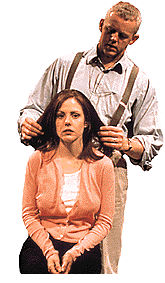
Read all safety instructions: Paula Vogel's play How I Learned to Drive, which won the Pulitzer Prize this year, feels like speeding down a snaking mountain road. The hairpin turns in this tale of seduction between the lovingly attentive pedophile Uncle Peck and his niece L'il Bit leave one's empathies in a puddle on the passenger-side floor. Its Brechtian scene titles -- "Idling in Neutral Gear" -- create some distance, but still it's a harrowing ride. The ignition: "This play is an homage to Lolita, but from Lolita's point of view," says the Brown University professor, who developed her play initially at Alaska's Perseverance Theatre. Shifting into overdrive: It opened off-Broadway, at the Vineyard Theatre, to critical acclaim in February of 1997 and enjoyed a year-long commercial run. Engine specifications: The play is powered by the two actors in the bravura leading roles (originated in New York by David Morse and Mary-Louise Parker), lubricated by a three-person Greek chorus that takes on a wide variety of characters, and accelerated by a lyrical memory-play purr broken by vaudeville-style scenes. Cruising at highway speed: This season Uncle Peck offers his tender and terrifying driving lessons at dozens of theaters. How I Learned to Drive zooms into Houston's Alley Theatre (Oct. 7-25; 713-228-8421), the Dallas Theater Center (Oct.21-Nov. 15; 214-522-8499), the Philadelphia Theatre Company (Oct. 23-Nov. 22; 215-545-9700), and San Diego Repertory Theatre (Oct. 30-Nov. 5; 619-544-1000). Try to stick to the speed limit on your way to the box office. --J.I.
Where The Boys Are
 | Matthew Bourne's
Swan Lake
|
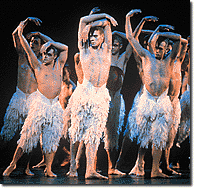
First it won the coveted Olivier Award in London. Next it sold out in Los Angeles. Now, after balletomanes worldwide have seen the television version and incessantly argued over it online, in person, and in print, Matthew Bourne's controversial reworking of Swan Lake is coming to Broadway. Call it ballet most fowl if you must, but this terpsichorean classic promises to be the novelty of the 1998-1999 season. Not only is it having a rare limited run on the Great White Way (Neil Simon Theatre, opening October 8; 212-307-4100), but also Swan Lake will be appearing in a new guise in the spring, when Peter Martin, the ballet master in chief of the New York City Ballet, marks the company's fiftieth anniversary with a new production. Not that variations on Swan Lake are something new to the dance world. They run the gamut from dozens upon dozens of productions more or less faithful to the 1895 Petipa-Ivanov-choreographed original to variants more and more irreverent (the delightful Nureyev-Miss Piggy outing called Swine Lake, for instance), with all manner of spoofs and spins in between. (Nureyev's version for the Paris Opera Ballet is particularly dark and brooding.) However, it seems safe to say that the Bourne Swan is the most sensational rendition of avian eroticism in the canon or out, with the swan corps not the airy-fairy white-tutu-clad ballerinas of tradition but hunky, bare-chested guys in feather pants. (The gender switch is bird only -- the prince remains a rather wimpily Oedipal young man with an exceedingly unpleasant mother.) The Bourne is faithful to the actual nature of swans -- nasty, highly territorial birds with lethal beaks. It is also marginally faithful to the story, and follows the Tchaikovsky score, which leads to what some ballet fans will consider insouciant in-jokes and others will brand heresy. Choreographers have been tiptoeing toward radical rewrites for some time now. If audiences flock to Bourne's Adventures in Motion Pictures production, ballet may never be the same again. --N.D.
Let's Hear It For The Musical
"Our Lord is testing us." Those words, intoned by a preacher who has helped to ban all dancing from a midwestern farm town, begin the 1984 film Footloose. They're also the words that ran through the mind of one theater critic after hearing that the movie was becoming a Broadway musical. However, messing with Footloose won't exasperate film historians (recall On the Waterfront or Sunset Boulevard) or overinflate a charming, intimate movie (see Victor/Victoria or Big). Anyway, Footloose always cried out to be a Broadway musical. Its soundtrack, with lyrics by the screenwriter Dean Pitchford, included a rack of Top 40 hits: the title tune, by Kenny Loggins; "Almost Paradise"; and, of course, "Let's Hear It for the Boy." The paper-thin plot excuse for the songs makes sense only in the stardust world of show music: the new kid in town starts a moral crusade for the right to hold a prom. Pitchford, the composer Tom Snow, and the director Walter Bobbie, late of the smash revival of Chicago, have reworked the book, and have added nine new songs. Footloose begins previews at New York's Richard Rodgers Theatre on October 2 (212-307-4100). Nostalgia for the 1980s officially begins. --J.I
Nancy Dalva is the author of Dance Ink: Photographs.
John Istel is a senior editor at Stagebill.
Go to ...
 
Copyright © 1998 by The Atlantic Monthly Company. All rights reserved.
|